Sodoran Treats an Heirloom Like an Honoured Guest
· 9 min read
Sodoran is the most public moment of the Tengger Karo festival, a sacred dance where villages take turns hosting the Jimat Klontong heirloom and receive each other the way families receive in-laws at a wedding.
Once a year, in the Tengger highlands of East Java, a set of old objects is taken out of storage, ritually cleansed, and given the kind of welcome usually reserved for a bride. The occasion is sodoran, the sacred dance at the centre of the Karo festival, and the guest of honour is not a person but an heirloom: the Jimat Klontong, a bundle of bamboo poles, horns, vessels and stone axes that no village claims to have made and every village takes turns keeping.
Sodoran is the set piece of Karo, the festival of the second month in the Tengger calendar, which fills the season with ancestor honouring and house to house visiting. Within that busy month, sodoran is the moment everyone gathers for. One village plays host, another arrives as guest, and both sides behave as if the meeting were a wedding, because in the local understanding, that is very nearly what it is.
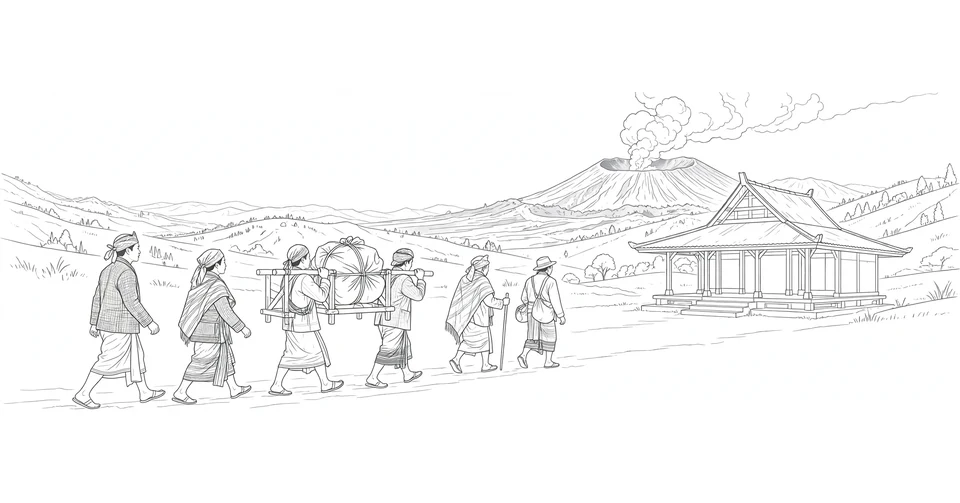
On the morning of sodoran, the guest village processes to the host village behind its headman, accompanied by a small gamelan. The heirloom comes out of its shrine. Dancing then runs, broken by riddles and a shared meal, from mid morning until mid afternoon. When it ends, the bundle is put away again, and its keeping passes quietly toward the village that will host the following year.
An heirloom that arrived by itself
The Jimat Klontong is not a single object but a set, and the East Java provincial library's archive of Tengger tradition lists it piece by piece. There are eight poles of apus bamboo, each about three metres long and darkened as if scorched, with coconut fibre tied at two points along each pole. There is a small ritual vessel, four black horns, a small black earthenware flask, a bamboo tube with a wooden lid holding old banknotes, and two monolithic stone axes. In the dance, nearly every piece has a role to play.
What the bundle does not have is a maker. In Tengger belief it is a jimat tiban, an heirloom that arrived by itself, its origin unknown. Around Ngadisari, people say it was first found by a priest named Kyai Dadap Putih. Around Tosari and Wonokitri, the story credits two hermits, Kyai Tunggak and Kyai Tompo, who came upon it after forty days of meditation. The disagreement is old and nobody seems in a hurry to settle it, which strikes me as exactly right for an object whose authority rests on mystery.
For most of the year the bundle rests in a storage shrine in whichever village currently keeps it. It is brought out and cleansed for sodoran, the high point of Karo, and only for sodoran. That rhythm of one annual appearance is a large part of its power. The heirloom stays sacred partly by staying absent, and sodoran is the door through which it briefly returns to public view.
Two villages meet like in-laws
The keeping of the Jimat Klontong rotates between villages, and so does the hosting of sodoran, which is held at the house of the petinggi, the village head, or at the village hall. The archive describes the social geometry plainly: the sodoran gathering is regarded as a meeting between two parties about to become besan, in-laws, and the two village heads stand in that relation to each other, one as the host with the celebration, the other as the honoured guest, with a third village attending as escort.
The record even preserves the casting across the years. In 1955, the head of Ngadisari was host and the head of Wonotoro his besan, with Jetak as escort. In 1978 the arrangement turned: Jetak hosted, Ngadisari came as the in-law guest, and Wonotoro escorted. Read those lines and you can feel what the rotation does. No village is permanently the giver or permanently the receiver. Honour circulates on a schedule, like the heirloom itself.
I find something quietly wise in this. A sacred object shared by rival neighbouring villages could easily become a source of friction. The Tengger answer is to wrap the sharing in the strongest social script they have, a marriage alliance, in which the other side is not a competitor but family by arrangement, owed food, ceremony and respect. Sodoran turns custody into kinship.
How sodoran fills a day
The sodoran day begins with arrival. The guest party comes at an agreed hour, usually around ten in the morning, the village head walking at the front, escorted by a gamelan the archive names as ketipung, built from drums, kenong gongs, the slompret trumpet and a small ketipung drum. At the host's place, long benches wait, and the participants take their seats in two bodies, hosts on one side and guests on the other, facing each other across the floor where the sodoran dancing will happen.
Food is already out before a step is danced, served in palm leaf containers: cakes called pasung, pipis and juadah, jenang porridge, rice and pisang ayu bananas. The host's headman states the purpose of the gathering and asks everyone to keep the rules. Then authority passes to the man appointed to lead the proceedings, who is known for the day only by his title, Prentah. His officers carry titles too, Kertijaya, Tunggur, Senapati and others, and the rule is strict: during sodoran, nobody may be called by their real name.
The Prentah opens with a mantra inviting the spirits to attend, then invites a dancer of the host village, called a Legen, to begin. The opening posture is precise, left hand on hip, right arm raised with the index finger extended, the steps measured against the gong, three paces forward and three back, turning always to the left. Soon a host dancer invites a guest dancer to join, and the two face each other from about six metres apart. In time they take up the sodor poles, gripping them with the fibre tipped end forward, advancing and retreating in pairs as the music quickens.
Each round of dancing ends with the Prentah's call of Sarak, at which the dancers take up horns filled with water. Between rounds, the Prentah trades riddles with his officers, set questions with answers everyone already knows by heart, one of them turning on the phrase maesa berik, the fighting buffalo. What looks like improvisation is nothing of the kind. Every sodoran round follows an order fixed by custom, and the riddles are part of its discipline. Later, when a particular melody announces that the wives have arrived carrying food, the dancing pauses and everyone eats together. Then sodoran resumes, and it does not close until about three in the afternoon, when the dukun, the Tengger ritual priest, recites the mantra that politely sends the invited spirits home.
Through all of this, the host village's great rice cone, the tumpeng gede, waits as the next act of the day, contributed to by every household and shared out afterward. Readers who want the full sweep of the season can find it in our account of Karo, the Tengger's other great gathering. Sodoran is one day inside that season, but it is the day the whole highland calendar leans toward.
A dance about the first meeting
Sodoran is also known by a grander name, Sangkan Paraning Dumadi, the dance of the origin of human life. A study of the sodoran dance by researchers at Universitas Negeri Surabaya, published in 2022, describes it as worship offered to Sang Hyang Widhi Wasa, the creator, who made humankind as man and woman, and as a service to the ancestors who began the line. The dance is performed by six to twelve dancers, and its movements are considered too sacred to be taught to just anyone.
The story sodoran tells unfolds in three stages. The first is Papakan, the meeting, in which man and woman encounter each other. The second is a contest, danced with the bamboo sodor poles. The third follows the pair into married life and children, with the birth of a child symbolised by the breaking of a sodor pole. There are twelve poles in the dance, one for each month of the year, and the poles themselves are more than props: the bamboo is wrapped with young leaves and filled with seeds, a small harvest carried in the hand.
The contest at the centre has its own legend. In the telling kept around Ngadisari, sodoran commemorates two servants of the culture hero Ajisaka, men whose loyalty was tested over a sacred heirloom placed in their keeping, and who fought over it when their orders collided. Around Tosari and Wonokitri, the dance is linked to Ajisaka himself and his followers. Either way, the moral is the same one the festival keeps repeating: faithfulness over a long time is the highest thing a person, or a village, can offer. The younger dancers' procession is even named like a wedding, Kirab Manten Sodor, the bridal procession of the sodor, following an elder who opens the dance.
The handover is the point
When the sodoran dancing ends, the Jimat Klontong is returned to its place, and in due course its storage moves on to the village that will host the next Karo. Nothing about the bundle changes hands in anger or in haste. It is counted, wrapped, carried and received, the way the Tengger handle most serious things: slowly, together, and with a meal nearby.
That patience is of a piece with the people who practise it. The same discipline that governs the heirloom's custody, renewed in public each year by sodoran, has kept the Tengger people and their calendar intact on the slopes of Mount Bromo through centuries of pressure from every direction. Sodoran is not a performance laid on for visitors, although visitors may watch. It is maintenance work on a relationship, between villages, between the living and the ancestors, and between the community and an object it treats as a member of the family.
I keep coming back to the elegance of the arrangement. The Jimat Klontong is never held long enough to become one village's trophy, and never neglected long enough to be forgotten. It is lent by the year and received like family. Sodoran, for all its titles, riddles and rules, is mostly a rehearsed way of saying the same thing each year: you are expected, the food is ready, the guest is honoured, and next year it will be our turn to come to you.
More in Culture & Society
- Edo's Hikeshi Wore Their Dragons Into the Fire
- You Can Read a Pecalang From Across the Street
- When the Gara-Gara Starts, the Puppets Drop the Plot
- Forty Pounds of Cowbells, and the Mamuthones Say Nothing
- The Oarfish Still Answers to a Name From the Dragon Palace
- Irezumi Was an Art Before It Was a Warning
Latest posts
- Kagawa Puts the Sweet Part Inside the Mochi
- A Yubatake Cools a Spring With Nothing but Wood and Gravity
- Toji Meant Moving to a Hot Spring Until You Got Better
- Nyuto Onsen Hides Seven Inns at the End of a Snow Road
- A Donko Never Got the Chance to Open
- The Milpa Is a Garden That Thinks Like a Forest
- The Kitamaebune Came Home Loaded With Kelp
- Nobody Just Watches a Panigyria, Everybody Dances
- Ponzu Began With a Fruit Too Bitter to Eat
- Kombu Is the Quiet Half of Dashi
- Manza Onsen Bathes at 1,800 Metres
- The Oshi Kept Fuji's Pilgrims Fed, Housed, and Devout
- Every Prefecture Argues About What Goes in Ozoni
- Japan's Population Decline and the Villages It Leaves Behind
- KRL Commuterline and the Trains That Move Jakarta