Nobody Just Watches a Panigyria, Everybody Dances
· 8 min read
Panigyria are the saints' day festivals of Greece, nights of communal food, live music and circle dancing that run until dawn and charge nothing at the door. Nowhere do they burn brighter than on Ikaria, where every generation dances in the same circle.
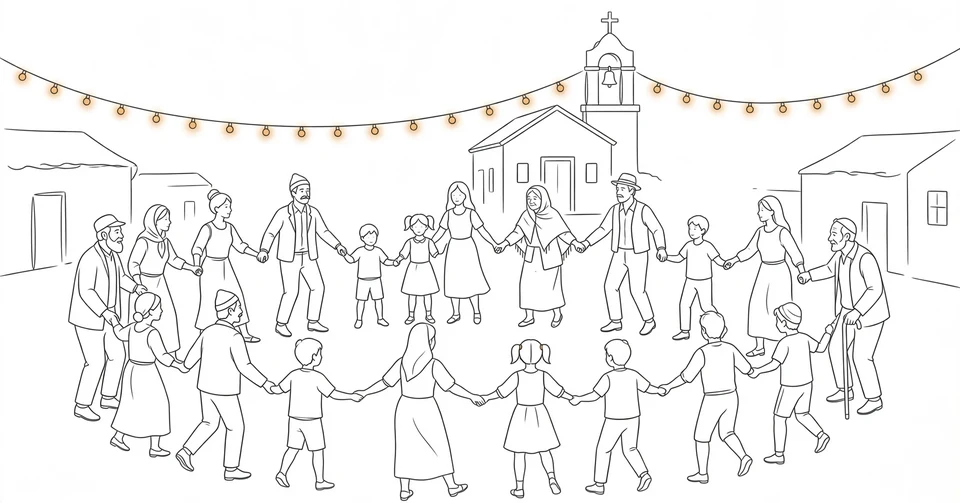
Every village in Greece keeps one date a year that belongs to its church, and when the date comes round, the village celebrates with one of its panigyria. There is no ticket office, no stage and no audience. There are long tables in the square, a small live band, plates of food cooked by the village itself, and a circle of dancers that keeps turning until the light comes back.
Panigyria, the plural of panigyri, are saints' day festivals, and they happen all over the country, in mountain villages, island ports and city neighbourhoods alike. But the panigyria of one island have become famous far beyond it. On Ikaria, in the north eastern Aegean, the festivals are a byword for endurance, and they explain the island's summers better than any beach does.
Ikaria already keeps its own hours, as I wrote when I looked at how the island runs on island time. Shops in the mountain village of Christos Raches open in the evening and trade past midnight. The panigyria take that same relaxed relationship with the clock and stretch it to its limit. A festival that only gets going at eleven at night and peaks at two in the morning is not badly organised. On Ikaria, it is organised exactly right.
What panigyria are and when they happen
A panigyri belongs to a saint. Each village church is dedicated to a patron, and on that saint's feast day the village holds its celebration, starting with a church service and continuing, once the formal part is done, with a feast in the open air. In that sense panigyria are religious festivals. In practice they are also the village's annual reunion, fundraiser and dance floor, all in one night.
Because saints' days are scattered through the church calendar, panigyria can turn up in any month, but they bunch heavily in the summer, when the weather allows a whole village to eat and dance outdoors. The one date that towers over the rest is 15 August, the Dormition of the Virgin Mary, known in Greek as Dekapentavgoustos. It is a public holiday across Greece, and because so many churches are dedicated to the Panagia, the Virgin, villages all over the country hold their panigyria on the same night, while Greeks who have moved away come home for it.
The season on Ikaria runs from late spring into September, with the biggest nights in high summer. The Transfiguration feast at Raches on 6 August is the island's best known single panigyri, and on 15 August several villages celebrate at once, drawing the largest combined crowds of the year. Dates are fixed by the church calendar but confirmed locally, sometimes only weeks ahead, so regulars learn to read the posters that appear around the island.
A night in the square
The evening begins more quietly than it ends. There is a service in the church first, and the feast that follows keeps one foot in that world. Dress is respectful, the saint is genuinely honoured, and only then do the tables fill. The panigyria are not folk themed parties that borrowed a saint for decoration. The devotion and the dancing are two halves of the same night, and the villages see no contradiction between them.
A panigyri has no venue in the modern sense. Long tables are set out in the village square or a clearing near the church, and the cooking is done communally, in quantities that assume the whole village plus whoever else turns up. On Ikaria the centrepiece is often goat, slow cooked until it gives way, served with the island's own wine. Nobody performs the food and nobody reviews it. It is simply what the village makes when it feeds itself in public.
The music comes from a small band, typically a violin and a laouto, a long necked lute, with a santouri, a hammered dulcimer, in some lineups. There is no stage worth the name and there are no set times. The band plays, people eat and talk, and at some point the dancing starts. As one Ikaria travel guide describes it, a square that is quiet at eleven at night can be packed by two in the morning, and the dancing often goes on until sunrise.
The dance that holds panigyria together
The dancing is done in a circle, hand to hand or shoulder to shoulder, in the broad family of Greek circle dances that includes the syrtos. Each place has its own dance, and Ikaria's is the Ikariotikos. The Ikariotikos is traditionally played on violin, laouto and the tsampouna, a Greek bagpipe, and it is a slow dance by design. Each village keeps its own version of the steps, which begin gently and build, so that a single circle can keep moving, and keep absorbing new dancers, for hours. The head of the line leads the figures and carries the circle's energy, and the honour of leading is earned over years.
What makes the circle remarkable is who is in it. Children are pulled in by the hand and pick up the steps by osmosis. Grandparents dance in the same ring as teenagers, and elderly Ikarians are not decorative guests at their panigyria. They are regulars. A circle dance has no front row and no back row, which means it has no spectators either. If you are standing at the edge holding a glass, you are simply a dancer who has not joined yet.
I find that design quietly brilliant. Most modern entertainment works hard to separate the people who perform from the people who watch. The panigyria refuse the distinction entirely, and the refusal is the point. The festival does not need an audience, because the whole village is the show.
Free to enter, funded by the tables
For all their scale, panigyria run on a strikingly uncommercial model. Entry is free. There is nothing to book and nothing to scan at a gate, because there is no gate. What you pay for is what you eat and drink at the tables, usually in cash, and the money raised goes back into the village, toward the church, communal projects and the costs of the night itself. The organising is done by local committees and volunteers rather than promoters, which is why the panigyria have kept their character while so many folk festivals elsewhere have turned into ticketed products.
There is a lesson in that arrangement, I think. The festival does not extract money from the community. It circulates money inside it, and everyone at the tables can see where their contribution went, because they will walk past the repaired church roof all year.
Panigyria and the island that lives longest
Ikaria is one of the five places where people live the longest, the so called Blue Zones, and an unusually high share of its people reach their nineties in good shape. Writers and researchers who study the island often point to the panigyria as part of the social fabric behind that pattern. The claim, to be clear, is an association rather than a medical finding. Nobody has isolated a festival in a laboratory. But the ingredients the panigyria deliver, regular movement, shared food and a standing appointment with your whole community, are the same ingredients the longevity literature keeps returning to, and it is hard to think of another institution that delivers all three at once, every summer, without charging admission.
Whether or not dancing until dawn adds years to a life, it plainly adds life to the years, and it does something subtler too. In a village where the old and the young hold hands in the same circle every summer, nobody drifts quietly out of the community's sight. The panigyria are, among other things, a census taken by dancing, a yearly confirmation that everyone is still here.
If you go
If you find yourself on Ikaria in summer, going to a panigyri is less a decision than a surrender. Ask locally which village is celebrating, because the calendar lives on posters and word of mouth more than on websites. If you can choose only one of the summer's panigyria, locals will point you to Raches on 6 August, or to any village at all on 15 August. Arrive late, bring cash, eat at the tables, and when the circle opens and a stranger's hand reaches for yours, take it. Nobody expects you to know the steps, and the slow start of the Ikariotikos is forgiving to beginners. Plan the trip home before you go, because the island's buses sleep at night even if its villages do not.
What stays with you after a night like that is not the music or even the dancing. It is the discovery that a party can be organised so that watching is the one thing nobody does. The panigyria have survived poverty and emigration by asking very little of people: show up, eat something, hold a hand, keep the circle moving. It turns out that is enough to hold a village together, and to keep it dancing until morning.
More in Life & Style
Latest posts
- Edo's Hikeshi Wore Their Dragons Into the Fire
- Kagawa Puts the Sweet Part Inside the Mochi
- Sodoran Treats an Heirloom Like an Honoured Guest
- You Can Read a Pecalang From Across the Street
- A Donko Never Got the Chance to Open
- The Milpa Is a Garden That Thinks Like a Forest
- The Kitamaebune Came Home Loaded With Kelp
- When the Gara-Gara Starts, the Puppets Drop the Plot
- Forty Pounds of Cowbells, and the Mamuthones Say Nothing
- The Oarfish Still Answers to a Name From the Dragon Palace
- Ponzu Began With a Fruit Too Bitter to Eat
- Kombu Is the Quiet Half of Dashi
- Irezumi Was an Art Before It Was a Warning
- The Oshi Kept Fuji's Pilgrims Fed, Housed, and Devout
- Every Prefecture Argues About What Goes in Ozoni