Forty Pounds of Cowbells, and the Mamuthones Say Nothing
· 9 min read
In the Sardinian mountain village of Mamoiada, the mamuthones open carnival at the fires of Saint Anthony, walking in silence under rows of heavy cowbells and dark wooden masks.
On the evening of 17 January, the village of Mamoiada, high in the Barbagia mountains of Sardinia, lights its bonfires for Saint Anthony, and out of the dark come the mamuthones. Nobody cheers and nobody speaks. The only sound is bells, dozens of them, crashing together in a slow, heavy rhythm as the figures pick their way through the narrow streets.
It is carnival, but it does not feel like a party. The mamuthones wear dark wooden masks with stern, mournful faces and heavy black sheepskins, and strapped across their backs are rows of cowbells that bend a strong man forward under the load. They advance in two lines, shaking their shoulders in unison, so that all the bells ring at once, as a single voice.
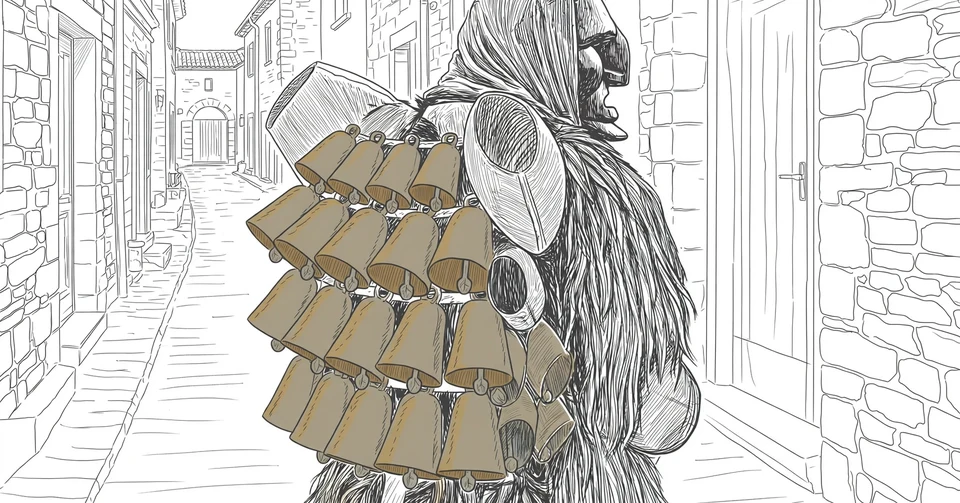
Walking with them are the issohadores, bright in white and red where the mamuthones are black, carrying a long rope that they flick out to catch people from the crowd. The contrast is the whole point of the Mamoiada carnival. Darkness walks beside light, the beast beside its keeper, noise beside silence, and the rite has been performed, studied and argued over for generations without anyone settling what it truly means.
What the mamuthones wear, piece by piece
The costume is built from the materials of a shepherd's world. The body of it is sheepskin, heavy black fleeces worn over ordinary clothes until the man inside disappears and only a stooped, shaggy shape remains. Nothing about it is decorative in the carnival sense. There are no colours, no sequins, no attempt at beauty, and that refusal is part of the effect.
The face is hidden by a dark mask, sa visera, carved by hand from pear or alder wood. Each mask is a little different, because each is cut by a carver's knife rather than a mould, but they share the same expression, stern, frowning and sad, with none of the grinning exaggeration of ordinary carnival masks. A mamuthone does not look like he is enjoying himself. He looks like he is enduring something, which, given the weight on his back, he is.
That weight has a name. The rows of cowbells strapped over the shoulders are called sa carriga, and descriptions of the costume, including Mamoiada's page on the Autunno in Barbagia portal, put the bells alone at about 30 kilograms. The full outfit weighs more once the sheepskins and the mask are added. So the round figure in this article's title is, if anything, generous to the men involved. The mamuthones carry their bells for hours, through the streets and around the bonfires, and the carrying is not incidental to the rite. It is the rite, or at least the part of it your body would remember.
Two lines of mamuthones, one rhythm
The mamuthones traditionally parade in a group of twelve, arranged in two parallel rows, and their movement is closer to a slow dance than to a walk. Each step is a small, rhythmic jolt of the shoulders and back, timed so that the bells of the whole group sound together. Between the jolts there is quiet. Accounts of the Barbagia carnival stress this again and again, that the bells are the only noise in an otherwise absolute silence.
That silence separates Mamoiada from almost every other carnival in Italy. Elsewhere, carnival means drums, shouting, confetti and jokes. In the Barbagia mountains, the mood described by guides to the island's traditions is dark and solemn, closer to a religious procession than to a street party. The crowd watches quietly. The mamuthones say nothing, because the figures are not supposed to be men in costume having fun. They are something older and less comfortable, and the village treats them that way.
The year's first outing is the January one, around the fires of Saint Anthony, the patron of animals, whose feast opens the Sardinian carnival season. The mamuthones then return for the closing days of carnival itself, on carnival Sunday and on Shrove Tuesday, before Lent puts an end to the season. Fire in January, bells in February, and then the masks go back into storage for another year.
The issohadores and the rope
Every procession of mamuthones is accompanied by the issohadores, and the two figures could not look less alike. Where the mamuthones are black, stooped and laden, the issohadores stand upright in a white shirt and a red cloth tunic, their faces covered by a pale, delicate mask that is almost expressionless. They walk a composed, orderly walk at the head and tail of the procession, guarding the mamuthones and keeping the rite on its path.
Their name gives away their job. Issohadores takes its root from sa soha, the long rope each of them carries, and at intervals along the route they throw the rope out into the crowd, whip-like, and catch a spectator, drawing the person briefly toward the procession before letting the loop fall. The catch falls often, though not only, on young women, and it is received as part of the day rather than as an ambush. Guides to the festival describe the pairing in terms of opposites, wealth and misery, youth and age, light and dark, and the rope is the visible thread between the two halves.
I find the pairing the most human part of the whole performance. The mamuthones on their own would be only weight and noise, a beast procession. The issohadores give the scene its order and its manners, the suggestion that the wild thing in the street is there by agreement, escorted by the village itself.
Nobody knows where the mamuthones come from
Ask what the rite means and the honest answer is that nobody knows. The village's own cultural portal says plainly that the significance of the archaic performance is not known with certainty. Scholars have been publishing studies of the masks since 1951, and the theories have only multiplied. One family of explanations reads the procession as an old agrarian rite, a shaking off of winter and a plea for the fertility of fields and flocks as the seasons turn, which fits the January fires and the patron saint of animals. Others reach much further back, tracing the figures to pre Christian Sardinia or even to the Nuragic Bronze Age civilisation that built the island's stone towers.
Those deep origins should be read as theories, not as facts, and the careful sources treat them that way. A guide to Sardinia's carnival traditions frames the island's carnival roots in the agrarian rituals of the Roman period, but even that is a framing, not a document. No ancient text describes the mamuthones. What can be said safely is that the rite is old, that it belongs to a family of masked winter processions found across the Barbagia, and that Mamoiada has kept its version with unusual seriousness. A few valleys away in Ottana, the Boes process in sheepskins and cowbells under ox masks carved with a symbol called the flower of life, driven and tamed by the Merdules, who carry a stick and work the crowd with a rope much as the issohadores do. The pattern repeats across the mountains, animal figures under bells, keepers with ropes, fire at the start of the season, and the mamuthones are simply its darkest and most disciplined expression.
Personally, I think the uncertainty suits it. A tradition that arrives with a complete explanation feels like a reconstruction, something assembled for visitors. The mamuthones have the opposite quality. The village performs the rite the way it performs it because that is how it is done, and the meaning, whatever it once was, has been carried in the doing rather than in any book.
The village behind the masks
Mamoiada is a small place, a few thousand people in the granite hills southwest of Nuoro, and for most of the year its fame rests on something else entirely. This is the village where some two hundred families still make their wine at home, working small plots of old vines, and where the wine in the glass is likely to be the strong local red I wrote about in a glass of Cannonau a day in the Sardinian hills. Masks in winter, grapes the rest of the year. The two trades share more than an address. Both are slow, physical and stubbornly local, and both are kept going by families rather than by any industry.
If you arrive outside carnival, the masks are still there. The village's Museum of Mediterranean Masks keeps Mamuthone costumes among a wider collection of carnival masks from Sardinia, the Alps and the Mediterranean, so the size of sa carriga can be checked in person, in a quiet room, at eye level. It is a good museum, by the accounts of it, but a costume behind glass is only the instrument. The music is the street in January, the firelight, and twelve men moving as one.
That, in the end, is what stays with me about the mamuthones. A village small enough to know every family by name hands its strongest men a burden of iron and bronze, dresses them as something half animal, and asks them to walk in silence through the winter dark. They say nothing, and they do not have to. The bells, ringing together and then stopping together, say that the village is still here, still carrying its weight, and still keeping its own counsel about what it all means.
More in Culture & Society
Latest posts
- Kagawa Puts the Sweet Part Inside the Mochi
- A Yubatake Cools a Spring With Nothing but Wood and Gravity
- Toji Meant Moving to a Hot Spring Until You Got Better
- Nyuto Onsen Hides Seven Inns at the End of a Snow Road
- A Donko Never Got the Chance to Open
- The Milpa Is a Garden That Thinks Like a Forest
- The Kitamaebune Came Home Loaded With Kelp
- Nobody Just Watches a Panigyria, Everybody Dances
- Ponzu Began With a Fruit Too Bitter to Eat
- Kombu Is the Quiet Half of Dashi
- Manza Onsen Bathes at 1,800 Metres
- The Oshi Kept Fuji's Pilgrims Fed, Housed, and Devout
- Every Prefecture Argues About What Goes in Ozoni
- Japan's Population Decline and the Villages It Leaves Behind
- KRL Commuterline and the Trains That Move Jakarta