Nyuto Onsen Hides Seven Inns at the End of a Snow Road
· 9 min read
Nyuto Onsen is a cluster of seven hot spring inns in the mountains of Semboku, Akita, each drawing on its own spring beneath Mount Nyuto. This is a look at its milky water, its oldest thatched inn, and why the long snowbound road is part of the appeal.
Some hot spring towns are built around a single spring. Nyuto Onsen, high in the mountains of Semboku in Akita Prefecture, is built around seven. Seven separate inns sit scattered through the beech forest at the foot of Mount Nyuto, above Lake Tazawa, and each one draws its water from its own source rather than from any shared supply.
That one detail explains almost everything about the place. Because no two inns share a spring, no two baths at Nyuto Onsen are quite alike. The water at one inn runs milky white, at another it is dark with minerals, at a third it is clear and mild. People do not come here for a single famous bath. They come to move slowly between seven of them, and to stay in a valley where the bathing changes every time the path bends.
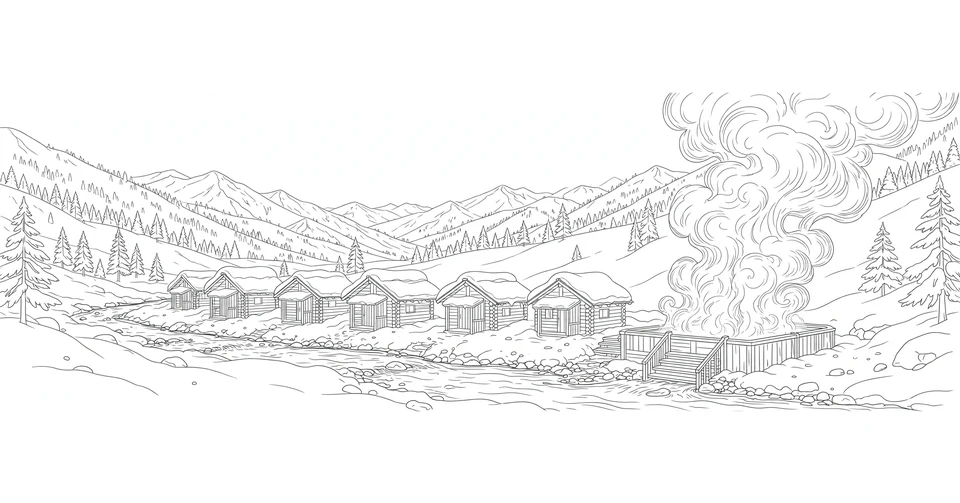
Getting there asks for a little patience, and winter asks for more. The last stretch of road climbs into serious snow country, and in the cold months the drifts pile up around the inns while access to the most remote of them can be restricted by the weather. To my mind, that difficulty is not a flaw in Nyuto Onsen. It is the filter that has kept the valley quiet, and it is why arriving feels like an achievement rather than a transfer.
Seven inns, seven springs at Nyuto Onsen
The seven inns of Nyuto Onsen are Tsurunoyu, Kuroyu, Ganiba, Taenoyu, Ogama, Magoroku, and the Kyukamura hotel. They are strung out along one mountain road inside Towada-Hachimantai National Park, close enough that most of them can be walked between in good weather, far enough apart that each keeps its own character. Ogama, for instance, makes its home in a relocated wooden schoolhouse, while Taenoyu is a modern building beside the Sendatsu River, and Kyukamura is a hotel in the modern style. There is even an eighth spring, Ippon-matsu, a free outdoor bath on the hiking trail up Mount Nyuto with no inn attached at all.
Because the inns grew up around separate sources, the sensible way to experience Nyuto Onsen is not to pick one bath and defend it. It is to bathe around. Overnight guests can buy a pass, described in the Nyuto Onsen entry on Wikipedia as the yumeguri-cho, which gives a single entry to the baths of every inn and stays valid for a year. A shuttle bus, the Yumeguri-go, loops between the inns roughly every two hours, and the version of the pass sold to staying guests covers both the shuttle and admission to all seven baths. It is a small system, run by seven independent businesses that long ago decided cooperation suited them better than competition.
I find that arrangement quietly admirable. Each inn keeps its own water, its own kitchen, and its own idea of what a stay should feel like, yet the valley presents itself to visitors as one place. Nyuto Onsen is less a resort than a loose federation of baths, and the pass is its constitution.
Tsurunoyu, the inn that started it
Ask anyone in Japan to picture Nyuto Onsen and they will picture Tsurunoyu. It is the oldest of the seven inns, with a history of more than 300 years, and some of its rooms date back to the Edo Period. The oldest building is a thatched honjin, an official rest house of the kind that once lodged the Akita domain's lords and their guards on the road, and stays there still centre on low wooden rooms and an irori fireplace rather than on anything resembling a hotel lobby.
Tsurunoyu also sits apart from the others, at the end of its own side road, several kilometres from the bus stop that serves it. That separation is part of the spell. By the time you have walked or been driven in through the forest, the modern world has had time to fall away, and what remains is a cluster of dark thatched roofs, a stream, and steam rising off water the colour of milk.
The inn's great open air bath is the image of Nyuto Onsen that travels around the world, and it earns the attention honestly. But I would argue the real luxury at Tsurunoyu is not the bath itself. It is the slowness of the place, the sense that very little has been asked to change, and that the inn has mostly been left alone to be what it has been for centuries.
Water the colour of milk, and water that is not
The signature water of Nyuto Onsen is the milky white sulphur spring at Tsurunoyu, cloudy enough that your body disappears below the surface. It is the photograph everyone takes home. Yet the name of the place has nothing to do with that whiteness. As the japan-guide page on Nyuto Onsen explains, the name comes from the shape of Mount Nyuto above the valley, not from the colour of the water below it.
Walk the road and the water keeps changing its mind. Kuroyu draws a dark, iron rich spring, about as far from milk as a bath can get. Magoroku, reached by a short walk off the main road and reopened in 2025 after a renovation, has clear and mild water. Taenoyu's baths look out toward a waterfall in the Sendatsu River gorge. Within a single small valley, Nyuto Onsen holds more distinct spring types than many whole prefectures can offer, and the variety is the point of the yumeguri pass. Without it, a visitor might assume the milky bath is the whole story.
There is a lesson in that for how these places are usually sold. A destination gets flattened into one image, one colour, one famous tub, and the rest becomes backdrop. Nyuto Onsen resists the flattening simply by being plural. Seven springs cannot be reduced to a postcard, however good the postcard is.
Mixed bathing that never quite left
Nyuto Onsen is also one of the places where konyoku, Japan's old tradition of mixed bathing, survives in something close to its original form. I have written elsewhere about how konyoku lingers on at remote inns long after it faded from city bathhouses, and this valley is one of its strongholds. Tsurunoyu's great outdoor bath is mixed, and Kuroyu, Taenoyu, and Ganiba all keep mixed outdoor baths of their own, alongside separate baths for men and women.
The milky water does some of the social work here. In a bath you cannot see through, modesty is easier to keep, and the mixed bath settles into something unremarkable, which is exactly what it was for most of Japanese history. Day visitors are welcomed at the inns during set hours for a fee, and the mixed baths ask for the usual calm behaviour rather than any special performance. Nobody at Nyuto Onsen is making a statement. They are keeping a habit.
That, I think, is why the tradition survives here and not in places that tried to preserve it as an attraction. A custom that has to be explained on a sign is already half gone. At Nyuto Onsen it is simply how the oldest bath in the valley has always been used.
An outdoor bath, deep snow, and weather
Winter is when Nyuto Onsen shows its full character. The beech forest disappears under some of the heaviest snow in Japan, the roofs carry thick white loads, and the road up from Lake Tazawa becomes a corridor between walls of ploughed snow. An open air bath in that season is a rotenburo, a bath that lets the weather in, and sitting in milky water while snow lands on the surface around you is the experience the valley is quietly famous for.
Not every inn keeps winter hours. Kuroyu, the most secluded of the seven, closes for the winter entirely, waiting out the months when its corner of the forest is effectively cut off. Others alter their access, and anyone driving up is expected to have winter tyres and a healthy respect for conditions. The snow is not a backdrop at Nyuto Onsen. It is a participant, and it decides who gets in.
I have always thought this is how a mountain onsen should behave. A hot spring that is equally easy to reach in January and July has usually traded something away to buy that convenience. Nyuto Onsen never made the trade, and winter visitors are rewarded with the full, unsoftened version of the place.
The road from Tazawako Station
For travellers without a car, Nyuto Onsen begins at Tazawako Station, served by the Akita Shinkansen. From there, buses operated by Ugo Kotsu climb into the mountains for around fifty minutes, passing Lake Tazawa, the deepest lake in Japan, and stopping near most of the inns. Tsurunoyu is the exception that proves the rule. Its guests get off at the Tsurunoyu Onsen Iriguchi stop and face a walk of about forty five minutes, or arrange in advance to be collected from the Arupa Komakusa stop instead.
None of this is difficult, exactly. It is simply unhurried in a way that modern travel has trained us to find suspicious. Buses are not frequent, the shuttle loops every couple of hours, and a missed connection means time spent in a quiet mountain valley rather than in a departure lounge. Most visitors adjust to the rhythm within a day, and many say afterward that the slowness was the part they brought home with them.
Nyuto Onsen will probably never be famous the way the great onsen towns are famous, and its seven inns seem content with that. What waits at the end of the snow road is not a resort competing for attention. It is a row of old baths in a beech forest, each with its own water, keeping hours set by the seasons. Some places you visit. This one you are permitted to enter, briefly, on its own terms, and that difference is worth the drive.
More in Life & Style
Latest posts
- Edo's Hikeshi Wore Their Dragons Into the Fire
- Kagawa Puts the Sweet Part Inside the Mochi
- Sodoran Treats an Heirloom Like an Honoured Guest
- You Can Read a Pecalang From Across the Street
- A Donko Never Got the Chance to Open
- The Milpa Is a Garden That Thinks Like a Forest
- The Kitamaebune Came Home Loaded With Kelp
- When the Gara-Gara Starts, the Puppets Drop the Plot
- Forty Pounds of Cowbells, and the Mamuthones Say Nothing
- The Oarfish Still Answers to a Name From the Dragon Palace
- Ponzu Began With a Fruit Too Bitter to Eat
- Kombu Is the Quiet Half of Dashi
- Irezumi Was an Art Before It Was a Warning
- The Oshi Kept Fuji's Pilgrims Fed, Housed, and Devout
- Every Prefecture Argues About What Goes in Ozoni