Aburaage Is the Fried Tofu Japan Simmers Sweet
· 19 min read
Aburaage is thin deep fried tofu that Japan simmers in sweet soy dashi, and it turns up everywhere from kitsune udon to inari-zushi. This is the story of a humble pouch that carries a whole cuisine on its shoulders.
A sheet of aburaage looks like nothing much. It is flat, golden brown, a little oily to the touch, and it sits in the tofu section of the supermarket in a plain plastic pack. You could walk past it a hundred times and never guess that it is one of the hardest working ingredients in Japanese cooking. Yet this thin pouch of fried tofu turns up in noodle bowls, in lunchboxes, in winter hot pots, and on shrine altars, and it has been doing so for centuries.
The story starts with a fox. Our earlier piece on kitsune udon quotes the folklore plainly: "Folklore says foxes love aburaage, the deep fried tofu that tops the bowl, so kitsune udon took the fox's name." That one sentence is worth a whole article, because the tofu in it is far more interesting than its humble looks suggest. Aburaage is not a garnish. It is a technique, a container, and a piece of folklore all fried into one golden sheet.
To understand aburaage, it helps to forget the word tofu for a moment and think of a sponge instead. A good piece of aburaage is hollow inside, light as a pillow, and built to soak. It drinks broth, it holds rice, and it carries flavour from one dish to the next without ever insisting on its own taste. That quiet generosity is the whole point of it, and it is why Japanese home cooks keep a pack of it in the fridge the way other kitchens keep onions.
What aburaage actually is
Aburaage is thinly sliced tofu that has been deep fried twice in oil until it puffs up and turns golden. The name itself is plain: abura means oil, and age means fried. Food in Japan describes it as thin Japanese deep fried tofu with a golden, spongy texture, and that short description is honest. The outside turns slightly crisp while the inside stays soft and airy, and when you cut a piece open you find a hollow pocket waiting to be filled.
The pocket is the whole idea. Chopstick Chronicles calls aburaage a pouched tofu with a crispy exterior and a soft, airy interior, and notes that the pockets are usually about 8 cm long and 4 cm wide. That size is no accident. It is big enough to hold a scoop of vinegared rice, small enough to sit neatly on a bowl of noodles, and thin enough to slice into ribbons for soup. A single ingredient that fits all three jobs is rare in any cuisine, and Japanese cooking leans on that versatility every day.
It is worth knowing what aburaage is not. It is not atsu-age, the thick fried tofu that keeps raw tofu at its core and never hollows out. It is not yaki tofu, which is grilled over a flame and stays firm and dense all the way through. The table below shows the difference at a glance, because the three are easy to confuse in a shop and they behave very differently in a pot.
| Tofu | Thickness | Inside | Best use |
|---|---|---|---|
| Aburaage | Thin, about 1 cm | Hollow and spongy | Inari-zushi, kitsune udon, miso soup |
| Atsu-age | Thick, 2 to 3 cm | Soft raw tofu | Simmered dishes, oden |
| Yaki tofu | Medium | Firm and dense | Sukiyaki, hot pots |
Japanese cooks also give aburaage different names depending on the dish it is heading for. When it is seasoned and ready to be stuffed with rice, it is inari-age. When it tops a bowl of udon, it is kitsune-age. When it is sold for sushi, some shops call it sushi-age. The ingredient never changes. Only the job does, and the name follows the job. I find that charming, because it treats the tofu as a worker with many uniforms rather than a single fixed product.
How a block of tofu becomes a hollow pouch
Making aburaage starts exactly where making tofu starts. Soybeans are soaked, ground with water, and boiled, then strained to give soy milk. A coagulant is stirred in, traditionally nigari, the mineral rich liquid left when salt is drawn from seawater, and the milk sets into curds that are pressed into a block. For aburaage the tofu is made on the firmer side, sliced thin at roughly 1 cm, and drained well before it ever meets the oil.
The frying happens in two stages, and the two stages are what make the pouch possible. First the slices go into oil at a gentle 110 to 120 degrees Celsius. At that heat the steam escapes slowly through the protein, the tofu expands from the inside, and the slice swells without browning. Then the oil is raised to 180 to 200 degrees, and the second frying seals the protein film and turns the outside golden. Chopstick Chronicles uses a simpler home version of the same idea, frying at about 150 degrees for around 20 minutes, then again at 180 degrees for a few minutes until the pieces turn a nice golden brown all over. The numbers differ between a factory and a home kitchen, but the principle never changes: low heat to puff, high heat to seal.
The single most important step comes before any of that, and it is the least glamorous one. The tofu must be drained completely. Food in Japan is blunt about it: thorough drainage is the single most critical step in the whole process, because any remaining water causes cracking or large holes during frying. Chopstick Chronicles says the same thing in plainer language. Wrap the firm tofu in kitchen paper, put a weight on it, leave it in the fridge overnight, and change the paper when it gets wet. Skip that step and the oil spits, the pouch tears, and the whole batch is ruined. There is a small lesson in that. The best fried tofu in Japan is made by people who are patient with a paper towel.
Some tofu shops still fry aburaage by hand, and the handmade pieces show it. They come out thick, uneven, and puffy, with a character that factory packs never quite match. In Kyoto, the handmade sheets are famously large and delicate, fried one at a time in rapeseed oil. In Fukui, they are bigger and fluffier still, and people travel there specifically to taste them fresh. A factory pouch will do the job in your kitchen. A handmade one reminds you that the job was once a craft.
Abura nuki, the step most cooks skip at their peril
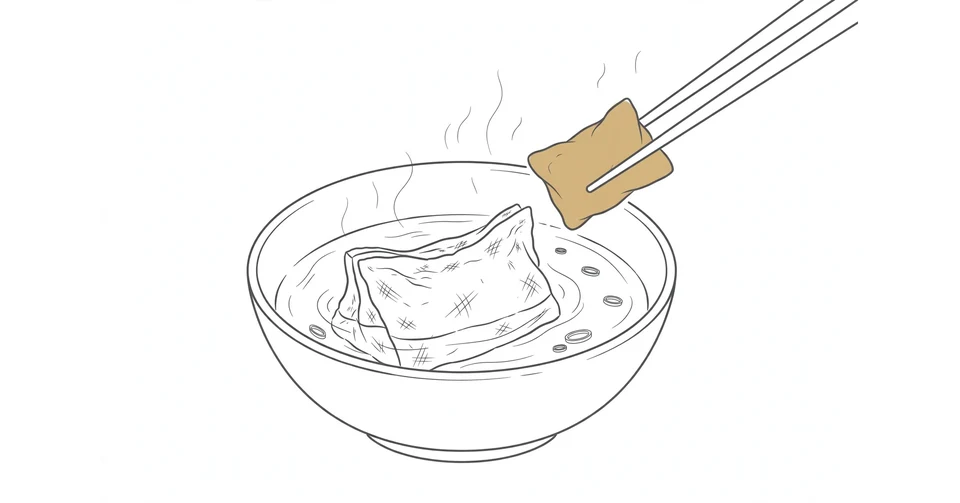
Fresh aburaage carries excess oil from the frying, and most Japanese cooks remove it before cooking. The step is called abura nuki, which simply means taking the oil away. You put the aburaage in a colander, pour boiling water over it, and squeeze it gently. Thirty seconds is enough. Alternatively, you can blanch it in hot water for about 30 seconds and press it between layers of kitchen paper.
It sounds fussy, and it is easy to skip when you are in a hurry. Do not skip it. The oil that comes off is the stale, slightly bitter oil from the factory fryer, and it muddies every flavour that follows. Once it is gone, the pouch takes on seasoning far more cleanly, and the difference is noticeable in miso soup and simmered dishes above all. I learned this the slow way, by making a soup with unrinsed aburaage and wondering why the broth tasted flat and greasy at the same time. One pot of boiling water fixed a mistake I had been making for months.
Abura nuki is also the moment when the pouch opens up for its next job. Squeezed gently after its hot bath, the aburaage lies flat and soft, ready to be simmered, stuffed, or sliced. Treat it roughly and it tears. Treat it gently and it does whatever you ask.
The sweet simmer that gives aburaage its flavour
On its own, aburaage tastes of almost nothing. It has a mild, savoury flavour from its soybean base, and the outer skin is slightly firm when fresh but softens quickly in hot liquid. That neutrality is a feature, not a flaw. Because aburaage absorbs liquid so readily, it takes on whatever flavours surround it, and the flavour it takes on most often is sweet soy dashi.
The simmer is simple. Dashi, soy sauce, mirin, and sugar go into a pan, the aburaage goes in after its hot water bath, and everything bubbles gently for about 15 minutes until the pouch is saturated and the liquid has mostly cooked away. Some cooks add a little sake. Some use a drop lid, an otoshi-buta, to keep the pieces submerged. The exact proportions vary from house to house, and every Japanese family seems to have its own idea of how sweet the simmer should be. What never varies is the result: a golden pouch that is sweet, salty, and juicy all at once, and that leaks a little of its seasoning into whatever it touches next.
That leaking is a virtue. When seasoned aburaage sits on a bowl of udon, its sweet juices seep into the broth and round out the salt. When it is chopped into takikomi gohan, the mixed rice dish, it seasons the rice from the inside as it cooks. The tofu is not just an ingredient in these dishes. It is a delivery system for flavour, and it does its work quietly, without ever asking for attention.
Aburaage in kitsune udon
The most famous job for aburaage is the one that gave this article its starting point. Kitsune udon is a bowl of thick udon noodles in a light, clear dashi broth, topped with a whole piece of sweet simmered aburaage. The name means fox udon, and the story behind it is the folklore we quoted at the top. Foxes are the messengers of Inari, the kami of rice and prosperity, and the old belief is that they adore fried tofu, so it became the offering left at Inari shrines.
There is a second theory, and it is charming enough to mention. The seasoned pouch may be called kitsune because it is the same golden brown colour as a fox, and Japanese recipes often say to cook something to a fox colour to describe that exact shade. The two theories do not fight each other. One says the fox loves the tofu, the other says the tofu looks like the fox, and both end in the same place: a golden sheet of fried tofu on a bowl of noodles, named after the animal that haunts the shrines. Kitsune udon is the bowl where aburaage became a star, and it remains the dish most people meet first.
The history has a competing origin story from Osaka. One account says that a customer in an Osaka noodle shop in 1893 ordered fried tofu on the side and tipped it onto his udon as a topping, and the shop began selling it that way. True or not, the name stuck, and the dish spread. A small warning is worth repeating for travellers. In Osaka, kitsune means udon with aburaage and tanuki means the same tofu on soba, while in Tokyo you would get kitsune either way and tanuki means crunchy tempura crumbs. Order carefully, or you will get a different bowl than the one you pictured.
What I love about kitsune udon is how little it asks of the cook. The broth is light, the noodles are chewy, and the aburaage does the heavy lifting with its sweet-savoury contrast. Nothing in the bowl is trying to impress you. Everything in it is trying to comfort you, and the tofu is the part that makes the comfort taste like something.
Aburaage in inari-zushi
If kitsune udon is aburaage as a topping, inari-zushi is aburaage as a container, and it is the cleverer of the two jobs. The seasoned pouch is opened like a small purse, filled with vinegared sushi rice, and served as one of Japan's most beloved lunchbox dishes. The rice is usually seasoned simply, sometimes mixed with sesame seeds or finely chopped vegetables, and the sweet pouch wraps around it like a gift.
Inari-zushi takes its name from Inari, the same kami whose fox messengers love fried tofu, and the dish has been sold by street vendors in Edo since at least the 1840s. That makes it older than kitsune udon by half a century, and it explains why the pouch was seasoned in the first place. A plain fried pouch is useful. A sweet simmered pouch that can hold rice is a meal you can carry in your hand, and Edo's street vendors understood that immediately.
Making inari-zushi at home is mostly a matter of patience. The aburaage is simmered until sweet and juicy, then pressed gently between two plates to remove excess liquid, then opened carefully at one end so the pocket does not tear. The rice goes in a little at a time, and the open end is folded shut or tucked under. Eaten cold or at room temperature, the pouch holds its shape, the rice stays moist, and the sweet and sour flavours balance each other in a way that feels considered rather than accidental. It is picnic food, train food, and festival food, and it travels better than almost any other sushi.
There is a quieter point here too. Inari-zushi is one of the few sushi that needs no raw fish, no knife skills, and no special equipment beyond a pot and a pair of hands. That accessibility is part of why it survives. A dish that anyone can make is a dish that everyone keeps making, and the aburaage pouch is what makes that possible.
Aburaage in miso soup and the home kitchen
The third great job for aburaage is the most ordinary one, and the most revealing. Slice it into thin strips, drop it into miso soup, and it absorbs the dashi and miso within seconds, adding body and a subtle sweetness to the bowl. It is the kind of addition that nobody comments on and everybody misses when it is gone. Add wakame seaweed and green onions and you have the classic miso soup that Japanese households serve at breakfast, a combination so familiar that it barely counts as a recipe.
From there, aburaage fans out across the home kitchen. It goes into oden, the winter hot pot, where whole pieces soak up light dashi broth over hours and are sometimes stuffed with mochi or fish paste. It goes into takikomi gohan, chopped small and simmered with rice, soy sauce, and seasonal vegetables. It goes into stir fries, where its sponge-like interior soaks up sauce, and into nimono, the simmered vegetable dishes that fill a Japanese dinner table. The fox behind the tofu has its own story, and once you know it, you start seeing its favourite food everywhere in the kitchen.
For cooks outside Japan, aburaage is also one of the easiest Japanese ingredients to keep on hand. Fresh pieces last only about two to three days in the fridge, but they freeze beautifully for up to a month, and frozen aburaage actually absorbs broth even better after thawing because the cell structure breaks down slightly during freezing. Chopstick Chronicles puts the freezer life at two to three weeks, and the conservative advice is to use frozen pieces within a month and thaw them in the fridge overnight or with a quick pour of hot water. Either way, a bag of frozen aburaage in the freezer is a quiet promise that a bowl of miso soup is never more than ten minutes away.
Aburaage beyond the pouch, in Fukui and Kyoto
Not all aburaage is the thin pouch from the supermarket. Two regions of Japan have turned it into a destination food, and they are worth knowing about if you ever travel with an appetite. Fukui Prefecture is famous across Japan for its thick, large format aburaage, notably bigger and fluffier than the thin pouches sold in most other regions. The local culture is tied to Hoon-ko, a Buddhist memorial event held to honour the death anniversary of Shinran, the founder of Jodo Shinshu Buddhism, when families and temple communities traditionally gathered to eat large aburaage during winter events. Today, Fukui's aburaage draws visitors from all over Japan who travel specifically to taste it freshly made.
The most famous shop is Taniguchiya, a long established tofu shop founded in 1925 in Sakai City, Fukui Prefecture. Its flagship product is fried for a long time in first pressed rapeseed oil, and the result is a rich, savoury aburaage with a texture that rivals both meat and fish in presence. It pairs especially well with sake, and visitors grill it and eat it with grated daikon and soy sauce, as simply as possible.
Kyoto takes the opposite approach. Ueda Tofu's Oagesan measures 25 to 30 cm long and 12 cm wide, thinner and denser than the Fukui style, and each piece is fried individually by hand at low and then high temperatures. The aroma of rapeseed oil and the juicy, moist texture make it a standout product, and Kyoto style aburaage tends to be more delicate overall, reflecting the region's refined food culture. The two cities disagree about what good aburaage should be, thick and hearty or thin and delicate, and the disagreement is the best kind: it gives travellers a reason to taste both.
What strikes me about these regional styles is how seriously Japan takes an ingredient that the rest of the world barely notices. A country that will argue about the proper thickness of fried tofu is a country that understands that small things done well are what make a cuisine. Aburaage is not a luxury ingredient. It costs almost nothing, it keeps in the freezer, and it asks for ten minutes of your time. The care lavished on it anyway says something about the cooking culture that produced it.
How to buy aburaage without buying the wrong thing
Shopping for aburaage can get confusing, because the same ingredient appears under several different names, and the wrong packet will ruin a dish. Food in Japan offers a short guide that is worth repeating here. The standard thin fried tofu pouch is simply aburaage, and it sits in the refrigerated tofu section of most Japanese supermarkets, usually vacuum packed in sets of two to six pieces. Inari-age is pre-seasoned aburaage sold ready to fill with sushi rice, often found in the refrigerated or ambient section. Kitsune-age is another informal name for aburaage, especially when used as a topping for udon or soba. Sushi-age is a regional name sometimes used in western Japan for the same thin fried pouch. Atsu-age is the thicker product with raw tofu inside, and you should not substitute it for aburaage in sushi or soup without adjusting cooking time.
Outside Japan, Asian grocery stores and Japanese supermarkets stock both fresh and pre-seasoned versions, and pre-seasoned inari-age is also sold in cans or shelf-stable pouches, which is convenient for quick inari sushi at home. If you are shopping online, look for the term inari age alongside aburaage to find all available options. One practical note: plain aburaage is vegan, since it contains only tofu and oil, but always read the label on pre-seasoned products, because some commercial inari-age is seasoned with dashi that may contain fish based ingredients. If you need a fully vegan option, choose plain unseasoned aburaage and season it yourself.
A last practical word on health, because it matters and because it is easy to overstate. Aburaage is a good plant based protein source because it starts as tofu, and it is naturally gluten free and dairy free. The double frying does add fat, so portion size matters, and performing abura nuki before cooking can reduce fat content noticeably. It is not a superfood, and nobody should pretend otherwise. Used in miso soup or mixed rice dishes rather than eaten alone, it contributes protein without dominating the calorie count, and as part of a balanced Japanese diet, it fits well.
Why a fried pouch deserves a whole article
Aburaage began as a way to make tofu richer and more satisfying, possibly in Buddhist temple kitchens where meat was forbidden and monks experimented to give tofu a more satisfying texture. The exact origin is not fully clear, and the honest sources say so. A popular cookbook from 1782, the Tofu Hyakuchin, may have included fried tofu, and by 1853 tofu pouches had already gained wide recognition throughout Japan. One popular theory traces aburaage to the Muromachi period, roughly 500 years ago. The records are hazy, and that haziness is part of the charm: an ingredient this old and this ordinary was never important enough for anyone to write down its birthday.
What is certain is what aburaage became. It became the fox's favourite food, the offering at Inari shrines, the pocket that carries sushi rice, the topping that names a noodle bowl, and the quiet strip of protein in a thousand breakfast soups. It asks for almost nothing, a little draining, a little hot water, a short simmer, and it gives back far more than it takes. Most ingredients in a kitchen want to be the star. Aburaage is content to be the pouch, the sponge, and the carrier, and Japanese cooking is better for having an ingredient that is happy to serve. The next time you see a flat golden sheet in the tofu section, do not walk past it. Buy it, rinse it, simmer it sweet, and put it on something. The foxes knew what they were doing.
More in Food & Travel
- Japanese Cheesecake and the Fluffy Cake That Jiggles
- Kitsune Udon Is the Bowl the Fox Would Order
- Tokyo Disneyland and Why Japan Loves It Differently
- Walking Through Senbon Torii Feels Like Entering Another World
- Onigiri, Japan's Two-Thousand-Year-Old Portable Meal
- Prambanan Towers Over Java With a Love Story in Stone
Latest posts
- Tamagushi Is the Sakaki Branch You Offer to the Kami
- The Miko Who Dance Between People and Kami
- Kotodama and the Spirit That Lives Inside Japanese Words
- Kagura Is the Sacred Dance Shinto Still Performs
- Norito Give a Shinto Ceremony Its Voice
- The Gohei Wand Carries the Kami Into the Ceremony
- Origami and How a Single Sheet of Paper Became Japan's Quiet Art
- A Hishaku Is the Bamboo Ladle That Starts Every Shrine Visit
- A Kitsune Is the Fox Messenger Who Guards the Shrines of Japan
- Temizuya Is Where Every Shrine Visit Begins With Water
- Shide Are the Paper Lightning That Marks a Sacred Space
- Yabusame Turns Horseback Archery Into a Moving Prayer
- Roro Jonggrang and the Thousand Temples Built in One Night
- Ten Thousand Vermilion Gates Lead Up Fushimi Inari
- Shimenawa Marks the Line Between Ordinary and Sacred