Kotodama and the Spirit That Lives Inside Japanese Words
· 16 min read
Kotodama is the old Japanese belief that words carry a spirit of their own, and once you notice it, you start hearing it everywhere, from wedding speeches to the names people refuse to say aloud.
Picture a wedding guest in Japan, pen in hand, crossing out a single word in a speech. The word is "end". But at a wedding, "end" is not allowed, because the belief is that saying it might invite an ending. The guest rewrites the sentence and nobody in the room thinks twice about it. That small act of editing is kotodama at work.
Kotodama is the belief that words carry a spirit of their own, and that what you say aloud can bring about what you name. The word itself is built from two parts, koto, meaning word or speech, and dama, from tama, meaning spirit or soul. Put them together and you get the spirit of words, the idea that a spoken word is not just a label for a thing but a living force that can act on the world. It is one of the oldest ideas in Japanese culture, and it is also one of the most quietly persistent, surviving in habits that millions of people follow without ever naming the belief behind them.
This article began with a single line in an earlier piece about norito, the formal prayers of Shinto, which noted that a norito is kotodama in its most formal shape. That line deserves a full article of its own, because kotodama reaches far beyond the shrine, into weddings and funerals, hospitals and exam halls, and the names parents give their children.
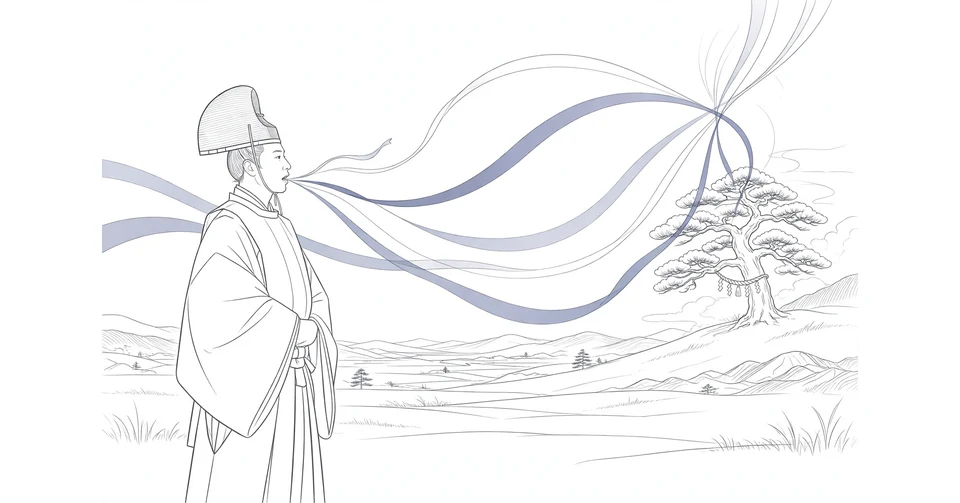
The belief is easy to misunderstand from the outside. It is not a doctrine with priests and scriptures, and nobody is taught it in school. It is closer to a habit of mind, something you absorb from being corrected as a child and from watching adults choose their words with care. Most Japanese people today would not claim that words have spirits, yet many follow the avoidances that kotodama prescribes, in the same way that people elsewhere will not wish an actor good luck before a performance.
What kotodama means, word by word
Start with the word itself, because the word already contains the whole idea. Koto means word, speech, the act of speaking. Dama comes from tama, spirit or soul, the same tama that appears in the word for soul. Kotodama is therefore the spirit that lives inside a word, the soul dwelling in speech. The scholar Kazuya Hara, writing about the belief in Japanese communication, put it plainly: kotodama is the folk belief that a soul dwelling in words has the power to make an idea in the mind come true simply by saying it aloud.
There is a second layer to the word that makes the belief feel less strange once you see it. In ancient Japanese, koto did not only mean word. It also meant thing. The two meanings were, in the view of the scholar Toyoda, indistinguishable to the people who used the word. A word and the thing it named were not two separate items, one a sign and the other the reality. They were the same. That is why the belief took the shape it did. If the name and its reality are one, then speaking a word is not describing the world from a safe distance. It is handling the thing itself, and handling it carelessly can set something in motion.
The oldest poem about it
The first written trace of kotodama appears in the Man'yoshu, the oldest surviving collection of Japanese waka poetry, compiled sometime after the year 759. In one of its poems, the poet Yamanoue no Okura calls Japan "kotodama no sakiwau kuni", the land where the spirit of words brings good fortune, or in another rendering, the land where the mysterious workings of language bring bliss.
The great folklorist Orikuchi Shinobu thought that reading was wrong, and his correction is one of the most interesting pieces of scholarship on the subject. Orikuchi argued that sakiwau does not mean that words are beautiful or blessed. It means that a result appears exactly in accordance with the meaning a word carries. In his words, as translated in a close reading of his lecture on language and folklore, the ancient people believed that words have a spirit, and that this spirit has a marvelous working, and that working is called sakiwau. So "kotodama no sakiwau kuni" is not a boast about the Japanese language. It is a statement of belief: this is a land where what is spoken in words comes to be just as the words say.
Orikuchi also used the shape of the phrase to date it. The phrase "kotodama no sakiwau", judged by its form, is a relatively new construction, belonging to the age when the songs of the Man'yoshu were being sung among the people. It does not seem to go back much before the Nara period. But Orikuchi was careful about what that dating does and does not prove. As for the belief itself, he said, whether it existed before that, one cannot say flatly that it did not.
The later misreading matters because it shows how easily a belief can be polished into a compliment. Scholars of a later age read "kotodama no sakiwau kuni" as Japan is a land where marvelous, mysterious words are in use, and from there as praise of how excellent and beautiful the words of Japan are. Orikuchi said that was a misunderstanding. The phrase was never about beauty. It was about power, the power of a spoken word to make reality match it. You can read the full argument in this close reading of Orikuchi on kotodama, which quotes his lecture and walks through the reasoning step by step.
From the shrine to the street
If the Man'yoshu gives us the oldest written trace of kotodama, the shrine gives us its oldest home. Orikuchi traced the meaning of the word through three stages, and the first stage is the most revealing. In its oldest sense, kotodama was the power of the kami, the Shinto gods, lying in the norito, the ritual prayers offered to them. The power belonged to the gods and lived in the prayer, and people received it along with the belief in souls. Only later did the meaning shift to the spirits in the norito themselves, and finally to the spirits in words in general.
The linguist Kindaichi Kyosuke sorted the belief into three types, and the sorting is still useful. There is the kotodama of verbal action, the idea that what people say will be realized. There is the kotodama in particular kinds of expressions or poems, where certain set phrases carry power by their form. And there is the kotodama lying in each word inherited from the ancestors, the sense that ordinary vocabulary itself carries a charge.
What strikes me about this history is the direction of travel. Kotodama did not start in the street and climb up to the shrine. It started in the shrine and walked down to the street, and it never quite left the shrine behind.
The words people refuse to say
The most visible sign of kotodama in modern Japan is not what people say. It is what they refuse to say. The taboo words, imikotoba, are avoided so that they do not bring on bad luck, and the list of them maps the anxieties of ordinary life with remarkable precision.
At a wedding, guests avoid the words cut, break, split, go back, and end, or any word that suggests separation. Speeches are rewritten to keep them out, and the avoidance is so thorough that even the closing of the wedding is not called an ending. It is called the opening. The word for to be over, owaru, is replaced with ohiraki, to bring up to a close, a phrase that points forward rather than backward. The logic is plain: at the start of a marriage, you do not want the word "end" in the room, because the word might do what it says.
At a funeral, the avoidance runs in the opposite direction. Repeated words like kasane kasane, again and again, and tabitabi, time after time, are kept out of the proceedings, because repetition suggests that the misfortune might repeat itself. Grief is not supposed to come in pairs. At a hospital visit, the numbers four and nine are avoided, and so is any talk of things getting worse, because the sound of four echoes shi, death, and the sound of nine echoes ku, suffering. Even the flowers people bring are chosen with the same ear. Cyclamens are kept away from a sickroom because their Japanese name contains the sounds shi and ku, death and hardship.
Before an exam, people try not to say slip or fall in front of the candidate, because the candidate might do exactly that. The number 43 is unlucky because shisan can also mean stillborn, while the number 17 is lucky because junana also means great wealth. These are coincidences of sound, and in a culture without kotodama they would be jokes. In a culture with it, they are warnings, and people act on them.
A name is the person
The same logic reaches into the most personal word of all, a name. In ancient Japan, a person's real name, the imina, was a secret. It was taboo to let a stranger know it, because the name was regarded as the person himself or herself, and someone who knew your true name could control you with the power of kotodama.
The custom left traces that are still visible in literary history. In the Heian period, some female writers' true names were never disclosed. Murasaki Shikibu and Sei Shonagon are pseudonyms, names by which the world knows them, while the names their families called them have been lost. Fujiwara no Michitsuna no haha is known to history as Fujiwara Michitsuna's mother, and another writer as Fujiwara Takasue's daughter, because their real names were not revealed. The anonymity was not modesty. It was protection, and the protection was built on kotodama.
The belief survives in quieter forms today. When naming babies, Japanese parents are careful to choose characters based on their meaning, and a name is treated as a kind of wish for the child, not just a label. If a person lives far from the meaning of his name, some will say he is not worthy of it.
The lucky side of the belief
Kotodama is not only about fear. The same belief that makes people avoid unlucky words makes them seek out lucky ones, and the lucky side is the warmer half of the story.
Saying a goal aloud is thought to help fix it, and some people explain the practice of writing wishes on ema, the wooden plaques at shrines, in the same way. The wish is not only thought or felt. It is written down and spoken, and the speaking is part of the wishing. New Year cards carry the greeting "Akemashite Omedetou Gozaimasu", a happy new year, written as a prayer for the recipient's happiness with the power of kotodama behind it.
In Hokkaido, a pair of train tickets became a good luck charm for the same reason. One was from the Station of Happiness and the other was to the Station of the Country of Love, and people kept the pair together as a charm for happiness and love. The tickets were ordinary paper, and the stations were ordinary stops, but the names on them were lucky, and the luck was in the names.
The shout that martial artists make when they attack, the kiai, belongs to the same family. It is a short cry uttered when making an attacking move in karate or aikido, and it is supposed to concentrate the attacker's resolve. The sound is the act. A modern visitor to Japan can see a summary of all of this in this clear guide to kotodama in everyday life, which moves from weddings to exams to hospital visits and shows how the same old idea explains each of them.
What I take from the lucky side is that kotodama was never only a superstition about danger. It was also a technology of hope, a way of using words to pull a desired future a little closer. Saying the good thing aloud does not guarantee it, and nobody serious claims it does, but the act of saying it changes the speaker. It commits them, and it makes the wish public, even if the only audience is the self.
Why silence became a virtue
There is a deeper consequence of kotodama, and it may be the most important one. If words have the power to make things happen, then not speaking is also a kind of power, and silence becomes a virtue. The scholar Satoshi Ishii argued that the fear of kotodama's magical power, internalized in Japanese culture, created the common belief that silence is a virtue and speech is a vice.
The mechanism is simple. If a careless word can bring on an unwanted result, then the safest course is to choose your words slowly, or not to speak at all until you are sure. That caution shows up in the practice of reading the atmosphere before speaking, in the preference for indirect expression over direct statement, and in the habit of giving an opinion for the public, tatemae, while keeping the true intention, honne, private.
The same caution explains the importance of honorific language. Honorific expressions are thought to have been generated originally from the words used to admire the kami, and they are based on the belief that people wished for happiness by using beautiful and roundabout expressions. Another view traces them to the fear of the taboo sense of careless words. Either way, the elaborate politeness of Japanese speech is not decoration on top of the language. It is the language's way of handling the power it believes words carry.
Kotodama in modern Japan
The belief has not stayed in the past. It keeps turning up in places where you would not expect it, and each appearance is a reminder of how deep the roots go.
In 1996, the pop rock band Southern All Stars had a big hit with a song called "Ai no Kotodama", the magical words of love. The title works because the audience already knows what kotodama means. A love song that calls its own words magical is not making a strange claim. It is using a word that has been in the language for more than a thousand years to say that the right words, said to the right person, change things.
The most famous modern echo is stranger. In 2004, the businessman and author Masaru Emoto claimed that human consciousness could affect the molecular structure of water. He conducted an experiment in which he spoke positive words to a bowl of water, which he said caused the water to produce beautiful crystal patterns when frozen, while mean words produced ugly patterns. His book became a New York Times bestseller, and the claim was repeated around the world. Emoto presented his work as science, and it is best understood as a claim rather than a finding, but the reason the claim travelled so far is that it spoke in the language of kotodama. It told people that their words could change the physical world, and that is a story people have wanted to hear for a very long time.
The belief has also been pulled into politics, and that history is darker. Because kotodama implies that the Japanese language itself has divine power, and that its strength owes something to its purity, it could be used to argue that foreign words polluted the language. In the past, some Shintoists avoided words that originated in China and used only yamatokotoba, the native Japanese vocabulary, in their rituals. In the years before the Second World War, nationalists tried to purge the language of what they called tekiseigo, the language of the enemy, and replace English loanwords with Sino-Japanese words. The word for rugby, ragubi, became tokyu, fight ball. The purge did not last, but the episode is a warning. A belief about the power of words can be used to include or to exclude, and kotodama has done both.
What it leaves us with
Kotodama is not a belief I hold in the literal sense. I do not think a word can summon an ending or a stillbirth or a fall. But I do think the people who shaped this belief understood something true about language, and I think the understanding survives even when the magic is set aside.
The true part is that words are not neutral. A word spoken at a wedding, in a hospital room, or before an exam does something to the people who hear it, and what it does depends on the word. Saying "end" at a wedding does not end the marriage, but it does put the idea of ending into a room where nobody wants it, and a room full of people who love the couple can feel that. Saying "you will be fine" to a sick friend does not cure them, but it does put a different idea into the room, and the room feels different for it. The magic is not in the word. The effect is in the hearing, and the hearing is real.
There is a kinship here with another Japanese idea, the search for a reason to live that ikigai describes so quietly. Ikigai asks what makes a life worth getting up for, and kotodama asks what makes a word worth saying. Both are small ideas with large consequences, and both reward the person who takes them seriously.
So the next time you catch yourself rewriting a sentence to remove a word that feels wrong, or choosing a kinder word when a sharper one is available, notice what you are doing. You are not being superstitious. You are practicing an old discipline, the belief that words carry something more than their definitions, and that the something they carry is worth handling with care. The shrine priest knew it, and the wedding guest knows it.
More in Culture & Society
Latest posts
- Aburaage Is the Fried Tofu Japan Simmers Sweet
- Japanese Cheesecake and the Fluffy Cake That Jiggles
- Kitsune Udon Is the Bowl the Fox Would Order
- A Hishaku Is the Bamboo Ladle That Starts Every Shrine Visit
- A Kitsune Is the Fox Messenger Who Guards the Shrines of Japan
- Temizuya Is Where Every Shrine Visit Begins With Water
- Shide Are the Paper Lightning That Marks a Sacred Space
- Tokyo Disneyland and Why Japan Loves It Differently
- Yabusame Turns Horseback Archery Into a Moving Prayer
- Walking Through Senbon Torii Feels Like Entering Another World
- Onigiri, Japan's Two-Thousand-Year-Old Portable Meal
- Roro Jonggrang and the Thousand Temples Built in One Night
- Ten Thousand Vermilion Gates Lead Up Fushimi Inari
- Prambanan Towers Over Java With a Love Story in Stone
- Shimenawa Marks the Line Between Ordinary and Sacred