Tamagushi Is the Sakaki Branch You Offer to the Kami
· 17 min read
A tamagushi is a small branch of sakaki decorated with paper streamers, offered to the kami at Shinto shrines, and this article explains what it is, how it is presented, and where it came from.
At a formal Shinto ceremony there comes a quiet moment when an ordinary visitor steps forward holding a small green branch. The priest hands it over, the visitor turns it slowly in both hands, bows, and lays it on the table before the altar. Nothing is said that the room cannot already read. The branch is a tamagushi, and it is the most personal offering in the whole ceremony.
A tamagushi is a small branch of the sakaki tree hung with strips of white paper, or cloth of red and white, and it is usually regarded as a symbolic offering to the kami. It is not food, and it is not money. It is a piece of a living tree, dressed in paper, and handed over by a human being to a spirit. That directness is what makes it worth understanding.
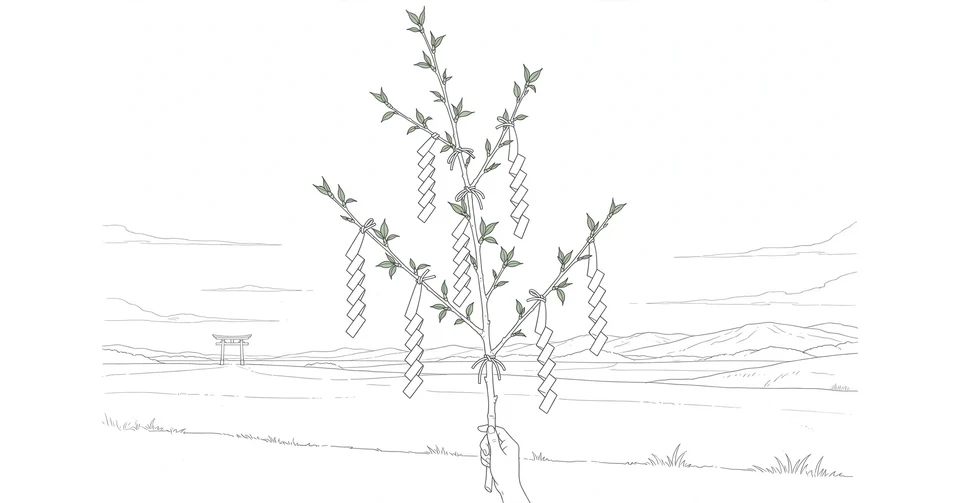
What strikes me about this branch is how little it asks of the person holding it and how much it still manages to say. You do not need to be a priest to offer one. You need two hands, a steady pace, and the willingness to stand in front of an altar and mean it. In a religion full of objects that only priests may touch, the branch belongs, briefly, to everyone.
What a tamagushi is
A tamagushi is a branch, not a wand carved from wood. That distinction matters, because the branch is still recognisably a branch when it is offered. The leaves are green, the stem is woody, and the paper streamers hang from it the way ribbons might hang from a small tree. The offering is a piece of nature, lightly dressed, rather than a tool made by human hands.
The streamers on the branch are shide, the same folded white paper that marks sacred things all across Japan. The branch may also carry yu, strips of cloth, usually in red and white. Together the branch, the paper, and the cloth form a single object that is presented as one gift. A scholarly study of Shinto symbols describes it as a small branch of the sakaki tree hung with strips of white paper or cloth of red and white, and calls it a symbolic offering, and that study of Shinto symbols places it among the sacred vessels used in Shinto ceremonies.
It is a token offering, a simple form of mitegura, the august hand offerings of old Shinto. It is always used at formal ritual services and on other important occasions, and it is usually placed on the table before the altar, sometimes set up in a flower holder on the table. The branch does not stay in the worshipper's hands. It is given, and giving is the whole point. Once it is laid down, the offering is complete, and the worshipper bows and returns to their seat.
There is a useful contrast here with the gohei, the wooden wand with two paper streamers that stands on the altar as a sign of the kami. A gohei is a wooden wand with two strips of folded white paper attached to it, and it represents the presence of the kami during ceremonies. The gohei stays where it is put. The branch is handed over and left behind. One is a seat that remains. The other is a gift that changes hands. To understand the wand, it helps to know that the gohei carries the kami into the ceremony, and the branch works beside it as the offering the visitor brings to the kami the gohei represents.
The sakaki branch
The tree behind the branch is the sakaki, an evergreen known to botanists as Cleyera japonica. Sakaki is considered sacred in Japanese mythology, and shrines often plant it on their grounds. Its evergreen leaves stay green through the winter, and that constancy is part of why it was chosen. A branch that never seems to die is a fitting gift for a spirit.
Sakaki branches serve today as the seat of the kami, as decoration at rituals, and as sacred devices for invoking the kami at special ceremonies. It is the most familiar form of that use, the branch cut small enough to hold in two hands and dressed for presentation. The tree is sacred, but the offering is modest. A single branch, not a whole tree, is enough.
When sakaki is hard to find, other evergreens are sometimes used instead. Branches of Japanese cedar, fir, and oak have all served as one, and at some shrines outside Japan camellia branches take the place of sakaki. The substitution is accepted because the form matters more than the species. What the kami receive is a green branch with paper streamers, offered with both hands, and the tree it came from is a detail the tradition can bend on.
The branch used for the offering is small. The same study that records its history notes that one was once four or five feet long, but that it gradually became smaller until today it varies from ten to twenty inches in length. That shrinking is worth pausing over. An offering that once needed two people to carry can now be held by one person in two hands, and the ceremony has grown more personal as the branch has grown smaller. The gift did not lose meaning when it lost size. It gained intimacy.
How a tamagushi is offered
Making an offering of the branch before the kami is called tamagushihoten, and the manner of it is precise. The steps are simple to describe and surprisingly hard to perform gracefully, which is exactly why they are taught with such care.
When the priest hands the branch to a worshipper, the base of the branch is held from above by the right hand, and the leaf apex is supported by the left hand. The left hand, holding the leaves, is kept higher than the right. The worshipper steps forward to the front of the desk and makes ichiyu, one small bow. Then the right hand is pulled back so that the base of the branch faces the worshipper and the leaf apex points toward the altar, the left hand shifts to hold the base, and the worshipper prays.
Then comes the turn that gives the rite its shape. The worshipper holds the leaf apex with the right hand and moves the branch clockwise, so that the base ends up pointing toward the altar. The branch is placed on the desk, and the worshipper performs nirei nihakushu ichirei, bowing twice, clapping hands twice, and bowing again, then makes one more small bow and returns to the original seat. A reference entry on the rite describes each of these steps in the same order, and that reference entry also notes that some shrines follow different manners, including forms known as tamagushihairei, kendamagushi, and tatetamagushi.
The turn matters more than it looks. For most of the approach, the leaves point toward the altar and the base points toward the worshipper. The clockwise turn reverses that, so the branch is laid down with its base toward the kami. The gift is not thrown or dropped. It is rotated, set down, and left in the correct orientation, the way you might turn a letter around before handing it to someone so they can read it. The gesture says that the offering now belongs to the kami, not to the person who carried it.
I find the slowness of this rite moving. Nothing in it is hurried, and nothing in it is hidden. The whole congregation watches one person walk forward, turn a branch, and bow, and the ceremony makes room for that single small act. It is a reminder that ritual does not have to be grand to be serious. A branch, two hands, and a careful turn are enough.
The meaning of the word tamagushi
The meaning of the word tamagushi is uncertain, and scholars have offered several explanations. The word is ancient, older than the Chinese characters with which it is now written. The element tama may mean jewel, offering, or spirit, or it may simply be an honorific. The element gushi means wand. Put together, the word has been read as a jewelled wand used as an offering, an offering attached to a wand, an august wand, a wand in which the spirit of the kami resides, and a sakaki tree set into the ground to indicate the seat of the kami.
The first three readings point in one direction. They suggest the tamagushi began as an offering to the kami, a gift carried on a wand. The last two readings point in another. They suggest the tamagushi began as an abode of the kami, a place where the spirit rests. The honest answer is that it has been treated as both, and the two meanings have lived side by side for centuries. A gift and a dwelling are not so far apart when the gift is a living branch.
Two old scholars disagreed about the word in a way that is still quoted. Hirata Atsutane held that the tamagushi was so called because it was decorated with balls, like the branch in the mythology. Motoori Norinaga held that the word came from tamukegushi, meaning pointing towards the altar. Another theory holds that tama refers to tamashii, spirit. None of these has settled the question, and the uncertainty itself is part of the story. A word that has survived for more than a thousand years without a single agreed meaning has earned its mystery.
There is also a poem that treats the tamagushi loosely, and it is worth knowing because it shows how ordinary people understood the offering. Sugawara no Michizane, writing in the Hyakunin Isshu, the collection of one hundred poems by one hundred poets, said he was too busy on his trip to make an offering, but asked that the coloured leaves of Mount Temukeyama be offered instead, since they were beautiful like brocade. The leaves in the poem have no shide and no cloth, yet the poem presents them as a tamagushi. The offering, in the end, is defined by the intention behind it as much as by the materials.
A branch with a long history
The tamagushi existed in primitive Shinto, and its story runs through the oldest texts of Japan. In a passage about Ame-no-Iwato, the rock cave of heaven, the Nihongi tells how the kami, after a conference, sent Yamazuchi, the spirit of the mountain, to gather many evergreen trees, and Nozuchi, the spirit of the field, to gather pampas grass or bamboo, so they could be used as wands to hold offerings for Amaterasu Omikami, the Sun Goddess. The branch at the centre of that story is the masakaki, the true sakaki, decorated with jewels and a mirror.
The same mythology gives the tamagushi a more famous scene. When Amaterasu hid in the cave of heaven, Futodama held the Ihotsu no masakaki, a branch covered with foliage and decorated with balls and mirrors, reverently with both hands. The image is the ancestor of every tamagushi offered since. A branch, held in both hands, decorated and presented to the kami. The rite performed at shrines today is a smaller, quieter version of that mythic moment.
The tamagushi has been used at the Grand Shrine of Ise since the very earliest days. The Engishiki, the old book of court procedure, states that the Ise Shrine called twigs of the sacred evergreen tree with tufts of cloth futo tamagushi, where both futo and tama are honorifics. In the Heian period, according to the Shoku Nihongi, the tamagushi seems to have been regarded as the abode of the kami, and it occupied a significant place in Shinto rituals.
For a long time, though, the tamagushi was not used generally in shrines. That changed around the Meiji Restoration, when Shinto priests reciting the Nakatomi purification prayer for noted worshippers used branches of sakaki to keep track of the number of times they recited the prayer. After the branches had been used this way they were called tamagushi o-harai, and they were considered a sort of charm and treated as symbols of the kami. Other shrines gradually adopted the custom, and today most shrines give such a tamagushi to worshippers, who take it home and set it up on the family altar. The tamagushi o-harai of the Grand Shrine of Ise are particularly prized.
That history has a shape I keep coming back to. The tamagushi began as a branch in a myth, became a counting stick for prayers, and ended as a charm that ordinary people carry home. It moved from the hands of gods to the hands of priests to the hands of visitors, and at each step it became smaller and more personal. The offering never stopped being sacred. It simply learned to fit in a person's hands and then in a person's home.
Tamagushi and its relatives
The tamagushi is easy to confuse with the other paper wands at a shrine, so it helps to set it beside them. Each one has its own job, and the differences are worth learning.
| Object | What it is | What it does |
|---|---|---|
| Tamagushi | Sakaki branch with shide | Offered to the kami as a gift |
| Gohei | Wooden wand with two shide | Marks the presence of the kami |
| Haraigushi | Wand with many shide | Purifies people, objects, and spaces |
| Shide | Folded paper streamers | Mark a place or object as sacred |
The paper is the shared language across all four. The shide on a tamagushi are the same folded streamers that hang from the sacred straw ropes at shrine entrances, and they carry the same message wherever they appear. To understand the paper itself, it helps to know that shide are the paper lightning that marks a sacred space, and the streamers on a tamagushi are that same sign, folded onto a living branch and carried to the altar.
The gohei and the tamagushi are the closest pair, and the contrast between them is the clearest way to remember both. The gohei is a wand of wood with two streamers, set on the altar as a seat for the kami. The tamagushi is a branch with streamers, offered by a visitor and left on the table before the altar. The haraigushi is different again. It is a wand with many streamers, waved by a priest over people and spaces to cleanse them. One marks presence, one is a gift, and one purifies. The paper is the same. The hands and the intentions are different.
Tamagushi ryo and the money for a prayer
There is a second life for the word tamagushi that has nothing to do with branches, and it shows how deeply the offering entered daily life. The money paid to a shrine when requesting a prayer is sometimes written as tamagushi-ryo, shrine fee, alongside hatsuho-ryo, ceremony fee. The term tamagushi-ryo is used only for the money paid when requesting a prayer, because it is paid instead of a tamagushi. Hatsuho-ryo also covers money paid in exchange for ofuda paper charms and omamori amulets. The fee carries the name of the branch because it stands in for the branch.
The same term appears at Shinto funerals, where tamagushi-ryo is written on the cover of the bushugi-bukuro, the envelope for a condolence gift. A word that began as a branch became a fee, and then became the label on an envelope handed to a grieving family. That is not a corruption of the tradition. It is the tradition spreading outward, from the altar into the ordinary exchanges of money and sympathy that surround a shrine.
The tamagushi has also been the subject of a court ruling. In 1997 the Supreme Court of Japan ruled in the Ehime case that public money could not be used to pay for tamagushi offerings, a decision that drew a line between the state and the shrine. The ruling did not touch the offering itself. Worshippers still present a tamagushi at shrines across Japan, and the branch still means what it has always meant. What the court settled was who may pay for it, not whether it matters. The distinction is worth keeping, because it shows that a small branch can raise a large question, and that Japan has been willing to argue about it in its highest court.
Where a visitor might see a tamagushi
Most visitors will see a tamagushi at a formal ceremony inside a shrine hall. At a wedding, a blessing, or a rite of passage, the priest will hand the branch to the family or the couple, and each person will step forward in turn to offer it. You may glimpse the green leaves and white paper against the dark wood of the altar, and you will hear the two claps that follow each offering. It is a quiet moment in a ceremony that is otherwise full of music and movement, and it is the moment when the ceremony belongs most directly to the people in it.
You may also see a tamagushi on a kamidana, the small household altar where families honour the kami. Most shrines today give a tamagushi o-harai to worshippers who take it home and set it up on the family altar, and the branch stays there until it is renewed. The home version is smaller and plainer than the one in the shrine hall, but it does the same work. It says the kami are present here too, not only in the grand hall but in the corner of an ordinary room.
If you are invited to offer a tamagushi yourself, the etiquette follows from the steps above. Take the branch with the right hand above and the left hand below, keep the leaves higher than the base, step forward, bow once, turn the branch clockwise, lay it down with the base toward the altar, bow twice, clap twice, bow once more, and return to your seat. Do not rush the turn. Do not drop the branch. And do not worry if your hands shake a little. The branch has been held by nervous hands for more than a thousand years, and the kami have never seemed to mind.
A branch, two hands, and a gift
A tamagushi is, in the end, a very small thing. It is a branch ten to twenty inches long, a few strips of folded paper, and perhaps a piece of red and white cloth. It wilts. It dries out. It is taken down and replaced, and a new branch is cut in its place. Nothing about it is built to last, and that is precisely why it stays with you once you have learned to see it.
What I take from the tamagushi is a lesson about giving that I think applies far beyond the shrine. We tend to assume that a gift must be expensive or permanent to matter, and that an offering must be grand to be worthy of the person receiving it. Japan has spent centuries proving the opposite with a branch you could hold in two hands. A gift can be a piece of a tree. An offering can be a living thing, briefly dressed in paper, handed over and left behind.
The next time you stand in a shrine in Japan and see someone step forward with a green branch in both hands, watch the turn. Watch the leaves swing toward the altar and the base settle toward the kami, and understand what is happening. A person is giving something alive to something unseen, and the whole ceremony has paused to make room for it. The branch is small, and the gesture is brief, and it has outlasted empires. That is worth a moment of your attention, and the tamagushi will still be there, green and quiet on the table, when you give it one.
More in Culture & Society
- The Miko Who Dance Between People and Kami
- Kotodama and the Spirit That Lives Inside Japanese Words
- Kagura Is the Sacred Dance Shinto Still Performs
- Norito Give a Shinto Ceremony Its Voice
- The Gohei Wand Carries the Kami Into the Ceremony
- Origami and How a Single Sheet of Paper Became Japan's Quiet Art
Latest posts
- Aburaage Is the Fried Tofu Japan Simmers Sweet
- Japanese Cheesecake and the Fluffy Cake That Jiggles
- Kitsune Udon Is the Bowl the Fox Would Order
- A Hishaku Is the Bamboo Ladle That Starts Every Shrine Visit
- A Kitsune Is the Fox Messenger Who Guards the Shrines of Japan
- Temizuya Is Where Every Shrine Visit Begins With Water
- Shide Are the Paper Lightning That Marks a Sacred Space
- Tokyo Disneyland and Why Japan Loves It Differently
- Yabusame Turns Horseback Archery Into a Moving Prayer
- Walking Through Senbon Torii Feels Like Entering Another World
- Onigiri, Japan's Two-Thousand-Year-Old Portable Meal
- Roro Jonggrang and the Thousand Temples Built in One Night
- Ten Thousand Vermilion Gates Lead Up Fushimi Inari
- Prambanan Towers Over Java With a Love Story in Stone
- Shimenawa Marks the Line Between Ordinary and Sacred