The Miko Who Dance Between People and Kami
· 20 min read
A miko is a Shinto shrine maiden who stands between people and the kami, dancing, assisting priests and keeping the shrine alive, and her role has changed more than almost any other in Japan.
Stand at the gate of almost any Shinto shrine in Japan on a festival morning and you will see her before you see the priest. A young woman in a white robe and scarlet trousers sweeps the stone steps, or arranges paper fortunes at a small wooden counter, or waits quietly at the edge of the hall with a fan in her hand. She is a miko, a shrine maiden, and she is the person most visitors actually meet when they come to a shrine.
The word miko is often translated simply as shrine maiden, and the translation is accurate as far as it goes. But it hides a long history. Today she is a trained assistant who helps the priests, performs the sacred dance and keeps the shrine running. A thousand years ago she was something larger and stranger: a woman believed to carry the voice of the gods in her own body. To understand her is to watch a role shrink and survive at the same time, from oracle to attendant, without ever quite losing the dance that made her sacred in the first place.
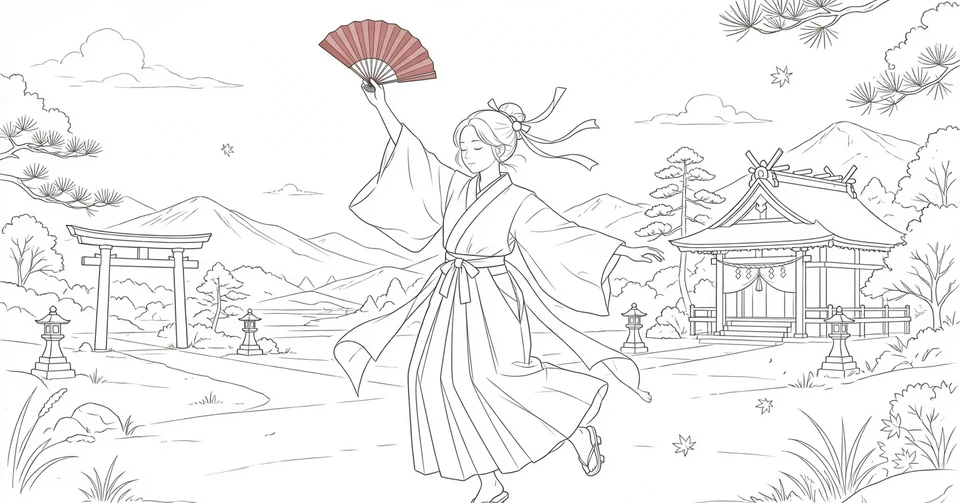
This is the story of that change, and of the work she still does. It begins with a dance, it passes through an imperial ban, and it ends, on most days, with a broom, a counter and a quiet prayer offered on behalf of strangers.
What a miko is, and what she is not
She is a young woman who serves at a Shinto shrine. She is not an ordained priest, and that distinction matters more than the white robe suggests. The priests of a shrine, the kannushi, pass examinations set by the Association of Shinto Shrines and carry the formal duties of ritual: the prayers, the offerings, the leadership of ceremonies. She assists them. She prepares offerings, helps during ceremonies, pours sacred sake at weddings, staffs the counter where amulets and votive plaques are given out, and performs the sacred dance. She does not lead the rite, and she does not read the formal prayers. Her work is the work around the rite, and the dance at its heart.
That sounds like a small job, and on an ordinary weekday it can look like one. But the job carries a weight that the job description misses. She is the human face of the shrine. The priest may be hidden in the inner hall for much of the day, but the miko is the one who greets the visitor, hands over the amulet, explains which fortune paper to tie to the branch, and dances at the festival when the whole neighbourhood is watching. If a shrine feels welcoming rather than forbidding, it is usually because a miko made it so.
The word itself carries the older meaning. Written with the characters for shrine and woman, the word has been used for female shamans, spirit mediums, shrine virgins and ritual dancers across Japanese history. The Kokugakuin University Encyclopedia of Shinto defines the term as a woman possessing the magico-religious power to receive oracles from the kami in a state of spirit possession, and adds that nowadays the term generally refers to a woman who assists shrine priests in ritual or clerical work. That single sentence holds the whole history: a definition that begins with possession and ends with paperwork.
There is a temptation to treat the modern shrine maiden as a diminished version of the ancient one, a shaman turned shopkeeper. I think that misses the point. Roles in a living religion are not museum pieces, and they do not stay powerful by staying the same. She survived because her work changed with the shrine itself, and the dance she still performs is the thread that connects the two ends of her history.
From shaman to shrine assistant: a long fall from power
The traditions reach back to the prehistoric Jomon period, when female shamans were believed to go into trances and speak the words of the gods. The comparison scholars often reach for is the oracle of ancient Greece, the Pythia at Delphi, a woman whose body became the channel through which a god spoke. In early Japan, that channel was a shrine maiden. She danced, she shook, she fell into trance, and when she spoke, the community listened, because the words were understood to come from somewhere beyond her.
The earliest written records mention figures like Himiko, a shaman queen who ruled over parts of Japan in the third century. The Chinese histories that describe her tell of a ruler who communicated with the spirits, and the connection to the later miko tradition is often suggested. It is worth being honest about the limits of that evidence: whether Himiko herself was a miko in the later sense is not something the records settle, and careful historians say so plainly. What the records do settle is that female religious authority was real, visible and powerful in early Japan, and that it was exercised by women who danced and spoke for the unseen.
Through the Nara period, from 710 to 794, and the Heian period, from 794 to 1185, shrine maidens continued to play important roles in court rituals and local spiritual life. She was part of the machinery of the state as much as of the village, called on when a ritual needed a woman's voice and a woman's dance. But her authority was already beginning to narrow. As Buddhism and Confucian thought spread through Japan, male priests gradually took over many of the functions shrine maidens had once held, and she was pushed toward the supporting roles she still occupies.
The decisive break came in the Meiji era. In 1873, the government issued an edict known as the Miko Kindanrei, which forbade all spiritual practices by shrine maidens. The ban was part of a larger effort to reshape Shinto into a state religion with a male priesthood at its centre, and it struck directly at the oldest part of the miko tradition: the trance, the oracle, the claim to speak for the kami. A role that had begun with possession was now forbidden to possess anything at all.
It is a strange thing to read about a government banning a kind of prayer. But bans of that sort rarely erase a tradition. They push it into a new shape. She lost the oracle and kept the dance, the costume, the shrine and the daily work. In the twentieth century she was restored to a respectable place in Japanese society, not as a shaman but as a trained attendant of the shrine. The fall from power was real. So was the survival.
There is something quietly instructive in that arc. Institutions that last are rarely the ones that refuse to change, and they are rarely the ones that change completely either. The miko changed enough to survive a ban and a century of modernisation, and kept enough to still be recognisable to a dancer from a thousand years ago. The fan is the same. The robe is the same. Only the claim has softened, from speaking for the gods to dancing for them.
The red and white uniform, and what it means
You can recognise one from across a shrine courtyard, and the recognition is instant because the outfit has barely changed. The traditional attire, known as miko shozoku, is described in detail in a guide to the miko and her dress, and it begins with a white robe called hakui, a kimono-like garment that symbolises purity. Below it sit the hibakama, bright red pleated trousers, or a long divided skirt in the same scarlet. White split-toed socks, tabi, and straw sandals complete the everyday dress. The hair is worn long and straight, tied back in a low ponytail with white or red ribbons.
For dances and ceremonies, she adds a chihaya, a white coat worn over the usual attire, sometimes decorated with patterns belonging to the shrine or the occasion. On special occasions she may wear an elaborate hairpiece or a small crown called a kanmuri. The effect is formal without being heavy, and it is deliberate. White stands for purity in Shinto belief, and red for vitality, and the two colours together have become shorthand for the religion itself. Walk into a shrine and the first thing you understand, before anyone says a word, is that this place keeps itself clean and alive at the same time.
The costume also does a quieter job. It makes the miko visible and it makes her anonymous in the same gesture. A visitor can spot her in a crowd and ask her a question, and at the same time the individual disappears into the role. That is not an accident. The miko is not performing as herself. She is performing as the shrine's representative, and the uniform is what lets a nineteen-year-old student carry the authority of an institution far older than she is.
It is worth pausing on the age, because it surprises people. The typical shrine maiden today is in her late teens or mid-twenties, and many are university students working part-time. Shrines provide their own training, covering etiquette, basic Shinto knowledge, ceremonial procedure, the performance of the sacred dance, and the handling of offerings and amulets. There are no standardised qualifications or certifications required to become a miko, and the training is practical rather than academic. Some go on to formal study in Shinto at universities such as Kokugakuin in Tokyo or Kogakkan in Ise, but that is the exception, not the rule.
During busy periods, especially the New Year, shrines hire temporary shrine maidens to cope with the crowds, and some of these are high school girls serving for a few days when the shrine is at its busiest. The image of the role as a lifelong vocation belongs mostly to the past. Today she is more often a young woman spending a few years at a shrine before moving on to something else, and the shrine accepts that rhythm. The role is built for passing through, which may be why it has lasted so long.
The dance that carries the prayer
If you ask one what part of her work matters most, the answer is usually the dance. The dances she performs are known as miko kagura or mikomai, the shrine maiden's dance, and they are the oldest surviving part of her tradition. Long before there were counters and amulet shops, there was a woman dancing for the kami, and the dance is still the moment when the miko stops being an assistant and becomes the centre of the rite.
The dance traces itself back to the oldest myth in the Shinto tradition. When the sun goddess Amaterasu hid herself in a cave and the world went dark, the goddess Ame no Uzume danced on an overturned bucket until the watching gods laughed, and the laughter drew the sun back out. That story is the claimed origin of kagura, the sacred dance performed at shrines, and the shrine maiden's dance is its most direct descendant. The miko does not dance for the crowd. She dances for the kami, and the crowd is lucky to be present.
A mikomai performance is slow, graceful and deliberate. The dancer moves to flute, drum and cymbals, holding the sacred objects of the rite: a fan, a branch of the sakaki tree, a cluster of small bells called kagura suzu, or a sprig of dwarf bamboo. The bells shake in rhythm, the fan opens and closes like a held breath, and the movements repeat in patterns old enough that nobody remembers who first set them. Learning the dance is an important part of a miko's training, because it demands more than physical skill. It asks the dancer to understand what the movements are for.
The older form of the dance was stranger and more intense than what most visitors see today. In the ancient rite, the dancer first danced to cleanse her body, whirling in one direction and then the reverse, until the movement carried her into a trance and the god was believed to enter her. The dance was the doorway to possession. The modern form keeps the whirling and the cleansing and lets the trance go, and the result is a dance that honours the gods rather than channelling them. Some would call that a loss. I think it is a translation: the same movement, speaking a quieter language.
At the Grand Shrine of Ise, the most important shrine in Japan, the miko are called maijo, dancing girls, and their main job is to dance and to offer prayers and offerings. That single fact says a great deal about how the tradition is valued at the top of the Shinto world. Where the shrine is most sacred, the dancer is most central, and the role is defined by the dance first and everything else second. She is a reminder that the job was never only about assisting priests. At its heart it has always been about movement offered to the gods.
The dance also survives in forms the visitor may not expect. At Yushima Shrine in Tokyo, shrine maidens dance at weddings and ceremonies, as well as selling amulets to students hoping for luck in their examinations. At small shrines during autumn festivals, four young shrine maidens may perform together in a hall barely larger than a living room, and the performance is no less serious for its size. The scale changes. The intention does not.
A working day at the shrine
Most days in the life of a miko are not festival days, and it is the ordinary days that explain the role best. The duties of a contemporary shrine maiden, as shrines describe them, run through the whole operation of the place. She assists the priests in rituals and ceremonies. She performs the sacred dance at festivals and special events. She sells omamori amulets and ofuda talismans to visitors. She offers omikuji, the paper fortunes, and guides visitors who have questions about the shrine. She keeps the shrine grounds clean, and she helps with the office work. On a busy day she may do all of these before lunch.
It is an honest list, and it is also a list that invites a misunderstanding. Read quickly, it sounds like a shop assistant in a costume, and there are people in Japan who would describe the modern miko exactly that way. But the list leaves out the part that cannot be listed: she is the person who stands between the visitor and the sacred, and who decides, in a hundred small ways, how that meeting goes. She is the one who notices a visitor hesitating at the purification fountain and shows them, without fuss, how to rinse their hands. She is the one who ties a fortune paper to the branch for an old woman whose fingers cannot manage the knot. The work is small. The trust it carries is not.
The rhythm of the year shapes the work. The New Year is the busiest season, when shrines fill with visitors making their first prayers of the year and the miko work long hours in the cold, handing out amulets and fortunes to lines that stretch down the stone steps. Spring brings weddings, and the miko pours the sacred sake and dances for the couple. Autumn brings the festivals, the harvest rites and the long nights of kagura. Summer is quieter, and the work turns to cleaning, preparation and the daily round of small ceremonies. The year is a circle, and the miko walks it with the shrine.
There is also a loneliness to the role that is rarely mentioned. She serves a tradition that most of her own generation knows only from festivals and anime, and she does so in an outfit that marks her out the moment she steps outside the gate. Some visitors treat her as a photo opportunity rather than a person. Others ask questions she cannot answer, about grief or illness or a dead parent, because she is the only person at the shrine who will listen. She is not trained as a counsellor and she is not a priest, but she is there, and being there is sometimes the whole job.
I find myself admiring that more than the dance. The dance is beautiful, but it is rehearsed. The ordinary work is not. It is improvised, patient and mostly unnoticed, and it is the part of the tradition that would be hardest to replace with a machine or a signboard. A shrine can buy a ticket machine. It cannot buy a person who notices that a visitor is lost and walks them to the right hall.
The miko at Ise, and the shrines that keep the old ways
Not every shrine maiden works in the same way, and the differences are worth knowing. The ethnologist Kunio Yanagita identified three main categories, and they still describe the landscape. The jinja miko belongs to a shrine, performs kagura and assists in shrine functions, and this is the type almost every visitor will meet. The kuchiyose miko acts as a spirit medium, speaking on behalf of the dead, and she can still be found in some areas, particularly in the northeast of Japan. The kami uba engages in cult worship and invocations, often connected to local folk traditions or new religious movements.
Beyond those three, researchers have named more specialised kinds: the itako, blind female shamans found mainly in northern Japan, who still help grieving families contact the departed; the moriko, associated with mountain worship in central Japan; and the nono, wandering miko of the same region. These are the remnants of the older, unaffiliated tradition, the miko who belonged to no shrine and travelled from village to village offering divination, healing and the words of the dead. Their numbers have declined sharply, and some of these roles survive now only in a handful of places, but they have not vanished entirely.
The contrast between these kinds and the shrine miko tells the story of the whole tradition in miniature. One branch was brought inside the institution, given a uniform and a timetable, and kept. The other stayed outside, kept the trance and the oracle, and faded with the world that needed it. The shrine gained a dancer. The countryside lost a medium. Both things are true at once, and neither is the whole story.
There is one more distinction worth making, because it confuses even people who know Shinto well. She is not a female priest, and women can in fact become priests, though few do. The priesthood is open to women through the same examinations as men, and the two Shinto universities, Kokugakuin and Kogakkan, award accreditation without distinction of sex. Yet the number of female priests remains small. At the end of June 2010, the Association of Shinto Shrines counted 2,995 working female priests, a figure that covers only women actually serving at shrines, and the proportion has stayed low for decades. About twenty women graduate from Kokugakuin as priestesses every year, and only one or two actually get jobs, largely because of a lingering perception that men are more suited to the position. That is the finding reported by a detailed survey of Shinto priests and shrine maidens, and it is worth stating plainly, because it shapes the choices open to a woman who wants to serve a shrine.
Most women who serve do so as shrine maidens, not as priests, and the role carries no path to the priesthood with it. One who wants to become a kannushi must leave the role and take the examinations like anyone else. The two tracks run side by side and rarely meet. That is a fact about the institution, not about the women in it, and it is one of the reasons the miko endures: for most women drawn to shrine service, she is the only door that is actually open.
The shrine world is not the only place the miko appears. Her image has travelled far beyond the shrine gate, into manga, anime and games, where shrine maidens are often drawn as mysterious girls with spiritual powers. That image owes more to the ancient shaman than to the modern attendant, and it is worth enjoying without mistaking it for a documentary. The fictional shrine maiden can summon spirits and fight demons. The real one sweeps the steps and dances at the festival. Both are part of the same long story, but only one of them has to get up early on New Year's Day.
And the shrine itself is full of other beings who guard its boundaries. The fox messengers of Inari shrines, for instance, stand watch at gates across Japan, and a kitsune is the fox messenger who guards the shrines of Japan with a patience the shrine maiden would recognise. The shrine is a crowded place, full of gods, messengers, priests and dancers, and the miko moves among them as the most human figure in the scene.
Why the miko still matters
It would be easy to end this story with a small elegy, to say that the miko was once powerful and is now decorative, and to leave it there. But that ending would be wrong, and it would miss what the shrines themselves understand. She still matters because the shrine still needs someone to stand between people and the kami, and no one else in the building does that job.
The priest stands closest to the gods. The visitor stands furthest away. She stands in the middle, and the middle is where religion actually happens. It happens when a visitor who has never prayed before is shown how to bow, when a child is given a paper fortune and told to tie it carefully, when a dancer raises a fan and a whole hall goes quiet. Those moments are small, and they are the entire point. A shrine without one would still have its rituals. It would not have its welcome.
There is also a deeper reason, and it has to do with the dance. The miko kagura is one of the oldest performing arts in Japan, older than Noh, older than Kabuki, older than the theatres that now claim the country's attention. It survives not because it was preserved in a museum but because a young woman still learns it, still puts on the white coat, still shakes the bells and still dances it in front of people who came for something else entirely. Every performance is a small act of transmission, a hand passing a flame to the next hand. If the dance ever stops being danced, no recording will bring it back.
So the next time you visit a shrine in Japan, look for the shrine maiden before you look for the priest. Watch how she moves through the grounds, unhurried, in white and red, carrying a branch or a fan or a tray of sacred sake. She is the descendant of women who spoke for the gods, and the colleague of men who pray to them, and she is also, on most days, a student with a part-time job who happens to be keeping a thousand-year-old tradition alive between lectures. That combination is not a contradiction. It is the reason the tradition is still alive at all.
Stand at the gate on a festival morning, and you will see her first. That is not an accident. It is the design. She has always been the person who stands between people and the kami, and she is still standing there, dancing, sweeping, listening, and waiting for the next visitor to arrive.
More in Culture & Society
- Tamagushi Is the Sakaki Branch You Offer to the Kami
- Kotodama and the Spirit That Lives Inside Japanese Words
- Kagura Is the Sacred Dance Shinto Still Performs
- Norito Give a Shinto Ceremony Its Voice
- The Gohei Wand Carries the Kami Into the Ceremony
- Origami and How a Single Sheet of Paper Became Japan's Quiet Art
Latest posts
- Aburaage Is the Fried Tofu Japan Simmers Sweet
- Japanese Cheesecake and the Fluffy Cake That Jiggles
- Kitsune Udon Is the Bowl the Fox Would Order
- A Hishaku Is the Bamboo Ladle That Starts Every Shrine Visit
- A Kitsune Is the Fox Messenger Who Guards the Shrines of Japan
- Temizuya Is Where Every Shrine Visit Begins With Water
- Shide Are the Paper Lightning That Marks a Sacred Space
- Tokyo Disneyland and Why Japan Loves It Differently
- Yabusame Turns Horseback Archery Into a Moving Prayer
- Walking Through Senbon Torii Feels Like Entering Another World
- Onigiri, Japan's Two-Thousand-Year-Old Portable Meal
- Roro Jonggrang and the Thousand Temples Built in One Night
- Ten Thousand Vermilion Gates Lead Up Fushimi Inari
- Prambanan Towers Over Java With a Love Story in Stone
- Shimenawa Marks the Line Between Ordinary and Sacred