Japanese Cheesecake and the Fluffy Cake That Jiggles
· 11 min read
Japanese cheesecake is a light, jiggly soufflé cake invented in Kobe in 1969. Here is how it differs from American cheesecake, where to try it, and how to bake one at home.
Give a Japanese cheesecake a gentle shake and it wobbles like a bowl of jelly. Cut into it and your fork sinks through something closer to a cloud than a cake. It tastes like cheesecake, but lighter, softer, and far less sweet than the dense New York style most people know. That wobble made it one of the most filmed desserts on the internet, and it is the reason bakery queues in Osaka and Fukuoka still stretch out the door.
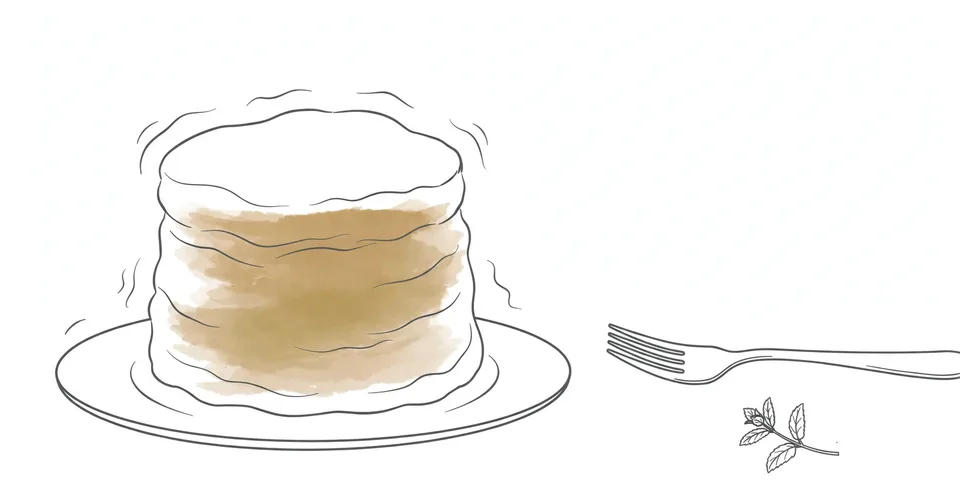
The first thing to know is that Japanese cheesecake is not really a cheesecake in the American sense. It is a soufflé cheesecake, also called cotton cheesecake, and it borrows more from sponge cake than from the baked cream cheese block. Once you understand that, everything about it makes sense, from the jiggle to the mild flavour to the way it deflates slightly as it cools. This is a dessert built on air, and the air is the whole point.
What makes Japanese cheesecake different
A classic American cheesecake is mostly cream cheese, sugar, and eggs, baked slowly until set, then chilled. It is dense, rich, and a small slice is usually enough. Japanese cheesecake flips that formula. It uses far less cream cheese and sugar, and it folds in a large amount of meringue, which is egg whites whipped with sugar until stiff. The meringue traps air, and that air gives the cake its height, its softness, and its famous wobble.
The cake is also baked in a water bath, a pan of hot water sitting in the oven around the cake tin. The steam keeps the temperature gentle and even, so the egg proteins set slowly instead of seizing up. That is why the top comes out smooth and golden instead of cracked, and why the inside stays moist and spongy. Skip the water bath and you get a dry, sunken cake, which is the most common mistake first time bakers make.
The flavour follows the same logic. Japanese cheesecake is deliberately mild. The cream cheese is there, but it whispers rather than shouts, and a little lemon juice or vanilla adds brightness without sweetness. People who find American cheesecake too heavy often love this version precisely because it does not sit in the stomach the same way. You can finish a whole slice and still want another, which is either a compliment or a warning depending on your self control.
A short history from Berlin to Kobe
Japanese cheesecake was invented in 1969 by Tomotaro Kuzuno, a confectioner working for Morozoff, a cake company based in Kobe. Kuzuno had visited Berlin in the 1960s and tasted käsekuchen, the traditional German cheesecake. He came home determined to make something lighter, something that suited Japanese tastes, which tend to favour delicate sweetness over rich indulgence. The result was the soufflé cheesecake, a cake that looked European but ate like something entirely new.
For years it stayed a regional treat, sold in department stores and patisseries around Kansai. Then, in the 1980s and 1990s, bakery chains turned it into a national habit. Rikuro's, the Osaka bakery famous for its freshly baked cheesecakes stamped with the owner's face, made buying one hot from the oven part of the experience. Uncle Tetsu, which started in Fukuoka, did the same, and its shops now draw queues in cities across Asia. The cake stopped being a dessert and became a souvenir, something travellers carried home in a box like a trophy. A detailed history of the soufflé cheesecake traces it back to Kuzuno's 1969 creation and the Berlin trip that inspired it.
Social media did the rest. A video of a tall Japanese cheesecake jiggling on a plate is almost impossible to scroll past, and home bakers around the world started trying the recipe. Today you can find Japanese cheesecake in bakeries from Jakarta to London, but the originals in Japan still set the standard, mostly because they are baked fresh in small batches and eaten the same day.
Why it jiggles, and why that matters
The jiggle is not a gimmick. It is the visible proof that the cake was made correctly. A Japanese cheesecake that does not wobble was probably overbaked, or the meringue was folded too hard and the air escaped. When the cake comes out of the oven it is tall and proud, and as it cools it settles a little, which is normal. The jiggle comes from the soft, moist crumb, which is held together by egg protein rather than by a thick mass of cream cheese.
That texture is also why the cake is best eaten fresh. A day in the fridge firms it up and dulls the wobble, though it still tastes good. Bakeries in Japan sell Japanese cheesecake the same day it is baked for exactly this reason, and the best ones stamp the box with the time it left the oven. If you buy one, eat it within a few hours, ideally still slightly warm, when the top is at its most fragrant and the inside is at its softest.
I think the jiggle matters for another reason too. Most desserts ask you to admire them, then eat them. Japanese cheesecake asks you to play with it first. That small moment of delight, the shake, the wobble, the laugh, is part of the flavour. It is a dessert that does not take itself seriously, and in a food culture that often treats sweets with great ceremony, that lightness feels refreshing.
Where to try Japanese cheesecake in Japan
The easiest place to start is a depachika, the food hall in the basement of a department store. Almost every major depachika has a cheesecake counter, and many sell slices so you can taste before committing to a whole cake. The counters are usually busy in the late afternoon, when office workers stop by for something to take home, so go earlier if you want the full selection. If you want to understand how seriously Japan takes its basement food halls, start there, and you will see why a simple cake gets a whole counter to itself.
Rikuro's in Osaka is the classic pilgrimage. The cakes come out of the oven at set times, the staff ring a bell, and a queue forms in minutes. A whole cake costs about the same as two slices in a Tokyo cafe, which is part of the appeal. Uncle Tetsu's shops work the same way, with the added theatre of the cake being boxed while it is still warm. Both chains are worth the wait, but if the queue is long, remember that plenty of smaller bakeries make excellent Japanese cheesecake too, and a quiet neighbourhood patisserie often bakes a better one than the famous names.
Convenience stores sell a simpler version as well, usually a small chilled slice in a plastic cup. It will not jiggle like the real thing, and it will not change your life, but for a few hundred yen it gives you a fair idea of the flavour. Japan's convenience stores have turned almost every classic dish into a grab and go snack, and cheesecake is no exception. Treat the konbini slice as a preview, not the main event.
How to bake one at home
Baking Japanese cheesecake at home is very doable, but it rewards patience more than skill. The ingredients are simple: cream cheese, butter, milk, eggs, sugar, a little flour and cornstarch, and lemon juice. The technique is where most people go wrong. The cream cheese must be completely smooth before anything else goes in, or the cake will have lumps. The egg whites must be whipped to soft peaks, not stiff dry ones, or they will not fold in evenly. And the folding itself must be gentle, a slow scooping motion that keeps the air in the batter.
The oven matters too. A water bath is not optional, and the temperature should stay low, around 160 degrees Celsius, for a long, slow bake of about an hour. Many recipes then leave the cake in the turned off oven for another 15 minutes so it cools gradually instead of collapsing from the shock of cold air. The first time you bake one, it will probably sink a little, or crack on top, or come out shorter than the photos. That is normal. Even experienced bakers lose a cake to a deflated middle now and then, and the second attempt is almost always better than the first.
One practical tip: use a springform tin lined with baking paper, and wrap the outside in foil so water from the bath cannot seep in. A soggy bottom is the second most common failure after a deflated top. A step by step baking guide walks through the temperatures and timings in detail, including the long slow bake and the resting time in the switched off oven. Another tip is to bring the eggs and cream cheese to room temperature before you start. Cold cream cheese refuses to go smooth, and cold egg whites whip badly, so half an hour on the counter saves a lot of frustration later.
Japanese cheesecake against American cheesecake
The two cakes share a name and a main ingredient, but they are built for different appetites. A side by side comparison shows how far apart they really are.
| Feature | Japanese cheesecake | American cheesecake |
|---|---|---|
| Texture | Light, airy, soufflé like | Dense, firm, creamy |
| Main structure | Whipped egg white meringue | Cream cheese and eggs |
| Sweetness | Mild, gently sweet | Rich and sweet |
| Crust | Usually none | Graham cracker or biscuit base |
| Baking method | Water bath, low heat | Slow bake, then chilled |
| Best eaten | Fresh, same day, slightly warm | Chilled, after a night in the fridge |
| Slice size | A generous slice feels light | A small slice is usually enough |
Neither is better in any absolute sense. The American version is a celebration cake, rich and deliberate, the kind of dessert you plan a meal around. Japanese cheesecake is an everyday pleasure, light enough for an afternoon snack and gentle enough to eat after a full meal. If you love the dense, tangy bite of a New York slice, the Japanese version may taste too subtle at first. Give it a second slice, though, and the subtlety starts to feel like the point.
Is the hype worth it
It is easy to be cynical about a dessert famous mostly for wobbling on camera. Plenty of viral foods turn out to be better to look at than to eat. Japanese cheesecake is not one of them. The jiggle is real, but so is the cake underneath it, and the flavour holds up long after the video ends. What makes it special is not a single trick but the balance of it all: the lightness, the mild sweetness, the warmth of a fresh bake, and the small joy of watching it move.
That balance is also why the cake travels so well as an idea. Home bakers everywhere have adopted it, and each country has bent it slightly, adding matcha, chocolate, or fruit on top. Those variations are fun, but the original, plain and golden, remains the best test of a bakery. If a shop can make a plain Japanese cheesecake that is tall, smooth, and gently sweet, it can make anything.
If you are visiting Japan, put a fresh Japanese cheesecake on your list next to the ramen, the sushi, and the station bento. Buy it in the morning, eat it before dinner, and shake the plate once before the first bite. The wobble is free, and it is the most honest advertisement a cake has ever had.
Practical notes before you go
Most bakery chains sell whole cakes, not slices, so bring a bag that can carry a box flat. A Japanese cheesecake is fragile, and a tilted box is the fastest way to ruin one. Keep it cool but not cold, and eat it the same day. If you are flying home, a whole cake will not survive the trip well, so eat it in Japan and keep the memory instead.
Prices vary by shop, but a whole cake from a chain bakery usually costs less than a single dessert in a sit down cafe, which makes it one of the best value sweets in the country. Smaller artisan bakeries charge more, and the difference is usually worth it. Either way, you are paying for fresh baking and careful technique, not for branding, and that is a fair trade.
More in Food & Travel
- Aburaage Is the Fried Tofu Japan Simmers Sweet
- Kitsune Udon Is the Bowl the Fox Would Order
- Tokyo Disneyland and Why Japan Loves It Differently
- Walking Through Senbon Torii Feels Like Entering Another World
- Onigiri, Japan's Two-Thousand-Year-Old Portable Meal
- Prambanan Towers Over Java With a Love Story in Stone
Latest posts
- Tamagushi Is the Sakaki Branch You Offer to the Kami
- The Miko Who Dance Between People and Kami
- Kotodama and the Spirit That Lives Inside Japanese Words
- Kagura Is the Sacred Dance Shinto Still Performs
- Norito Give a Shinto Ceremony Its Voice
- The Gohei Wand Carries the Kami Into the Ceremony
- Origami and How a Single Sheet of Paper Became Japan's Quiet Art
- A Hishaku Is the Bamboo Ladle That Starts Every Shrine Visit
- A Kitsune Is the Fox Messenger Who Guards the Shrines of Japan
- Temizuya Is Where Every Shrine Visit Begins With Water
- Shide Are the Paper Lightning That Marks a Sacred Space
- Yabusame Turns Horseback Archery Into a Moving Prayer
- Roro Jonggrang and the Thousand Temples Built in One Night
- Ten Thousand Vermilion Gates Lead Up Fushimi Inari
- Shimenawa Marks the Line Between Ordinary and Sacred