The Baduy People and Life Without Modern Technology
· 10 min read
The Baduy people of Kanekes, Banten, live without electricity, vehicles, or formal schooling by choice, guided by custom and the Sunda Wiwitan belief.
About 120 kilometres from Jakarta, past the toll roads and the housing estates, the forest closes in and the road gives way to a footpath. There, in the village of Kanekes in Lebak Regency, Banten, the Baduy people live by rules their ancestors set down long before Indonesia had a name for modern life. They farm rice without fertiliser or irrigation, they light their homes without electricity, and they walk everywhere on foot. The Baduy people are not a community that modern life forgot. They are a community that looked at modern life and chose, deliberately and together, to keep its distance.
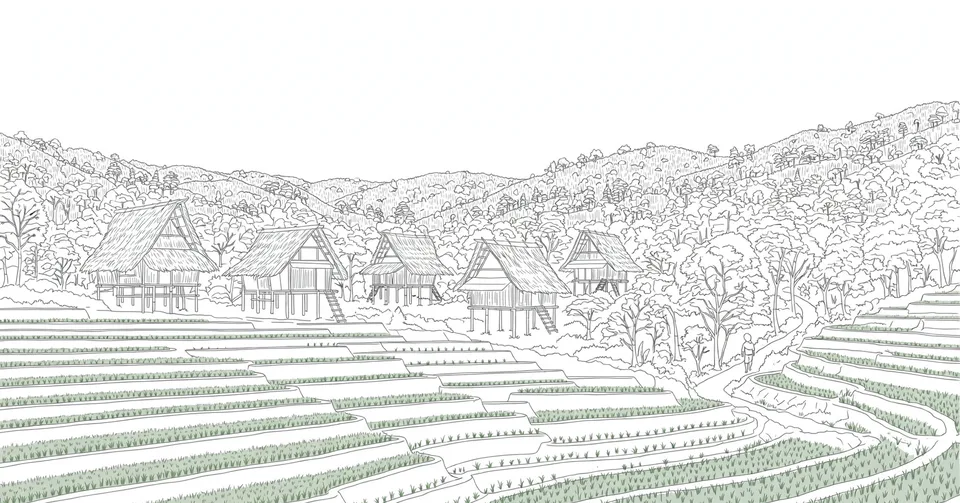
To understand the Baduy people, it helps to forget the usual story about remote tribes. They are not hidden. Their homeland sits in the foothills of the Kendeng mountains, on about 50 square kilometres of hilly forest, and visitors have walked in from the town of Rangkasbitung for generations. What makes them remarkable is not isolation. It is consistency. For centuries, through Dutch rule, independence, and the arrival of the internet in the villages around them, they have kept the same customs, the same farming, and the same refusal of the things most of us now treat as necessities. This article looks at who they are, how they live, and how to visit them without doing harm.
Who the Baduy People Are
The Baduy people, who call themselves Urang Kanekes, or the people of Kanekes, are an indigenous Sundanese group native to the southeastern part of Banten. Their homeland is a pocket of forest and farmland in Leuwidamar District, and their language, Baduy, is closely related to Sundanese. Counting them is harder than it sounds. Wikipedia cites a population of 11,620 from the 2015 census, while Statistics Indonesia recorded 11,699 people in 2017 and only 9,558 in 2023, so any single number should be read as an approximation. Roughly 12,000 is a fair way to describe the community today, with the honest note that the count moves with the source and the year. The Baduy people are not a large group, and that is part of the point. A small community can hold a custom together in a way a large one cannot, because everyone knows everyone, and everyone can see when a rule is kept or broken. Banten itself is a province with a long history on the world stage. It faces the Sunda Strait, where the Krakatoa eruption of 1883 sent its shockwave around the planet, and the Baduy homeland lies inland from that same coast, sheltered by the Kendeng hills.
The Baduy People of the Inner and Outer Villages
The community is divided into two groups, and the difference between them is the clearest way to understand how the Baduy people think about contact with the outside world. The Baduy Dalam, or Inner Baduy, live in three secluded villages deep in the forest, Cibeo, Cikeusik, and Cikertawarna. They keep the strictest form of the custom. They dress in black and white, the men wearing white headscarves, and they allow almost no trace of modern life into their villages. The Baduy Luar, or Outer Baduy, live in villages closer to the entrance at Ciboleger, in places such as Kaduketuk, Kadukolot, and Cikadu. They wear black clothing and dark headscarves, and they have more contact with visitors, traders, and the local government. The community counts more than 50 villages in total, most of them Outer Baduy. There is also a third group, the Dangka, who live outside the Kanekes area and follow the custom more loosely, but the story of the Baduy people is mostly the story of the Inner and the Outer, and of the line the Inner draw around themselves. The line is not a wall. Outer Baduy villagers walk between the two worlds every day, carrying rice, woven cloth, and news in both directions, and that traffic is part of how the custom survives. The Inner villages stay strict because the Outer villages absorb the contact.
Pikukuh and the Sunda Wiwitan Belief
For the Baduy people, custom is not decoration. At the centre of their life is pikukuh, a set of ancestral rules that governs almost everything, from how rice is planted to what may not be eaten, worn, or owned. The rules are not written down. They are remembered, repeated, and enforced by the Puun, the customary leaders, three of whom live in the three Inner villages. The belief behind the rules is Sunda Wiwitan, the old Sundanese faith, which honours ancestors and the spirits of nature, and which the Baduy have kept even as Islam, Christianity, and Hinduism spread around them. The most sacred place in this belief is Arca Domas, a site whose location is kept secret and which outsiders may not visit. One theory holds that the Baduy descend from the aristocracy of the Pajajaran kingdom, who took refuge in these hills centuries ago rather than convert to Islam. It is a theory, not a settled fact, and historians treat it with care. What is certain is that the Baduy people have kept their faith alive through oral tradition, through ritual, and through the daily discipline of the rules themselves. Stories, songs, and ceremonies carry the history, much as the shadow puppet theatre of wayang carries the epics of Java, and the telling matters as much as the tale.
Rice, the Leuit, and a Year of Farming
If there is one thing that explains the Baduy people, it is rice. Rice is their food, their calendar, and their wealth, and the farming year is divided into four phases, from clearing the fields to planting, tending, and harvesting. The Baduy people plant dry rice on hillsides in the way their ancestors did. They do not fertilise their crops and they do not irrigate them. They rely on rain alone. Part of every harvest goes into the leuit, the communal granary, where it is stored for weddings, ceremonies, and hard years. The leuit is more than a storehouse. It is a promise that no family in the village will go hungry while the granary holds grain, and it is also a limit. Because the harvest is finite and shared, nobody plants more than the land and the custom allow. Rice sits at the centre of the Indonesian table in every region, and the dish the world knows best, rendang, is itself built to be eaten with rice, but for the Baduy people the grain is not a side dish. It is the measure of the year, and the Seba festival at its end is a way of giving thanks for it. To farm this way is to accept a smaller harvest than a modern farm would produce, and to accept it gladly, because the point was never to produce as much as possible. The point was to produce enough, and to keep the forest standing so the rain keeps coming.
The Seba Festival
Once a year, the Baduy people walk out of the forest for the Seba festival, carrying baskets of rice and forest produce to the town of Rangkasbitung, and onward to Serang, the capital of Banten, where they present the harvest to the regent and the governor. The walk itself is part of the ceremony. Hundreds of villagers travel on foot, in their black and white dress, through villages that watch them pass. Seba is a reminder that the Baduy do not live apart from Indonesia. They live inside it, on their own terms, and the festival is the one moment in the year when the terms are displayed in public. The harvest is offered, the leaders are honoured, and the villagers return home the same way they came, on foot, to a village without electricity. For the Baduy people, Seba is both a duty and a celebration. For visitors, Seba is the easiest time to see Baduy culture in the open, but it is also the busiest, and the same rules of respect apply. Watch, do not crowd, and remember that a ceremony is not a performance put on for cameras.
Visiting the Baduy People Respectfully
The Baduy people do receive visitors, but on their terms, and the terms are strict. Foreigners are not permitted to enter the Inner Baduy villages, and even Indonesian visitors need a local guide and must follow the rules of the community. There are no vehicles inside the homeland, so every visit is a walk, sometimes for hours, over forest paths and across streams. Visitors are asked to dress modestly, to carry out everything they carry in, and to leave nothing behind. Photography is restricted in some areas, and in the Inner villages it is not welcome at all, so the respectful choice is to ask first and to accept no as an answer. Practical guidance from travel writers who know the area stresses the same points, walk in, walk out, take nothing, and leave the villages as you found them. The Baduy people ask little of visitors, and what they ask is mostly restraint. The Outer villages are the right place for a first visit. The people there are used to guests, the paths are shorter, and a day trip from Ciboleger can give a real sense of Baduy life without pressing on the boundaries of the Inner villages. Staying overnight is possible in some Outer villages, in simple homes, without electricity, and that night, without lights or screens, is often the part visitors remember longest.
What the Baduy People Can Teach the Rest of Us
It is easy to describe the Baduy people as people who refused the modern world, but that misses the more interesting truth. They did not refuse the world. They examined it, village by village and rule by rule, and they kept what served them and set aside what did not. Electricity, vehicles, and formal schooling were not unknown to them. They were offered, and the community decided together that the cost was higher than the benefit. I find that decision worth sitting with, because most of us never get to make it. We inherit our tools and our pace, and we call the result progress without asking who it serves. The Baduy people ask the question out loud, and they answer it with their lives, not with a manifesto. Their answer is not one the rest of us can copy. A city of millions cannot farm rain-fed rice and store it in a granary. But the question travels well. What would be enough, for you, for your family, for your street, and what would you give up to keep it? That is the part of the Baduy story that stays with a visitor after the walk home, longer than the photographs, and longer than the memory of a village without lights.
The Baduy people will still be there next year, farming the same hillsides, storing the same harvest, and walking the same paths to Seba. The forest around them will keep changing, the towns will keep growing closer, and the pressure to change will not go away. Whether the custom holds for another generation depends on the Baduy themselves, and on visitors who understand that the best way to help a community keep its way of life is to respect the lines it draws. Go if you go with that in mind, and go gently.
More in Culture & Society
- The Dalang, the Single Voice Behind Every Wayang Puppet
- Yadnya Kasada, the Festival That Feeds the Crater of Mount Bromo
- The 8050 Problem, When Retired Parents Still Carry Their Adult Children
- Anak Krakatau, the Child of Krakatoa That Keeps Growing
- Coelacanth and the Living Fossil of the Deep Sea
- Numazu Imperial Villa and Japan's Seaside Imperial Retreat
Latest posts
- Chankonabe, the Hot Pot That Feeds a Sumo Stable
- Koji Mold, the Quiet Engine Behind Japanese Food
- Moai, Okinawa's Lifelong Circles of Friends
- Otohime, the Small Sound That Protects Privacy in Japanese Toilets
- Yozakura, Japan's Cherry Blossoms After Dark
- Nomikai, the After-Work Drinks That Are Part of the Job in Japan
- Sakura Ebi and the Tiny Shrimp Only Suruga Bay Catches
- Senbon Matsubara and the Pine Grove of Numazu
- Shirasu and the Whitebait Bowls of Shizuoka
- Uchiura and the Quiet Fishing Village Behind Love Live Sunshine
- Love Live Sunshine and How Anime Changed Numazu
- Numazu Deep Sea Aquarium and the Creatures of Suruga Bay
- Numazu Himono and the Art of Dried Fish
- Numazu Port and the Freshest Seafood in Shizuoka
- Disaster Vending Machines in Japan That Give Their Drinks Away