The Salaryman and Japan's Loyal Office Culture
· 10 min read
A salaryman is more than an office worker in a suit. This is the story of where the figure came from, what a day in the life looks like, what the loyalty costs, and how the model is changing in 2026.
Every weekday morning, millions of men in dark suits pour out of Tokyo's stations and into office towers, briefcases in hand and ties knotted tight. They are the salaryman, the most familiar figure in modern Japan, and the word itself tells you most of what you need to know. A salaryman is a salaried white-collar employee of a company, usually a large one, expected to give the firm his loyalty, his time, and in the classic version of the story, his whole career.
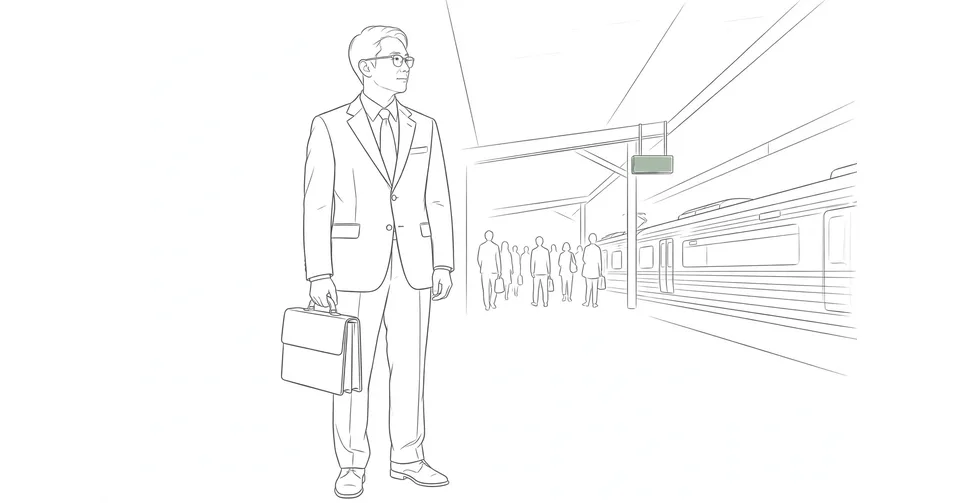
The figure is easy to caricature and harder to understand. To outsiders he looks like a man in a uniform, commuting in silence, working late, and drinking with his boss. To Japan he has been something larger, a symbol of the postwar economic miracle and of a bargain between worker and company that shaped a whole society. That bargain is now being renegotiated, and the salaryman is changing with it.
Where the Salaryman Came From
The salaryman was born with Japan's postwar recovery. In the 1950s and 1960s, as the economy grew at a pace the world had never seen, large companies needed a workforce they could train, keep, and rely on for decades. The answer was a system built on three promises, later called the three sacred treasures. The first was lifetime employment, known in Japanese as shushin koyo (終身雇用). A company hired graduates straight from university and kept them until retirement. The second was seniority pay, or nenko joretsu (年功序列), under which wages rose with years of service rather than with the job itself. The third was the enterprise union, which organised workers inside one company rather than across an industry.
For the worker, the deal was clear. Pay started low but rose every year, and the job was safe. Leaving was costly, because a worker who moved to another firm started again near the bottom of that firm's pay scale. For the company, the deal was just as clear. It got employees who identified with the firm, accepted transfers to distant cities without complaint, and stayed through bad years as well as good ones. Loyalty ran in both directions, and the salaryman became the human face of that exchange.
This system never covered everyone. Labour scholars estimate that formal lifetime employment applied to only about a third of the workforce, concentrated in large companies and government offices. But the image was so powerful that it came to stand for Japanese work itself. The salaryman in his dark suit was the country's postwar success story, worn on the morning train.
The word salaryman itself comes from English, salary plus man, reshaped in Japanese as sarariman (サラリーマン). It entered common use in the early twentieth century and became a household word during the postwar boom. Unlike a simple job title, it describes a way of life, and that is why it still matters as the jobs change.
A Day in the Life of a Salaryman
A salaryman's day starts early and ends late. He leaves a suburb before seven, joins the crush on the platform, and rides a packed train into the city centre, often standing the whole way. The commute itself is part of the job, and in Tokyo it can swallow two hours or more of the day. It is no accident that Japanese trains run with such precision, since the whole working day is built around them. The same crowds return on a grander scale during Golden Week, the busiest holiday week of the year.
At the office the day is long, and the end of it is the least fixed part. Official hours may end at six, but leaving on time can still feel like a small act of defiance. Overtime is often unpaid in practice, and the last person to leave is rarely the least committed. A young salaryman learns quickly that presence is part of performance, and that the hours themselves signal commitment to colleagues and managers.
The evening often belongs to the company too. After-work drinks, known as nomikai (飲み会), are a regular fixture, a dinner with colleagues at an izakaya where the talk is freer than in the office. A salaryman is expected to show up, at least sometimes, because relationships built over drinks smooth the working day, and the night can run long.
Somewhere in this routine, sleep gets squeezed, and the salaryman adapts. Commuters doze on the train in a practice called inemuri (居眠り), dozing while present, which is tolerated because it reads as proof of hard work rather than laziness. It is a telling detail. A system that leaves so little time for rest has invented a word for sleeping in public, and treats it as a badge of effort.
The Unwritten Rules
Much of what governs a salaryman's life is never written down. The suit is dark, the shirt white, the tie plain. Individuality is expressed quietly, if at all, because looking like everyone else is part of belonging. A new recruit learns the rules by watching, not from a manual, and the first of them is that the group comes before the individual.
Decisions are rarely made in the meeting where they are announced. They are made beforehand, through nemawashi (根回し), the slow work of sounding people out one by one until everyone is on board. The meeting itself is a formality, a place to confirm what has already been agreed. To a newcomer this can look slow, and it is. It is also how a salaryman avoids open conflict, because disagreement is handled in private first.
The path into this world begins before the first day of work. University students spend their final year in shukatsu (就活), a formal season of job hunting in which they visit company seminars in identical suits and follow a strict timetable set by the firms. Success means a job for life, or at least the promise of one, and failure can feel like a verdict on a whole future. For many young Japanese, the salaryman track is still the safe road, and the pressure to get on it starts early.
What the Loyalty Costs
The bargain had a price, and Japan has a word for the worst of it. Karoshi (過労死) means death from overwork, and it entered the language as doctors in the late 1960s and 1970s began to see healthy men dying of strokes and heart attacks after months of extreme overtime. The first case was reported in 1969, when a 29-year-old shipping company employee died of a stroke. Official figures still record around 200 deaths from overwork a year, and researchers have long argued that the true number is higher. The salaryman ideal made overwork normal, and karoshi was its darkest consequence.
A 2016 government survey found that 23 percent of Japanese companies had employees working more than 80 hours of overtime in a month, a level at which the risk of death from overwork becomes serious. The law has since set limits on overtime, and companies must now report when workers pass them, but the culture changes more slowly than the rules, and the pressure to stay late and put the company first does not disappear because a regulation says it should.
The cost is not only measured in health. A salaryman who leaves before dawn and returns after his children are asleep can spend a whole working week as a stranger in his own home. Wives have traditionally managed the household alone, and the arrangement held while the bargain delivered security and a rising wage. As wages stalled after the bubble burst, the trade began to look worse, and more families began to ask what the loyalty was actually buying, especially in a city where living in Tokyo costs more than newcomers expect.
There is something genuinely admirable in a worker who keeps his word to a company for forty years, and something genuinely troubling in a system that treats exhaustion as proof of character. Loyalty is a virtue when it is freely given and fairly returned. It becomes a trap when demanded without limit, and the honest measure of any workplace is not how much its people endure but how much they are allowed to live outside it. The salaryman deserves respect for what he built, and a working life that does not ask him to pay for it with his health.
How the Salaryman Is Changing
The classic salaryman is not gone, but his world has narrowed. Since the mid-1990s, the share of non-regular workers, people on fixed-term, part-time, or dispatch contracts without the old guarantees, has grown steadily. Many do the same work as regular employees for less pay and no promise of a career. For a young graduate today, the lifetime job is one option among several, not the default it once was.
The 2026 spring wage talks, known as shunto, produced an average pay rise of 5.26 percent, the third year in a row above 5 percent, as companies competed for workers in a tight labour market. That is good news for people in work, and it shows that the old system can still deliver. But the gains have not been shared evenly, and workers outside the regular track have seen far less of them. The salaryman who stayed is better paid than he was, while the worker who never got in is still waiting.
Younger workers, including the salaryman of 2026, are asking different questions. Many want to leave on time, to work from home, and to change jobs without being judged for it. Job-hopping, once a mark of disloyalty, is becoming normal among people in their twenties and thirties, and companies have begun to hire mid-career workers they would once have ignored. The suit is still on the morning train, but the person wearing it is less willing to give the company everything.
None of this means the figure is finished. Lifetime employment still survives in large firms, and many workers still want it. What is changing is that it is now a choice rather than a fate, made with open eyes. A salaryman today knows what the bargain costs, because the country has spent decades counting it.
What Remains
The salaryman will probably outlast the system that created him, because the qualities behind him, steadiness, duty, and care for the group, are not going away. The question for Japan is whether those qualities can be kept without the exhaustion that came with them. A culture that rewards presence over results will always produce tired people, while one that rewards results and respects rest will keep the best of the old bargain and leave the worst behind.
For anyone visiting Japan, the morning train is still the best place to see this story in motion. Watch the rows of dark suits, the briefcases, the quiet dozing between stations, and remember that each one is a person weighing the same bargain. The salaryman is not a museum piece. He is a worker in a long negotiation between loyalty and life, and the outcome is still being written.
More in Money & Work
- Nomikai, the After-Work Drinks That Are Part of the Job in Japan
- The E33G Remote Worker Visa and How to Legally Work from Bali
- Key Money in Japan and Why Renting Costs Four Months Up Front
- Akiya, Japan's Free Houses That Are Not Really Free
- Why Bali Became the World's Remote Work Capital
- Karoshi, the Japanese Word for Death by Overwork
Latest posts
- The Dalang, the Single Voice Behind Every Wayang Puppet
- Yadnya Kasada, the Festival That Feeds the Crater of Mount Bromo
- Chankonabe, the Hot Pot That Feeds a Sumo Stable
- The 8050 Problem, When Retired Parents Still Carry Their Adult Children
- Koji Mold, the Quiet Engine Behind Japanese Food
- Moai, Okinawa's Lifelong Circles of Friends
- Anak Krakatau, the Child of Krakatoa That Keeps Growing
- Otohime, the Small Sound That Protects Privacy in Japanese Toilets
- Yozakura, Japan's Cherry Blossoms After Dark
- Coelacanth and the Living Fossil of the Deep Sea
- Sakura Ebi and the Tiny Shrimp Only Suruga Bay Catches
- Senbon Matsubara and the Pine Grove of Numazu
- Shirasu and the Whitebait Bowls of Shizuoka
- Uchiura and the Quiet Fishing Village Behind Love Live Sunshine
- Love Live Sunshine and How Anime Changed Numazu