Wabi-Sabi and the Japanese Beauty of Imperfect Things
· 9 min read
Wabi-sabi is the Japanese way of finding beauty in things that are imperfect, worn, and unfinished. Here is where the two words came from, how the tea masters turned them into an aesthetic, and why the idea still shapes design today.
Wabi-sabi is the Japanese way of seeing beauty in things that are imperfect, impermanent, and unfinished. A rough handmade bowl. A wooden step worn smooth by feet. A wall darkened by a century of weather. None of these things is flawless, and that is exactly why they can be beautiful.
The term joins two older words. Wabi suggests quiet, austere simplicity. Sabi suggests the patina that age leaves behind. Fused together, wabi-sabi names a whole way of looking at the world, one shaped by Zen Buddhism and refined in the tea ceremony.
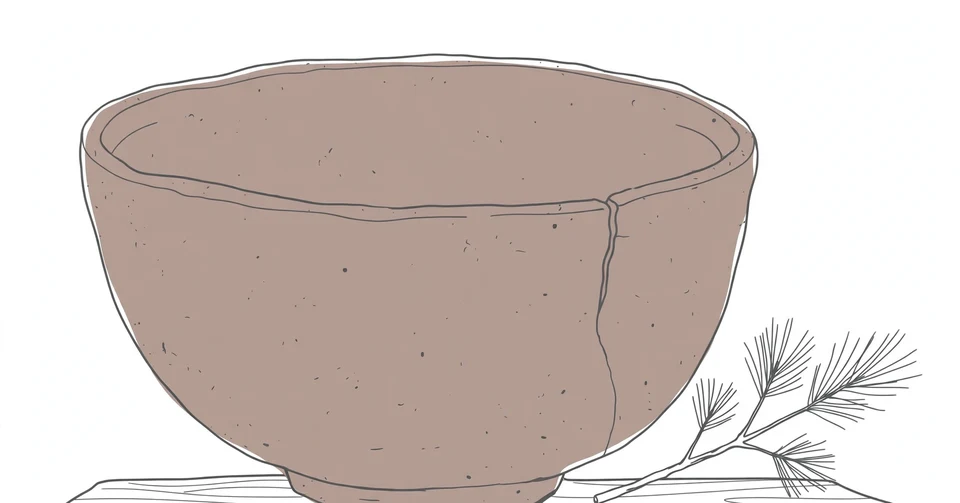
It is an idea that is easier to feel than to define. But wabi-sabi has a real history, and knowing it explains something you notice all over Japan: why an old, cracked, or uneven thing is so often treated with more respect than a new and perfect one.
Two words with separate pasts
Wabi and sabi did not start life as partners. Each had its own meaning, and each meaning softened over the centuries before the two were joined.
In the eighth century anthology of poems called the Manyoshu, wabi described the suffering and loneliness of unfulfilled love. It had nothing to do with beauty at all. The tea historian Kumakura Isao describes what it later became: a state of mind that seeks spiritual satisfaction in simplicity and poverty. By the Heian period, which ran from 794 to 1185, the word had begun to carry an appreciation of stillness and solitude. In the Middle Ages it came to describe a hermitlike withdrawal from the world, an embrace of simplicity, and a taste for glimpses of the moon behind clouds rather than the bright full moon.
Sabi travelled a similar road. In the Manyoshu it carried a sense of desolateness. Later it came to mean something that has aged well, grown rusty, or gathered a patina that makes it beautiful. The Stanford Encyclopedia of Philosophy gives the two words their standard short glosses: wabi as subdued, austere beauty, and sabi as rustic patina. Sabi is the beauty of encroaching time, of wintry landscapes and old surfaces, and it stands at the opposite end from anything gaudy or showy.
The hyphen itself is younger than most people assume. As a history of the terms published by Nippon.com explains, wabi and sabi were used near each other for centuries, mostly around the tea ceremony, but they were not commonly treated as a single set until the second half of the twentieth century. Wabi-sabi, as one tidy package, is partly a modern invention.
The Zen underneath
Underneath both words sits a Buddhist idea: impermanence. In the Japanese Buddhist tradition, the basic condition of existence is change. Nothing stays, and a beauty that pretends otherwise is built on a refusal to accept how things are. The thirteenth century Zen master Dogen expressed this more forcefully than anyone, and Zen temples became the places where the taste for plainness and quiet was trained.
Yoshida Kenko, writing in his Essays in Idleness in 1332, asked whether we are to look at cherry blossoms only in full bloom, and at the moon only when it is cloudless. Branches about to blossom, he said, and gardens strewn with faded flowers are worthier of admiration. That preference, for the moment just before perfection and the moment just after it, is the seed of wabi-sabi.
How wabi-sabi took shape in the tea room
The taste became a practice in the tea ceremony. In the fifteenth century, the tea master Murata Juko, whose name is also read as Shuko, founded one of the first schools of tea. He began mixing plain Japanese pottery with the treasured Chinese pieces that wealthy hosts had competed to show off. The point was spiritual rather than decorative: tea as a discipline of attention, not a display of wealth.
A century later, Sen no Rikyu, who lived from 1522 to 1591, took the idea to its limit. Rikyu served the two most powerful men in Japan, Oda Nobunaga and Toyotomi Hideyoshi, and he used that position to strip tea down to almost nothing. The tea room Tai-an at Myoki-an temple, traditionally attributed to him, is just two tatami mats in size, and guests entered through a low doorway. The bowls he favoured were rough Korean and Japanese pieces, and he enlisted the potter Chojiro to make tea ware that embodied the same roughness. In the Edo period, this ritual of restraint came to be called wabi-cha, the tea of wabi.
The records of Rikyu's sayings, the Namporoku, put the attitude plainly. In the small tea room, it is desirable for every utensil to be less than adequate, and people who dislike a piece because it is slightly damaged show a complete lack of comprehension. Implements with small imperfections were valued more highly than flawless ones, and a broken utensil that had been well repaired was valued most of all. Importantly, this was not asceticism. The same record insists on moderation: a meal of one soup and two or three dishes, not a performance of poverty.
The ceremony that grew around this taste is a large subject of its own. I have written separately about the Japanese tea ceremony and the art of slowing down, and much of its quiet discipline comes from this one aesthetic decision: that less, older, and rougher could be better.
What wabi-sabi looks like
Definitions only go so far. Wabi-sabi is easier to recognise in objects than in words.
- A handmade tea bowl that is slightly lopsided, with a rough foot and a glaze that pools unevenly. In the tea room, that unevenness is not a defect. It is what the hand rests on and the eye returns to.
- An old wooden beam or a weathered wall. The novelist Tanizaki Jun'ichiro wrote that the Japanese love things that bear the marks of grime, soot, and weather, and the muted sheen that calls to mind the past that made them.
- The Silver Pavilion at Ginkakuji in Kyoto, which was meant to be covered in silver foil and never was. Without its coating, the plain wooden pavilion became what scholars call the epitome of sabi.
- The moss garden at Saiho-ji, Kyoto's famed moss temple, where a green carpet covers the ground beneath the trees. As Zen culture spread, moss came to express the values of wabi and sabi, and gardeners have tended that soft, slowly aging surface ever since.
None of these things was made ugly on purpose. Each is simply a thing that was allowed to be what it is, and to show the time it has lived through. To my eye, that is the most useful part of wabi-sabi for daily life. It is a permission to stop sanding away every trace of use.
Wabi-sabi is not kintsugi
Because the two ideas travel together, they are often confused. Kintsugi, the Japanese art of repairing broken things, is a craft: a set of techniques for mending pottery with lacquer and powdered gold. Wabi-sabi is not a technique at all. It is the worldview that explains why the gold seams look right.
Think of it this way. Wabi-sabi is the philosophy, and kintsugi is one of its most visible expressions. A bowl can show wabi-sabi without ever being broken, simply by being rough, quiet, and old. And a repair can be done carelessly, in a hurry, without any of the patience the philosophy asks for. The craft needs the worldview more than the worldview needs the craft.
What the West often gets wrong
Outside Japan, wabi-sabi is often sold as a look: distressed furniture, crumpled linen, beige rooms. The word reached Western artists and designers largely through Leonard Koren's short 1994 book, Wabi-Sabi for Artists, Designers, Poets and Philosophers, and it has been a design label ever since. There is nothing wrong with liking rough textures. But a style you can buy sits uneasily with an idea that began as freedom from material attachment.
Another common mistake is to treat wabi-sabi as an excuse for neglect. A dirty room is not wabi-sabi. A Rikyu tea room was plain, but it was kept with intense discipline, and the damaged bowls it prized were damaged bowls that had been carefully repaired, not abandoned. The aesthetic asks for more care, not less. It is closer to tending than to letting go.
There is also the assumption that wabi-sabi is a single ancient doctrine, handed down unchanged. The history above shows the opposite. The words shifted their meaning over a thousand years, and the habit of treating them as one fixed set belongs mostly to the last century.
Wabi-sabi in modern design
Used well, the idea still does real work in modern design. Potters leave throwing lines and fingerprints in the clay instead of polishing them away. Furniture makers choose wood, stone, clay, and other natural materials partly because those materials record age honestly. A table that shows its years is not failing. It is doing what sabi describes.
At home, the same thinking argues for keeping things longer. Repair the chair. Use the chipped cup you actually like. Let the garden keep its mossy corner. I find this the most practical gift of wabi-sabi: it lowers the pressure to replace things that are merely imperfect, which is good for a house and, not incidentally, for the planet.
Wabi-sabi will probably never be defined to everyone's satisfaction, and that may suit it. It began as words for loneliness and desolation, and it ended as a way of finding richness in plain, aging, unfinished things. The bowl does not need to be perfect to be worth your attention. It only needs to be honestly what it is, and to be looked at properly.
More in Culture & Society
- The Dalang, the Single Voice Behind Every Wayang Puppet
- Yadnya Kasada, the Festival That Feeds the Crater of Mount Bromo
- The 8050 Problem, When Retired Parents Still Carry Their Adult Children
- Anak Krakatau, the Child of Krakatoa That Keeps Growing
- Coelacanth and the Living Fossil of the Deep Sea
- Numazu Imperial Villa and Japan's Seaside Imperial Retreat
Latest posts
- Chankonabe, the Hot Pot That Feeds a Sumo Stable
- Koji Mold, the Quiet Engine Behind Japanese Food
- Moai, Okinawa's Lifelong Circles of Friends
- Otohime, the Small Sound That Protects Privacy in Japanese Toilets
- Yozakura, Japan's Cherry Blossoms After Dark
- Nomikai, the After-Work Drinks That Are Part of the Job in Japan
- Sakura Ebi and the Tiny Shrimp Only Suruga Bay Catches
- Senbon Matsubara and the Pine Grove of Numazu
- Shirasu and the Whitebait Bowls of Shizuoka
- Uchiura and the Quiet Fishing Village Behind Love Live Sunshine
- Love Live Sunshine and How Anime Changed Numazu
- Numazu Deep Sea Aquarium and the Creatures of Suruga Bay
- Numazu Himono and the Art of Dried Fish
- Numazu Port and the Freshest Seafood in Shizuoka
- Disaster Vending Machines in Japan That Give Their Drinks Away