Disaster Vending Machines in Japan That Give Their Drinks Away
· 10 min read
In Japan, disaster vending machines are ordinary drinks machines with a second job. When a strong earthquake strikes, they unlock and give their drinks away for free, under agreements between drinks companies and local governments.
In Japan, some vending machines are built to stop selling. When a strong earthquake strikes, disaster vending machines unlock the drinks inside them and give those drinks away for free, turning an ordinary street corner into a small emergency supply point.
They are not a separate species of machine. Most disaster vending machines look like any other drinks machine, glow like any other, and take your coins like any other. The difference is hidden in the agreements, the wiring, and a release mechanism that waits quietly for the worst day of the year.
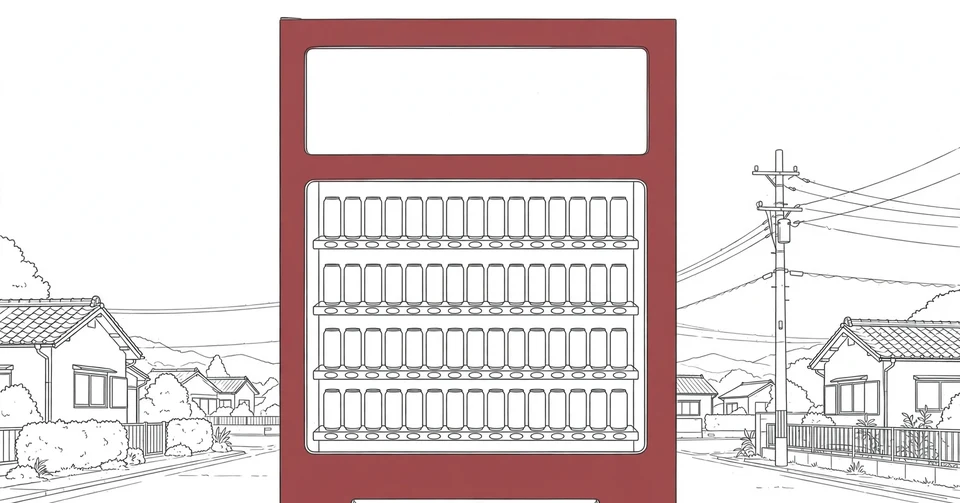
Japan did not build this system for novelty. It built disaster vending machines because earthquakes are not rare events here, and because the first hours after one are exactly when the shops are closed, the roads are jammed, and a simple bottle of water becomes the most valuable object on the street.
How disaster vending machines work
On a normal day, disaster vending machines sell canned coffee, tea, and water to anyone who walks up. You pay with coins, with an IC card, or with one of the QR code payments that now sit on machines all over the country. Nothing about the transaction hints at the machine's second job.
The change comes when disaster strikes. As I described in my earlier piece on why Japan has a vending machine on every corner, these machines switch into disaster mode when an earthquake of magnitude 5 or higher strikes. Once that switch is thrown, the drinks inside are free. No coins, no card, no phone. You press a button and the machine hands over a drink, because in that moment the machine is no longer a shop. It is a stockpile that happens to have a shop built around it. That single change is the whole idea of disaster vending machines: the stock stays sold on every ordinary day, and becomes public property exactly when the public needs it most.
Not every machine on the street can do this. Disaster vending machines are specific units, installed in agreed places and connected, in one way or another, to the people responsible for responding when something goes wrong. The rest of the country's millions of machines keep selling as usual, which is part of what makes the disaster-ready ones easy to overlook.
Three ways a locked machine opens
The interesting problem is distance. When an earthquake hits, the person who owns the machine is usually somewhere else, and the people who need the drinks are standing in front of it. Disaster vending machines solve that problem in three ways.
The first route is remote. Some machines receive an emergency release command over the network, sent by the local government or by the company that operates the machine. Coca-Cola Bottlers Japan describes the machines it installs under its disaster agreements in exactly these terms: they can be configured remotely and made to dispense the products stocked inside free of charge. Nobody has to reach the machine. A decision made in a city office travels down a wire and opens a box across town.
The second route is human, and deliberately low tech. Some disaster vending machines are unlocked with a special key by a designated local administrator, a named person at the school, office, or facility where the machine stands. This route matters because networks fail. A key in the hand of a neighbour who is already on the scene works even when every screen in the prefecture is dark.
The third route is built into the newest models, which can detect the shaking themselves and switch to free mode on their own. Earthquakes often cut the power, so these disaster vending machines run on their own battery or on a hand-cranked generator to keep dispensing while the grid is down. A hand crank on a drinks machine sounds almost comic on a quiet day. At midnight, in a blackout, with the street full of people who cannot go home, it is the least comic object in Japan.
The agreements behind the machines
Disaster vending machines do not appear by accident. They stand where they stand because a drinks company and a local government signed a piece of paper first. These disaster support agreements settle, in calm times, the questions that would waste precious minutes in a crisis: which machines give their drinks away, who is allowed to release them, and who pays for the stock. The answer to the last question is the company, and the stock given away is a donation.
DyDo DRINCO states this plainly: it has signed a disaster aid agreement with many local governments to donate, for free, the beverages held in its distribution bases and in its disaster aid vending machines in the event of a large-scale disaster. DyDo also gives the reason cities are happy to sign. The arrangement reduces the cost to local governments of stockpiling drinking water for emergencies, because part of the stockpile is sitting in machines that are restocked as a matter of daily business.
The Hakone agreement shows what this looks like in one town. Coca-Cola Bottlers Japan signed an agreement on disaster resilience improvement with Hakone, a hot spring town in Kanagawa Prefecture, inside Fuji-Hakone-Izu National Park, that fills with tourists all year. Under the agreement, the company installs its disaster-proof vending machines in places where many tourists visit and at evacuation sites, the two places where crowds and need are most likely to meet. It is a small agreement with a long memory, and it is how disaster vending machines quietly multiply across the map, one town at a time.
For the drinks companies, this is not charity bolted onto an unrelated business. DyDo says roughly 90 percent of its sales come through vending machines, which it treats as its retail outlets. A company whose shops stand on every street in the country is, whether it planned it or not, already holding one of the largest emergency drink networks in Japan. The agreements simply make that fact official.
The lesson of the 2011 Tohoku earthquake
The modern system has a date: 11 March 2011. That day, a magnitude 9 earthquake off the Tohoku coast triggered a tsunami that killed nearly 20,000 people. Whole towns lost their shops, their water, and their power in an afternoon.
In the days that followed, the drinks industry moved water at a scale that showed what a national distribution network can do. Coca-Cola distributed more than seven million bottles of drinks after the quake, including free dispensing from selected vending machines. The lesson was absorbed across the industry: the machines were already standing in the right places, stocked and cold, in towns where every shop had been swept away or shuttered.
DyDo DRINCO began building disaster-relief machines in earnest after that disaster, placing them in school grounds, coastal towns, and office districts. The placement is the point. Schools are where neighbourhoods gather and where evacuation shelters open. Coastal towns live closest to the tsunami risk. Office districts hold thousands of commuters who may have no way home. After 2011, disaster vending machines stopped being an experiment and became a habit, repeated town by town in agreements like the ones described above.
Later disasters kept the habit alive. Each large earthquake since has renewed the same argument in city offices: the drinks are already out there, distributed and refrigerated, and disaster vending machines are already standing where people will need them, so the paperwork may as well be ready before the ground moves, not after.
More than drinks
Some disaster vending machines carry a second cargo besides liquid: information. In the first hours after a major earthquake, information can be nearly as scarce as water. Rumours travel fast, phones die, and official guidance often struggles to reach the people standing in the street.
The machines Coca-Cola Bottlers Japan installs in Hakone have a built-in message board that can display disaster prevention information provided by the municipality. The same box that hands out free drinks can also tell the crowd in front of it what the town government wants it to know, in the town's own words, without depending on anyone's phone battery.
Other machines go further. Some broadcast free Wi-Fi under the name 00000JAPAN, the emergency network name used in Japan so that anyone can get online after a disaster regardless of their phone contract. Some display the locations of evacuation shelters on an electronic sign, answering the first question every stranded person asks: where do I go from here? Of all the features attached to disaster vending machines, I find the signboard the most quietly moving. A machine that sells coffee has been taught to point people toward shelter.
Why the density of machines is the real technology
None of this would work in a country where vending machines are rare. Japan has about 2.6 million vending machines, roughly one for every 48 people, and more than two million of them sell drinks. Disaster vending machines draw their strength from that ordinariness. A dedicated emergency warehouse has one address, one door, and one road leading to it. A network of machines has thousands of addresses, spread across school gates, station fronts, office blocks, and country roads where no warehouse would ever be built. When one street is cut off, the next street still has a machine standing on it. In a crisis, people do not go searching for disaster vending machines. They go to the corner they already know, and the machine is simply there.
There is a limit, and it is worth stating plainly. A vending machine holds a few hundred drinks, not a town's supply. Disaster vending machines are a bridge across the first hours of a crisis, not a replacement for the water trucks, shelters, and official stockpiles that must follow. Their stock also has to be rotated before it expires and their agreements kept current, quiet maintenance that nobody photographs and nobody praises.
Living in Shizuoka, a prefecture that has spent decades preparing for a great earthquake of its own, I pass these machines without noticing them, which is exactly their condition on a good day. That, to me, is the most Japanese thing about them. The preparation is not announced. It is installed, stocked, plugged in, and left glowing on the corner, doing its small everyday job while it waits for the one day it will be asked to do the important one. Disaster vending machines will not save a city. But when the ground stops shaking and the shops are dark, they are already there, and the first drink is free.
More in Tech & Internet
Latest posts
- The Dalang, the Single Voice Behind Every Wayang Puppet
- Yadnya Kasada, the Festival That Feeds the Crater of Mount Bromo
- Chankonabe, the Hot Pot That Feeds a Sumo Stable
- The 8050 Problem, When Retired Parents Still Carry Their Adult Children
- Koji Mold, the Quiet Engine Behind Japanese Food
- Moai, Okinawa's Lifelong Circles of Friends
- Anak Krakatau, the Child of Krakatoa That Keeps Growing
- Yozakura, Japan's Cherry Blossoms After Dark
- Nomikai, the After-Work Drinks That Are Part of the Job in Japan
- Coelacanth and the Living Fossil of the Deep Sea
- Sakura Ebi and the Tiny Shrimp Only Suruga Bay Catches
- Senbon Matsubara and the Pine Grove of Numazu
- Shirasu and the Whitebait Bowls of Shizuoka
- Uchiura and the Quiet Fishing Village Behind Love Live Sunshine
- Love Live Sunshine and How Anime Changed Numazu