Women Only Train Cars in Japan and the Problem They Answer
· 9 min read
Women only train cars run on crowded commuter lines across Japan as a direct answer to chikan, the groping problem on packed trains. Here is how they began, how they work, and why the debate around them has not ended.
On a weekday morning in Tokyo or Osaka, one car on many commuter trains is different from the rest. It carries women only, by design, and it is one of the most literal answers any railway has ever given to a crime. Women only train cars are a normal part of rush hour in Japan's big cities now, and they exist for a plain reason. In a carriage packed too tight to turn around, a crime that takes three seconds became almost impossible to stop.
That crime is chikan, the Japanese word for groping. On trains carrying far more people than they were built for, a hand in the crowd is anonymous. The victim often cannot see who did it, and by the next station the man is gone. Women only train cars are the railway answer to that anonymity. They do not try to catch the groper. They remove the crowd he hides in.
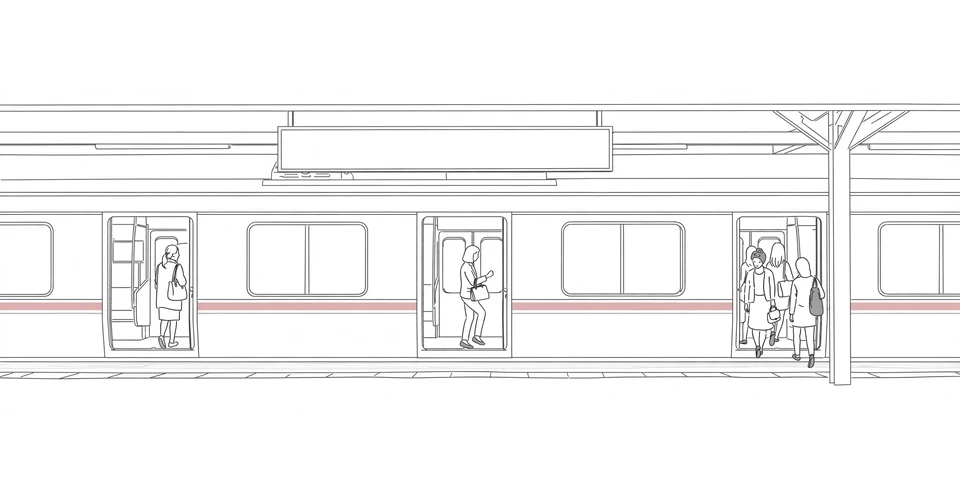
The cars are not backed by a law, and nobody is arrested for boarding one. They run on platform signs, floor markings, and social pressure, and women only train cars in their modern form have been part of Japanese commuting for more than two decades. This is the problem they answer, how they started, and why Japan still argues about them.
The problem behind women only train cars
Start with the crowding, because the crowding is the condition everything else grows in. The punctuality machine described in why Japanese trains are almost never late moves enormous numbers of people through the same few corridors at the same few hours. Osaka's Midosuji Line has carried passengers at as much as 160 percent of its intended capacity, and it had a reputation for the worst groping problem in all of Japan.
The recorded numbers are bad enough on their own. According to figures from the National Police Agency and the Ministry of Justice, reported indecent assaults in subway carriages across Japan ranged from 283 to 497 cases a year between 2005 and 2014. Tokyo police reported in 2004 that reported groping cases on public transport had tripled in eight years. And those are only the cases victims reported. A government survey in 2000, cited by researchers Horii and Burgess, found that 48.7 percent of women over 20 said they had been groped at least once. Plenty of women simply endured it in silence, moved to another car, or changed their commute.
Railways and police tried the usual tools first. There were poster campaigns telling men that groping is a crime and telling women to speak up. Sentences grew tougher. The problem stayed, because a poster cannot watch a crowd of two hundred people crushed shoulder to shoulder, and a victim pressed between strangers often cannot name, or even see, the man responsible. The women only train cars were built for exactly that gap between a crime everyone knew about and a culprit nobody could point to.
An old idea that returned in 2000
Separating passengers by sex on Japanese trains is older than the problem's modern name. The earliest women-only passenger cars ran in 1912 on what is now the Chuo Main Line, during rush hours, to separate male and female students. Nicknamed the Flower Trains, they lasted until the Second World War. Cars for women and children returned in 1947 on the Chuo and Keihin Tohoku lines, when crowding was so severe that women and children often could not physically board. The Chuo Line cars stayed on morning inbound trains until 1973.
The modern revival began in December 2000, when Keio Electric Railway ran women only train cars late at night on a trial basis. The trigger was complaints about groping by drunken men during the bonenkai, the end of year party season. The trial became permanent in March 2001. That July, JR East started women only train cars on the Saikyo Line, a route notorious for gropers because of its crowding and the longer distances between its stops.
Osaka moved faster than Tokyo. In July 2002 JR West became the third company to run women only train cars, and the first to offer them in the morning rush hour. Hankyu added them the same year and became the first operator to run them all day. Tokyo area companies held back, worried about logistics and about squeezing even more men into the remaining cars, but in 2005 they gave in and added women only train cars to rush hour services, after campaigns and tougher sentencing had failed to move the numbers.
How the cars work in practice
In daily use, women only train cars are simple, and the simplicity is the point. The typical pattern on most lines looks like this:
- One designated car on the train, often at the front or the rear
- Pink or clearly worded signs on the platform floor and on the train doors, showing where the car stops and when the rule applies
- Operation on weekdays only, with holidays excluded
- Hours set by each operator, usually the morning rush, sometimes the evening too
- All day operation on some lines in the Osaka region
The markings matter more than they might seem. At a station like Shibuya, where the crowd coming down from Shibuya Crossing pours straight onto the platforms, a woman does not have to search for the right car or ask anyone. She stands on the floor marking, the doors open in front of her, and she boards. Some operators limit women only train cars to rapid service trains, which are more crowded and stop less often, so a groper has longer to work and the victim longer to wait for a chance to escape or object.
Who else may ride
Strictly speaking, the women only train cars are not quite women only. Most operators allow two groups of male passengers aboard. The first is boys of elementary school age or younger, who ride with their mothers. The second is passengers with disabilities, together with the people assisting them. JR West states this plainly on its train and station manners page, where it explains that cars carrying the Women Only sticker are for female passengers, and that male passengers who are no older than elementary school age, or who require assistance such as nursing care, may ride in them too.
There is also no real punishment behind the signs. A law from 1900 set a fine of 10 yen for a man entering a female only car, but the Japanese government has said that the old law does not apply to the cars in use today. In practice, compliance is voluntary and kept by convention. A man who boards by mistake is asked to move to another car, usually by a conductor or by the looks of the other passengers. It works because almost everyone treats the sticker as a rule even though, on paper, it is closer to a request.
The debate around the cars
Reactions split in an interesting way. Many women describe the cars simply as relief, a carriage where they can stop being alert for the length of a commute. Some men welcome them for an unexpected reason. They say a women only car also protects them, because nobody in it can be falsely accused of groping, a fear that Japanese media discussed heavily through the 1990s and 2000s.
The critics have their own list. Squeezing the same crowd into fewer mixed cars makes those cars worse, and some passengers worry that a woman riding a mixed car is now at greater risk, as if she had declined the protection she was offered. Others argue that women only train cars treat the symptom and excuse the cause, walling women away instead of stopping the men. There have also been small embarrassments built into the system. Visually impaired men have boarded the cars without realising, and been warned out of them by fellow passengers.
Living in Japan, I find women only train cars easy to defend and slightly sad at the same time. They work, in the narrow sense that a woman inside one will not be groped by a stranger on that ride. The sadness is that the most effective answer a rich country found to a daily crime was not to end it, but to timetable around it.
Other countries, similar answers
Japan is the country most associated with women only train cars, but it is far from the only one that has tried them. In Mumbai, suburban trains have compartments reserved for women around the clock, plus Ladies Special trains at peak hours reserved for women entirely. Jakarta's commuter line added women only train cars in August 2010, marked with large pink stickers and placed at each end of the train, after repeated reports of harassment. Indonesia even tried a fully women only train from 2012, though that service ended in 2013 after mixed cars grew more crowded while the reserved ones ran underused. Cairo's metro reserves its middle cars for women, and Mexico City and Rio de Janeiro run their own versions at rush hour. The details differ, and so does the enforcement, but the reasoning is the same everywhere. Where crowds are thickest and anonymity is easiest, separation is the quickest protection a railway can offer.
More than two decades after Keio's late night trial, women only train cars have not ended chikan, and nobody serious claims they have. What they offer is smaller and more honest than that. For a few hours a day, on the busiest lines, they offer one car where a woman does not have to think about the hand behind her. As long as the crowds stay as they are, the cars are likely to stay too.
More in Culture & Society
- The Dalang, the Single Voice Behind Every Wayang Puppet
- Yadnya Kasada, the Festival That Feeds the Crater of Mount Bromo
- The 8050 Problem, When Retired Parents Still Carry Their Adult Children
- Anak Krakatau, the Child of Krakatoa That Keeps Growing
- Coelacanth and the Living Fossil of the Deep Sea
- Numazu Imperial Villa and Japan's Seaside Imperial Retreat
Latest posts
- Chankonabe, the Hot Pot That Feeds a Sumo Stable
- Koji Mold, the Quiet Engine Behind Japanese Food
- Moai, Okinawa's Lifelong Circles of Friends
- Otohime, the Small Sound That Protects Privacy in Japanese Toilets
- Yozakura, Japan's Cherry Blossoms After Dark
- Nomikai, the After-Work Drinks That Are Part of the Job in Japan
- Sakura Ebi and the Tiny Shrimp Only Suruga Bay Catches
- Senbon Matsubara and the Pine Grove of Numazu
- Shirasu and the Whitebait Bowls of Shizuoka
- Uchiura and the Quiet Fishing Village Behind Love Live Sunshine
- Love Live Sunshine and How Anime Changed Numazu
- Numazu Deep Sea Aquarium and the Creatures of Suruga Bay
- Numazu Himono and the Art of Dried Fish
- Numazu Port and the Freshest Seafood in Shizuoka
- Disaster Vending Machines in Japan That Give Their Drinks Away