Bullet Climbing Mount Fuji, the Overnight Ascent Japan Is Trying to Stop
· 9 min read
Bullet climbing Mount Fuji is the all night ascent done without sleep, and Japan now blocks it with a gate that closes from 2 in the afternoon to 3 in the morning. Here is why people did it, what it does to the body, and the hut based plan that replaced it.
Bullet climbing Mount Fuji means starting at the 5th Station in the evening, walking through the night without sleep, and standing on the summit at sunrise. It has a name in Japanese, dangan tozan, and for years it was the standard shortcut. Japan is now trying to stop it, and since 2025 the rules make bullet climbing Mount Fuji close to impossible on all four trails.
The short version is a gate. The gate at the 5th Station now closes from 2 in the afternoon to 3 in the morning on every trail, and only climbers with a mountain hut booking may pass. Add a fee of 4,000 yen per person and, on the Yoshida Trail, a daily cap of about 4,000 climbers. Bullet climbing Mount Fuji always depended on that gate standing open at night, and the gate is what changed.
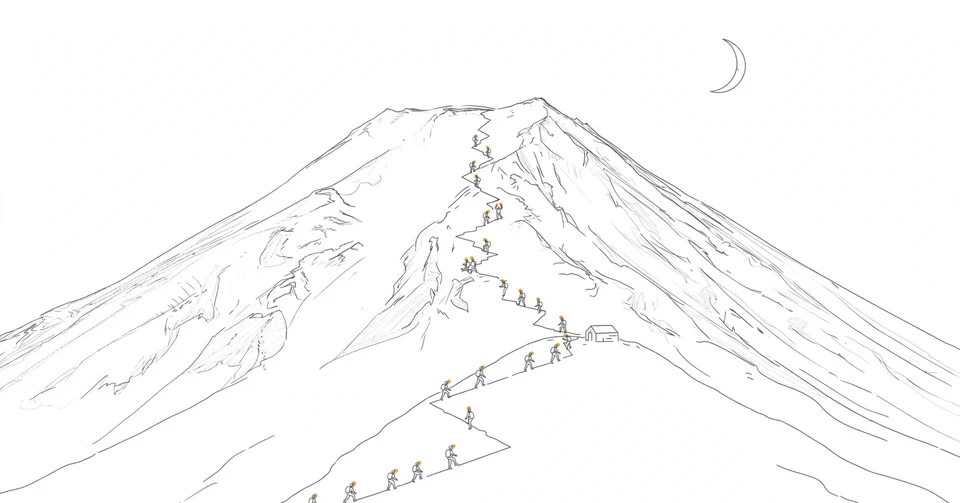
What surprises many visitors is that the target was never the night climb itself, which still exists, a line of headlamps winding up the dark cone. The target is the sleepless part. Bullet climbing Mount Fuji treats a 3,776 metre volcano as something you can power through on willpower alone, and that assumption is what the prefectures decided to remove.
What bullet climbing Mount Fuji actually means
The name dangan tozan translates as bullet climbing, after the bullet train, and the idea is speed and compression. A climber arrives at the 5th Station, already at about 2,300 metres, in the late afternoon or evening, and instead of sleeping, they walk. The ascent on the popular Yoshida Trail takes about six hours, so a start at around 10 at night puts a fit walker on the summit before dawn, in time for goraiko, the sunrise. Then comes a descent of three to five hours, and often a train home or a flight the same day.
Seen on paper, bullet climbing Mount Fuji looks efficient. One night, no hut bill, no holiday used up. The mountain encourages the illusion, because its trails are paths rather than technical climbs, with no ropes or rock faces. What the paper plan leaves out is the body: the altitude, the cold, and a night without sleep.
Why people chose the bullet climb
Most people who attempted bullet climbing Mount Fuji were not thrill seekers. They were travellers with three days in the area, workers with one free weekend, students counting yen. A mountain hut costs money on top of the fee, and the good ones sell out weeks ahead in July and August. And since the culture of the climb sold the sunrise as the single prize, sleeping below the summit felt like wasting the trip.
There was also plain underestimation: Fuji looks smooth and gentle in photographs, and the 5th Station start is already more than halfway up in height. A walk of six hours in daylight sounded easy to repeat at night with a headlamp and a jacket. Some managed it without trouble. The problem was never that bullet climbing Mount Fuji always ended badly. The problem was how often it ended with a rescue, and how predictable that pattern had become.
What a sleepless night does at altitude
From the 5th Station the summit still stands about 1,400 metres above you. The body adjusts to thin air slowly, over days ideally. Bullet climbing Mount Fuji gives it a few hours, then takes the sleep out of them. Altitude sickness arrives as headache, nausea, and a heavy tiredness, and deepens when you keep climbing instead of resting. Sleep is when the body does much of its adapting, and bullet climbing Mount Fuji removes exactly that, on the night it is needed most.
The cold finishes what the altitude starts. The official climbing site warns that even in summer the summit can sit near 0 degrees before sunrise, and the longer you wait for the sun, the higher the risk of hypothermia. Picture the typical bullet climber in that moment: at the summit at 3 in the morning, exhausted and damp with sweat, standing still in thin clothing for two hours while the wind works on them. Rescue teams were called to that scene all season.
And the summit is only halfway: most injuries on Fuji happen on the descent, when tired legs meet loose gravel, and a bullet climber starts it having been awake all night. The two prefectures concluded that bullet climbing Mount Fuji was the main cause of altitude sickness, hypothermia, and rescue call outs on the mountain. Their rules were written to remove the pattern, not to punish the people caught in it.
A gate built to stop bullet climbing Mount Fuji
The rules arrived in two steps. Yamanashi Prefecture moved first in 2024, putting a gate and the daily cap on its Yoshida Trail. In 2025 the two sides of the mountain aligned. The hiking fee became 4,000 yen per person on all four trails, and every trailhead adopted the same entry restriction hours. The official Mt. Fuji climbing site states them plainly: entry is restricted from 2 in the afternoon to 3 in the morning, except for people staying at a mountain hut.
Notice how precisely those hours are aimed. They do not ban walking at night. With a hut booking you may pass the gate in the afternoon, walk up to your hut, sleep, and finish the climb in the dark, as climbers have always done. What you cannot do is start at the hours a bullet climb needs. Start before 2 in the afternoon and you wait for hours on the cone. Start at 3 in the morning and too little darkness is left to reach the summit by sunrise. Nobody outlawed bullet climbing Mount Fuji in so many words. It was scheduled out of existence.
The fee alone would never have done this, since a determined climber can afford 4,000 yen, and the cap is really crowd control for the Yoshida Trail rather than a safety tool. The hours do the real work. Registration and the fee are arranged in advance through the official system, which is careful to say that paying the fee is not reserving a hut. Confusing the two is now the easiest way to be turned back at the gate.
The first season under the new rules
Did it work? The early numbers point that way. On the Shizuoka side of the mountain, about 84,000 people climbed during the 2025 season, and just 36 of them needed assistance, down from 64 the year before, a fall of 44 percent. Six climbers died on those trails in 2024. In 2025 there were no deaths on the Shizuoka side during the season, according to the local police figures reported by Kyodo and carried by The Straits Times. Yamanashi, which started a year earlier, reported a similar drop in rescue cases.
One season of numbers does not prove the rules ended bullet climbing Mount Fuji on their own, and weather and luck play their part on any mountain. But the direction matches the design. If the gate works by keeping exhausted people off the upper mountain in the small hours, then fewer stranded climbers is exactly the result you would expect first.
The hut is the alternative, not the obstacle
It is tempting to read the gate as the mountain selling beds. I read it differently. Tents are not allowed on Fuji and there is no camping above the 5th Station, so a mountain hut is the only legal place to sleep on the mountain at all. The hut system is the old way up: dinner at dusk, a space in a shared bunk room, a wake up call in the small hours, and a start already high on the cone. It is the plan I laid out in my guide to climbing Mount Fuji, and the new rules have made the classic way the only way.
A hut night also changes the risk in quiet ways. You sleep, even if only four or five hours, at an altitude partway to the summit, which gives your body a head start on adjusting. You begin the hardest section rested and fed, in a crowd of climbers doing the same thing in the same dark. Bullet climbing Mount Fuji stripped away every one of those small protections at once, and in the end its defenders were mostly defending a schedule, not an experience.
A sensible one night plan
If you want the sunrise, the honest replacement for bullet climbing Mount Fuji still fits inside a single night on the mountain. It looks like this:
- Reach the 5th Station late in the morning, and spend an easy hour there letting your body notice the altitude.
- Start climbing in the early afternoon, slowly, and reach a hut on the upper trail by early evening.
- Eat the hut dinner, and sleep as early as the bunk room allows.
- Wake around 2 in the morning, climb the final section in the dark, and watch the sunrise from the summit.
- Walk the crater rim if the weather is kind, then take the three to five hour descent slowly, poles out, knees forgiving.
Two bookings make the plan possible: the climbing registration with its 4,000 yen fee, and the hut itself, reserved separately and early, because good huts fill weeks ahead in mid season. Everything else is ordinary mountain sense. Warm layers for a summit near freezing, rain gear, a headlamp with spare batteries, water, cash for the huts and toilets, and the humility to turn back if a headache builds instead of fading.
After the descent, give the area a slow day rather than a dash to the airport. The lakes at the northern foot of the mountain are the natural place to recover, and I wrote about them in my guide to the Fuji Five Lakes. A hot spring that evening will do more for tired legs than the early flight home that bullet climbing Mount Fuji was usually bought for.
Bullet climbing Mount Fuji belonged to a time when the mountain was treated as endlessly patient. It is not. It is a sacred peak that lends itself to more than 200,000 climbers every summer, and the gate, the fee, and the hut booking are how that stays fair for the mountain and survivable for the climbers. Sleep on the mountain, climb in the dark, and watch the sun come up with rested eyes. The sunrise was never the problem. Spending a day and a night awake to reach it was.
More in Food & Travel
Latest posts
- The Dalang, the Single Voice Behind Every Wayang Puppet
- Yadnya Kasada, the Festival That Feeds the Crater of Mount Bromo
- The 8050 Problem, When Retired Parents Still Carry Their Adult Children
- Moai, Okinawa's Lifelong Circles of Friends
- Anak Krakatau, the Child of Krakatoa That Keeps Growing
- Otohime, the Small Sound That Protects Privacy in Japanese Toilets
- Nomikai, the After-Work Drinks That Are Part of the Job in Japan
- Coelacanth and the Living Fossil of the Deep Sea
- Uchiura and the Quiet Fishing Village Behind Love Live Sunshine
- Love Live Sunshine and How Anime Changed Numazu
- Numazu Deep Sea Aquarium and the Creatures of Suruga Bay
- Numazu Himono and the Art of Dried Fish
- Numazu Imperial Villa and Japan's Seaside Imperial Retreat
- Numazu Port and the Freshest Seafood in Shizuoka
- Disaster Vending Machines in Japan That Give Their Drinks Away