The E33G Remote Worker Visa and How to Legally Work from Bali
· 9 min read
The E33G remote worker visa is the Indonesian permit that lets you live in Bali while working for a foreign employer. Here is who qualifies, what it costs, and where its limits are.
Working from Bali on a tourist visa has always been a gamble, and there is now a legal alternative. The E33G remote worker visa is the Indonesian permit built for exactly this life. You live in Indonesia, you keep your job with a company based abroad, and you do the work openly instead of quietly hoping nobody asks.
It is not a loose arrangement. The E33G remote worker visa asks for an employment contract with a foreign company and proof of income of at least US$60,000 a year. In return it gives you a one year stay permit that can be extended, with the right to come and go while it is valid.
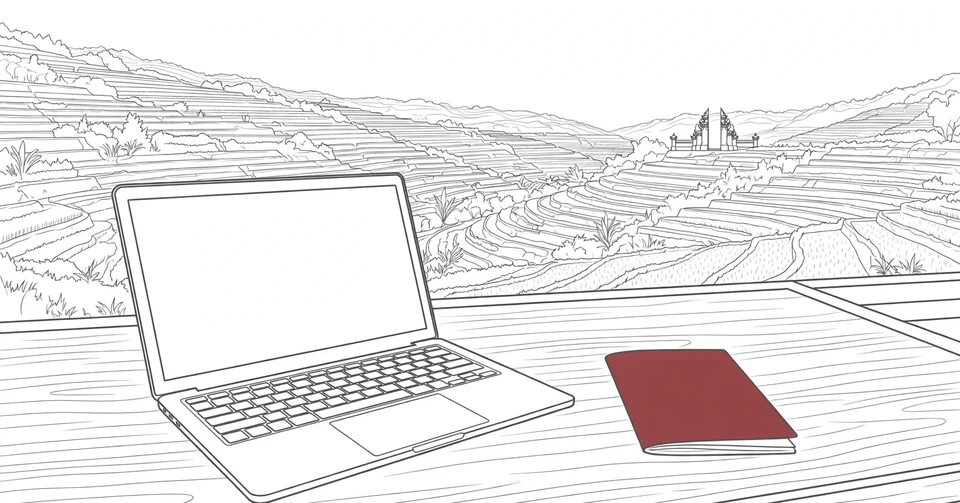
I think the E33G remote worker visa also says something honest about what Indonesia wants from the remote work crowd. The welcome is real, but it is aimed at people who bring a foreign salary with them, spend it locally, and leave Indonesian jobs to Indonesian workers. That seems to me a fair shape for a welcome.
What the E33G remote worker visa actually is
The official name is Visa Rumah Kedua Pekerja Jarak Jauh, which translates roughly to a second home visa for remote workers. When I wrote about why Bali became the world's remote work capital, the line that kept standing out was the one about this permit. The E33G Remote Worker Visa finally launched in April 2024, and it is the permit the whole scene had been waiting for.
In legal terms, the E33G remote worker visa is a limited stay visa. Once you enter Indonesia on it, your limited stay permit and your re-entry permit are issued automatically at the border. While the re-entry permit is valid, you can leave and return as often as you like. The official immigration page also notes that holders may travel as tourists and visit friends or family, so the permit covers an ordinary life, not just a desk.
The stay itself is one year. Extensions are handled online through the same e-Visa portal, and the permit can in principle be converted to another stay permit later. To understand the E33G remote worker visa, it helps to drop the word nomad from your thinking. This is not a travel document. It is a residence permit with a narrow, specific purpose: carrying out work for a company overseas while your home is in Indonesia.
Who can get the E33G remote worker visa
The core requirement is a job that points entirely outward. The immigration directorate asks for an employment agreement with a company established outside Indonesia, and it asks you to prove the relationship with documents, not just describe it.
The financial tests are the heart of the E33G remote worker visa, and there are two of them. First, a bank account that proves salary or income of at least US$60,000 per year, which works out at about US$5,000 a month. Second, proof that you can support yourself while you settle in: a bank statement covering the last three months showing at least US$2,000, in your own name.
Around those two tests sits the ordinary paperwork. Your passport must be valid for at least six months. You need a recent colour photograph, a CV, and a travel itinerary. One practical advantage stands out. Unlike most Indonesian work permits, the E33G remote worker visa needs no Indonesian sponsor and no local guarantor behind the application. You apply in your own name, with your own account.
There is a grey area worth naming plainly. The official wording asks for an employment contract, which points at salaried workers. Freelancers with foreign clients exist in a less certain space, and detailed guides to the E33G remote worker visa advise them to get their paperwork checked carefully before applying, because a stack of invoices is not the same thing as a contract.
What it costs and how to apply
The government fee for the E33G remote worker visa is Rp7,000,000 for a one year stay. The official page breaks that total down into four parts.
- Limited stay visa: Rp500,000
- Visa verification, category II: Rp2,000,000
- Limited stay permit for up to one year: Rp3,000,000
- Re-entry permit for up to one year: Rp1,500,000
Everything runs online. The requirements are listed on the official E33G page of the Directorate General of Immigration, and the application itself is made through the government e-Visa portal. You create an account, log in, and upload your documents as PDF or JPEG files. Immigration then checks the file, verifies the payment, builds your profile, and issues the visa. The stated processing time is five working days after the payment is received. Once issued, the visa must be used within 90 days, or it lapses and you apply again.
Agencies will happily handle the process for a fee on top of the Rp7,000,000, and for complicated cases that may be money well spent. But the E33G remote worker visa was designed so that an organised applicant can do it alone, and an English language guide to the E33G walks through the same steps in plain language for anyone who wants a second explanation before paying anyone.
For scale, the fee is the small part of the bargain. What it really costs to live in Tokyo puts a single person there at 170,000 to 250,000 yen a month, most of it rent, and a comfortable month in Bali costs less than that. The E33G remote worker visa does not really ask whether you can afford Bali. It asks whether you earn at a level Indonesia considers worth a year of residency.
What the E33G remote worker visa does not allow
The permit is generous in one direction and strict in every other. You may not take a job with an Indonesian company, and you may not be paid by Indonesian clients. Earning income from Indonesian sources is outside the permit, even if the money is paid into a foreign account in a foreign currency. The official page also prohibits selling goods or services in Indonesia, except where your foreign job itself requires it.
This is why working quietly on a tourist visa has become a worse idea, not a safer one. A Visa on Arrival never authorised remote work, and Bali immigration has stepped up checks in recent years, with remote workers among those deported. The E33G remote worker visa exists precisely so that the legal route and the honest route are the same route.
One claim deserves a direct answer. You will still find articles promising a five year digital nomad visa for Bali. That idea was discussed in 2022, but it was never implemented. There is no five year version of the E33G remote worker visa. The real permit runs one year at a time, and planning around anything longer is planning around a rumour.
Family, extensions and the honest limits
A permit you can build a year of life around raises a family question, and the answer improved recently. Since late 2025, holders of the E33G remote worker visa have been able to sponsor a spouse, children and parents on dependent permits of their own, tied to the main permit and applied for after it is granted. The details sit with immigration, and each family member has a separate file, but the direction is clear. Indonesia expects some holders to arrive as households, not just as solo workers with laptops.
The limits deserve the same plain treatment. The income bar excludes many of the people who made Bali famous as a nomad hub. Plenty of freelancers, junior remote workers and location independent founders earn less than US$60,000 a year, and for them the E33G remote worker visa is a locked door, whatever their intentions. The contract requirement shuts the door further for people whose work is real but informal.
Extensions and reporting duties continue for as long as you stay. The permit can be extended online, though the official page does not promise how many extensions exist, so treat each year as something to apply for rather than something owed to you. You must keep your address registered, report changes, and in Bali register with your local neighbourhood association after you arrive. Staying past your permit, or working outside its terms, carries real penalties.
Tax is the last honest limit. Spending more than 183 days in Indonesia in a year can make you an Indonesian tax resident, which changes what you owe and where. The rules interact with treaties and with your home country in ways no blog post can settle. If you plan to stay on the E33G remote worker visa for a full year, that is a conversation for a tax adviser before you move, not after.
None of this makes the permit a bad deal. It makes it a specific one. The E33G remote worker visa is the first Indonesian permit that treats remote work for a foreign employer as a normal, legal way to live in the country, and for the people who clear its bar it removes the low level anxiety that used to hang over every laptop in every cafe in Canggu. One year at a time, foreign salary, local spending, no local clients. If those terms fit your life, the door is genuinely open, and it is better to walk through it properly than to keep slipping past it.
More in Money & Work
- Nomikai, the After-Work Drinks That Are Part of the Job in Japan
- The Salaryman and Japan's Loyal Office Culture
- Key Money in Japan and Why Renting Costs Four Months Up Front
- Akiya, Japan's Free Houses That Are Not Really Free
- Why Bali Became the World's Remote Work Capital
- Karoshi, the Japanese Word for Death by Overwork
Latest posts
- The Dalang, the Single Voice Behind Every Wayang Puppet
- Yadnya Kasada, the Festival That Feeds the Crater of Mount Bromo
- Chankonabe, the Hot Pot That Feeds a Sumo Stable
- The 8050 Problem, When Retired Parents Still Carry Their Adult Children
- Koji Mold, the Quiet Engine Behind Japanese Food
- Moai, Okinawa's Lifelong Circles of Friends
- Anak Krakatau, the Child of Krakatoa That Keeps Growing
- Otohime, the Small Sound That Protects Privacy in Japanese Toilets
- Yozakura, Japan's Cherry Blossoms After Dark
- Coelacanth and the Living Fossil of the Deep Sea
- Sakura Ebi and the Tiny Shrimp Only Suruga Bay Catches
- Senbon Matsubara and the Pine Grove of Numazu
- Shirasu and the Whitebait Bowls of Shizuoka
- Uchiura and the Quiet Fishing Village Behind Love Live Sunshine
- Love Live Sunshine and How Anime Changed Numazu