Bali Has Its Own Semar, and His Name Is Twalen
· 11 min read
Twalen is the fat, funny old servant of Balinese wayang kulit, father of Merdah and wearer of the black and white poleng cloth, and Balinese tradition holds that twalen is no clown at all but a god who came down to earth to serve.
Every wayang tradition in Indonesia keeps one servant who turns out to be far more than a servant. In Java, that figure is Semar, the round bellied clown who is secretly a god and the guardian spirit of the island. Bali has its own answer to the same idea, and his name is Twalen.
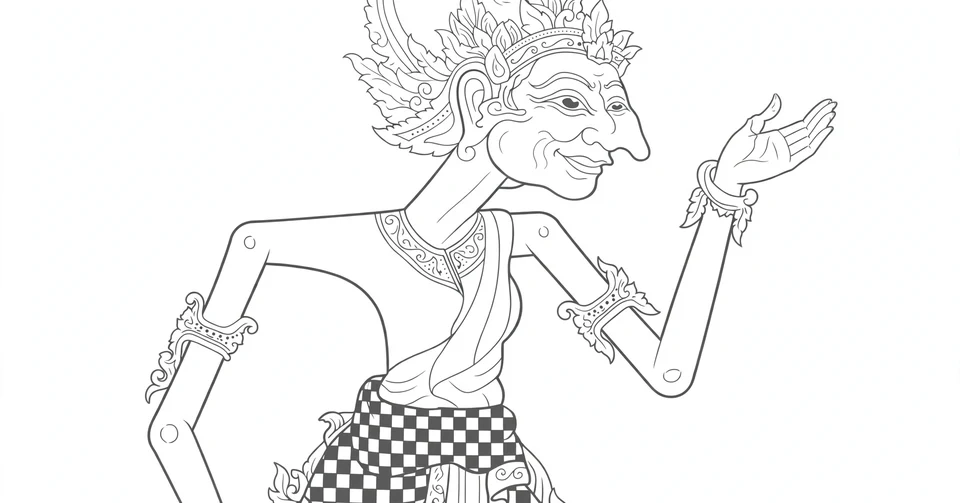
Twalen is, on the surface, a clown. He is fat, dark skinned, flat nosed and thick lipped, dressed in a loincloth of black and white checks, and he spends the performance carrying the hero's baggage, muddling his orders and keeping the audience awake with jokes. He is also, by Balinese tradition, older than the gods whose story he serves.
That double identity is not a joke at the character's expense. It is the whole design of twalen, and once you see how Bali builds him, servant, translator, father and god at the same time, the fat old clown starts to look less like comic relief and more like the centre of the performance.
A Balinese shadow play is run by one man, the dalang, who sits behind a white screen with an oil lamp above his head, working flat leather puppets against the light while a small orchestra of bronze gender instruments plays beside him. Kings and gods speak in an ancient court language. Then, somewhere in the middle of the night, the servants take over the stage, and the whole register of the play drops from heaven to the village. That is where Twalen lives.
The shape of the night is fixed enough that an experienced audience can read it like a clock. Formal court scenes come first, stiff with ceremony and high language. The long clown scene arrives in the middle, and it is the stretch many people have really come for, the part where the story loosens its collar and talks about real life. Battles and a resolution close the performance, but a Balinese wayang night is remembered by its middle, and its middle belongs to the servants.
A god who came down to serve
Ask where Twalen comes from and Balinese tradition gives answers that place him above the heaven of the Hindu epics, not below it. One account recorded by scholars of the dalang's training holds that he was formed from the dust of the body of Sang Hyang Tunggal, the supreme god, and was sent down to live among virtuous human beings. He carries a third eye, tradition says, the mark of inward sight and wisdom. Other tellings connect him with Sang Hyang Ismaya, the elder brother of Batara Guru, king of the gods, which makes Twalen the senior member of a divine family in which the ruler of heaven is his younger brother.
The tellings do not fully agree with each other, and it is better to say so than to tidy them up. What they share is the direction of the story. In every version, Twalen is not a nobody who got lucky. He is a somebody who came down. Reference works on the character describe him as older and more powerful than all the Hindu gods of the epics, the elder brother of Shiva himself, working in the one job nobody would think to look for him in. He serves the Pandawa brothers through the Mahabharata nights and serves Rama when the story is the Ramayana, and he never once steps out of the servant's role to claim his rank.
There is something quietly radical in that arrangement, and I think Balinese audiences have always known it. A theology that hides its highest being in the kitchen, carrying luggage and absorbing insults, is making an argument about where real worth sits. The epics arrive from India full of thrones and titles. Bali answers by putting its oldest god at the bottom of the household staff.
Four servants, arranged in two pairs
Twalen does not work alone. Balinese wayang has four clown servants, called panasar in Bali and punakawan in Java, and they come arranged as two pairs facing each other across the story. On the hero's side, the right hand side of the screen, stand Twalen and his son Merdah. On the opposing side stand Delem and Sangut, who serve the villains with the same loyalty and roughly half the wisdom.
The family arrangement matters. Twalen is the eldest of the four, the senior servant, and Merdah is his child, a smaller, browner, brasher young figure who is brave to the point of rashness and always certain he is right. Much of the comedy of a Balinese performance is a father and son act, the old man slow, kind and unshakeable, the boy quick, proud and forever talking himself into trouble. The opposing pair invert the recipe. Delem is fiery and full of himself, and Sangut, slyer and cooler, spends his scenes managing the damage. Good and evil in Balinese wayang both travel with servants, and the servants tell you which side you are on before the heroes say a word.
None of these four figures exists in the Indian epics the plays are built from. The Mahabharata and Ramayana reached Indonesia without clowns, and the archipelago added them itself, which is exactly why they are free to behave the way they do. A prince must stay inside his story. A servant invented by local tradition can look out of the story at the audience, and Twalen, as the eldest of these local inventions, has been looking out the longest.
Whether Bali borrowed this figure from Java or both islands grew him from the same root is a question scholars still handle carefully. Mary Zurbuchen pointed to the Kidung Sudamala, a poem from the last years of the Majapahit kingdom in East Java, in which a servant strikingly like Twalen already walks beside the hero Sadewa under the name Semar. The safest reading is not copy and original but cousins: one old, sacred servant type, raised differently on two islands, until Java had Semar and Bali had Twalen.
What the name twalen means, and why he wears checks
Even his name is a small summary of the character. Balinese writers on classical wayang read Twalen as built from tua, old, and len, other or different: an old man, but a different kind of old man. On paper he belongs to the lowest order of society, a servant with no caste standing at all. In practice, as those same writers point out, this supposed nobody can outstrip the gods themselves in wisdom and self knowledge. The name carries the whole paradox in two syllables.
You can recognise his puppet before he speaks. The body is round and heavy, the skin dark, the nose flat, the lips thick, and in the Balinese carving tradition he sometimes wears a full noble crown, a makuta, which is an odd thing to give a menial until you remember who he is supposed to be. Museum puppets of Twalen, like the one held by the Horniman Museum in London, are made with an articulated jaw, so that the dalang can make him chew, grumble and talk like a real old man. The Horniman describes him as the most important of the four panasar, a symbol of knowledge, openheartedness and wisdom, which is a fine set of words to attach to a clown.
And then there is the cloth. Twalen always wears poleng, the black and white checkered fabric that visitors to Bali see wrapped around sacred trees, statues, shrines and temple gateposts all over the island. The checks stand for paired opposites held in balance, light and dark, good and bad, the Balinese idea often named rwa bhineda, two things that differ and must be kept in proportion. Older Balinese scholarship on the shadow theatre notes that such a poleng girdle was a prerogative of exceptional persons and pointed to supernatural power in the wearer. The servant, in other words, is dressed in the island's most sacred pattern. His costume has been giving away his secret all along.
Twalen also escapes the screen. In the classical Kamasan painting tradition of east Bali, the four servants appear in version after version of the great stories, although they never appear in the written texts those paintings illustrate, a point the anthropologist Anthony Forge noted when documenting the style. Painters kept painting Twalen anyway, because a Balinese telling of the story without its servants felt unfinished. On temple walls and painted ceiling cloths he stands in his checks beside the kings, in exactly the position the dalang gives him, between the audience and the gods.
The servant who translates the epic
The most practical reason Twalen exists is language. In Balinese wayang, the noble characters speak Kawi, the archaic Old Javanese court language of the old poems, and almost nobody in a village audience follows it word by word. The servants carry the meaning across. Twalen is the one servant who can meet the heroes in their own elevated tongue and follow every word of it, and Merdah, his son, then turns the exchange into the everyday Balinese the audience actually speaks. Between the father's understanding and the son's retelling, the whole epic crosses over into the present tense.
Scholars of Balinese shadow theatre, Mary Zurbuchen most notably, have stressed that this is not translation in the dictionary sense. The panasar paraphrase. They explain, they argue, they add examples, they wander off into stories of their own, and in that wandering the modern world enters the ancient one. The World Encyclopedia of Puppetry Arts notes that through this translation role the clowns link epic time and present time, and gives a sharp example: when the villains of the Mahabharata burn the Pandawa's palace in the story, a Balinese clown might fold in remarks about the 2002 Bali bombings, letting an old act of arson carry a grief the audience still owns.
This is also why Twalen is often described as the figure closest to the dalang himself. The dalang voices every character, but the clown is where his own voice lives. Through Twalen he can praise, tease, mourn and criticise, commenting on village quarrels, officials, prices, tourists and anything else the night has brought in, all under the cover of an old servant who is only repeating what his master said. Kings cannot say these things. Gods cannot say them either, not in their own persons. A fat servant in a checkered cloth can say nearly anything, and everyone in the audience knows exactly who is speaking.
Why audiences trust the clown
Strip the jokes away and what remains is a counsellor. In performance, Twalen advises his masters, stays loyal when the story turns against them, and offers moral guidance whenever a character does wrong, which in an epic is often. The humour is the delivery system, not the cargo. A dalang who wants to tell his village something uncomfortable about greed, or anger, or a corrupt official, does not lecture. He lets an old servant say it while people are laughing, and the lesson goes down with the laughter and stays there.
The tradition backs this weight with ritual as well as theatre. The old dalang manuals, the Dharma Pawayangan texts, map the four servants onto the human body, and they place Twalen in the heart. Wayang centred on Twalen is also used in purification ceremonies, where the performance itself is part of the cleansing. A clown who sits in the heart of the puppeteer's own ritual body, and whose plays can be used to purify a person, is not light entertainment wearing a sacred costume. He is a sacred figure who chose entertainment as his method.
My own feeling, watching how Bali treats him, is that Twalen survives because he solves a problem every culture has: how to keep old wisdom in circulation among people who did not ask for a sermon. Java solved it with Semar, and Bali, characteristically, solved it in its own way, with a father instead of a solitary sage, a son to argue with, and a checkered cloth that quietly announces the balance he stands for. Twalen does not preach balance from a throne. He embodies it, one joke, one translation, one piece of unwanted advice at a time.
Sit through a Balinese wayang night and the heroes will blur together a little by morning, all gold crowns and high language. The old servant will not blur. Long after the screen comes down, what the audience carries home is the fat figure in the black and white checks, laughing at the powerful, translating heaven into village speech, and turning out, as he always turns out, to have been the wisest person in the story.
More in Culture & Society
Latest posts
- KRL Commuterline and the Trains That Move Jakarta
- Kecap Manis and the Sweet Soy Sauce of Indonesia
- In Mamoiada, Two Hundred Families Still Make Wine at Home
- Shochu and the Quiet Spirit of Japan
- A Dried Shiitake Is Louder Than a Fresh One
- Loma Linda's Long Lives Run on Saturdays
- Maruten Numazu and the Towering Kakiage Bowl of the Port
- The Three Sisters Grow Better Together
- Tatamiishi Terraces Filter a River Through Stone
- Wasabi-Zuke Puts the Whole Plant in Sake Lees
- Konyoku Is Still Out There, Past the Last Train Station
- Dry January Lasts a Month on Purpose
- Ikaria Runs on Island Time
- Why Nicoya Cooks Its Corn in Lime
- Juryo Is Where Sumo Starts Paying