Why Nicoya Cooks Its Corn in Lime
· 9 min read
On Costa Rica's Nicoya Peninsula, cooks still simmer dried corn in lime water before grinding it, a Chorotega step called nixquezado that produces nixtamal. The alkaline bath is what makes the corn nutritious, and leaving it out once caused pellagra epidemics on three continents.
On the Nicoya Peninsula, a tortilla does not start in a cornfield. It starts the night before, in a pot. Dried corn kernels are simmered in water clouded white with lime, then left to soak in the hot, alkaline liquid for hours. Only after that bath are the kernels rinsed, rubbed free of their skins, and ground. The treated corn is called nixtamal, and the process that makes it, nixtamalization, is among the oldest food technologies in the Americas.
In Nicoya the step has a local name, nixquezado, inherited from the Chorotega people who farmed this dry corner of Costa Rica centuries before the country existed. It would be easy to file nixquezado under flavour, or ritual, or the stubbornness of village kitchens. It is none of those things. The lime water produces nixtamal, a genuinely different food from the kernel that went into the pot, and it does quiet chemistry that the Chorotega could feel but never name. The rest of the world once learned, at terrible cost, what happens to people who eat corn without it.
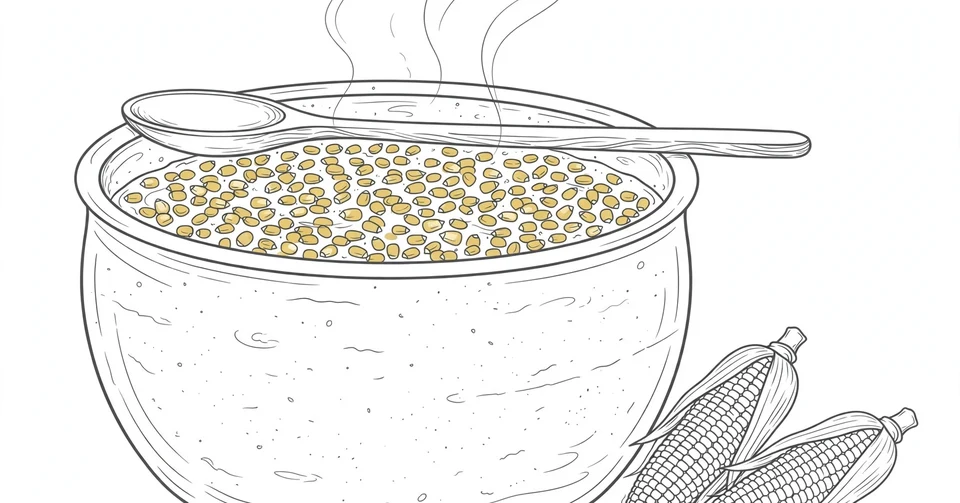
Nicoya is known today as one of the blue zones, the five places where people live the longest, and when demographers went looking at what its old people eat, they found a plain table built on the old trio of corn, beans, and squash. But the corn on that table is nixtamal, softened and changed by lime, and it is not quite the same food as the corn that left the Americas in the holds of European ships. The difference between the two is a single skipped step, and the story of that step is written partly in kitchens and partly in hospital records.
What nixtamal actually is
The method is simple enough to describe in one breath. Dried kernels are cooked in an alkaline solution, most often slaked lime dissolved in water, sometimes wood ash lye instead, held at or near boiling, and then steeped in the same liquid for anything from a few minutes to about a day, depending on the place and the dish. The steeping time is not a detail. It decides how firm the finished nixtamal will be and what it can become.
Afterwards the cloudy cooking liquid, called nejayote in Mexico, is poured away, and the swollen kernels are washed clean. The alkali has loosened the pericarp, the tough outer skin of each kernel, so it rubs off between the palms or comes away in a mill. What remains is nixtamal. Whole, it can be boiled into soups, the puffed kernels English speakers know as hominy, or it can be ground fresh and wet into masa, the soft dough of tortillas and tamales. Dried and milled, it becomes masa harina, and the bags of that flour on supermarket shelves far from Central America are nixtamal too, just paused.
That last transformation matters more than it looks. Plain cornmeal mixed with water crumbles and will not hold together as a dough. Masa does. Tortillas, tamales, and a whole architecture of Mesoamerican cooking exist because the lime step changes the grain's starches and proteins enough to make them workable. The same chemistry now runs at industrial scale in tortilla factories, and English language labels on packaged tortillas usually give the step away in plain words: corn treated with lime. Nixtamal is not corn with something added for taste. It is corn made usable.
A word that remembers the recipe
The word nixtamal comes from the Nahuatl nixtamalli, a compound of nextli, meaning ashes, and tamalli, the word for corn dough that survives in the modern tamal. The name itself preserves the original alkali. Before lime became the standard, cooks used the ash of burned wood, and some still do. The longer word built on it, nixtamalization, is a modern label for a practice far older than the languages now spoken around it.
The earliest evidence sits on the southern coast of Guatemala, where equipment for making nixtamal dates to somewhere between 1200 and 1500 BCE. Nobody knows exactly how the process was discovered, though one plausible guess involves limestone country. Chunks of heated limestone dropped into cooking pots, or used as boiling stones, would have made the water alkaline by accident, and some observant cook noticed that the corn came out softer, easier to grind, and better to eat.
From Mesoamerica the practice travelled with the crop itself. It reached the peoples of North America, who turned their ash treated corn into hominy, and the Mississippian cultures of the southeast, who were nixtamalizing by around 900 CE. Wherever corn went in the Americas, for thousands of years, nixtamal went with it. The grain and the instructions were a package.
The quiet chemistry of nixtamal
What the alkaline bath does first is structural. Lime water dissolves hemicellulose, the glue like material in the kernel's cell walls, which is why the skins slip off and the grain softens and swells. Starches gelatinize, the protein matrix changes, and the cooked corn grinds more easily and digests more kindly than the raw grain.
The nutritional changes matter more. Corn on its own is a poor source of niacin, vitamin B3, and much of what little it holds, along with the amino acid tryptophan, is not readily available to the body. Nixtamalization makes the niacin nutritionally available and frees the tryptophan, which the body can then convert into niacin of its own. Researchers who study the process describe this as its central gift, and it is joined by others. The kernels drink calcium straight out of the lime, picking up smaller amounts of iron, copper, and zinc along the way, and the alkaline bath destroys most of the aflatoxins that can contaminate stored corn.
None of this was visible to the cooks who perfected the method. There was no laboratory in a Chorotega village. There was only the accumulated evidence of generations: corn treated this way fed people well, and corn handled carelessly did not. The recipe was the science, carried in practice rather than in writing.
The places that skipped the lime
Corn crossed the Atlantic quickly after 1492, and colonial trade carried it onward to Africa and Asia, prized because it yielded heavy harvests on little land. The recipe did not cross with it. European farmers took the grain and left the instructions behind, and European settlers in North America, who had watched Indigenous cooks at work, largely dismissed the ash and lime treatment as unnecessary, a superstition not to their taste.
The bill arrived slowly, then all at once. Pellagra, the disease of niacin deficiency, was described in Spain by the physician Gaspar Casal as early as 1735. It became endemic in the corn eating north of Italy, where more than 100,000 people were affected by the 1880s, and it stalked poor, corn dependent regions of Africa as well. Its classic signs were taught as the four Ds: dermatitis, diarrhea, dementia, and, untreated, death. In hindsight, pellagra was the disease of corn divorced from nixtamalization.
The worst chapter opened in the American South, where cornmeal had become the cheapest staple of the poor. Pellagra reached epidemic proportions there in the early twentieth century. Between 1906 and 1940, more than three million Americans were affected and over 100,000 died. Many doctors assumed a germ, or a poison in spoiled corn. It took Joseph Goldberger of the US Public Health Service to show, from 1915 onward, that changing the diet in orphanages and asylums made the disease disappear, and the history of pellagra only turned when diets improved and flour began to be fortified with niacin. One clue had been sitting in plain sight the whole time: the disease was strangely absent in Mesoamerica, where nixtamal was the daily bread. I find something sobering in that record. The knowledge needed to prevent the epidemic had existed for millennia, had crossed the ocean in the same ships as the corn itself, and had been set aside because it arrived in the wrong accent.
Nicoya kept the step
On the peninsula, nobody set it aside. The nixtamal habit never left the kitchen, because it was simply how corn was handled, a Chorotega routine repeated daily until it stopped looking like a decision at all. The corn still grows in the milpa beside beans and squash, the three sisters planted together for centuries, the beans quietly supplying amino acids that corn lacks.
When Luis Rosero-Bixby and his colleagues published their 2013 survival study of elderly Costa Ricans, they flagged the lime step as one of the peninsula's hidden assets. A nixtamal tortilla carries calcium from the pot itself, and Nicoya's drinking water is naturally rich in calcium and magnesium on top of that. The researchers noted that this mineral intake was not fully captured in their diet estimates, and they connected it to one of the zone's quieter statistics: how rarely its oldest residents break bones. A fall that might begin a final decline elsewhere is, in Nicoya, more often something an old man simply gets up from.
Honesty requires a limit here, and the study itself supplies it. Measured carefully, the ordinary Nicoyan diet differed only modestly from what the rest of Costa Rica ate, and no one has shown that lime treated corn alone adds years to a life. In my earlier article on the peninsula's plan de vida, I argued that Nicoya's longevity is a braid of purpose, work, family, and food that demography cannot fully untangle. Nixtamal is the strand of that braid you can hold in your hand, which is perhaps why it deserves a story of its own.
What I take from the lime pot, reading about it from Japan, is a small correction to how we usually talk about traditional food. We praise old cuisines for their ingredients, as if health lived in the shopping list. Nicoya suggests it can live just as much in the procedure, in an unglamorous step done the night before, by hand, for reasons nobody wrote down. Corn plus lime is not a superfood. It is something better: a reminder that preparation is part of nutrition, and that the people who domesticated a crop usually understood it more deeply than the people who imported it.
The cooks of Nicoya still fill the pot in the evening, not because a study told them to, but because that is how corn becomes nixtamal, and nixtamal becomes tortillas. The chemistry rides along quietly, exactly as it has for more than three thousand years, in the cloudy water nobody thinks about anymore.
More in Food & Travel
Latest posts
- Manza Onsen Bathes at 1,800 Metres
- Irezumi Was an Art Before It Was a Warning
- The Oshi Kept Fuji's Pilgrims Fed, Housed, and Devout
- Japan's Population Decline and the Villages It Leaves Behind
- KRL Commuterline and the Trains That Move Jakarta
- Loma Linda's Long Lives Run on Saturdays
- Maruten Numazu and the Towering Kakiage Bowl of the Port
- The Three Sisters Grow Better Together
- Half the Old Springs in Japan Thank Kobo Daishi
- Tatamiishi Terraces Filter a River Through Stone
- Wasabi-Zuke Puts the Whole Plant in Sake Lees
- Konyoku Is Still Out There, Past the Last Train Station
- Karo Is the Tengger's Other Great Gathering
- Dry January Lasts a Month on Purpose
- Urashima's Dragon Palace Had a Name, Ryugu