A Ngaben Can Take a Village Years to Prepare
· 10 min read
A ngaben, the Balinese Hindu cremation ceremony, can take a village years to prepare, as families save for the tower, wait for an auspicious day, and build the whole farewell together.
If you hear gamelan music rolling down a Balinese street at midday and see a tower of bamboo and bright paper swaying above the crowd, you are probably watching a ngaben, the cremation ceremony at the heart of Balinese Hindu life. It looks like a festival. In a sense it is one, except that its guest of honour may have died months ago, and sometimes years ago.
That gap between death and cremation is the first thing outsiders misunderstand. A ngaben is not arranged in the hurried week after a death, the way funerals are in much of the world. It is a sacred duty that a family owes its dead, and like most sacred duties in Bali, it waits until the money, the calendar, and the whole neighbourhood are ready.
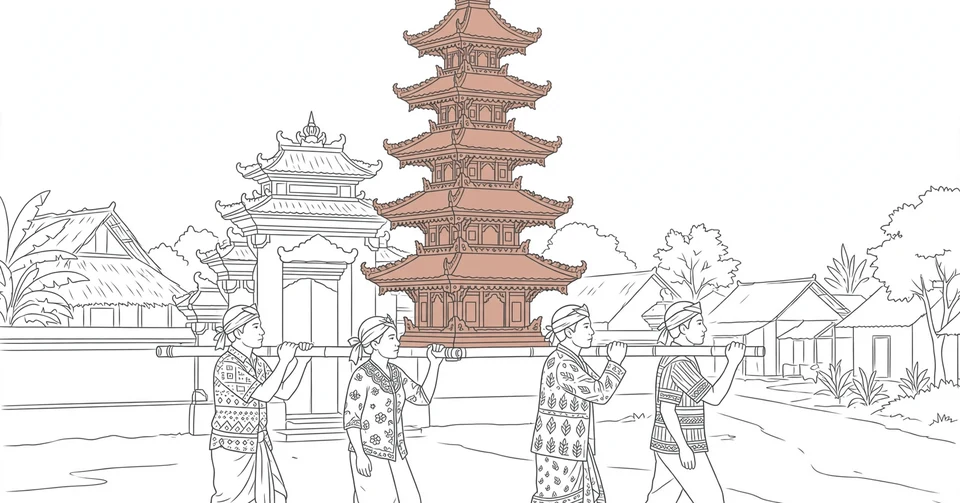
When everything finally aligns, the result is one of the most striking public rituals in Indonesia. A tower built by dozens of hands rises over the village street, the gamelan plays at full volume, and a fire is lit that is meant to set a soul free. This is what all the waiting is for, and why a ngaben can take so long to arrive.
What a ngaben is actually for
Ngaben, also called Pitra Yadnya, is the Hindu funeral ritual of Bali, the offering a family makes to its ancestors and its dead. Its purpose is precise. The ceremony is performed to release the soul of the dead person, the atma, from the body and from its ties to the world, so that it can enter the upper realm. There it may wait to be reborn, or, more rarely, win liberation from the cycle of rebirths altogether.
Balinese Hindu theology gives this errand a certain urgency. The soul, once separated from the body, is not safe by default. There are residents of the lower realm who would gladly capture it, and a proper cremation improves the soul's chances of reaching the upper realm instead. Fire is the instrument of every ngaben because fire purifies. It returns the physical body to the elements it was borrowed from and loosens the soul's grip on everything it has to leave behind.
This is also why a ngaben is not treated as an optional farewell or a private family matter. In Balinese belief, the seen world and the unseen world have to be kept in balance, and a soul left lingering in between unsettles both. Performing the ngaben restores that balance. It is devotion, but it is also maintenance, the community keeping the cosmos in working order one funeral at a time.
Why the wait can stretch for years
A quick ngaben, held soon after death, is what most families would prefer. It is also, for most families, unaffordable. A private ceremony involves a tower, a sarcophagus, priests, offerings, musicians, and food for a small army of guests and helpers, and one widely read guide to the ceremony puts the cost of a private ngaben at anywhere from IDR 30 million to more than IDR 150 million, depending on how grand the family intends it to be. For a farming family, that is not a bill. It is a long term savings project.
So the dead wait. In the interim, the body is usually buried in the village cemetery, often near the Pura Prajapati, the temple of the dead, and the burial is understood by everyone to be temporary. Some families keep the body in a holding structure instead. Either way, the grave is a waiting room, not a final address, and the family spends the months or years that follow pooling money with relatives until the ngaben can be done properly.
Money is not the only clock. A priest has to choose an auspicious day from the Balinese ritual calendar, and the great cremation days have to be fitted around temple festivals and other ceremonies that already fill the year. The date of a ngaben is therefore negotiated between a savings book and a sacred calendar, and neither of them hurries.
I find something quietly humane in this arrangement. A culture that insists the dead must be cremated properly, and then gives families years to gather what that costs, has built patience into its theology. The waiting is not a failure to perform the ritual. It is the first, longest part of the ritual itself.
The tower, the bull, and the road to the fire
Once a date is set and announced in the village, the building of the ngaben begins. The centrepiece is the bade, a tiered tower of bamboo, wood, and paper that will carry the body to the cremation ground. Its roofs are stacked in odd numbers, and the height and splendour of a bade follow the standing of the family, so the tallest towers, the ones that have to be ducked under power lines and steered around corners, belong to the highest ranking dead. A great bade is a temporary building raised for a single journey, and it is built to be admired for exactly one morning.
The body itself is burned inside a patulangan, a sarcophagus made of bamboo, wood, and paper. The most famous form is the lembu, a great bull, black for most families and white for priests, with the body placed inside its hollow body. Other families use a temple shaped vessel instead. On the day, the corpse is washed, dressed in Balinese attire, and farewelled by family and friends with prayers at the house before the procession sets off.
Then the street takes over. Bearers carry the bade on their shoulders through the village, accompanied by gamelan music and singing, in a procession that is deliberately anything but solemn. Where the route crosses a major junction, the bearers spin the tower around three times, a manoeuvre meant to confuse the spirits of the lower realm so they lose the soul's trail. At the cremation ground, the body is transferred into the lembu, final hymns are sung, and the pyre is lit. While it burns, the musicians play beleganjur, martial music that acts out the soul's fight with the underworld on its way up. A ngaben procession is loud because, in the local understanding, the soul needs all that noise at its back.
A village builds it together
No Balinese family produces a ngaben alone, and this is where the years of preparation become concrete. The work is carried by the banjar, the neighbourhood association that organises everything from temple anniversaries to security patrols. In the weeks before a ngaben, the men of the banjar raise the bamboo frame of the bade and build the lembu, while the women prepare the offerings, hundreds of small constructions of palm leaf, flowers, rice, and fruit, and cook for the workers and the guests who will descend on the house. Contributions arrive in every form a village has: bamboo, coconuts, rice, cash, and evenings.
It is the same collective machinery that keeps the rest of Bali's ceremonial calendar turning, including the wayang performances where Twalen, Bali's own version of the clown servant Semar, shuffles onstage to translate the gods for the audience. A death simply turns that machinery toward one household for a while. What strikes me, watching how the labour is organised, is how little of it is hired. The tower is tall because forty neighbours showed up, not because a contractor was paid, and the family receiving all this help knows it will stand in the same street, carrying someone else's tower, soon enough.
One fire for many families
Because cost is the real bottleneck, Bali has increasingly answered it with arithmetic. Villages hold a communal ngaben, often called ngaben massal, in which dozens of families cremate their dead on the same day and split the bill for the priests, the musicians, and the ceremony between them. The same guide that prices a private ceremony in the tens of millions puts a place in a communal one at roughly IDR 5 to 10 million per family. On the appointed day, relatives who were buried temporarily, some of them years earlier, are exhumed and brought to the shared fire, each with its own smaller tower and its own lembu.
It would be easy to assume that a shared ngaben feels like a lesser one, a discount rite for people who could not afford the real thing. In practice the opposite is often true. A mass ngaben is frequently the biggest event in a village's year, with rows of towers moving down the street and crowds that fill every wall and rooftop. The savings are real, but so is the spectacle, and the families involved are not apologising for either. Practicality and piety, in this case, are pulling in the same direction.
After the fire, the sea
The ngaben does not end when the fire goes out. Twelve days after the burning, the family returns to collect the ashes of the dead person. The ashes are placed inside a coconut shell and carried to the sea, where they are released into the water, returning what is left of the body to the elements for good. Only after this does the long process that began at the graveside feel complete. The soul has been escorted out of the house, through the fire, and off the edge of the island, free to take its place in the upper realm and, in the fullness of time, to be reborn.
A cousin rite on a volcano
Bali is not the only place in Indonesia where a funeral is a communal project with a very long fuse. High on the slopes of Mount Bromo in East Java, the Tengger people hold entas-entas, a rite in which the dead are carried out of the village so their souls can be lifted free of the body. When people reach for a comparison, they reach for ngaben, and the Tengger chief priest Suja'i, quoted in coverage of the rite, accepted the comparison up to a point: entas-entas carries a similar meaning, he said, only done in the Tengger way. Two communities, an island and a volcano, arriving at the same conviction by different roads: the dead must be escorted properly, and escorting them is work that belongs to everyone.
A ngaben asks a great deal of the living. It asks for money that takes years to gather, for weeks of evenings spent weaving offerings and raising bamboo, for a whole village to put its shoulders under one family's grief. But it gives something back in return, which is time: time for a family to save without shame, time for a village to gather itself, time for grief to turn into work. When the tower finally rises and the gamelan starts up and the whole street begins to move, nobody in that procession is thinking about how long it took. They are thinking that it is, at last, exactly enough.
More in Culture & Society
Latest posts
- Kombu Is the Quiet Half of Dashi
- Manza Onsen Bathes at 1,800 Metres
- Every Prefecture Argues About What Goes in Ozoni
- KRL Commuterline and the Trains That Move Jakarta
- Kecap Manis and the Sweet Soy Sauce of Indonesia
- In Mamoiada, Two Hundred Families Still Make Wine at Home
- Shochu and the Quiet Spirit of Japan
- A Dried Shiitake Is Louder Than a Fresh One
- Loma Linda's Long Lives Run on Saturdays
- Maruten Numazu and the Towering Kakiage Bowl of the Port
- The Three Sisters Grow Better Together
- Tatamiishi Terraces Filter a River Through Stone
- Wasabi-Zuke Puts the Whole Plant in Sake Lees
- Konyoku Is Still Out There, Past the Last Train Station
- Dry January Lasts a Month on Purpose