Juryo Is Where Sumo Starts Paying
· 10 min read
Promotion to juryo is the line where a sumo wrestler stops living on an allowance and starts earning a real salary. Only 28 wrestlers hold the rank, and one losing tournament can send a man back below it.
Professional sumo has six divisions and several hundred wrestlers, but only one line on the ranking sheet changes a man's life overnight. That line is promotion to juryo, the second highest division, and juryo is where sumo starts paying. Above the line a wrestler draws a monthly salary. Below it he is still classed as a trainee, living on a small allowance however many years he has already given the sport.
The odd thing is how small the step looks. The lowest seat in juryo sits one place above the highest seat in makushita, the third division, and on paper the two men are neighbours. In daily life they inhabit different worlds, and people inside sumo often describe the gap between top makushita and bottom juryo as the gap between heaven and hell. Having seen what changes on promotion day, I find it hard to call that an exaggeration.
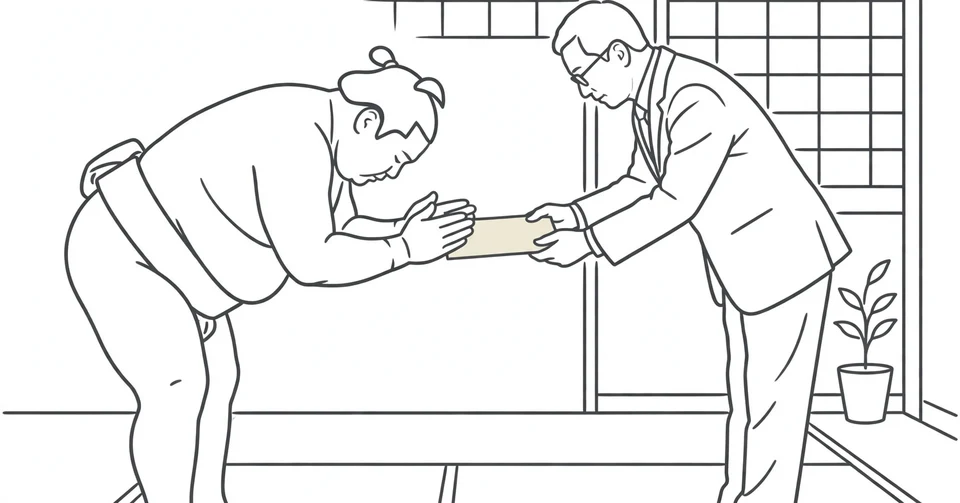
This is why a first promotion to juryo matters so much to wrestlers and their families. A top division debut may come later and bring more fame, but this is the moment the apprenticeship ends. From that day a wrestler has a salary, a room of his own, and men assigned to serve him. He also has something new to lose, because the same ranking sheet that raised him can drop him back below the line after a single bad tournament.
What juryo is
Juryo is the second of the six professional divisions run by the Japan Sumo Association, sitting directly under the top division, makuuchi. Its size never changes: exactly 28 wrestlers, arranged in 14 ranks with an east and a west side to each rank. Together with the 42 men of makuuchi, the juryo wrestlers make up the 70 sekitori, the salaried elite of the sport.
The name itself is about money. Juryo means ten ryo, referring to the gold coins of the Edo period, and it was once roughly the income a wrestler at this level could expect. The division's formal name is actually jumaime, meaning tenth placing, but almost nobody uses it. Juryo is the word on the posters, in the commentary, and in every stable conversation about who has made it and who has not.
The division has its own rhythm inside a tournament day. Its bouts fill the middle of the afternoon, after the lower divisions have finished and before the top division takes over the arena, and its wrestlers perform their own ring entrance ceremony in front of the growing crowd. When a makuuchi wrestler withdraws injured, a juryo man near the top of the division may be called up for a bout in the top division, a brief preview of the next line above this one.
The day everything changes
Promotion to juryo is announced only a few days after a tournament ends, while wrestlers in the lower divisions wait weeks to learn their new ranks. The hurry is practical. A new juryo wrestler has a great deal to prepare, and almost all of it is visible.
He trades the plain black cotton mawashi of the lower divisions for coloured silk in tournament bouts. His hair, grown long since the day he joined, is now dressed in the full oicho topknot reserved for sekitori. He takes part in the ring entrance ceremony wearing a kesho-mawashi, a heavily embroidered silk apron that is often paid for by his supporters club. The silk and the ceremony are the public face of the rank, and I looked at that side of promotion in my piece on what it means to become a sekitori.
Life inside the stable changes just as much. A juryo wrestler gets a private room instead of a sleeping place in the communal dormitory. He may marry and live outside the stable with his family, something not permitted to the men below him. Junior wrestlers, called tsukebito, are assigned as his attendants. They lay out his clothes, prepare his bath, cook, clean, and run his errands. The new sekitori was doing those same jobs for someone else the previous month.
A supporters club of his own, a koenkai, can now form around him, pooling money for things like his kesho-mawashi and hosting parties after tournaments. He also gains a small but telling privilege: only sekitori are allowed to make tegata, the inked handprint autographs that fans treasure. A lower division wrestler cannot give his autograph in sumo's traditional form even if asked. The juryo man can.
New juryo promotions are also one of the few moments when the sport openly shows emotion. The announcements are made at the stable in front of cameras, and grown men who have spent a decade being shouted at through dawn training regularly break down in tears while their stablemaster speaks. It looks disproportionate until you remember what the word juryo actually buys.
What a juryo salary looks like
Then there is the salary itself. On the pay scale published in January 2019, a juryo wrestler receives about 1.1 million yen a month, a figure set out in the salary tables for the top two divisions. A maegashira in the division above earns about 1.4 million yen on the same scale, and a yokozuna 3 million, so juryo pay is the floor of the salaried world rather than its heights. It is still a transformation. Set against it, a makushita wrestler receives only a modest allowance for each tournament, and he earns it while cooking and cleaning for the men above him.
On top of the salary, sekitori collect mochikyukin, a bonus paid at every tournament that grows with each winning record across a career. A long serving juryo regular will not get rich by the standards of professional sport, and the money stops the moment the rank goes. But it is real, regular, professional pay, in a sport where most participants never receive any. That, more than the silk or the ceremony, is the whole point of that line.
There is little else to top it up. The sponsored prize envelopes handed to winners of popular top division bouts are mostly a makuuchi luxury. A juryo wrestler's income is basically the salary, the career bonus, and whatever he can win from his own division's championship, which pays a small fraction of the 10 million yen that goes to a top division champion. The package is comfortable by ordinary standards and modest by sporting ones, and every part of it depends on keeping the rank.
Fifteen bouts, not seven
Promotion also doubles a wrestler's workload in public. Juryo wrestlers fight on all 15 days of a tournament, like the top division. Everyone below them fights only seven bouts, spread across the fortnight. A juryo afternoon is part of the main show, wrestled in front of a filling arena shortly before the makuuchi bouts begin, while the lower divisions perform in the morning to rows of empty seats. The division also has its own championship race each tournament, followed closely by the kind of fans who arrive early and stay all day. Television sharpens the contrast further. Standard live coverage on NHK is reserved for the top division, while juryo and everything beneath it is left to streaming services, so a juryo wrestler performs for the arena crowd and the committed online audience rather than the whole country.
The boundary is porous in one direction. Late in a tournament, high ranked juryo men are sometimes matched against makuuchi opponents to help settle promotion questions, and the top makushita wrestlers may be handed an extra bout against juryo opposition. Win that extra bout and it counts; lose it and it is quietly forgotten. For a makushita man, that single afternoon is an audition for the salaried life, wrestled with his hair already dressed like a sekitori but his plain cotton mawashi giving him away.
The way back down
What the ranking gives, the ranking takes away. A juryo wrestler who finishes a tournament with more losses than wins slides down the division, and a poor enough record drops him into makushita altogether. The fall is total. The salary stops, the private room and the attendants go with it, and the coloured silk goes back in its box. He returns to seven bouts a tournament, to the dormitory, to chores, and to serving the same men he recently outranked.
The road back is clearly marked, at least. A makushita wrestler ranked in the top thirty of his division who wins all seven of his bouts is guaranteed promotion back to juryo, and the committee that redraws the rankings after every tournament handles the rest of the arithmetic. What no rule can guarantee is the body. Knees, necks, and shoulders worn down by years of training do not recover on schedule, and a wrestler demoted at thirty faces teenagers and twenty year olds who want his old seat.
Some wrestlers cross the juryo line again and again, promoted one season and demoted the next, and their stables treat each crossing as routine. Others, especially veterans whose bodies are worn down, decide that one fall is enough and retire from the lower divisions rather than start the climb again. There is no shame in either choice. But it explains the tension around the bottom of the rankings in the final days of every tournament. Those men are not fighting for a trophy. They are fighting to keep their jobs.
Why so few ever reach juryo
Most recruits join a stable at about fifteen, straight out of junior high school, and start at the very bottom in jonokuchi. The routine that shapes them barely changes as they rise: up before dawn, and a warm up built around exercises like shiko, the great leg stamp that starts every sumo day. Years of that routine carry a talented boy through jonidan and sandanme into crowded makushita, where 120 wrestlers compete for the handful of juryo places that open up each year.
There are shortcuts, but they are narrow. Successful college champions are allowed to start partway up the ladder, at makushita or sandanme, as a reward for amateur titles. Even they then have to survive makushita, the most contested division in sumo, where young climbers meet older men who have fallen from juryo and are desperate to return. The division is a waiting room where almost everyone is either arriving with hope or leaving with a story.
Only a small fraction of the boys who enter a stable ever hold a juryo rank. The arithmetic is brutal. There are only 28 seats, successful wrestlers can occupy one for years, and injuries can end a climb at any point. For every man who crosses the line, many more retire from the unpaid divisions with little to show for their twenties beyond the training itself.
There is also a longer shadow to the line. Only wrestlers who have held sekitori rank can eventually qualify to become elders of the Sumo Association, the men who own the stables and run the sport. So juryo is not just the gate to a salary. It is the gate to any future in sumo after retirement, and the men who never cross it leave the sport entirely when their bodies give out.
That is what makes juryo the most honest rank in sumo. It promises nothing grand: not fame, not a championship, not even security for longer than the two months until the next ranking sheet. It simply marks the point where an ancient sport agrees to pay a man for work he has already been doing, unpaid, for years. For the 28 wrestlers above the line, sumo is a living. For the hundreds below it, juryo remains the address they are all still trying to reach.
More in Culture & Society
Latest posts
- Kombu Is the Quiet Half of Dashi
- Manza Onsen Bathes at 1,800 Metres
- Every Prefecture Argues About What Goes in Ozoni
- KRL Commuterline and the Trains That Move Jakarta
- Kecap Manis and the Sweet Soy Sauce of Indonesia
- In Mamoiada, Two Hundred Families Still Make Wine at Home
- Shochu and the Quiet Spirit of Japan
- A Dried Shiitake Is Louder Than a Fresh One
- Loma Linda's Long Lives Run on Saturdays
- Maruten Numazu and the Towering Kakiage Bowl of the Port
- The Three Sisters Grow Better Together
- Tatamiishi Terraces Filter a River Through Stone
- Wasabi-Zuke Puts the Whole Plant in Sake Lees
- Konyoku Is Still Out There, Past the Last Train Station
- Dry January Lasts a Month on Purpose