White Silk Means You Made It as a Sekitori
· 11 min read
A sekitori is one of only seventy salaried wrestlers at the top of sumo, and you can read his rank in his white training mawashi, his ginkgo leaf topknot, his private room and the servants who were once his seniors in everything but name.
Walk into a sumo stable on any morning and you can read the hierarchy without a word being spoken. The teenagers train in black. The men in white are the sekitori, the seventy wrestlers at the top of the sport, and the colour of a length of cloth tells you everything about who serves, who is served, and who gets paid.
That whiteness is not decoration. Below the top two divisions, a wrestler is a trainee who cooks, cleans and carries bags for his seniors, and receives no salary at all. Cross one line on the ranking sheet and the same young man is handed a monthly wage, a room of his own, finer clothes than he has ever owned, and juniors of his own to command. In sumo the word for that line is sekitori, and few promotions in any sport change a life so completely, so visibly, in a single day.
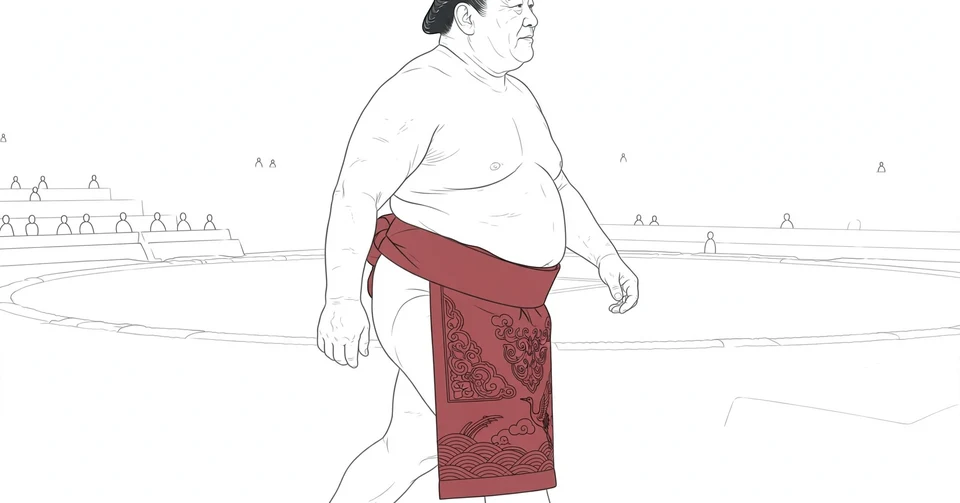
The Japanese have a saying for the gap: the difference between a sekitori and everyone below him is like heaven and hell. It sounds like exaggeration until you list what actually changes. Almost every comfort, freedom and scrap of dignity in a wrestler's working life is rationed by rank, and nearly all of it switches on at exactly the same moment.
Seventy men out of six hundred
Professional sumo is a pyramid of six divisions. Every wrestler, or rikishi, belongs to a stable and climbs the same ladder, from the jonokuchi division at the bottom through jonidan, sandanme and makushita, toward the two divisions that matter most. The second division, juryo, holds 28 wrestlers. The top division, makuuchi, holds 42, from the numbered maegashira ranks up through sekiwake, ozeki and the yokozuna at the summit. Add the two together and you get seventy, out of a total of roughly 600 active wrestlers.
Those seventy are the sekitori. The word is old and rather beautiful. It means something like the man who has taken the barrier, from the sekisho, the checkpoint barriers that once controlled the roads of feudal Japan and were guarded by exactly the kind of big, strong men that early sumo recruited. To be a sekitori is to have passed a checkpoint that most never pass. The arithmetic is unforgiving: by the usual reckoning, only about one wrestler in fifty ever reaches juryo, and one in a hundred reaches the top division. Most recruits, who join at fifteen or so, will spend their whole careers in the black mawashi of the lower divisions and retire without ever being paid a wage.
Promotion is decided every two months, when a new ranking sheet, the banzuke, is drawn up from the results of the last fifteen day tournament. A sekitori fights fifteen bouts in a tournament and needs eight wins to hold his ground. That rhythm matters, because everything described below is rented, not owned. The white cloth is re-earned six times a year.
What a sekitori wears, from the training hall to the ring
Start with the training hall, because that is where the white appears. For morning practice a sekitori wears a white mawashi while every junior wears black, so a glance across the clay tells you who may be greeted and who does the greeting. The cloth itself is plain cotton, and there is a quiet honesty in that which I have always liked. The badge of the elite is not a jewel or a logo. It is laundry. Seniority even shows inside the white, since years of washing fade and yellow the cloth, and an experienced eye can spot the veteran by the tired colour of his mawashi.
Silk belongs to tournament days. In an official bout a sekitori wears a coloured silk mawashi called a shimekomi, with stiffened cords, the sagari, hanging at the front, while the lower divisions still fight in their dark training cloth. For the ring entering ceremony he adds the kesho-mawashi, a heavily embroidered apron of silk, often a gift from his supporters' club, worn for the slow, formal parade around the ring and then removed before the fighting starts. Nothing about it is practical. That is rather the point.
The rest of the uniform follows the same logic of visible rank. A sekitori's hair is dressed in the oichomage, an elaborate topknot fanned out into the shape of a ginkgo leaf, where a junior wears a simpler knot. Away from the ring he may wear a crested kimono and haori jacket with hakama trousers, white tabi socks and fine sandals, a wardrobe closer to a formal gentleman's than an athlete's. Dress in sumo is a published ranking that a wrestler carries on his body all day, and the sekitori wardrobe is the edition everyone can read.
The morning turns upside down
Nothing shows the reversal better than training. The day at a stable begins before dawn for the juniors, who rise first, clean, cook and stretch, and begin the dawn session known as asageiko on empty stomachs. The sekitori arrive last of all. As each one enters, the room greets him, and his own attendants break off from their training to help him tie on the white mawashi. The boy who was woken at four to scrub the kitchen may, a few years and one promotion later, be the man being greeted at the door.
The order of everything follows rank. Sekitori bathe first after practice, in clean water, while the juniors wait. They eat first, served by wrestlers below them, while the juniors wait again, hungry, until the seniors have finished and gone to nap. A junior's whole day is structured around serving people above him. A sekitori's day is structured around being served, and the switch between those two lives happens on the morning the new banzuke is published, not gradually, rank by rank. Yesterday's servant wakes up as somebody's master.
A salary, at last
The money is the bluntest part of the change. Wrestlers have only been paid a proper wage since 1957, and to this day the wage stops at the same barrier as everything else. A sekitori receives a real monthly salary from the Japan Sumo Association. A wrestler one rung below him, in makushita, receives none, and neither does anyone further down.
The salary figures in force since the January 2019 tournament, the first raise in almost two decades, are a ladder of their own. A juryo wrestler, the lowest sekitori, earns 1.1 million yen a month. A rank and file maegashira in the top division earns 1.4 million. Sekiwake and komusubi earn 1.8 million, an ozeki 2.5 million, and a yokozuna 3 million yen a month. On top of the salary, sekitori collect a bonus called mochikyukin, paid at every tournament and built up across a whole career from wins, championships and victories over yokozuna, so that two men at the same rank can be paid quite differently according to what they have done.
Below the barrier, the numbers fall off a cliff. Wrestlers who are not sekitori, known collectively as toriteki, get no salary at all. Instead they receive a modest allowance at each tournament: 165,000 yen for a makushita wrestler, then 110,000 in sandanme, 88,000 in jonidan and 77,000 yen in the bottom division. It is pocket money for toiletries and a phone bill, handed to grown men who train beside millionaires. What the toriteki do receive is their keep. The stable feeds and houses them, which is exactly why the system can be defended and criticised in the same breath. Nobody below juryo starves. Nobody below juryo is paid, either.
Servants, a private room and a door that closes
The full list of sekitori privileges runs long, but three of them change daily life more than all the money. The first is the tsukebito, the personal attendant. Every sekitori is assigned at least one, and the higher he climbs the more he has. The tsukebito helps him dress, carries his belongings in the traditional bamboo akeni box, runs his errands, helps him bathe and acts as a kind of secretary. What gives this its charge is who the tsukebito are: junior wrestlers, doing for the sekitori exactly what the sekitori once did for his own seniors. The promotion does not just end your servitude. It hands you the other side of it.
The second is a private room. A junior sleeps in a shared dormitory with the rest of the stable's young wrestlers, on a futon in a room that is never entirely his. A sekitori gets a room of his own, with a door that closes, which in the compressed world of a stable is a form of wealth all by itself. The third is freedom to leave. Wrestlers below sekitori must live in the stable, and marriage is effectively out of reach. A married sekitori may live outside with his family and come in to train, the first arrangement in his adult life that resembles an ordinary person's.
Around these come the honours. A sekitori may have his own supporters' club, a koenkai, whose members fund things like his kesho-mawashi and gather at parties after tournaments. His name is painted on the tall nobori banners that line the arena entrance on tournament days. He alone may give fans a tegata, a print of his hand in ink signed with his ring name, sumo's version of an autograph. And if he holds the rank long enough, he earns the right to stay in the sport after retirement as an elder, one of the men who actually run the association. No toriteki, however long he serves, can do any of these things.
The ceremony before the fight
On tournament days the status is staged for the public. Sekitori take part in the dohyo-iri, the ring entering ceremony, circling the clay in their kesho-mawashi while the crowd applauds each man by name. The juryo ceremony comes in the afternoon, the makuuchi one later, and a yokozuna performs his own slower version, stamping the ring nearly empty of everyone but his attendants.
Even the minutes before his bout belong to a different sport than the one the juniors play. A sekitori throws salt to purify the ring, rinses his mouth with the water of strength, and stamps out shiko, the high leg stamp that drives evil from the clay, in rituals the lower divisions simply skip. He has a personalised towel waiting for him. A makuuchi wrestler has his own silk cushion to sit on while he waits. The crowd, meanwhile, watches a man whose every small comfort has been itemised by tradition, and who earned each item the only way the sport allows.
Heaven and hell are one bad tournament apart
It is worth ending on the fragility, because the privileges are real and so is the drop. A juryo wrestler who loses eight or more of his fifteen bouts will usually be demoted to makushita, and with that single step down he loses, all at once, the salary, the private room, the attendants, the kesho-mawashi and the white mawashi itself. He goes back to serving the men he was served by last month. Careers in sumo are short, injuries are common, and the ranking sheet is reprinted six times a year with no sentiment in it at all.
And yet I cannot bring myself to call the arrangement simply cruel. There is something almost old fashioned in how legible it is. Modern sport hides its hierarchies behind contracts and agents and clauses nobody may read. Sumo prints its hierarchy on the cloth around a man's waist, in full view of everyone, and lets him keep it only for as long as he can defend it in the ring, fifteen seconds at a time. The white mawashi is not a reward for being famous, or marketable, or well connected. It is a receipt for wins.
That, in the end, is what the white silk means. It means a fifteen year old who arrived at the stable with nothing has beaten the longest odds in Japanese sport, and that everyone in the building, from the stablemaster to the newest recruit scrubbing the kitchen floor, can see exactly what he did, because he is wearing it.
More in Culture & Society
Latest posts
- In Mamoiada, Two Hundred Families Still Make Wine at Home
- Shochu and the Quiet Spirit of Japan
- A Dried Shiitake Is Louder Than a Fresh One
- Loma Linda's Long Lives Run on Saturdays
- Maruten Numazu and the Towering Kakiage Bowl of the Port
- The Three Sisters Grow Better Together
- Tatamiishi Terraces Filter a River Through Stone
- Wasabi-Zuke Puts the Whole Plant in Sake Lees
- Konyoku Is Still Out There, Past the Last Train Station
- Dry January Lasts a Month on Purpose
- Ikaria Runs on Island Time
- Why Nicoya Cooks Its Corn in Lime
- Nobody Eats the Daidai, and That Is the Point
- There Are Only 105 Toshiyori Shares in All of Sumo
- Kasuzuke Pickles Almost Anything in Sake Lees