Katsuobushi Is a Fish You Shave Like a Block of Wood
· 11 min read
Katsuobushi begins as a skipjack tuna and ends as a dark block hard enough to plane like timber. Here is how simmering, smoking and mold turn one fish into the backbone of Japanese dashi.
Knock two blocks of katsuobushi together and they do not thud, the way fish should. They ring, with a dry, bright note closer to two pieces of wood, and makers trust that sound as a final test. If it rings, the fish is finished. The odd part is that the thing making the noise was, roughly half a year earlier, a skipjack tuna pulled silver and thrashing from the Pacific.
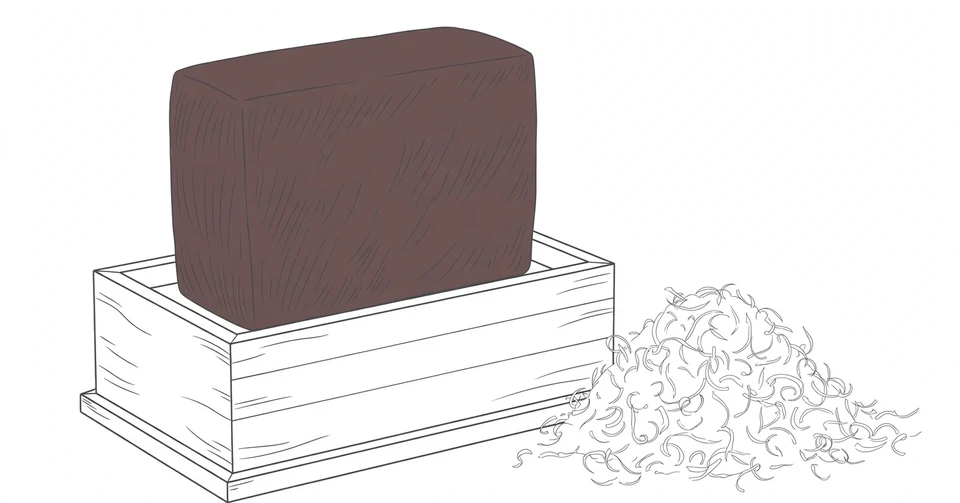
Katsuobushi is what Japan does to that tuna when it wants the flavour to outlast the fish by years. The fillet is simmered, smoked, scraped clean and then deliberately covered in mold, giving up almost all of its water and most of its weight, until what remains is dense and dark and far too hard for any kitchen knife. You do not slice katsuobushi. You plane it, the way a carpenter planes a beam, and the pale curls that fall from the blade are the bonito flakes behind dashi, the stock under half of Japanese cooking.
It is often called one of the hardest foods in the world, and that title turns out to be only half folklore. What is not folklore at all is the patience involved. Before anyone shaves a single flake of katsuobushi, one block can spend around six months being patiently taken apart by heat, smoke and fungus.
It starts as a skipjack, not a plank
The raw material is the skipjack tuna, Katsuwonus pelamis, a fast, muscular relative of the larger tunas, known in English as bonito and in Japanese as katsuo. Not every skipjack qualifies. Fat is the enemy of the whole process, because over months of drying it oxidises and turns the finished block rancid, so katsuobushi makers favour the lean fish of the spring migration over the fat ones of autumn. Ninben, a Tokyo katsuobushi house trading since 1699, specifies fish of four and a half to six kilograms and a fat content in the raw flesh of only one to three percent. Anything larger, and the centre of the fillet cannot be dried through.
The fish is beheaded, gutted and filleted, and the fatty belly section is trimmed away because it does not preserve well. What remains is split into firm back pieces and belly pieces, and at this point the fillet still holds close to seventy percent water, almost as much as it did while swimming. Everything that follows in the making of katsuobushi is an argument with that water.
Simmered, boned, and smoked day after day
The fillets are laid in baskets and lowered into water held just below boiling, somewhere between seventy five and ninety eight degrees, for an hour to an hour and a half. The water is never allowed to roll at a full boil, because large rising bubbles would jostle the fillets until they broke apart. The gentle simmer sets the protein so that moisture can travel out of the flesh later. Then workers pull the rib bones out by hand, one piece at a time, and the skin is deliberately left partly on, partly to stop the flesh collapsing in the smoke, and partly because the wrinkles it forms as it shrinks are how an experienced maker reads dryness by eye.
Next comes the smoking that gives katsuobushi its keeping power, called baikan, over oak and sawtooth oak fires. This is not one long session but a rhythm: hours over the fire, then a full day of rest, called anjo, while the moisture inside migrates outward to the surface, then back into the smoke again. The cycle repeats ten to fifteen times over two to four weeks. The pause matters more than the fire. Smoke a fillet continuously and only its surface hardens, sealing the water inside a shell. Rest it between fires and each round can carry more water away, down to about twenty percent. The stages are old and stubbornly consistent, as Wikipedia's account of the traditional process lays out, and they have barely changed since the Edo period.
What comes out of the smokehouse is black, rough and coated in tar, and it already has a name of its own: arabushi, the rough fillet. For the great majority of production, this is where the journey ends. Arabushi, katsuobushi that stops early, is shaved, packed and sold across Japan, and there is nothing second rate about it. But for the blocks destined to become true katsuobushi, the strangest stage is still to come.
The mold that finishes katsuobushi
First the block has to be made presentable, and hospitable. Workers shave away the tar deposited by the smoke, along with fat that has wept to the surface, and true up the warped shape the heat left behind. What emerges is a smooth, reddish brown block called hadakabushi, the naked fillet. The shaving is not cosmetic. Smoke residue is antimicrobial, which was the point of smoking in the first place, and no mold will colonise a surface still coated in it. The maker has to remove the protection just applied in order to invite something in.
What gets invited is a mold of the Aspergillus glaucus group, a dry loving fungus that thrives where almost nothing else can grow, and a distant cousin of the koji mold that drives miso, soy sauce and sake. The naked fillets are sprayed with a pure culture, nowadays propagated deliberately by the katsuobushi cooperative in Yaizu, and moved into a warm, humid curing room. Within a week or two the surface blooms. Then the blocks come out into the sun, are dried hard, and are brushed clean of mold by hand, one at a time, before going back in to be colonised all over again. Repeat the cycle at least twice and the fillet can be called karebushi. Repeat it three or more times, across months, and it graduates to honkarebushi, the true dried fillet.
What the mold does to a block of katsuobushi is mostly subtraction. Its threads draw water evenly out of the centre of the block, where smoking alone stalls, bringing a finished honkarebushi down to twelve to fifteen percent moisture. Its enzymes digest the residual fat, which is why a broth drawn from this intensely animal ingredient can come out perfectly clear, with no slick of oil on top. It softens the aggressive smoke into something rounder and quieter, and by occupying the surface it keeps less welcome molds out. A long investigation into what the mold actually does makes the point well: most fermentation adds things, alcohol, acid, sugar. This one takes things away.
Harder than rock salt, softer than a coin
So is katsuobushi really the hardest food in the world? Somebody in Japan actually checked. A dashi retailer tested a prize honkarebushi, the most thoroughly cured katsuobushi of all, against the Mohs mineral scale, scratching it with reference materials, and placed it at about 2.5: harder than rock salt, softer than a ten yen coin. They also went looking for the Guinness record that articles love to cite and found that no such record exists. The superlative is folklore. The density underneath it is not.
Consider what the process leaves behind. A five kilogram skipjack becomes a block of eight hundred to nine hundred grams, roughly a sixth of its landed weight, after one hundred and fifty to one hundred and eighty days of work. Water falls from about seventy percent to about thirteen. The Japan Katsuobushi Association requires anything sold under the name to sit below twenty six percent moisture, and honkarebushi rests at about half that. Slice a block open and the inside is a translucent deep ruby red, nothing like the dull beige of the surface. At that dryness there is nothing for a knife to do. The block has to be shaved.
Shaved on a box, never sliced
The tool is the katsuobushi kezuriki, a plane blade fixed upside down into a small wooden box, with a drawer underneath to catch the flakes. For centuries, shaving the morning's katsuobushi was one of the ordinary sounds of a Japanese kitchen, and the craft is old enough that the word hanagatsuo, flower bonito, for blossom thin curls from a well planed block appears in a text from 1489. Thick shavings, called kezurikatsuo, are the ones brewed into stock. The thin ones, hanakatsuo, go on top of food: scattered over okonomiyaki and takoyaki, where they curl and sway in the rising steam, or over cold tofu with ginger.
Chop the shavings fine, dress them with soy sauce, and you have okaka, a seasoning in its own right and the classic savoury heart of an onigiri rice ball. It also turns up in furikake, the sprinkle that rescues plain rice. Few ingredients work both ends of the kitchen, stock pot and garnish, as easily as katsuobushi does.
Most households, honestly, no longer keep a block and a box. The aroma of katsuobushi is volatile and starts leaving the moment shavings meet air, so the industry answered with sealed packs of ready shaved flakes, a format Ninben spent eleven years developing before launching it in 1969. A 2020 survey by a katsuobushi retailer found only around twenty three percent of respondents had ever used a shaving plane at all. Something real was traded away there, mostly aroma, but the packs are why the flavour survived the modern kitchen at all.
Why kelp and katsuobushi multiply each other
The reason all this effort matters sits in one molecule. Katsuobushi is rich in inosinic acid, a nucleotide that the simmering, smoking and curing concentrate far beyond what the raw fish holds. Kelp, kombu, brings glutamate. Put the two together in hot water and the umami does not add, it multiplies, each compound amplifying the other in the synergy that sits at the heart of dashi, the quiet stock under almost everything Japan cooks.
The grade of katsuobushi you choose changes the register of the broth. Honkarebushi gives a pale, clear, rounded dashi with the smoke pushed far into the background, the kind wanted for a clear soup where there is nothing to hide behind. Arabushi keeps its smoke up front: darker, sharper, more assertive, and often the better tool under miso or other strong seasoning. Neither is the fake version of the other. They are two tools that happen to share a fish.
Three towns make nearly all of it
For all its fame, katsuobushi comes from a very short list of places. Ministry of Agriculture fisheries statistics put national output at 26,493 tonnes in 2024, and more than three quarters of it, 20,193 tonnes, came from Kagoshima Prefecture alone, above all from Makurazaki and the Yamakawa district of Ibusuki, down on the southern tip of the Satsuma Peninsula. Shizuoka accounted for a further 6,114 tonnes, effectively all of it from the port city of Yaizu. Those three towns, Makurazaki, Ibusuki and Yaizu, are the whole map of the katsuobushi industry. Fully cured honkarebushi is a small minority of what circulates, by trade estimates around a fifth or less.
Living in Shizuoka, I admit a small bias here. Yaizu is close enough to home that its name is on the packs in my local supermarket, and its cooperative is the one that propagates the mold culture other makers spray on their blocks. One of the three towns keeping this six month craft alive is, by the standards of Japanese food geography, a neighbour.
The smoke, oddly, nearly exiled the finished product. Smoking generates compounds that the European Union regulates tightly, and traditionally made katsuobushi could not clear those limits, leaving a foundation ingredient of Japanese cuisine effectively barred from Europe just as Japanese food was booming there. The producers of Makurazaki responded by emigrating with their craft: in 2016 a plant built by a Makurazaki group opened in Concarneau, a fishing port in Brittany, running the full sequence from raw skipjack to shaved packs on European soil.
Set katsuobushi beside Japan's other great fermentations and it sits oddly among them. Miso, soy sauce and sake are all constructive, building flavour richer than what went in. This block is the opposite. Six months of heat, smoke and fungus hand back something smaller, harder and plainer than the fish that entered the process, and then a cook shaves two grams of it into hot water and the whole apparatus disappears into a bowl of soup that tastes, above all, restrained. Japan's cooking is often described as an art of subtraction. Usually that describes something a cook does. Here it describes something a mold did, slowly, in the dark, while the maker watched the weather.
More in Food & Travel
Latest posts
- Japan's Population Decline and the Villages It Leaves Behind
- KRL Commuterline and the Trains That Move Jakarta
- Loma Linda's Long Lives Run on Saturdays
- The Three Sisters Grow Better Together
- Half the Old Springs in Japan Thank Kobo Daishi
- Tatamiishi Terraces Filter a River Through Stone
- Wasabi-Zuke Puts the Whole Plant in Sake Lees
- Konyoku Is Still Out There, Past the Last Train Station
- Karo Is the Tengger's Other Great Gathering
- Dry January Lasts a Month on Purpose
- Urashima's Dragon Palace Had a Name, Ryugu
- Petruk's Nose Arrives Before He Does
- Ikaria Runs on Island Time
- Why Nicoya Cooks Its Corn in Lime
- A Ngaben Can Take a Village Years to Prepare