Bogu Is the Armour That Lets Kendo Strike at Full Speed
· 18 min read
Bogu is the protective armour that lets kendo practitioners strike each other at full speed without serious injury, and each of its four parts has a job to do.
A shinai can move fast enough to sting through a cotton uniform. It is bamboo, split into four slats and bound tight, and when two practitioners meet in the middle of a dojo the sound of it landing is sharp enough to make a visitor flinch. The reason nobody flinches for long is the bogu, the armour standing between the strike and the body.
As the kendo article on this site puts it, "Practitioners wear protective armour called bogu and strike each other with a bamboo sword called a shinai." That one sentence carries the whole bargain of the sport. The sword is real enough to demand respect, and the armour is strong enough to let people commit to a strike without holding back. Without bogu, kendo would be a slow, careful dance. With it, two people can meet at full speed and both walk away unhurt.
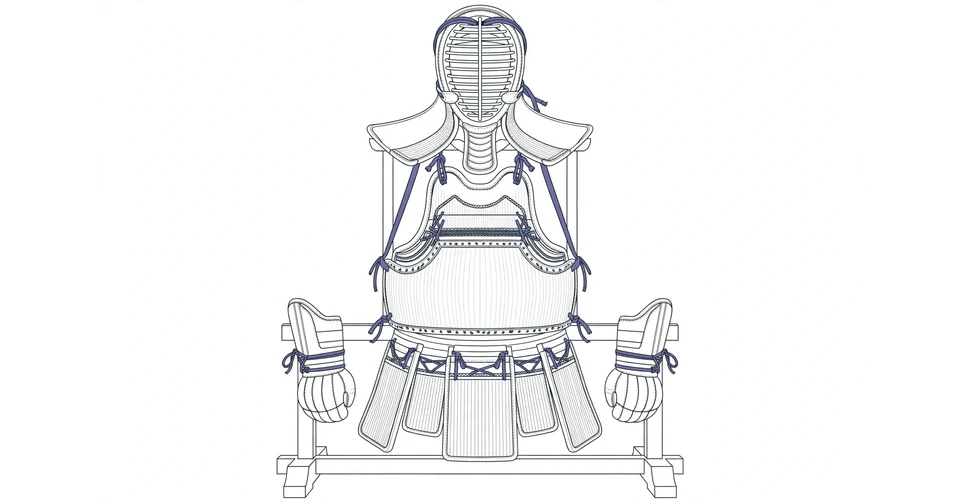
The armour, the bogu, has four parts, and each one is a small piece of engineering. The men protects the head and shoulders, with a metal grille across the face and thick padding at the throat. The kote are padded gloves that guard the wrists and forearms. The do is a curved breastplate, often lacquered, that covers the torso. The tare hangs at the waist and protects the hips and groin. That description, quoted from the same article, is the map for everything that follows. Each part of bogu answers a question the sword asks, and together they answer the biggest question of all, how to practise a sword art honestly without hurting anyone.
What bogu actually is
Bogu is training armour, and its formal name is kendogu, which simply means kendo equipment. It is worn in kendo, and in close relatives such as jukendo and naginata, wherever people strike each other with a shinai or a polearm and need to do it again the next day. The word itself is plain. Bo means protect, and gu means equipment, so bogu is protection you wear.
It looks old because its shape is old. The men borrows from the kabuto helmet, the do borrows from the cuirass of samurai armour, and the tare hangs like the skirted plates that once guarded a warrior's hips. But bogu is not a museum piece dressed up for the dojo. It is a working tool, and every part of it has been changed over generations to fit a single purpose, letting people strike and be struck at full commitment. A suit of samurai armour was built to turn aside a blade in battle. Bogu is built to absorb a bamboo sword in practice, hundreds of times a week, and to keep doing it for years.
There is a quiet honesty in that difference. Samurai armour promised survival in a fight that might happen once. Bogu promises something harder, a routine in which you are hit on purpose, over and over, and you learn to welcome it. The armour does not pretend the strike is not happening. It lets you feel it, hear it, and stand your ground, and it draws the line just short of injury. That is a kind of wisdom in itself. Protection that removes all feeling teaches nothing, while protection that removes only the damage teaches everything.
The men guards the head and the throat
The men is the most recognisable part of bogu, and the first thing a stranger notices. It is a padded helmet with a metal grille across the face, called the mengane, and thick quilted flaps, the mendare, that fall over the shoulders. Under the chin sits the tsukidare, a reinforced flap that guards the throat, because the thrust to the throat, tsuki, is one of the legal targets in kendo and one of the most dangerous places to be hit.
The grille is the clever part. Its horizontal bars are spaced so that a shinai cannot pass through, while the gap between the bars is wide enough to see through. One gap is set slightly wider than the rest, the monomi, and a practitioner rests their eyeline there, looking out through the bars at the opponent. The metal was once iron or nickel silver, and today it is often a light alloy such as duralumin, or titanium for adults who want the strongest grille at the lowest weight. A modern variant removes some bars near the monomi and covers the opening with a clear polycarbonate panel, a design first sold in 1997 under the name Mujumen, and now accepted in competition.
The rest of the men is padded cloth, stitched in the dense quilting called sashiko, thick enough to soften a strike to the top of the head or the side of the skull. Underneath it, the practitioner wears a tenugui, a thin cotton towel wrapped around the head. The towel absorbs sweat, protects the hair from the padding, and keeps the men from slipping. The men is tied with cords called himo, and the knot sits at the back of the head, neat and short. A loose cord is not just untidy, it is a hazard, and seniors in the dojo will notice it before they notice your footwork.
Wearing the men changes how the world sounds. Your own breathing is loud inside it, your voice comes back to you, and the grille turns everything into a fine grid. Beginners often lift their chin to see better, which exposes the throat, and the men quietly punishes that habit until posture improves. It is a strict teacher, but a fair one.
The kote protect the hands that hold the sword
The kote are padded gloves, and they were designed expressly for kendo, which makes them the youngest idea in bogu. Each one covers the hand and the forearm, with a thick quilted cuff, the kotebuton, and a leather fist, the kotegashira. The palm is thin leather, so that the fingers can still feel the grip of the shinai, and the thumb sits in its own separate pocket, which keeps the grip firm without forcing the hand into an awkward shape.
They have to do two jobs that pull in opposite directions. They must be thick enough to take a direct strike to the wrist, one of the four legal targets, and they must stay flexible enough for the fast, small movements of the hands that drive a shinai. The answer is layers. Cotton or synthetic fabric, stuffed with thick filling, gives the padding its bulk, while the leather palm and the narrow wrist section keep the glove close to the hand. Some modern kote add high density foam for extra impact absorption, and some are made to be washed, which matters in a sport where the gloves soak up sweat every session.
The kote also reveal something about the spirit of bogu. The wrist is a small target, and a good player will bait an opponent into reaching for it. To strike kote cleanly, you must be fast and precise, and to receive a kote strike, you must trust the padding. That trust is earned slowly. The first time a shinai lands on your wrist, you brace for pain, and then you feel the padding spread the force and realise you are fine. After that, the kote stop being a shield and start being permission, permission to keep your hands forward and your guard honest.
The do turns the torso into a drum
The do is the breastplate, a curved shell that covers the chest, the abdomen, and the sides of the body. Its core is hard, traditionally bamboo, and today often plastic or fibre, covered with leather and finished with urushi, Japanese lacquer. The classic finishes are black roiro or dark brown tameiro, polished to a deep shine, though some do are left as plain leather, and many carry embroidered patterns such as cloud shapes or latticework across the chest. It is the part of bogu where a practitioner is allowed a little vanity, and dojo seniors will tell you to check with your teacher before choosing a loud design, because the do also carries the name of your dojo in the eyes of everyone watching.
A strike to the do is the loudest sound in kendo. The shinai lands on the hard shell and the whole torso rings like a drum, and judges listen for that sound as part of the evidence that a strike was committed and clean. The do takes the blow on its curve and spreads it, so the ribs underneath feel pressure rather than pain. That is why the do matters beyond protection. It turns a hit into something audible and honest, a sound both fighters can hear and agree on.
Under the do, the body is still working hard. The breastplate is rigid, so it does not breathe with you, and in summer the heat inside it is part of the training. Practitioners learn to breathe low and steady, to keep the shoulders down inside the armour, and to let the do move with the body rather than fight it. A do that fits well disappears from your attention. A do that fits badly will remind you of itself with every step, which is its own lesson about the value of good equipment.
The tare guards what no point can win
The tare is the least dramatic part of bogu, and the easiest to underestimate. It is a belt of thick quilted cloth worn around the waist, with three flaps hanging down at the front and two smaller flaps at the sides. The flaps cover the hips, the groin, and the tops of the thighs. It is tied with long cords, the tare himo, crossed at the back and knotted in front, and the top of the tare should sit level with the navel.
No point is scored for striking the tare. The hips and groin are not legal targets, so the tare never wins a match, but it does a quieter job. It catches the strikes that miss, the shinai that slides off a do, the cut that falls short of a men, the careless swing of a beginner. It also carries the zekken, or nafuda, the cloth name tag stitched to the centre flap with the name of the practitioner and the dojo. In a crowded practice hall where every men looks the same, the name tag on the tare is how people know who you are.
There is a small lesson in the tare about the difference between glory and usefulness. The men and the do get the attention because they are targets and they make the noise. The tare gets none of that, and it does its work anyway, every session, without applause. Kendo has a place for that kind of humility, and bogu builds it into the body, a piece of armour that protects without ever scoring.
From samurai armour to the modern dojo
Bogu was not invented in a single moment. Its shape comes from the armour of the samurai, but its purpose was worked out slowly, in the practice halls of Edo period Japan, from 1603 to 1868. Training with a real sword was too dangerous for daily practice, so wooden swords appeared, first the bokken and then the shinai, and armour based on the samurai's own gear was developed so that partners could strike each other and survive the lesson. Early forms of this training armour existed in schools such as Jikishinkage-ryu from around the middle of the 17th century, but it was in the Meiji period that bogu took on the design we would recognise today.
The history has named heroes. In the early 18th century, Naganuma Shirozaemon Kunisato of Jikishinkage-ryu spread a style of training in which partners struck each other with a shinai while wearing protection, a practice called uchikomi. A generation later, Nakanishi Chuzo of the Itto-ryu school added an iron men and bamboo armour, and other schools took up the same method. The four slat shinai that modern kendo uses arrived later in the Edo period, replacing an older leather wrapped bamboo sword. By the time kendo took its modern name in the early 20th century, the bogu and the shinai had grown up together, each one shaped by the other.
The full story of the parts, their materials, and the order in which they are worn is told in detail in a Japanese reference work on bogu, which traces the design from samurai armour through the improvements of the Meiji period to the modern set. What strikes me about that long history is how little the idea has changed. The materials improved, iron gave way to alloy, bamboo gave way to fibre, but the purpose stayed exactly the same, to let two people practise a sword art at full speed and go home whole.
Putting bogu on and looking after it
Bogu is put on in a set order, and the order is part of the discipline. First the tare, tied snug at the waist. Then the do, its cords tied in flat, horizontal bows at the back. Then the tenugui, wrapped around the head, then the men, tied at the back of the head. Then the left kote, then the right kote. Taking it off runs the same order in reverse. Beginners are sometimes allowed to wear only the tare and the do at first, so they can learn footwork and distance before the men closes over their face.
The cords, the himo, deserve attention out of proportion to their size. A men himo that is tied too long can catch a shinai or trail across the floor. A kote himo left dangling can flick an opponent. Teachers check them the way a pilot checks a checklist, because a loose cord is a small failure of care, and care is what keeps a room full of swinging bamboo safe.
After practice, bogu needs the same care it gives. The men absorbs sweat quickly, so it should be wiped inside and aired in a shaded, ventilated place, never left in direct sun. The kote need thorough drying, or bacteria will grow in the padding and the leather palms will crack. The do and the tare can be wiped with a dry cloth, and the stitching should be checked for fraying, because a torn seam is a weak point. A guide to kendo armour puts it simply, clean the gear after each session, dry it properly, and inspect it for damage, and it will last for years of hard use.
Packing bogu away is a small ritual of its own. The tare himo are smoothed flat and wound around the centre flap, the tare is tied to the outside of the do so that its curve is preserved, and the men goes inside the do with the kote tucked on either side. It is a tidy bundle, and the tidiness is the point. A person who folds their armour with care is a person who will tie it with care, and a person who ties it with care is a person other people can trust to swing a sword at them.
Why bogu fits the four legal targets
Kendo has four legal striking targets, men, kote, do, and tsuki, the thrust to the throat. Bogu is built around exactly those four places, and the match between armour and target is no accident. Each piece of bogu guards a target, and each target is only legal because the armour guards it. The men covers the head and the throat. The kote cover the wrists. The do covers the torso. The tare covers the rest, the places that are not targets at all.
That symmetry is what makes kendo possible as a sport. Without it, a competition would be a long argument about what counts as a fair hit. With it, the rules are simple enough for a beginner to understand in a single lesson, and deep enough for a lifetime of practice. You may strike the head, the wrist, the torso, or the throat, and nowhere else. The armour draws the map of the body, and the map draws the rules.
It also keeps the practice honest. A strike that lands on the tare does not score, so a fighter who aims low to avoid the guarded targets is wasting effort. A strike that lands flat, or without spirit, will not be counted even if it touches the right place, because the judges are listening for the sound and watching for the commitment. Bogu does not make kendo easy. It makes kendo fair, which is a harder and better thing.
How bogu turned sword practice into full speed training
Before bogu, sword practice had a problem with no good answer. A real sword could not be used against a partner, and a wooden sword used without armour could still break bones. The result was kata, prearranged forms practised slowly, and drills where the strike stopped short of the body. Those are valuable, but they leave a gap. A swordsman who has never been struck at full speed does not know what a real exchange feels like, and a swordsman who has never committed to a strike does not know what commitment costs.
Bogu closed that gap. With the armour on, two practitioners can strike each other with full intent, and the shinai can land hard enough to be heard across the hall. The fear of injury does not vanish, but it moves to a place where it can be managed, and what is left in its place is something closer to the real thing. Distance, timing, and courage can be trained under pressure, not just imagined in slow motion. That is why the history of kendo and the history of bogu are the same story. The armour did not just protect the art, it allowed the art to exist in its modern form.
There is a parallel here that goes beyond the dojo. Good protection does not remove risk, it makes risk worth taking. A climber trusts the rope and climbs higher. A student trusts the teacher and asks a harder question. Bogu works the same way. It does not pretend the sword is harmless, and it does not let the sword do real harm. It holds the space between the two, and in that space people learn faster than they would in safety or in danger alone.
The first time you wear bogu
Most dojo make beginners wait before they wear the full set. At one Australian club, the wait is about three or four months of regular training, and the pattern is similar in many dojo around the world. The delay is not a punishment. It is a kindness. Footwork, posture, and the basic cuts need to be in the body before the armour closes over it, or the beginner will spend all their attention fighting the equipment instead of learning the sword.
When the day comes, the first sensation is weight. The men presses on the head, the do holds the torso stiff, the kote make the hands feel clumsy, and the tare tugs at the waist with every step. Vision narrows to the gap between the bars, and the sound of the room changes, muffled and close. Many beginners feel clumsy and a little ridiculous, and then the first strike lands, and something shifts.
The strike is loud, and it is not painful. That is the moment bogu makes its promise, and it is a strange and generous feeling. Someone has just hit you as hard as they can, on purpose, and you are fine. You can breathe, you can move, you can answer. The armour has done its job, and the fear that was holding your shoulders up begins to let go. From then on, the weight stops being a burden and starts being a boundary, the edge of a safe space inside which you are allowed to be brave. I think that is the real gift of bogu, not the padding or the lacquer, but the courage it lends to people who have not yet found their own.
Kendo is often described as the way of the sword, and the sword gets most of the poetry. The shinai is the weapon, the cut is the drama, and the point is the glory. But the way of the sword is walked inside armour, and the armour decides how far and how fast a person can walk it. Bogu is the quiet partner of the shinai, the part that takes the blow so the practice can continue. The next time you watch two practitioners meet in the middle of a dojo, listen for the crack of the shinai on the do, and remember what is standing between the sound and the skin. It is four pieces of cloth, leather, bamboo, and steel, stitched and tied by hand, and it carries a tradition that began when swordsmen decided that the best way to keep the sword alive was to make it safe to practise.
More in Culture & Society
- Pancawara Gives Bali a Five Day Week That Never Stops Turning
- Hanami Turns Cherry Blossom Season Into Japan's Longest Picnic
- Ema Lets You Hang a Wish Where the Kami Can Read It
- Bonsai and the Thousand-Year Art of Tiny Trees
- The Shinai Is a Bamboo Sword That Teaches Before It Strikes
- Omikuji Tells Your Fortune on a Slip of Paper
Latest posts
- Natto, the Sticky Fermented Beans Japan Loves and Visitors Fear
- Japan Meets the New Year at Hatsumode
- The Way of the Sword Lives On in Kendo
- Hakama Turn a Kimono Into Ceremony
- A Haori Is the Jacket That Turns a Kimono Formal
- The Taiko Musubi Turned a Kimono Sash Into a Drum
- Hiroshige Walked the Tokaido and Japan Followed
- Hokusai Spent a Lifetime Chasing One Mountain
- Tabi Are the Split Toe Socks Japan Wears Under Everything
- Ukiyo-e Turned Everyday Edo Into Art Anyone Could Own
- Zori Are the Quiet Sandals Japan Wears to Every Formal Occasion
- An Obi Is the Knot That Holds a Kimono Together
- Joya no Kane Rings Out the Old Year One Hundred Eight Times
- Base Genep Seasons Every Balinese Feast From the Mortar Up
- Geta Still Clatter Through Japanese Summer