Ema Lets You Hang a Wish Where the Kami Can Read It
· 16 min read
An ema is a small wooden plaque on which you write a wish and hang it at a Shinto shrine, and this guide follows the tradition from live horses to the painted plaques visitors still dedicate today.
Walk through the grounds of almost any Shinto shrine in Japan and you will come to a wooden rack covered in small plaques, each one carrying a handwritten wish. Some ask for exam success, some for good health, some for love, and some simply say thank you. The plaques flutter slightly in the wind, and together they look like a wall of quiet conversations between ordinary people and the kami. An ema is that plaque, a small piece of wood that turns a private hope into something you can see, touch, and leave in a sacred place.
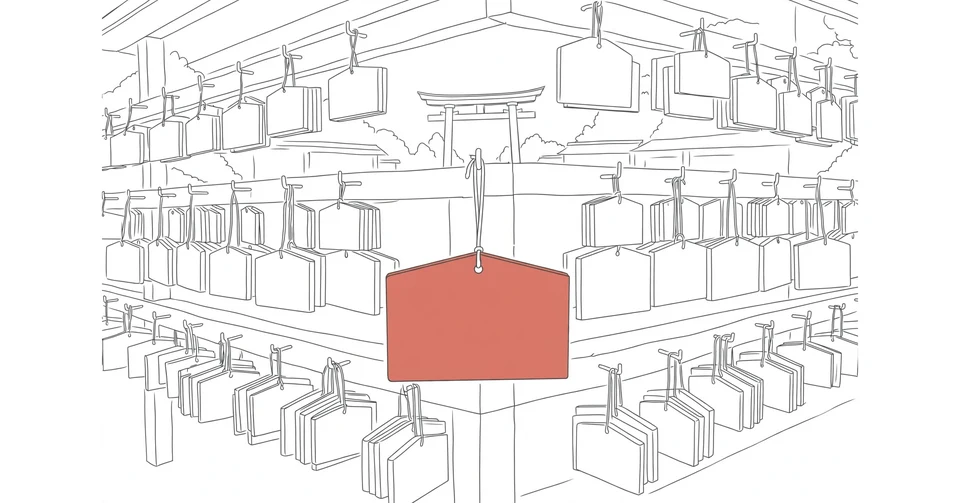
The idea behind the ema is beautifully simple. You buy a plaque at the shrine, write your wish on it, and hang it where the kami can receive it. As we wrote in our guide to the New Year shrine visit, many shrines sell ema, wooden plaques on which you write a wish and hang it up for the kami to receive, and that sentence still captures the whole practice in one breath. Our guide to fortune slips says it just as plainly: "An ema is a wooden plaque on which you write a wish and hang it up for the kami to receive. The word literally means picture horse, and the plaques stand in for the real horses once offered to shrines." What looks like a souvenir is really a letter, written by hand and delivered in person.
There is something honest about a wish you have to write down. A thought can drift away before you finish it, but a sentence on wood asks you to decide what you actually want. That is the first lesson of the ema, and it is why a tradition more than a thousand years old still fills the racks of busy shrines every New Year.
From a living horse to a painted one
The history of the ema begins with a real animal. In early Shinto practice, the horse was seen as a messenger of the kami, a sacred creature that could carry prayers between the human world and the divine. Wealthy patrons and rulers donated live horses to shrines, especially when they prayed for rain in a drought or for the rain to stop in a flood. A horse was an expensive gift, and it was also a living one, which made the offering serious in a way that a coin in a box could never be.
Not everyone could afford a horse, and shrines could not stable an endless herd of them. So people began to offer substitutes, first small figures of horses made from clay or wood, and then flat wooden plaques painted with the image of a horse. The earliest known ema date back to the Nara period, which ran from 710 to 794, and the earliest written record of such a substitution comes from the Honcho Bunsui of 1013, which describes an offering of three paper horses at Kitano Tenjin shrine. By the Heian period, which ran from 794 to 1185, the painted horse on wood had become a familiar sight at shrines.
The practice kept changing as Japan changed. During the Kamakura period, from 1185 to 1333, the custom spread from Shinto shrines into Buddhist temples as well, and the ema became part of a shared religious landscape rather than the property of one tradition. In the Muromachi period, from 1336 to 1573, shrines began to display plaques with images other than horses, such as the foxes of Inari shrines. The Azuchi-Momoyama era, from 1573 to 1600, saw the rise of emado, halls where artists displayed their large painted plaques, and the Edo period, from 1603 to 1867, made the small personal plaque a common purchase for ordinary visitors. The large decorative plaques, known as o-ema, were often commissioned by wealthy patrons, guilds, or village communities and hung as permanent decorations inside shrine buildings, while the small ema that visitors bought for a few hundred yen became the version most people know today.
What strikes me about this history is how practical it is. The ema did not survive because someone declared it sacred and froze it in place. It survived because each generation found a cheaper, simpler, or more personal way to keep doing the same thing. A live horse became a clay horse, a clay horse became a painted board, and a painted board became a small plaque anyone could buy. The form kept shrinking, but the intention never did, and that is a good test for any tradition. If it can get smaller and still mean the same thing, it is probably built on something real.
How to write and hang an ema
Using an ema is simple, and there is no exam to pass before you try it. You buy the plaque at the shrine office, which is called the juyosho, or at the shrine goods counter. Prices typically range from 500 to 1,000 yen for a standard plaque, with larger or more elaborate shapes costing more. Many shrines set out felt-tip pens at a writing station near the rack, because the unfinished wood takes marker ink well, while pencil tends to fade over time.
The usual convention is to write your wish on the front, the side that carries the shrine printed design, in any language you like. Common Japanese formulas include gokaku kigan, a prayer for exam success, en-musubi, a prayer for a good romantic match, kenko kigan, a prayer for good health, and shobai hanjo, a prayer for business prosperity. You do not have to use any of these. A wish in plain English, Indonesian, or any other language is just as valid, because the wish is a personal message to the kami, not a test of vocabulary. On the back, some people add their name, age, and home prefecture or country, which is said to help the kami direct the blessing to the right person, but this is optional and many visitors leave it out for privacy.
Once the wish is written, you hang the ema on the emakake, the dedicated wooden rack in the shrine precincts. There is no prescribed ritual. You find a free hook, hang the plaque with the written side facing outward, and step back. If you like, you can drop a small offering in the collection box. That is all there is to it, and the simplicity is part of the point. Nobody needs a priest to translate, nobody needs to know the right words, and nobody is turned away for doing it imperfectly.
One piece of etiquette matters more than the rest. The racks are full of other people's private hopes, and reading them closely or photographing a specific plaque that carries personal details is considered intrusive. A general photo of a rack from a distance is usually fine, but leaning in to read a stranger's wish about an illness or a divorce is not. The ema is public in the sense that anyone can see it, and private in the sense that it was never addressed to you. Holding both of those facts at once is a small exercise in respect, and shrines are good places to practice it.
The designs change with the seasons
No two shrines sell quite the same ema, and that variety is half the pleasure of the tradition. The standard shape is a five-sided pentagon with a pointed top, like a miniature shrine roof, typically about 15 cm wide and 9 cm tall. The shape is said to give the kami a small home to reside in while receiving the prayer. But beyond that standard form, the designs spread in every direction, and they usually reflect the deity, the season, or the story of the shrine that sells them.
The twelve animals of the zodiac are the most reliable annual change. Each year, shrines produce a special ema in the shape of that year's zodiac animal, sold from New Year onward, and collectors return year after year to complete the set. The cycle runs through rat, ox, tiger, rabbit, dragon, snake, horse, ram, monkey, rooster, dog, and boar. A shrine that sold a rabbit ema one year will sell a dragon the next, and regular visitors learn to watch for the change the way other people watch for the first cherry blossoms.
Seasonal designs follow the same rhythm. Spring brings cherry blossom plaques at shrines famous for flower viewing, summer brings cool water and festival motifs, and autumn brings maple leaves and harvest themes. Heart-shaped plaques appear at shrines known for matchmaking, car-shaped plaques at shrines associated with traffic safety, and academic designs at shrines where students pray before entrance exams. The ema is a small canvas, and the shrine uses it to say something about itself.
The designs also carry the history of their shrine. Foxes belong to Inari shrines, cows to Tenjin shrines dedicated to the scholar Sugawara no Michizane, deer to the shrines of Nara, and rabbits to Okazaki Shrine in Kyoto, where the rabbit is the divine messenger. When you buy an ema at a particular shrine, you are not just buying a generic wish board. You are buying a small piece of that place, printed with its symbols and its story, and that is why collectors can look at a plaque years later and remember exactly where they stood when they wrote on it.
Where to find the most memorable ema
If you want to see the ema tradition at its most vivid, a few shrines stand out, and each one shows a different face of the practice. Fushimi Inari Taisha in southern Kyoto, the head shrine of roughly 30,000 Inari shrines across Japan, sells the most photographed ema in the country. Its white fox-shaped plaques come with a blank face, and visitors draw their own expression on the fox with a marker at a dedicated station, so the racks fill with rows of individualized fox faces showing joy, determination, and hope. The shrine is famous for its thousands of vermilion torii gates, but the fox ema are the sight that visitors remember most personally, because each one carries a face that someone invented on the spot.
Meiji Jingu in Tokyo offers the opposite experience, which is scale. The vast forested shrine in Harajuku, dedicated to Emperor Meiji and Empress Shoken, displays one of the largest single collections of ema during the New Year period, when the shrine receives around 3 million visitors in the first three days of January. The racks in the inner precincts hold wishes in dozens of languages, and the sheer number of plaques turns a personal act into a shared one. Standing there, you understand that you are one voice in a very large crowd, and somehow that makes the wish feel less lonely rather than less important.
Kitano Tenmangu in Kyoto, the shrine tied to the Honcho Bunsui record of 1013, sells elaborate cow ema in several sizes, along with pencil-shaped plaques that students favor when they pray for exam success. Its plum orchard blooms in late February, so a late winter visit pairs the ema with one of the best flower displays in the city. Dazaifu Tenmangu in Fukuoka is another Tenjin shrine where cow ema are popular with students, and Kasuga Taisha in Nara sells deer-shaped plaques, with the sacred deer of Nara Park wandering nearby as you write. Kanda Myojin near Akihabara is famous for anime character ema, where approved characters from games and animation appear on plaques with the shrine blessing, and some shrines now sell official branded plaques tied to popular series.
Each of these places proves the same point from a different angle. The ema is not one object repeated identically across Japan. It is a local craft, shaped by the deity, the history, and the visitors of a single shrine, and the best way to understand it is to go and see a few different racks for yourself.
What happens to an old ema
A rack cannot hold wishes forever, and shrines have a graceful answer to that problem. From time to time, the accumulated plaques are taken down and ceremonially burned in a ritual called otakiage, the ritual burning of votive objects. The fire is understood to liberate the wish from the writer and return it to the divine realm, and it also clears space on the racks for the next season of wishes. The burning usually happens around the New Year period, when the previous year plaques are retired, and sometimes again at other seasonally significant times.
The oldest surviving ema in Japan date from the early Edo period in the 17th century, and examples are preserved at Itsukushima Shrine on Miyajima Island and at Zuishin-in Temple in Kyoto. Most plaques, though, were never meant to last. The large o-ema that wealthy patrons donated were painted to be displayed for generations, but the small personal ema was always a temporary object, written, hung, and eventually burned. That temporariness is not a flaw in the tradition. It is the design. A wish that stayed on the rack forever would eventually become clutter, but a wish that is released by fire keeps moving, and the rack is ready for the next person.
I find this part of the practice quietly wise. We live in a time when almost everything we write is stored forever, searchable, and impossible to take back. The ema works the other way. You write something that matters, you leave it in a public place for a season, and then it is gone, carried away by smoke. There is relief in that. Not every hope needs to be archived. Some hopes just need to be spoken once, clearly, and then let go.
Ema, omikuji, and omamori are not the same thing
Visitors often meet three wooden and paper objects at a shrine, and it is easy to mix them up, so it helps to keep them straight. The ema is the one you write on and leave behind. The omikuji is the one you draw and read. Our guide to the fortune slips explains that an omikuji tells your fortune on a slip of paper, and the contrast with the ema is instructive. With an omikuji, you receive a message. With an ema, you send one. The omikuji is a small act of listening, and the ema is a small act of speaking, and a shrine visit can comfortably hold both.
The omamori is the third object, and it works differently again. An omamori is a small amulet, usually a cloth pouch, that you carry with you for protection or good fortune. You buy it, keep it close, and return it to the shrine after a year or so for ritual burning. The ema stays at the shrine, the omikuji is read and often tied to a branch or a rack at the shrine, and the omamori travels with you. Three objects, three directions: one stays, one answers, one accompanies.
Knowing the difference matters because it changes how you approach each one. You would not write your deepest wish on an omikuji, because the omikuji is not asking for your words. You would not expect an ema to protect you on a journey, because the ema is not coming with you. Each object has its own job, and the shrine is organized around the idea that a visitor might need all three at different moments in a life.
Why a small wooden plaque still matters
The ema endures because it asks so little and gives so much back. It asks for a few hundred yen, a few honest words, and a moment of attention. In return, it gives you a physical record of something you want, a place to leave it, and the company of thousands of strangers who wanted something too. The practice fits the Japanese idea of genze riyaku, the this-worldly benefits that religious practice can bring to everyday life, and it fits just as well into a modern life that rarely stops to name what it hopes for.
There is also a social side that is easy to miss. An ema hung on a rack is a public statement that someone has made a wish, and a rack full of them is a portrait of a community at a particular moment. In hard years, the racks fill with prayers for health and safety. In exam season, they fill with school names and hopeful scores. Researchers who have studied the plaques note that they reveal what a society is worried about, and that the wishes change with the times, from recovery after disaster to an end to a pandemic. The ema is a folk archive, written by everyone, and it is more honest than most official records because nobody writes a wish to impress a historian.
The tradition has adapted without losing its shape. Some shrines now offer digital ema services, letting people submit wishes online, a practice that grew during the pandemic when visiting in person was difficult. Artists still paint large o-ema for shrine halls, and fans of anime and games hang ita-ema, plaques decorated with characters from popular series, at shrines connected to those stories. Kanda Shrine near Akihabara is a well-known center for this, and some rights holders now sell official branded plaques in collaboration with shrines. The ema keeps absorbing the culture around it, which is exactly what a living tradition is supposed to do.
If you ever visit a shrine in Japan, buy an ema and write something true on it. Not the wish you think you should have, and not the one that sounds impressive, but the one that has been quietly waiting for you to say it out loud. Write it in your own language, hang it on the rack, and walk away without looking back. The kami, if you believe in them, will read it. And even if you do not, you will have done something rare, which is to stop, decide what you want, and put it into words where you can see it. That is worth a small piece of wood.
More in Culture & Society
- Pancawara Gives Bali a Five Day Week That Never Stops Turning
- Hanami Turns Cherry Blossom Season Into Japan's Longest Picnic
- Bogu Is the Armour That Lets Kendo Strike at Full Speed
- Bonsai and the Thousand-Year Art of Tiny Trees
- The Shinai Is a Bamboo Sword That Teaches Before It Strikes
- Omikuji Tells Your Fortune on a Slip of Paper
Latest posts
- Natto, the Sticky Fermented Beans Japan Loves and Visitors Fear
- Japan Meets the New Year at Hatsumode
- The Way of the Sword Lives On in Kendo
- Hakama Turn a Kimono Into Ceremony
- A Haori Is the Jacket That Turns a Kimono Formal
- The Taiko Musubi Turned a Kimono Sash Into a Drum
- Hiroshige Walked the Tokaido and Japan Followed
- Hokusai Spent a Lifetime Chasing One Mountain
- Tabi Are the Split Toe Socks Japan Wears Under Everything
- Ukiyo-e Turned Everyday Edo Into Art Anyone Could Own
- Zori Are the Quiet Sandals Japan Wears to Every Formal Occasion
- An Obi Is the Knot That Holds a Kimono Together
- Joya no Kane Rings Out the Old Year One Hundred Eight Times
- Base Genep Seasons Every Balinese Feast From the Mortar Up
- Geta Still Clatter Through Japanese Summer