Hanami Turns Cherry Blossom Season Into Japan's Longest Picnic
· 13 min read
Hanami is Japan's spring picnic under the cherry blossoms, a tradition that began with plum blossoms in the Nara period and now fills parks across the country every year.
Hanami is the Japanese custom of gathering under cherry trees in spring to eat, drink and watch the blossoms while they last. The word means flower viewing, and for a week or two each year it turns ordinary parks into the busiest picnic grounds in Japan.
It sounds simple, and in a way it is. You spread a blue sheet under a tree, open a box of food, and sit. But hanami has been part of Japanese spring for more than a thousand years, and the simple picnic carries a long history with it, from court poetry parties to the public parks of Edo.
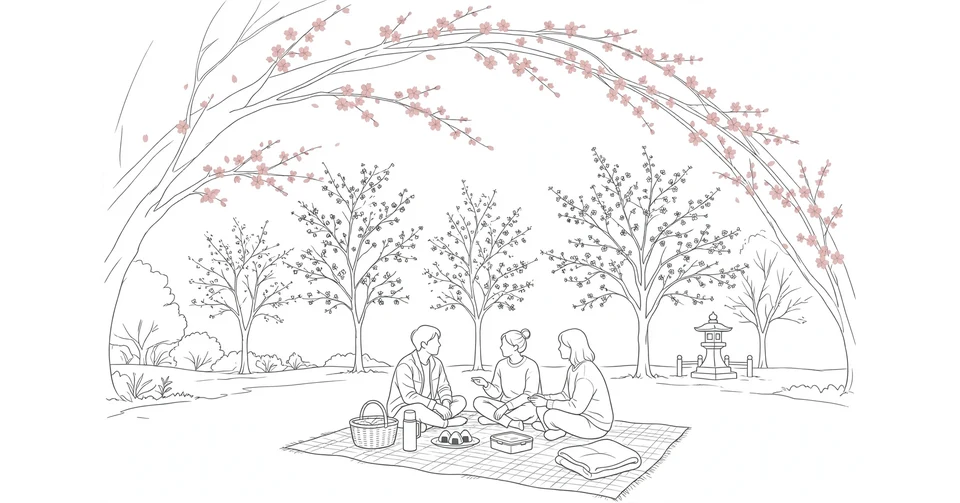
What makes hanami different from any other picnic is the clock. The blossoms are at their best for about a week, and everyone knows it. That short window is why people plan around it, travel for it, and treat a patch of ground under a tree like something worth keeping.
What hanami actually means
The word is built from two plain parts. Hana means flower, and mi means viewing. In practice the flower is almost always the cherry, sakura, although the same word can cover plum blossom viewing too. The older, narrower word for plum viewing is umemi, and it still exists, but when most people say hanami today they mean cherry blossoms.
The season runs from late March into May across most of Japan, with the far south blooming first and the far north last. In Okinawa the first trees can open as early as February. That long, slow wave is part of the appeal. Hanami is not one weekend in one city. It is a season that travels the length of the country, and people follow it the way they might follow a favourite band on tour.
I like that the word itself is so plain. Flower viewing promises nothing grand, and that is honest. Nobody goes to a hanami party expecting a spectacle with a schedule. You go to sit under a tree that will be bare again next week, and the plainness of the word matches the plainness of the act.
From plum blossoms to cherry blossoms
Hanami did not start with cherry blossoms at all. It started with plums. The custom began in the Nara period, from 710 to 794, when Japanese nobles copied a Chinese pastime called kyokusui no utage. Guests sat beside a stream, composed poems, and drank sake from cups that floated down the water from one person to the next. The parties were held on the third day of the third month of the lunisolar calendar, a date that falls in early April today. The trees they admired were ume, Japanese plum, and momo, peach, both introduced from China. In the eighth century, the blossoms that nobles admired in spring were not sakura. The full history is told in the nippon.com guide to hanami, which traces the custom from those court parties to the public picnics of today.
The shift came in the Heian period, from 794 to 1185, when Japan grew more intent on building a culture of its own. Sakura were common in the wild, and their flowers looked much like plum blossoms, so cherry trees gradually replaced plums as the flower of spring. The court chronicle Nihon Koki records a cherry blossom viewing party hosted by Emperor Saga in 812, and the Heian novel The Tale of Genji was the first work to use the word hanami in the sense of cherry blossom viewing. The old poetry collection Man'yoshu tells the same story in numbers of a different kind. It holds far more poems about plum blossoms than about cherry blossoms, a record of a time when the plum was still the flower that mattered.
That change of flower changed the feeling of the custom too. Plum blossoms are fragrant and hardy, and they bloom while winter is still leaving. Cherry blossoms are quieter in scent, and they fall almost as soon as they open. Over time the falling petal became the point. The blossom was beautiful because it did not last, and the picnic under it became a way of sitting with that fact rather than looking away from it.
How one tree changed everything
For centuries hanami belonged to the court and the aristocracy, then slowly to the samurai class. It became a custom for ordinary people in the Edo period, from 1603 to 1868, when flower viewing moved from private gardens to urban public spaces. The eighth Tokugawa shogun, Yoshimune, planted hundreds of wild yamazakura cherry trees at Asukayama and Gotenyama in Edo, so that ordinary people could enjoy them. Those parks became favourite places to eat, drink and make merry under the trees, and the modern hanami party began there.
One tree did more than any shogun to spread the custom. Somei yoshino, the pale pink cherry that most people picture when they hear the word sakura, got its start in the mid to late nineteenth century in the village of Somei in Edo. Horticulturists there crossed the wild edohigan and oshima-zakura cherries, and the result bloomed before it leafed out, grew tall quickly, and covered itself in pale pink flowers. Because somei yoshino are grown by grafting, every tree is a clone of the others, so whole avenues of them bloom at the same time in the same soft shade. In the Meiji period the tree was planted in parks, schools and along roads all over the country, and the Edo custom of sitting under the trees spread with it. It is fair to say that thanks to somei yoshino, hanami became a springtime activity that everyone could enjoy.
Japan still holds far more than that one famous cultivar. The country has ten species of wild cherry trees, and the genus holds over a hundred species across the temperate northern hemisphere. On Mount Yoshino in Nara Prefecture, wild yamazakura have been blooming and delighting the eye for over a thousand years. Knowing a little of that variety makes a hanami afternoon richer. The tree above your picnic sheet has a name and a history, and the pale pink canopy is only the most famous member of a large family.
The picnic under the trees
The food is half of hanami, and the range of it is part of the charm. At one end there is the elaborate hanami bento, packed at home or bought from a department store basement, with rice balls, rolled omelette, fried chicken, simmered vegetables and pickles arranged in neat rows. At the other end there is a bag of convenience store onigiri and a can of beer, eaten sitting cross legged on a sheet that cost a few hundred yen. Both count. Nobody at a hanami party is grading the food.
Two spring sweets belong to the season in particular. Sakura mochi is a pink rice cake wrapped in a pickled cherry leaf, and the leaf is meant to be eaten with it, salt against sweet. Hanami dango is a skewer of three dumplings in pink, white and green, the colours of spring in a single bite. They turn up in parks, at food stalls and in sweet shops all through the season, and they are as much a sign that hanami has begun as the blossoms themselves.
Drink follows the same relaxed pattern. Beer and sake are the usual choices, and the custom of drinking under the blossoms goes back to the court parties of the Nara period, when sake cups floated down a stream between poems. I think the food matters because it slows the afternoon down. A picnic cannot be rushed the way a walk can. You have to sit, open things, share things, and stay put, and staying put is the whole skill of hanami.
The quiet rules of the park
Hanami looks informal, but it runs on manners, and the manners are mostly about leaving the trees and the park as you found them. The japan-guide.com guide to doing hanami sets them out plainly. Treat the trees carefully. Do not pull on or shake branches. Do not pick blossoms. Do not climb the trees, and do not stand on their roots. Take proper care of your garbage, and remember that many parks do not have garbage bins, so be prepared to take your rubbish home with you.
Local rules differ from park to park, so check before you go. Many parks do not allow barbecuing. Some have a curfew in the evenings. A few do not allow alcoholic beverages at all. These are not suggestions. Parks that host hanami crowds every year have learned what a thousand picnics can do to a lawn and a tree, and the rules are the price of keeping the blossoms there for the next spring.
The other unwritten rule is about the sheet itself. At famous spots the best places are claimed early, and the usual practice is to spread your sheet in the morning and mark it with your group name and the starting time, or to leave someone sitting there until the rest of the group arrives after work. In many parks it is forbidden to leave sheets unattended, so the early riser is often the hero of the party. To me this is the most Japanese part of hanami. The celebration is free and open to everyone, and the only thing it asks in return is that you look after the place while you enjoy it.
Reading the bloom forecast
Because the season is short, timing is everything, and Japan has turned timing into a small national science. Each spring, forecasters publish the sakura zensen, the cherry blossom front, a map that tracks the opening of the blossoms as it moves north across the country. The front starts in the south and travels over several weeks, and the forecasts are updated through the season as the weather changes. The full picture, including when each region reaches its peak, is covered in the bayu.id guide to Japan's cherry blossoms and when to see them.
The two dates that matter are the first opening and the full bloom. Full bloom usually arrives about a week after the first flowers open, and the trees hold their peak for only a few days before the petals begin to fall. Rain and wind can shorten that window, and a warm spring can pull the whole front forward. That is why regular visitors check the forecast the way other people check the weather before a beach weekend. Nobody wants to arrive a week late and find green leaves where the blossoms were.
My own advice is to aim for the days just before full bloom rather than the peak itself. The trees are nearly there, the crowds are a little thinner, and if the weather turns, you still saw the blossoms at close to their best. Hanami rewards the person who goes a day early more often than the person who waits for the perfect day.
Where to go for hanami
Tokyo has the most famous spots, and two of them show the range of the custom. Ueno Park holds more than a thousand cherry trees, and its main path under the blossoms becomes one of the liveliest picnic grounds in the country during the season. Shinjuku Gyoen is the calmer opposite, a large garden with spacious lawns and many varieties of cherry, including late blooming kinds that stretch the season by a week or more after the famous trees have peaked.
The water makes a difference too. At Chidorigafuchi, the moat of the former Edo Castle, hundreds of cherry trees lean over the water, and the blossoms double themselves in reflection. Along the Meguro River in Nakameguro, about eight hundred trees arch over a narrow canal, and the walk beneath them is one of the most photographed in Tokyo.
For the older, wilder version of hanami, Mount Yoshino in Nara Prefecture is the place to go. Wild yamazakura have bloomed on its slopes for over a thousand years, and the mountain in full flower is less a park than a landscape that happens to be pink. Far to the north, Hirosaki Park in Aomori holds more than 2,500 cherry trees around a castle keep, and because the north blooms weeks after Tokyo, it is a second chance for anyone who missed the capital's season. Each of these places offers a different hanami, and that is the point. The custom is one idea with a hundred local forms.
When the sun goes down
Hanami does not have to end at sunset. The same trees that draw picnic crowds at noon are lit for a few hours in the evening at many parks, temples and castle grounds, and the night version has its own name, yozakura. As the bayu.id guide to yozakura, Japan's cherry blossoms after dark puts it, daytime viewing has its own name, hanami, and it has been part of Japanese spring for centuries. Yozakura is the same tradition continued past dark rather than a different custom.
The mood changes completely. The picnic sheets are folded away, the groups thin out, and the evening belongs to the stroll. Office workers stop on the way home, couples walk the river paths, and photographers outnumber picnickers. The blossoms look different too. The common somei yoshino flowers are nearly white in flat daylight, but under lantern light they read as properly pink, and against a black sky they can look almost luminous. If your trip allows only one blossom evening, give it to yozakura. Hanami in daylight is cheerful and social, and it deserves its crowds, but the lit trees at night are the version people still describe months later.
Why hanami lasts
Hanami has survived for more than twelve centuries because it asks so little and gives so much in return. It asks for a sheet, some food, and an afternoon, and it gives a reason for friends, families and coworkers to sit together outside at the exact moment the year turns warm. It began as a court pastime for nobles drinking sake beside a stream, and it became a public picnic because ordinary people wanted the same thing the nobles had wanted, which was simply to be under a flowering tree with people they liked.
The blossoms will fall whether you watch them or not. That is the quiet lesson of the season, and it is why the picnic matters more than the photograph. Go a day early, take your rubbish home, and sit a little longer than you planned. The tree will be bare again next week, and the afternoon you spent under it will be the thing you remember.
More in Culture & Society
- A Torii Gate Marks Where the Ordinary World Ends
- The Yumi Stands Taller Than Its Archer
- Kyudo Turns Archery Into a Moving Meditation
- Iaido Is the Art of Drawing the Sword Before the Fight Begins
- Pancawara Gives Bali a Five Day Week That Never Stops Turning
- Bogu Is the Armour That Lets Kendo Strike at Full Speed
Latest posts
- Ekiben, the Train Station Bento That Turns a Journey into a Meal
- Natto, the Sticky Fermented Beans Japan Loves and Visitors Fear
- Ema Lets You Hang a Wish Where the Kami Can Read It
- Bonsai and the Thousand-Year Art of Tiny Trees
- The Shinai Is a Bamboo Sword That Teaches Before It Strikes
- Omikuji Tells Your Fortune on a Slip of Paper
- Japan Meets the New Year at Hatsumode
- The Way of the Sword Lives On in Kendo
- Hakama Turn a Kimono Into Ceremony
- A Haori Is the Jacket That Turns a Kimono Formal
- The Taiko Musubi Turned a Kimono Sash Into a Drum
- Hiroshige Walked the Tokaido and Japan Followed
- Hokusai Spent a Lifetime Chasing One Mountain
- Tabi Are the Split Toe Socks Japan Wears Under Everything
- Ukiyo-e Turned Everyday Edo Into Art Anyone Could Own