Pancawara Gives Bali a Five Day Week That Never Stops Turning
· 13 min read
The pancawara is the five day market week of Java and Bali, and this guide explains its five days, its market rhythm, and the holy days it creates when it meets other cycles.
Ask someone in Yogyakarta or Ubud what day it is and you may get two answers at once. One is the day you already know, Monday or Friday or Sunday. The other belongs to a shorter week that most visitors never notice, a five day cycle called the pancawara that has been turning in Java and Bali for centuries. It does not replace the seven day week. The pancawara runs beside it, quietly naming every day a second time, and that second name still decides when markets fill, when ceremonies fall, and which weton a child born on a given morning carries for life.
The word itself gives the game away. Pancawara comes from the world of the pasar, the market, and the five days of the pancawara once told farmers and traders where to be and when. A village market did not open every morning. It opened on its own pasaran day, and sellers travelled a circuit of villages in step with the cycle, so that each place had its busy day in turn. The pancawara was a timetable you could walk to, and in many towns the old market names still remember it.
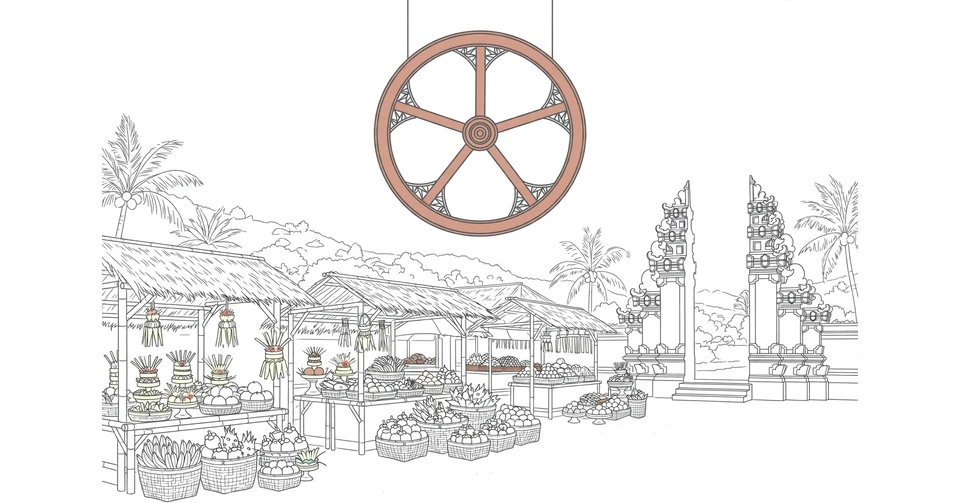
The five days of the pancawara are Legi, Paing, Pon, Wage, and Kliwon, in that order. In Bali the first day is called Umanis instead of Legi, but it is the same day under a Balinese name, so the Balinese order reads Umanis, Paing, Pon, Wage, Kliwon. If you have seen the days listed in a different order, that is not a mistake so much as a property of a circle. A cycle has no true beginning, and lists often start at Paing simply because the writer began there. The standard order used in Javanese sources starts at Legi, and that is the order this article uses throughout.
The five days of the pancawara, in order
Each day of the pancawara has two names in Javanese, one for everyday speech and one for the polite krama register, and each one is tied to a direction and a colour. The pairing is part of what makes the cycle feel less like a calendar and more like a small map of the world, with every day pointing somewhere.
| Day | Balinese name | Polite krama name | Direction | Colour |
|---|---|---|---|---|
| Legi | Umanis | Manis | East | White |
| Paing | Paing | Pait | South | Red |
| Pon | Pon | Petak | West | Yellow |
| Wage | Wage | Cemeng | North | Black |
| Kliwon | Kliwon | Asih | Centre | Blurred, all colours at once |
Legi opens the pancawara. Its krama name Manis means sweet, and it belongs to the east and the colour white, the direction of the sunrise and the start of things. Paing follows, also spelled Pahing in older sources, and its krama name Pait means bitter. It belongs to the south and the colour red. Pon comes third, with the krama name Petak, and it belongs to the west and the colour yellow, the direction of the setting sun. Wage is fourth, krama Cemeng, black and north. Kliwon closes the cycle, krama Asih, and it belongs to the centre, where the colours blur together and no single direction claims it.
That last detail is worth pausing on. Kliwon has no direction of its own because it sits in the middle of the other four, and that central position is exactly why it carries the most spiritual weight in the cycle. The days that close a round often feel heavier than the days that open one, and in the pancawara that feeling has a geography. Legi starts the week facing the sunrise, and Kliwon ends it standing in the centre, facing everywhere at once.
The spelling differences you meet in books are a matter of convention rather than disagreement. Paing appears as Pahing, Pon appears as Pethak in its krama form, and Kliwon appears as Keliwon in some Balinese writing. The sounds are the same days, and the order of the pancawara does not change. When in doubt, the Javanese spellings Legi, Paing, Pon, Wage, and Kliwon are the safest ones to use, because they are the forms most Javanese sources agree on.
How the pancawara set the rhythm of the market
The pancawara began as a practical tool before it became a spiritual one. The name pasaran comes from the root word pasar, meaning market, and the pancawara was first of all a roster for trade. Villagers gathered at local markets to meet, to buy and sell farm produce and cooked food, and to trade the goods of home industries. Because no single village could support a market every day, the sellers moved. A merchant would visit one village on Legi, the next on Paing, and so on through the five days, and the cycle let a small number of traders serve a large area.
The English writer John Crawfurd suggested in 1820 that the length of the cycle was related to the number of fingers on a hand, a neat theory that is still quoted today even though the true origin of the five day week is not known. What is certain is that the roster worked, and that it shaped the map. Many markets in Java still carry names that record the day they once opened, such as Pasar Legi and Pasar Kliwon, and those names survive even where the market itself now opens every morning.
Most markets no longer operate under the traditional pancawara cycle, and the change is easy to understand. A town with a permanent market hall and daily customers has no reason to close four days out of five, and the Gregorian week has become the rhythm of shops, schools, and offices. Yet the old pattern has not vanished entirely. Some markets in smaller towns are still much busier on their pasaran day than on the other days, and on the market name day the itinerant sellers appear with livestock, plants, and goods that are bought less often or cost more, exactly as they did in earlier times.
I find something quietly admirable in that persistence. A calendar that no longer runs the economy still runs the memory of it, and the names of the markets keep teaching the pancawara to people who have never needed to count it. The pancawara did not need to win the argument against the seven day week. It only needed to stay useful in the corners where the seven day week has nothing to say, and the market square is one of those corners.
The full history of the Javanese calendar, including the pasaran cycle and its market origins, is laid out in the Javanese calendar entry on Wikipedia, which traces the system from its inauguration under Sultan Agung of Mataram in 1633 to the cycles still in use today.
When the pancawara meets the saptawara, a weton is born
The pancawara on its own is a short, simple loop. Its real power appears when it runs against the seven day week, the saptawara, because the two cycles turn at different speeds and only line up again after 35 days. Five times seven is 35, and that 35 day round is called the wetonan cycle, because the pancawara contributes five days and the saptawara contributes seven. Every day inside it has a double name, one half from each week, and no combination repeats until the round starts again. A Tuesday that falls on Wage is Selasa Wage, and it will not come around again for five weeks.
That double name is the weton, and in Javanese belief it says something about the person born on that day. The combination of the pancawara day and the weekday of birth is read as a sign of character and destiny, in a way that resembles how a birth sign works in Western astrology, and families still take it seriously when they plan weddings and other rites of passage. The weton is also how important dates are remembered. The proclamation of Indonesian independence on 17 August 1945 fell on Jumat Legi, a Friday Legi, and that same weton is remembered as the birth and death day of Sultan Agung, the king who shaped the modern Javanese calendar. Some traditions are stricter still: the ritual bedhaya dance may only be performed on Kemis Kliwon, a Thursday Kliwon.
The saptawara, the seven day week inside every weton, is the partner the pancawara turns against, and the two cycles only make sense together. One counts the days of the ordinary week, and the other counts the days of the market week, and the weton is the place where the two counts cross. To ask for one without the other would be like asking for the hour without the minute: each number is correct on its own, but the meaning lives in the pair.
There is a detail here that rewards attention. Days in the Javanese calendar begin at sunset, not at midnight, so a weton belongs to the evening as much as to the morning that follows. I like that, because it makes the day feel less like a box on a chart and more like a stretch of lived time, beginning when the light changes and ending when it changes again. A calendar that starts its day at sunset is a calendar built by people who watched the sky, not the clock.
Kajeng Kliwon and the days when two cycles collide
In Bali the pancawara meets a third cycle as well, the triwara, a three day week whose days are Pasah, Beteng, and Kajeng. When Kajeng, the third day of the three day week, falls on the same day as Kliwon, the fifth day of the five day week, the result is Kajeng Kliwon, one of the most charged days in the Balinese calendar. The two cycles meet every 15 days, because 15 is the smallest number divisible by both three and five, and on that day families make offerings called canang sari and segehan, placing them at entrances, crossroads, and temples.
The offerings on Kajeng Kliwon are made to the unseen forces that Balinese Hinduism treats with respect and caution, and the day is understood as a time to honour and protect oneself through ritual and prayer. It is not a festival in the ordinary sense, with music and crowds. It is a quiet, watchful day, and that is part of its character. A day that returns every 15 days does not need to shout to be noticed. It only needs to return, and people arrange their lives around it.
The same meeting of cycles produces the Tumpek days, which arrive when Saniscara, the seventh day of the seven day week, meets Kliwon, and once again the pancawara supplies the Kliwon half of the pair. That meeting happens every 35 days, and there are six Tumpek days in the round, each honouring a different part of life. Tumpek Landep honours weapons and metal objects, Tumpek Uduh honours plants, Tumpek Kuningan honours ancestors, Tumpek Krulut is dedicated to music, Tumpek Kandang blesses animals, and Tumpek Wayang pays homage to the shadow puppets. Each Tumpek is a reminder that the calendar does not only mark time. It marks gratitude, and it gives every part of ordinary life its own day of attention.
The NOW! Bali guide to the pawukon calendar and its cycles explains how these meetings work and why Kliwon, as the fifth day of the five day cycle, sits at the centre of so many of them. Kliwon, the last day of the pancawara, is the day the other cycles keep colliding with, and that is no accident. A cycle that ends in the centre will always be the place where the other cycles arrive.
The pancawara inside the 210 day pawukon
All of these cycles live inside a larger machine, the pawukon, the 210 day calendar of Bali and Java. The pawukon is built from ten concurrent weeks of different lengths, from one day to ten days, all running at the same time, and the pancawara is the five day week among them. The saptawara is the seven day week, the triwara is the three day week, and each of the ten weeks names every day in its own way, so that a single date carries ten names at once. The pawukon runs for 210 days and then begins again, and its 30 seven day weeks, the wuku, give the round its backbone.
The arithmetic of the pawukon is not perfectly tidy, and the calendar is honest about that. Because 210 is not divisible by four, eight, or nine, extra days must be added to the four, eight, and nine day weeks to keep the count working. The pancawara has no such problem. Five divides 210 cleanly, 42 times exactly, so the five day week turns through the pawukon without ever needing an adjustment. Among the ten weeks, the pancawara is one of the few that never needs a correction. It is one of the gears in the machine that never slips.
The pawukon calendar, which runs Bali on 210 days, holds the full picture, including the ten weeks and the 30 wuku. Read beside it, the pancawara looks smaller than it is. It is only one week out of ten, and only five days out of 210, yet it names the days people actually use. Visitors to Bali hear Umanis, Paing, Pon, Wage, and Kliwon far more often than they hear the names of the longer weeks, because the five day week is the one that sets the market rhythm and the holy days, and the one that meets the seven day week to make a weton.
The pawukon also sits beside a second Balinese calendar, the Saka, a lunar calendar of roughly 355 days that counts the years and sets Nyepi. The two systems do different jobs, and Bali keeps both. The Saka tells the island which year it is, and the pawukon tells it which day it is, in all ten of its senses at once. The pancawara is the part of that answer that most people reach for first, because five days is a span a person can hold in mind without counting on their fingers.
Why a five day week still matters
The pancawara survives because it answers a question the seven day week never asks. The seven day week tells you when to work and when to rest. The five day week tells you when the market comes to your village, when the cycles cross, and who you are in the eyes of a tradition that reads character from the day of your birth. One week organises labour, and the other organises meaning, and a full life needs both kinds of order.
That is, I think, the real reason the cycle has lasted so long. It never tried to be the only calendar. The pancawara was content to be the second one, the quiet partner turning beside the week everyone knows, naming the day a second time and giving that second name real work to do. Markets still carry its names, ceremonies still fall on its meetings, and children are still born into its 35 day round. A week that short, and that stubborn, does not need to be long to last. The pancawara only needs to keep turning, five days at a time, and it has done exactly that for centuries.
More in Culture & Society
- A Torii Gate Marks Where the Ordinary World Ends
- The Yumi Stands Taller Than Its Archer
- Kyudo Turns Archery Into a Moving Meditation
- Iaido Is the Art of Drawing the Sword Before the Fight Begins
- Hanami Turns Cherry Blossom Season Into Japan's Longest Picnic
- Bogu Is the Armour That Lets Kendo Strike at Full Speed
Latest posts
- Ekiben, the Train Station Bento That Turns a Journey into a Meal
- Natto, the Sticky Fermented Beans Japan Loves and Visitors Fear
- Ema Lets You Hang a Wish Where the Kami Can Read It
- Bonsai and the Thousand-Year Art of Tiny Trees
- The Shinai Is a Bamboo Sword That Teaches Before It Strikes
- Omikuji Tells Your Fortune on a Slip of Paper
- Japan Meets the New Year at Hatsumode
- The Way of the Sword Lives On in Kendo
- Hakama Turn a Kimono Into Ceremony
- A Haori Is the Jacket That Turns a Kimono Formal
- The Taiko Musubi Turned a Kimono Sash Into a Drum
- Hiroshige Walked the Tokaido and Japan Followed
- Hokusai Spent a Lifetime Chasing One Mountain
- Tabi Are the Split Toe Socks Japan Wears Under Everything
- Ukiyo-e Turned Everyday Edo Into Art Anyone Could Own