Natto, the Sticky Fermented Beans Japan Loves and Visitors Fear
· 12 min read
Natto is Japan's stickiest breakfast, a fermented soybean dish that most Japanese eat weekly and most visitors approach with caution. Here is how natto is made, why Mito claims it, and how to eat it without flinching.
Open a pack of natto and the first thing you notice is the smell, sharp and earthy, like old cheese left in a warm room. Then you lift the chopsticks and thin white threads stretch between the beans, refusing to break. This is natto, fermented soybeans, and it is one of the most ordinary breakfasts in Japan and one of the most feared foods on earth for visitors.
Most Japanese people eat it without thinking about it. It sits next to rice, miso soup, and grilled fish on millions of breakfast tables, and a three-pack at the supermarket usually costs less than 200 yen. Roughly half a million tons of the dish are made and eaten in Japan every year. At the same time, it regularly tops lists of foods foreigners cannot finish, and even some Japanese people, especially in the west of the country, quietly avoid it. The divide is part of the charm. Few foods inspire this much loyalty and this much disgust at once.
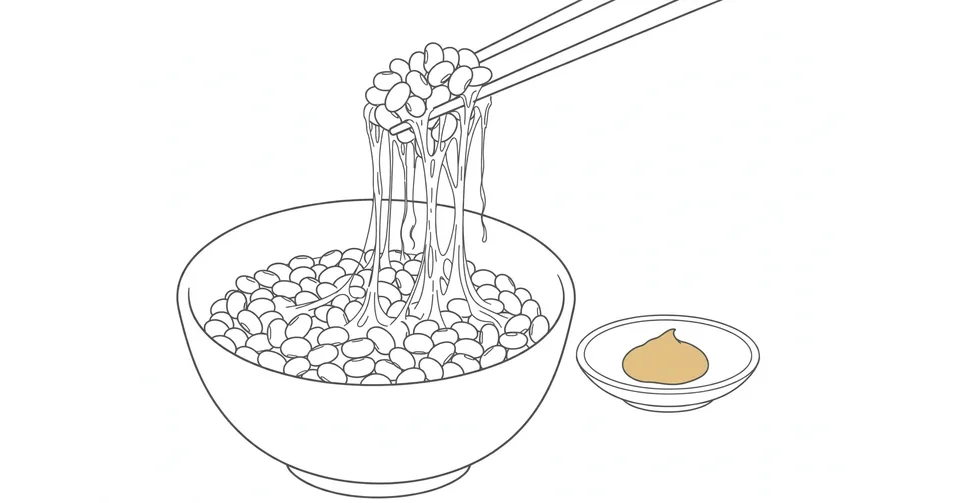
The dish deserves a fair trial, because behind the smell and the strings there is a food with a thousand-year history, a clever bit of microbiology, and a genuine claim to being one of the healthiest things in a Japanese kitchen. This is the story of how soybeans, straw, and a samurai on horseback produced a dish that still divides a nation at the breakfast table.
The samurai legend behind natto
Nobody knows exactly when the dish was first made. The earliest written mention comes from a diary dated 19 December 1405, in which the courtier Fujiwara no Noritoki calls it itohiki daizu, string-pulled soybeans. That name already describes the dish perfectly. But the favourite origin story is older, louder, and almost certainly part legend.
In the 1080s, during the Gosannen War in the north of Japan, the samurai lord Minamoto no Yoshiie and his army were on the move. According to the story, his men packed cooked soybeans into sacks made of rice straw and slung them on horseback. By the time the sacks were opened, the warm beans had fermented. The straw carried a natural population of Bacillus subtilis, a soil bacterium, and the heat of the journey did the rest. The result was sticky, smelly, and edible. The soldiers ate it anyway, and a dish was born. The fullest account of this legend, including the straw-sack detail and the Mito connection, is told in a history of the dish published by NYrture.
Historians treat the tale with caution, and the truth is probably slower and less dramatic. Soybeans and straw were both common in ancient Japan, and the discovery could have happened many times, in many places, whenever warm cooked beans sat in straw for a day. But the legend stuck, and so did the method. For centuries, it was made by wrapping steamed soybeans in bundles of rice straw, called wara, and keeping them warm until the bacteria had done their work. That straw-wrapped version, wara natto, is still sold today as a premium, old-fashioned product.
Commercial production changed in the early twentieth century. In 1906, the researcher S. Sawamura isolated the bacterium responsible for the fermentation and gave it the name Bacillus natto, now known as Bacillus subtilis var. natto. Once a pure starter culture existed, makers no longer needed straw, and natto could be produced consistently in factories. The Mito version was first sold at Mito railway station in 1889, and the city in Ibaraki Prefecture has claimed the dish as its own ever since.
How natto is made
Making it is simple in outline and fussy in detail. Whole soybeans, usually a small variety bred for the purpose, are soaked in water, then steamed until soft. While they are still warm, around 40 degrees Celsius, they are mixed with a starter culture of Bacillus subtilis var. natto and left to ferment for 15 to 24 hours in a warm, humid place. During that time the bacteria multiply, break down proteins, and produce the sticky threads that define the dish.
Those threads are made of polyglutamic acid, a long chain molecule that the bacteria secrete. It is the same family of compound that makes okra slimy, and it is the reason a lifted chopstick pulls a web of strings behind it. The smell comes partly from pyrazine compounds produced during fermentation, and partly from ammonia-like notes that develop as proteins break down. The flavour is nutty and savoury, with a mild bitterness underneath, and it is far gentler than the smell suggests. Most people who expect a horror show are surprised by how mild natto actually tastes.
The finished beans are packed in small polystyrene cups, usually 40 to 50 grams each, with a sachet of soy-based sauce and a dab of karashi, hot yellow mustard. The standard way to eat it is to stir it hard, often fifty times or more, until the threads thicken and the beans turn glossy, then mix in the sauce and mustard and spoon it over hot rice. Chopped green onion is the most common addition. A raw egg, mixed in before the sauce, is a popular variation that softens both the smell and the texture.
Why Mito calls itself the natto capital
Mito, the capital of Ibaraki Prefecture, is to the dish what Napa is to wine. The city calls itself the birthplace of the dish, and the claim rests on more than the samurai legend. Mito sits in a region where farmers grew the small soybeans best suited to fermentation, and the area became the centre of natto production as the dish spread. Today Mito identifies as the epicentre of natto culture in Japan, and its station shops sell wara natto wrapped in straw alongside the standard cups.
The geography of liking it is real and measurable. It is most popular in eastern Japan, in the Kanto region around Tokyo and in Tohoku to the north, and least popular in the west, in Kansai around Osaka and Kyoto. Surveys have repeatedly found that people in the east eat it several times a week, while many in the west eat it rarely or never. A good overview of the Mito version, its history, and its place in Japanese food culture is available from Japan Experience. Nobody fully agrees why. One theory is that the east had more soybeans and more straw, so the dish took root there first. Another is that the divide follows old trade and transport routes. Whatever the cause, the east-west split is one of the most reliable food facts in Japan, and it gives dinner guests something to argue about.
Mito leans into the identity with unusual enthusiasm. The city mascot, Mito-chan, is a cheerful figure with a head of natto beans. Local shops sell ice cream, senbei crackers, and curry flavoured with the beans. Visitors can buy wara natto at Kairakuen Park, one of Japan's three great gardens, and the city's tourist office treats natto the way other cities treat a castle or a temple. For a food that many visitors approach with dread, Mito has built a small and cheerful tourism industry around it.
What natto does for your body
It has a serious claim to being a health food, and the numbers back it up. A 100-gram serving contains about 16.5 percent protein, with all nine essential amino acids, plus fibre, iron, and B vitamins. But the two compounds that made natto famous in nutrition circles are vitamin K2 and nattokinase.
It is one of the richest dietary sources of vitamin K2, with roughly 870 micrograms per 100 grams. Vitamin K2 helps the body use calcium properly, directing it into bone rather than into artery walls, and it is linked to stronger bones and better cardiovascular health. This is one reason it is so often recommended to older people in Japan, and one reason it earned a place on a well-known list of the world's five healthiest foods published by the American magazine Health.
Nattokinase is an enzyme produced during fermentation, discovered in 1987 by the Japanese researcher Hiroyuki Sumi. Laboratory studies have found that it can dissolve blood clots and may help lower blood pressure, and it is now sold as a dietary supplement around the world. The evidence in humans is promising but not yet conclusive, so the honest way to put it is this. The dish is a genuinely nutritious food with interesting compounds, not a medicine, and it should be eaten as food rather than taken as a cure.
There is one honest warning worth giving. Because it is so rich in vitamin K2, people who take blood-thinning medication such as warfarin should talk to a doctor before eating it regularly. Vitamin K affects how those drugs work, and a sudden change in intake can matter. For everyone else, a small cup a few times a week is simply a cheap, protein-rich breakfast.
How to eat natto without flinching
The first pack is a rite of passage, and a few practical tricks make it much easier. Start with the smallest cup you can find, usually 40 grams, and eat it with a full bowl of hot rice rather than on its own. The rice dilutes the smell and gives the sticky beans something to cling to. Stir it well before adding the sauce, since stirring is what creates the glossy texture and mellows the flavour. Add the mustard, which cuts through the richness, and a handful of chopped green onion, which adds freshness.
Temperature matters. Cold beans straight from the fridge smell stronger and feels firmer. Let the cup sit at room temperature for a few minutes, or spoon it over rice that is still steaming, and the beans soften and relax. If the strings bother you, chop the beans roughly with a knife before stirring, or mix it into a dish where the texture disappears, such as fried rice or pasta made with the beans, butter, and soy sauce.
If you still cannot face a plain bowl, try it in disguise. Natto maki, a thin sushi roll with the beans and green onion, is a standard item at conveyor-belt sushi restaurants, and the seaweed and rice wrap the flavour into something gentle. It works for the same reason sushi works as an introduction to raw fish, the format carries the unfamiliar ingredient gently. Natto on toast, a surprisingly common breakfast in Japan, works the same way, with the bread and butter softening the edges. My own view is that natto is best judged the second time, not the first. The first try is mostly about the smell and the surprise. By the second or third, your attention moves to the nutty flavour and the satisfying way it sits on rice, and that is when most people decide whether it is theirs or not.
Natto beyond breakfast
It is no longer just a breakfast side dish. Japanese cooks have spent decades finding new places for it, and some of the results are genuinely good. Fried rice made with the beans is a staple of home cooking, where the beans crisp slightly in the pan and the strings vanish into the rice. Mixed with grated yam, it becomes natto tororo, is a slippery, silky bowl that fans of sticky textures love. Pasta tossed with the beans, butter, soy sauce, and green onion, has become a quiet classic of the home kitchen.
Restaurants have pushed further. There is pizza, gyoza, tempura, and even ice cream made with it in Mito. Some of these are novelties designed to amuse tourists, but the better ones work because natto is, at heart, a savoury fermented food, and fermented foods are versatile. The same logic that makes cheese work on a burger and miso work in a marinade applies to natto too. It adds depth, salt, and a little funk, and in small amounts it improves dishes that would otherwise be plain.
The comparison with cheese is worth making, because it explains the cultural divide. Many visitors who recoil from the beans happily eat blue cheese, which smells stronger and tastes sharper. The difference is familiarity, not logic. Cheese is a fermented food that the West learned to love over centuries. It is a fermented food that Japan learned to love over centuries. Neither is objectively stranger than the other, and the person who grew up with one will always find the other a little alarming at first.
A dish that refuses to be ignored
The dish sits at an odd crossroads in Japanese food culture. It is ancient and modern at once, a samurai legend and a factory product, a health food and a punchline. It is the cheapest protein in the supermarket and the centrepiece of a city's identity. It is eaten daily by millions and avoided by millions more, often within the same family.
For me, the honest answer is that it is worth the effort, and worth more than one try. I did not love it on first tasting, and I doubt many people do. The smell arrives before the flavour, and the strings look like a science experiment. But the food underneath is simple and good, soybeans transformed by bacteria into something richer, more nutritious, and more interesting than the sum of its parts. Japan's convenience stores sell it for a little over a hundred yen, its home cooks stir it into breakfast without ceremony, and its history stretches back to a war in the 1080s. A dish that survives that long, in that many kitchens, has earned more than a flinch.
If you visit Japan, buy a three-pack at a convenience store, find a bowl of hot rice, stir it until it turns glossy, and give it a fair chance. You may join the majority of Japanese people who eat it without a second thought, and if you do not, you will at least understand why they do. Either way, you will have tasted one of the most honest foods Japan makes, a food that never pretends to be anything but itself.
More in Food & Travel
- Ekiben, the Train Station Bento That Turns a Journey into a Meal
- Base Genep Seasons Every Balinese Feast From the Mortar Up
- Sambal Matah Wakes Up Every Balinese Plate Raw
- Sate Lilit Wraps Bali's Feast Around a Lemongrass Stick
- Babi Guling Turns a Whole Pig Into a Balinese Feast
- Lawar Is the Dish Bali Serves When the Whole Village Eats
Latest posts
- The Yumi Stands Taller Than Its Archer
- Kyudo Turns Archery Into a Moving Meditation
- Iaido Is the Art of Drawing the Sword Before the Fight Begins
- Pancawara Gives Bali a Five Day Week That Never Stops Turning
- Hanami Turns Cherry Blossom Season Into Japan's Longest Picnic
- Bogu Is the Armour That Lets Kendo Strike at Full Speed
- Ema Lets You Hang a Wish Where the Kami Can Read It
- Bonsai and the Thousand-Year Art of Tiny Trees
- The Shinai Is a Bamboo Sword That Teaches Before It Strikes
- Omikuji Tells Your Fortune on a Slip of Paper
- Japan Meets the New Year at Hatsumode
- The Way of the Sword Lives On in Kendo
- Hakama Turn a Kimono Into Ceremony
- A Haori Is the Jacket That Turns a Kimono Formal
- The Taiko Musubi Turned a Kimono Sash Into a Drum