Boro Turns Rags Into the Cloth Japan Refused to Throw Away
· 13 min read
Boro is the Japanese art of patching worn cloth layer upon layer until rags become a warm, durable textile, and this is the story of how peasant families made it, why indigo runs through it, and how to recognise the real thing today.
A coat hangs in a museum gallery in New York, and visitors stop in front of it the way people stop in front of a painting. It is not silk. It is not new. It is a work garment made from dozens of small rectangles of faded blue cloth, stitched together in uneven rows, with frayed edges and patches on top of patches. That coat is boro, and its journey from shame to gallery wall is one of the most honest stories in Japanese craft.
Boro is a class of Japanese textiles that have been mended or patched together, layer upon layer, until the repairs become the cloth itself. The word comes from boroboro, a Japanese term for something tattered or repaired. A boro garment began as an ordinary coat or blanket, wore thin at the elbows or the knees, received a patch, wore thin again, and received another patch, and went on like that for decades, sometimes for generations.
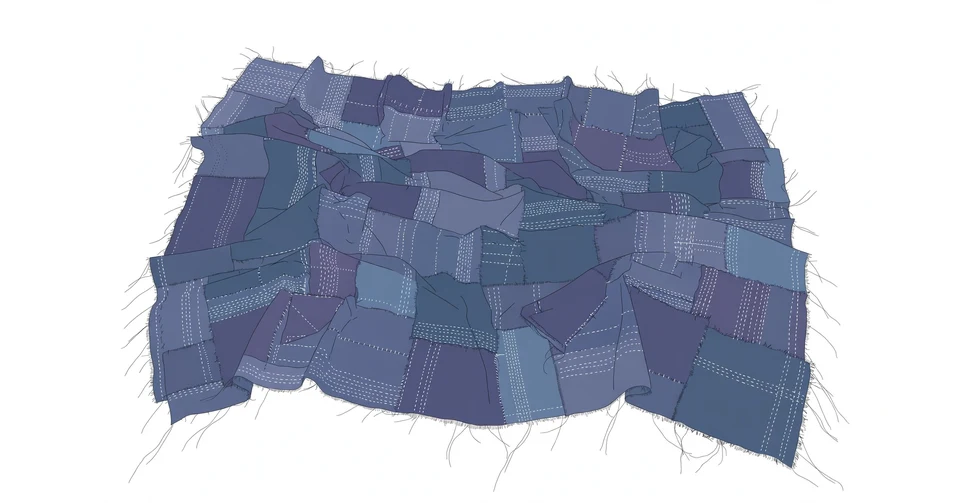
What makes boro worth a closer look is that nobody set out to make it beautiful. It was made by people who could not afford to waste anything, in a part of Japan where the winters were long and cotton was hard to come by. The beauty arrived later, uninvited, as a side effect of care repeated over many years.
A cloth born from scarcity
Boro grew out of the farming and fishing villages of northern Japan, above all in the Tohoku region and in Aomori Prefecture at the northern tip of Honshu. The climate there is cold, the growing season is short, and cotton, the warm fibre that merchants traded in Osaka and Kyoto, did not grow easily in the north. Families wove their own cloth from hemp and ramie, which offered little warmth.
The social rules of the Edo period, which ran from 1603 to 1867, made the gap wider. Fine silk and cotton fabrics were reserved for a select part of the upper classes, either through official edicts of dress or through the simple fact of cost, and silk was also unsuitable for working clothes. A farming family therefore made its clothes from what it could grow, spin, dye, and weave itself, and when those clothes wore out, buying replacements was rarely an option. The families who made boro were not being sentimental. They were being practical in a place where practicality was a form of survival.
Layer upon layer, patch upon patch
The making of a boro textile is easy to describe and hard to do well. When a garment wore through, its owner laid a scrap of cloth over the thin place and stitched through all the layers to hold it in place. When the patch itself wore thin, another patch went on top of it. Over decades, a single coat could accumulate so many layers that it became thick, stiff, and far warmer than the thin cloth it started as, which was exactly the point in a northern winter.
The same layering went into bedding. A futon cover, a sleeping mat, or a kotatsu blanket could be patched just as a coat could, and the heaviest pieces were the sleeping covers for the whole family. One famous type of night robe, the donja, was a padded, kimono shaped cover that a family slept under together, and it could weigh as much as 35 pounds, its insulation made of hemp and textile leftovers, yarns, leaves, and straw. The curator Yukie Kamiya described it plainly, saying of such pieces, "This is a kind of creation for and from survival. They have to pile and pile and patch and patch to make it thicker and that's the result we can see." Thickness was not decoration. Thickness was warmth.
The patches on a boro piece are not arranged in a pattern chosen from a book. They are arranged by need, wherever the cloth failed first, so the surface is irregular, with different shades of blue side by side and stitching that changes direction as the work moved around the garment. The padded winter jacket known as the hanten works on a related idea, with layers stitched together to hold warmth in place, and the story of the hanten shows how much of Japanese winter clothing depends on this quiet logic of layers. Boro simply takes the logic further than anything else, until the repair is the garment. Each patch marks a moment when someone looked at a worn coat and decided it was still worth saving.
Boro and sashiko, cloth and stitch
Boro is often confused with sashiko, and the confusion is understandable, because the two are almost always found together. The difference is simple once it is stated. Boro is the cloth itself, the layered and patched textile built up by repeated mending, while sashiko is the stitching, the small running stitch that holds the layers together and keeps the patches in place. Sashiko appears the moment neat rows of running stitch cross the surface.
The stitch does far more than hold patches down. Rows of sashiko running through several layers of cloth compress the layers, spread the stress of wear across a wider area, and stop the loose patches from shifting during use. The stitching can form loose geometric patterns, but those patterns grew out of practical need rather than a plan. The story of sashiko tells how that stitch began as a way to strengthen worn cloth, and boro is where the stitch does its hardest and most useful work.
The two crafts grew up together in the same place. In the far north, the long winters gave families months of indoor work, and mending was winter work, done by lamplight while the fields lay under snow. The women of the household usually did the stitching, unstitching old futon covers, dyeing the cloth again to refresh its colour, and sewing the pieces into work clothes that would then be passed down. A garment could move from parent to child to grandchild, gathering patches from each generation. The families who made boro bought almost nothing at all, and they kept what they had alive for as long as humanly possible.
Why indigo blue runs through nearly every piece
Almost every old boro textile is blue, and the reason is as practical as everything else about the craft. Indigo was historically the cheapest and easiest to grow dyestuff available to the lower classes, and it was often the only dyestuff a peasant family could get. Indigo plants could be grown and processed by the families themselves. The Wikipedia entry on boro notes that indigo dye would often be grown and processed by the peasant classes themselves, and that one indigo dyebath could be used to dye fabric a number of times, unlike most dyebaths, which had only one use.
Indigo had other advantages that a farming family would have noticed quickly. The dye is said to repel moths, which helped protect stored clothes through the summer, and its strong smell was believed to keep mosquitoes and other insects away from outdoor workers. A weak dyebath also had a hidden benefit, since cloth dipped a few times in a strong bath would fade quickly, while cloth dyed repeatedly in a weak bath held its colour longer. The range of blues across a single boro piece, from pale sky to deep navy, is often a record of how many times each patch was dipped. Not every patch is blue, and some of the most striking pieces carry red patches dyed with benibana, the safflower flower, a dye that was expensive and precious in the north. The cloth is blue because blue was what ordinary people could afford, and the beauty of the blue is inseparable from the poverty that chose it.
The Amuse Museum and the man who saved the rags
For a long time, almost nobody wanted to save boro. After the Meiji period, which began in 1868, living standards rose across Japan, cheaper ready made clothing reached even remote villages, and most boro pieces were discarded and replaced by newer clothes. To many working class Japanese people, the patched garments were an embarrassing reminder of former poverty, and little effort was spent by government or cultural institutions to preserve them.
What survives today survives largely because of one man. Chuzaburo Tanaka, a folklorist who lived from 1933 to 2013, spent more than forty years travelling to farmhouses across northern Japan and asking families whether they had old cloth they were planning to discard. He personally collected more than 20,000 pieces of boro during his lifetime, and 786 of those items are now designated as Important Tangible Cultural Properties of Japan, a formal recognition that the rags of poor farmers are part of the national heritage. One person looked at what everyone else was throwing away and saw something worth keeping.
A large part of the Tanaka collection found a public home at the Amuse Museum in Asakusa, Tokyo, where 1,500 of the pieces were exhibited. The museum has since closed, but the collection has travelled on, and its most famous outing was the exhibition Boro Textiles: Sustainable Aesthetics at the Japan Society in New York, which ran from March 6 to June 14 in 2020. The show brought more than 50 archival pieces from the Tanaka collection to the United States for the first time, set alongside work by contemporary designers. The Hyperallergic review of that exhibition describes how the pieces were made in the 19th century by peasants in the Tohoku region, in response to extreme cold, by mending, patching, and repairing the same piece as many times as needed for use by successive generations of the same household. The review also notes the reversal at the heart of the show, that reuse was once a source of shame for peasants, while today it is a source of shame not to reuse and recycle. You can read the full review in the Hyperallergic account of the Japan Society exhibition.
Why boro is valued today
Boro is now valued for three reasons that pull in the same direction. The first is historical. A boro garment is a document of ordinary life in a period when ordinary people left few written records, and its patches, stitches, and stains record what a family wore, what it could afford, how cold its winters were, and how long its clothes had to last.
The second reason is aesthetic. Over time, boro came to exemplify wabi-sabi, the Japanese sense of beauty in imperfection, impermanence, and the incomplete, and the faded patches and uneven stitching that once signalled poverty are now read as signs of a life honestly lived. Indigo fades gracefully, softening from deep navy to a pale, almost grey blue, and a patchwork of those fading blues has a quiet harmony that no new fabric can imitate, because new fabric has not yet had time to fade. Designers such as Rei Kawakubo, Issey Miyake, and Yohji Yamamoto all drew on boro in their work.
The third reason is the one that feels most urgent now. Boro is an early example of sustainable fashion, made by recycling long before recycling had a name. A boro garment was never thrown away. It was repaired, then repaired again, then cut up and sewn into something else, and even its smallest scraps could be rewoven into new cloth. A related technique, saki-ori, wove strips of old kimono cut about one centimetre wide into new fabric, and a single obi made this way could require roughly three old kimono. The families of northern Japan were practising circular design and zero waste two hundred years ago, not as a theory but as a necessity.
The value of boro today lies in holding both truths at once, that it was born of hardship and that it produced something genuinely beautiful.
How to tell real boro from a reproduction
The popularity of boro has brought reproductions, and some of them are very good, so it helps to know what to look for before paying a high price for a piece that claims to be old. Real boro, sometimes called antique boro to distinguish it from new work in the same style, is not hard to recognise once you know the signs, and the signs are all consequences of how the cloth was actually used.
First, look at the patches themselves. On a genuine old piece, the patches vary in size, shape, and shade, because they were added at different times from whatever cloth was at hand, and the edges are often frayed or uneven. A reproduction tends to be too tidy, with patches cut to similar sizes and arranged in a pleasing pattern, as if someone designed the randomness rather than letting need decide it. The stitching tells a similar story. Real sashiko on an old piece is functional first, with rows of running stitch that follow the patches, while a reproduction often has stitching that is too even, too decorative, and too obviously placed for show.
Second, look at the cloth and the fading. Old boro is usually made of hand woven cotton, linen, or hemp, and the indigo has faded unevenly, paler where the garment saw sun and wear, deeper where it was protected. The layers feel dense and stiff. A new piece made to look old can imitate the colour, but it rarely imitates the weight and the stiffness that come from decades of layered stitching.
Third, ask about the history. A genuine piece should have a plausible story, a region of origin, usually Aomori or the wider Tohoku region, a likely date range, most often between 1850 and 1950, and a previous owner or dealer who can say where it came from. Pieces in the Tanaka collection were made by Japanese peasants between 1850 and 1950 from leftover, indigo dyed cotton, which gives a useful benchmark, and a seller who cannot place a piece even roughly in that world should be treated with caution. Price is a clue too. Real antique pieces are scarce, and they are priced accordingly, while a piece that looks old and costs very little is almost certainly new work, which is fine as a craft object but should be sold as new work rather than as an antique.
The distinction matters, and not only for buyers. Calling a new patchwork jacket antique boro does a small injustice to the families who made the real thing. New work inspired by boro is a good thing, but honesty about what a piece is protects both the buyer and the history. If you want the history, look for the uneven patches, the faded indigo, and the story that comes with it.
Boro turns rags into the cloth Japan refused to throw away, and the refusal is the whole story. A torn coat could have gone to the bin. Instead, it was patched, worn, patched again, and handed down, until the patches became the coat and the coat became a record of the people who kept it alive. The next time a favourite garment tears, it is worth remembering the farmhouses of the north, where a tear was never the end of a garment. It was the beginning of its next layer, and sometimes, many layers later, the beginning of something beautiful.
More in Culture & Society
- Iga Ware Fires the Clay Pot That Holds Heat the Longest
- Sashiko Turns Mending Into the Most Beautiful Part of a Garment
- Warosoku Burns Brighter Because Its Wick Is Hollow
- Japanese Chopsticks and the Quiet Rules Behind Every Meal
- The Haze Tree Grows the Wax Behind Japan's Oldest Candles
- Haze Wax Keeps Japan's Oldest Candles Burning
Latest posts
- Mount Takao and the Day Trip Tokyo Takes When It Needs Air
- A Donabe Turns a Clay Pot Into Japan's Slowest and Warmest Way to Cook
- A Shichirin Turns a Handful of Charcoal Into a Full Meal
- A Tanzen Is the Full Length Robe Japan Wears Indoors in Deep Winter
- A Hanten Is the Winter Jacket Japan Wears to Work
- Furoshiki, the Japanese Cloth That Wraps Almost Anything
- Japanese Candles Are Still Rolled by Hand in Japan
- Ubame Oak Is the Tree That Turns Into White Charcoal
- Binchotan Is the Charcoal That Made the Hibachi Possible
- Igusa Is the Humble Grass Under Every Tatami Mat
- Japanese Incense and the Art of Listening to Smoke
- Kumiko Builds Beauty From Wood Without a Single Nail
- A Hibachi Carries the Hearth Anywhere in the House
- A Kotatsu Turns a Cold Winter Evening Into the Warmest Room in the House
- The Jizaikagi Hangs Above the Fire and Sets the Pace of Dinner