Iga Ware Fires the Clay Pot That Holds Heat the Longest
· 19 min read
Iga ware is the pottery of Iga in Mie Prefecture, and its coarse, porous clay makes a donabe that stores heat longer than any other clay pot in Japan.
A clay pot that stays hot long after the flame is gone sounds like a small miracle, and in a way it is. Iga ware is the pottery behind that miracle. Made in the city of Iga in Mie Prefecture, it is fired from a coarse, porous clay that soaks up heat slowly and gives it back even more slowly, so that rice finishes cooking in its own steam and a stew keeps simmering at the table while everyone eats.
The pot itself looks unremarkable. An Iga ware pot is squat and heavy, rough on the outside and glazed on the inside, with a thick lid and two small handles. Pick it up and the first thing you notice is the weight. That weight is the point. The thick walls are a storehouse for heat, and a cook who learns to use one will find that the pot does half the work of the meal on its own, quietly, long after the burner has been turned down.
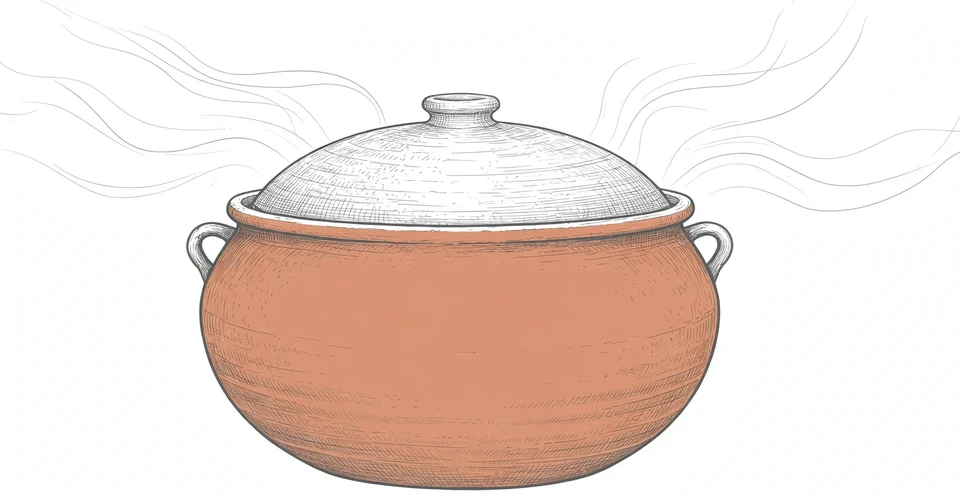
What follows is the story of Iga ware, from an ancient lakebed to the kilns of Iga, through tea ceremonies and a ban on digging clay, to the modern kitchens where chefs still reach for the heaviest pot on the shelf. It is also a practical guide, because Iga ware is not a museum object. It is a working tool, and knowing how it is made will tell you how to choose one, how to treat it, and why it is worth the patience it demands.
A town built on old lake clay
Iga sits inland in Mie Prefecture, a quiet city ringed by low mountains, and Iga ware begins with geology rather than with any potter. About four million years ago, the ground beneath Iga was the bed of ancient Lake Biwa, and the sediment that settled there became the clay that potters still dig today. That clay is full of tiny organic matter, and when a pot is fired at high temperature the organic matter burns away, leaving behind a web of microscopic holes. The result is a clay that is coarse to the touch and porous all the way through, and it is this porosity that makes Iga ware behave the way it does in the kitchen.
A porous wall stores heat the way a brick stores the warmth of a fire. The heat sinks in slowly, spreads evenly through the thick clay, and then leaks back out just as slowly, so the food inside cooks gently from every side at once. A steel pot heats fast and cools fast, and its hottest spot is always the part touching the flame. An Iga ware pot heats all over, and it keeps cooking after it leaves the stove. That is why a pot of rice made in an Iga ware donabe comes out fluffy and faintly sweet, and why a stew made in one tastes as if it has been simmering far longer than it has.
Iga is also the birthplace of the haiku poet Matsuo Basho, who lived from 1644 to 1694, and the city still carries that old castle town feeling, with narrow streets and a castle on its hill. The pottery and the poetry suit each other. Both are quiet crafts that reward attention, and both come from a place that has never hurried. When you hold an Iga ware pot, you are holding something shaped by a landscape that was a lakebed long before anyone in Japan wrote a poem about it, and I think that slow history is part of what makes the pot feel so calm in the hand.
How Iga ware survived the tea ceremony and a ban
The history of Iga ware stretches back more than 1,300 years, to the Nara Period, which ran from 710 to 794. It began humbly, as everyday farming utensils like pots and jars, and for centuries Iga ware stayed that way. The change came with the tea ceremony. During the Azuchi-Momoyama Period, from 1573 to 1603, tea masters began to prize imperfect, irregular beauty, the quality the Japanese call wabi-sabi, and Iga ware fit that taste exactly. Its rough surfaces, its wave-like patterns pressed by hand or with a spatula, and its scorched, uneven colours looked like accidents, and to a tea master those accidents were the whole point.
In 1548, Tsutsui Sadatsugu, the lord of the Iga Domain, ordered kilns to be built throughout his lands and told the craftspeople to make tea utensils as they pleased. The potters shaped their pieces by hand, deliberately leaving them irregular, and fired them at high temperatures until the wood ash in the kiln melted into a glassy green glaze the Japanese call bidoro. The pieces made in Tsutsui's time became known as Tsutsui Iga, and those made under his successors, the Todo family, became known as Todo Iga. Together they form the old style called Koiga, or Old Iga, and the story of the kyusu shows how the same love of small, handmade tea ware runs through Japanese pottery as a whole.
Then, in 1669, the extraction of the clay needed for Iga ware was outlawed, and the craft faded away. It is a strange thing to read about, a whole pottery tradition stopped by a ban on digging, but it lasted for a century. The revival came in 1770, when Todo Takasato, the ninth lord of the Tsu Domain, began endorsing Iga pottery again and invited potters from Kyoto and Seto to come and work in his lands. They brought knowledge of ceramic glazing with them, and production grew to a mass scale. From then on, the craft moved away from tea utensils and toward everyday necessities like bowls and pots, and that shift is what eventually made Iga ware a kitchen ware rather than only a tea ware. The guide to Iga ware from BECOS traces this whole arc, from farming pots to tea utensils to the everyday ware of today, and it notes that Iga ware has been designated a traditional Japanese craft by the Ministry of Economy, Trade and Industry.
The clay that stores heat like a brick oven
The firing is where Iga ware gets its looks. The pieces are fired at high temperatures in wood kilns, and as the wood burns, ash settles on the surface of the pots and melts into glass. The small pebbles inside the clay react with the ash and turn transparent and bright green, and the process is repeated at high temperatures until the ash becomes the green, glassy bidoro glaze. The outside of the pot comes out scorched and dark, marked with spots of green and thin cracks, and no two pieces ever come out alike. The Japanese word for this change of shape and colour in the kiln is yohen, and it means that the final appearance of each piece depends entirely on the individual kiln and the skill of the potter.
This is not decoration added at the end. It is the fire itself writing on the clay, and it is why Iga ware looks the way it does. A factory could copy the shape of an Iga ware donabe in an afternoon, but it could not copy the scorch marks or the green glaze, because those are made by ash and flame in a wood kiln, not by a mould. I find that honesty appealing. The pot does not pretend to be perfect. It shows exactly what the fire did to it, and the cook who uses it every day gets to watch those marks deepen with use, as the inside glaze develops a fine network of cracks called kannyu, which is valued as a sign of the pot's character rather than a flaw.
The same clay that gives Iga ware its green glaze also makes the pot heat resistant. Because the clay around Iga is highly resistant to fire, it is often used to make heat resistant pots and tableware, and that is the practical heart of the whole tradition. The rough, porous body can take direct flame without cracking, and it can be fired more than once without damage. That toughness is what lets a pot of earth sit on a gas burner and cook a meal, and it is what separates a cooking pot from a piece of pottery that only has to look good on a shelf.
Two weeks from wet clay to finished pot
Making an Iga ware donabe is slow work, and the slowness is not a flaw in the process. It is the process. The pots are made by kneading the clay, then forming and trimming the vessels by hand. They are partially dried, then knobs and handles are applied. After another period of drying, they are fired, glazed, and fired again. Each stage needs its own time, and the drying in particular cannot be rushed, because a pot that is fired while still damp inside will crack in the kiln.
The Wikipedia entry on the donabe records that Iga style donabe have been made since 1832, that Iga pottery in general dates back to the 7th century, and that the highest quality donabe can take two weeks to make. Two weeks for a single Iga ware pot is a long time in a world where a factory can press out a steel pan in minutes, and it is worth stopping to think about what those two weeks buy. They buy an Iga ware pot whose walls are evenly dried and evenly fired, whose glaze has had time to settle, and whose heat will spread evenly rather than in hot spots. A pot made in a hurry would still look like a donabe, but it would not cook like one.
The 1832 date belongs to Nagatani-en, the kiln in the Marubashira district of Iga that has been making Iga ware for nearly two centuries. The kiln was founded in 1832 and has been run by the Nagatani family for eight generations. Its grounds hold a 16 chamber climbing kiln, a noborigama, built into a hillside and used until the late 1970s, and the kiln and the old Taisho era building on the site are both registered as tangible cultural properties of Japan. Nagatani-en is also the maker of Kamado-san, a donabe rice cooker that became famous for cooking fluffy rice without boiling over and without the cook adjusting the heat. That Iga ware pot is a modern design, developed after years of research, but it is made from the same coarse clay and fired in the same tradition as the tea utensils of four centuries ago.
Every September, the Iga Ware Festival brings together potters from about 40 kilns to exhibit more than 30,000 pieces of Iga ware, and more than 20,000 pottery lovers travel to Iga from across Japan to see them, talk to the makers, and haggle over a piece to take home. That is a large crowd for a small inland city, and it says something about how alive this craft still is. The festival is not a memorial for a dead tradition. It is a market, and the potters there are selling pots that people will cook with that same week.
Iga ware against Banko ware
Most donabe a buyer meets will come from one of two pottery traditions, and both of them are in Mie Prefecture. The first is Iga ware, and the second is Banko ware, from Yokkaichi. The two are often sold side by side, and knowing the difference is the most useful thing a buyer can learn before spending money. The story of the donabe tells the same comparison in detail, and it is worth repeating here because it shapes every choice that follows.
Banko clay is rich in petalite, a mineral that can make up 40 to 50 percent of the clay body, and that mineral barely expands when heated. That is what lets a Banko pot take direct flame without cracking, and it is why Banko pots are often thinner walled and lighter than Iga pots. They heat a little faster, they are easier to lift when full of stew, and they are usually cheaper. The Banko wholesalers' association says its members ship close to 80 percent of the donabe sold wholesale in Japan, so a Banko pot is the one most people meet first.
Iga ware leans the other way. The walls are thicker and heavier, the clay is more porous, and the pot heats more slowly and holds its heat for longer. It suits long simmers and rice, the dishes where patience pays. A Banko pot is the friendly everyday pot, quick to heat and easy to handle. An Iga ware pot is the slow pot, heavier to lift and slower to warm up, but once it is hot it stays hot, and it keeps cooking after the flame is turned down. Neither is better in any absolute sense. The choice is between a pot that leans toward convenience and a pot that leans toward patience, and either one will cook a good meal once the cook learns its rhythm. My own preference is for the Iga ware pot on quiet nights, when there is time to let a stew deepen, and for the lighter pot on busy evenings, when dinner needs to be on the table quickly. Owning both is not a contradiction. It is a recognition that different nights ask for different tools.
There is one more difference worth knowing. Iga ware pots need more care. The porous clay drinks water, so a new pot must be seasoned before its first meal, a process called medome, in which the pores are filled with starch from simmered rice porridge so the pot will not leak or soak up smells. Banko pots, with their denser clay, need far less of this. That is a real cost in time and attention, and a buyer who does not want it should choose accordingly. But the seasoning is also the start of a relationship with the pot. A seasoned pot, used and dried properly for years, develops its kannyu crackle and its own character, and a pot like that is not just a tool any more. It is part of the kitchen.
Why chefs reach for the heavy pot
Chefs prize Iga ware for the same reason home cooks do, only more so. A professional kitchen is a place of timers and flames and orders coming in fast, and a pot that holds its heat is a pot that forgives a moment of delay. Rice cooked in an Iga ware donabe comes out fluffy and tender, with a faint sweetness that an electric cooker rarely matches, and the bottom of the pot sometimes holds okoge, the golden crisp layer of rice that is prized for its nutty flavour and its crunch. A chef who can offer that without a machine is offering something a machine cannot copy.
The heat retention also changes how a dish is served. A donabe arrives at the table still hot, the lid is lifted, and everyone serves themselves from the same pot. There is a Japanese phrase for this way of eating, nabe o kakomu, which means surrounding the pot, and it captures the idea that the meal is built around the pot rather than served from a kitchen far away. A heavy Iga ware pot holds its heat long enough for a whole table to eat slowly, serving themselves piece by piece while the conversation fills the gaps. A lighter pot cools sooner, and the meal hurries. The difference is not only in temperature. It is in the pace of the evening, and I think that is the real reason chefs keep these pots on their shelves. They are not just cooking in them. They are setting the speed of the meal.
The pot is also versatile in a way that surprises first time buyers. The same gentle heat that suits rice and hot pots also suits soups, stews, braised dishes, and steamed vegetables, and the pot can finish a stew on the table rather than on the stove. That matters more than it sounds. A cook who can bring the pot to the table and let it finish there is a cook who can sit down with everyone else, and that is a small but real improvement to an evening. The pot asks for patience at the start, while it heats, and pays it back at the end, while it keeps the food warm.
What to look for when buying one
Buying an Iga ware pot is a purchase to make slowly, and the first thing to check is the weight. Pick it up. A genuine Iga ware donabe is heavy for its size, because the walls are thick. If a pot labelled as Iga ware feels light, ask questions, because lightness is the signature of a different clay, not of Iga. The second thing to check is the surface. The outside should feel rough and sandy, not smooth, and the glaze inside should be even and free of large chips. Small irregularities in shape are normal, and they are a good sign. A perfectly symmetrical pot with a flawless surface is more likely to be machine made than handmade.
Size matters more than most buyers expect. Donabe are sized by the sun, an old Japanese unit of measurement, and they come in sizes for a single person or a whole family. A pot that is too large for the household will waste heat and cook unevenly, because a small amount of food in a large pot cannot build up the steam it needs. A pot that is too small will boil over. Think about the dish you will cook most often, rice for two or hot pot for four, and buy the size that fits that dish, not the size that looks impressive on the shelf. A good seller will ask about your household before recommending a size, and that question is itself a sign of a seller worth trusting.
The lid deserves its own check. It should sit firmly on the rim with no rocking, because a lid that rocks lets steam escape, and steam is what the rice still needs in the final minutes of cooking. Some Iga ware donabe, like the Kamado-san rice cooker, use a double lid to hold steam in, and that design is worth the extra cost if rice is the main job the pot will do. Look also for the maker's mark, usually stamped on the base, and for the name of the kiln. A pot from a known kiln in Iga, such as Nagatani-en, carries a history you can check, and that history is part of what you are paying for.
Price is the last check, and it is the one most likely to mislead. A handmade Iga ware pot that took two weeks to make cannot be cheap, and a very cheap pot with the name on it is a reason to be careful rather than pleased. That does not mean the most expensive pot is the best one. It means the price should make sense for handmade work, and a buyer who is unsure should compare two or three pots in the same size from different kilns before choosing. The right pot is the one that feels heavy, sits steady, and fits the meals you actually cook, and when you find it, you will know it by the way it sits in your hands.
Living with a pot that cannot be hurried
A new Iga ware pot needs one job done before it cooks anything, and the job is called medome. The pot is filled about 80 percent full of water, two tablespoons of uncooked short grain rice are added, and the water is brought slowly to a boil over medium low heat. Once it boils, the heat is turned down low and the porridge simmers for an hour, then the pot is left to cool to room temperature with the porridge still inside. Only then is the porridge thrown away and the pot rinsed and dried. The starch fills the microscopic pores of the clay, so the pot will not leak, crack, or soak up the smells of its first meals, and the same treatment can repair fine hairline cracks if they appear later.
Daily care is simple but firm. The outside of the pot must be completely dry before it goes on the flame, because moisture trapped in the clay will expand in the heat and can chip or crack the pot. It must never be heated while empty, and it must never be shocked by sudden changes of temperature, such as high heat from the start or cold water poured over a hot pot. Start on medium low heat, raise it gradually to medium, and turn it down to low once the liquid boils. Wash with warm water and a soft sponge, never soak the pot, never put it in a dishwasher, and dry it thoroughly, ideally upside down overnight. Leftover food should be moved to another container for storage rather than left in the pot.
These rules sound fussy, but they become habit quickly, and they are the price of a pot that can last for decades. A few old donabe have survived for centuries, and the ones in old Kyoto restaurants were sometimes kept for decades and brought out only for special guests, so that they could age into their best cooking years. A pot that lasts that long stops being a purchase and becomes a companion, and the crackle in its glaze becomes a record of the meals it has cooked.
Iga ware endures because it refuses to hurry, and that refusal is its gift. In a kitchen built for speed, a pot that takes two weeks to make and fifteen minutes of waiting with the lid closed is a small act of resistance, and it is one worth keeping. The clay is old, the kilns are old, and the pot on the table is still hot long after the flame is gone. That is the whole story, and it is enough. A pot made of earth has outlasted so many pots made of steel, not because it is faster or cheaper, but because it treats heat as something to store rather than something to spend, and a meal made that way tastes of the time it was given.
More in Culture & Society
- Boro Turns Rags Into the Cloth Japan Refused to Throw Away
- Sashiko Turns Mending Into the Most Beautiful Part of a Garment
- Warosoku Burns Brighter Because Its Wick Is Hollow
- Japanese Chopsticks and the Quiet Rules Behind Every Meal
- The Haze Tree Grows the Wax Behind Japan's Oldest Candles
- Haze Wax Keeps Japan's Oldest Candles Burning
Latest posts
- Mount Takao and the Day Trip Tokyo Takes When It Needs Air
- A Donabe Turns a Clay Pot Into Japan's Slowest and Warmest Way to Cook
- A Shichirin Turns a Handful of Charcoal Into a Full Meal
- A Tanzen Is the Full Length Robe Japan Wears Indoors in Deep Winter
- A Hanten Is the Winter Jacket Japan Wears to Work
- Furoshiki, the Japanese Cloth That Wraps Almost Anything
- Japanese Candles Are Still Rolled by Hand in Japan
- Ubame Oak Is the Tree That Turns Into White Charcoal
- Binchotan Is the Charcoal That Made the Hibachi Possible
- Igusa Is the Humble Grass Under Every Tatami Mat
- Japanese Incense and the Art of Listening to Smoke
- Kumiko Builds Beauty From Wood Without a Single Nail
- A Hibachi Carries the Hearth Anywhere in the House
- A Kotatsu Turns a Cold Winter Evening Into the Warmest Room in the House
- The Jizaikagi Hangs Above the Fire and Sets the Pace of Dinner