Mount Takao and the Day Trip Tokyo Takes When It Needs Air
· 15 min read
Mount Takao is a 599 metre mountain less than an hour from Shinjuku, with a 1,200 year old temple, a cable car, and about 2.6 million visitors a year. Here is how to climb it, which trail to take, and when to go.
Fifty minutes from Shinjuku, the train stops, the city thins out, and a forested mountain fills the window. Mount Takao is only 599 metres tall, which is modest by Japanese standards, yet it draws about 2.6 million visitors a year, making it one of the most climbed mountains on earth. The reason is simple. It is close, it is easy, and it still feels like a real mountain, with cedar forest, a working temple, and a summit where Mount Fuji appears on clear winter days.
Mount Takao is not a wilderness expedition. It is a half day out, the kind of trip Tokyo takes when it needs air. You can walk the whole way up in about ninety minutes, or ride a cable car halfway and stroll the rest. Families with small children do it. Office workers in trainers do it. Elderly hikers with walking poles do it, and they pass everyone. What follows is how the mountain works, which trail suits you, and the small details that turn a pleasant walk into a good day.
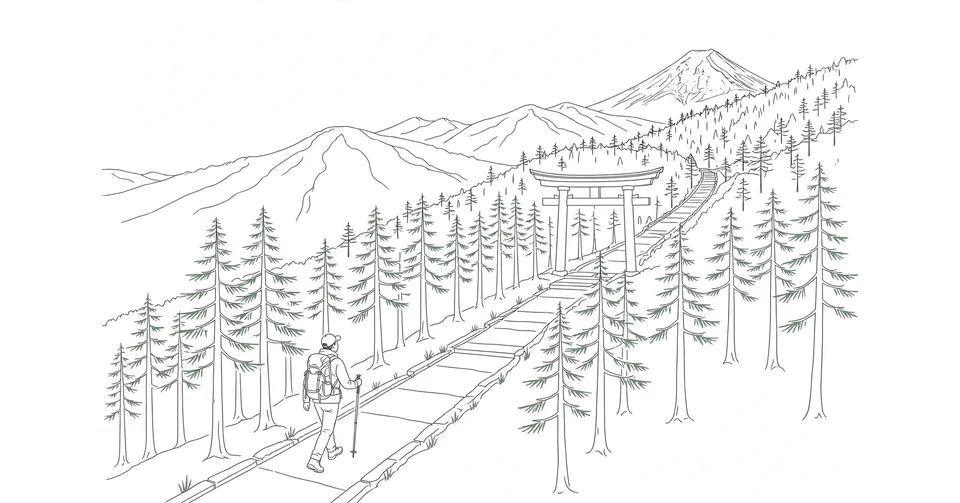
The first thing to understand about Mount Takao is that it is not one path but a small network. Eight marked trails cross the mountain, and they suit very different moods. Trail 1 is the main route, paved all the way, wide enough for crowds, and the one most people take. Trail 6 follows a stream through the forest and gets your boots wet. The Inariyama ridge trail is quieter and steeper, and it is the one regulars choose when they want the mountain to themselves. Knowing this before you arrive matters, because the mountain is at its best when you pick the trail that matches your day, not the one the crowd picks for you.
Why Mount Takao draws millions
The numbers are the first surprise. Mount Takao stands 599 metres high in Hachioji, at the western edge of Tokyo, inside Meiji no Mori Takao Quasi-National Park. Japan's Ministry of the Environment has cited an estimate of about 2.6 million visitors a year, and some guides put the figure closer to three million. Either way, it is more visitors than most famous peaks receive, and the mountain earns them with a rare combination: it is reachable by ordinary train, it can be climbed in sneakers, and it still offers forest, wildlife, and a view worth the effort.
Part of the appeal is history. Mount Takao has been a sacred mountain for more than 1,200 years, and the temple on its slope, Yakuoin, has stood there since 744. Pilgrims have been climbing it for centuries, long before anyone called it a day trip. The other part is practical. The mountain sits at the meeting point of warm and cool temperate forest, so the seasons change visibly on its slopes. Cherry blossom in spring, deep green in summer, red maple in autumn, and clear long views in winter. There is no bad season, only a crowded one, and that is usually November.
A Michelin travel guide awarded Mount Takao three stars in 2007, and the numbers have never come back down. The award puzzles some visitors, because the mountain is neither tall nor remote. But the guide was rating the experience, not the altitude, and the experience is a complete one: a train ride, a forest walk, a temple, a summit, and a bowl of soba at the end. Few mountains anywhere pack that much into a single morning.
Getting there from Shinjuku
The journey to Mount Takao is part of the pleasure, because it is so easy. From Shinjuku Station, take the Keio Line to Takaosanguchi Station. The ride takes about 50 minutes on a fast service, and the fare is 430 yen each way. A detailed Mount Takao day trip guide confirms the same ride time and fare. Takaosanguchi is the last stop on the line, so you cannot miss it, and the station building itself is worth a look. It was rebuilt with cedar wood and a sweeping roof that echoes the mountain.
If you plan to ride the cable car or the chairlift as well, consider the Takaosan Kippu, a discount ticket from Keio that covers the round trip train fare plus a round trip on the cable car or lift. It costs 1,450 yen for adults, which saves a few hundred yen over buying everything separately. You can buy it at Shinjuku or any Keio station on the way.
From Takaosanguchi Station, it is a five minute walk to the cable car station and the start of the trails. The road passes souvenir shops, soba restaurants, and the TAKAO 599 MUSEUM, a free visitor centre that explains the mountain's plants and animals. It is a good first stop if you are climbing with children, because it turns the forest into something they can recognise on the way up. The mountain is also easy to reach from other parts of Tokyo, but Shinjuku is the simplest starting point for most visitors, and the Keio Line runs often enough that you never need to plan around a timetable.
Trail 1, the main climb
Trail 1, called the Omotesando, is the route most people take, and it is the right choice for a first visit. It is 3.8 kilometres long, fully paved, and it climbs from the base to the 599 metre summit in about ninety minutes on foot. The path passes the monkey park, the ancient cedar grove, and Yakuoin Temple, so it is really three attractions in one walk. It is wide and gentle enough for families, though the final stretch is steep enough to make you feel you have earned the view.
The first landmark is the monkey park, where a troop of Japanese macaques lives in a large enclosure on the slope. It is a small detour and a cheerful one, especially for children, though the mountain's wild monkeys are a different matter. Wild macaques live on Mount Takao too, and they sometimes appear along the quieter trails. The rule is the same as everywhere in Japan: watch, do not feed, and keep your food out of sight.
Past the monkey park, the trail enters the cedar grove, a stretch of tall straight trees that shades the path even in summer. This is the part of Mount Takao that feels oldest. The trees were planted centuries ago, the air cools noticeably under them, and the sound of the crowds fades. It is also where the climb starts to feel like a climb, because the slope steepens after the grove. Take it slowly. There is no prize for speed, and the temple is the next stop.
The cable car and the chairlift
If ninety minutes of uphill on Mount Takao sounds like too much, or if you are short on time, the mountain offers two mechanical shortcuts. The cable car has run since 1927, climbing 271 vertical metres over about one kilometre of track in six minutes, from Kiyotaki Station at 201 metres to Takaosan Station at 472 metres. Its steepest gradient is 31 degrees and 18 minutes, which the operator says makes it the steepest cable car track in Japan. The fare is 490 yen one way, or 950 yen for a round trip.
Beside it runs the chairlift, an open two seater that glides through the forest canopy for twelve minutes over a span of 872 metres. It costs the same as the cable car, and on a fine day it is the better ride, because you sit above the trees with nothing between you and the forest. It has no safety bar, which surprises some visitors, but it moves slowly and the ride is calm.
From the upper station, the summit is about forty minutes on foot, passing Yakuoin Temple on the way. That is the most popular way to do Mount Takao: ride up, walk the rest, and walk all the way down. Walking down takes about an hour and is gentler on the knees than it sounds, because Trail 1 is paved. If you ride up and walk down, you get the temple, the summit, and the forest, and you are back at the station in time for a late lunch.
Yakuoin and the tengu
About two thirds of the way up Trail 1 stands Yakuoin, formally Takaosan Yakuoin Yukiji, a Buddhist temple that has been on the mountain since 744. Tradition says the monk Gyoki founded it on the orders of Emperor Shomu, as a place to pray for the protection of the eastern provinces. It belongs to the Chizan branch of Shingon Buddhism, and it has served for centuries as a training ground for yamabushi, the mountain ascetics who practise fire walking and waterfall meditation.
The temple is famous for its tengu. These long nosed mountain spirits of Japanese folklore are said to attend the temple's principal deity, Izuna Daigongen, and their statues stand around the buildings: a great tengu with a long nose, and a crow beaked karasu tengu beside it. Visitors rub the statues for good fortune, and the temple sells tengu charms and amulets that are hard to find anywhere else. The temple grounds are free to enter, and the main hall, the prayer wheels, and the steep stone steps between the buildings are worth thirty unhurried minutes.
Every March, the temple holds its fire walking festival, the Hiwatari-sai, and members of the public are invited to cross the embers at the end. It is one of the most striking events on Mount Takao, and it draws a large crowd. The temple is also busy at New Year, during Golden Week, and in the autumn foliage season, so if you want quiet, visit on a weekday morning. The summit itself is about twenty minutes on foot from the temple, and the path between them is one of the prettiest stretches on the mountain.
What the summit gives you
The summit of Mount Takao is a wide gravel clearing with picnic benches, restrooms, a visitor centre, and observation platforms. It is not dramatic in the way a high alpine peak is dramatic. There is no sheer drop and no knife edge ridge. What it offers instead is a broad view across the Kanto Plain, and on clear days, especially in winter when the air is dry, Mount Fuji appears to the west, framed neatly above the ridges. That view is the payoff, and it is worth waiting for a clear day to see it.
On a clear winter morning, the summit of Mount Takao feels like a reward out of proportion to the effort. You climbed for ninety minutes, or forty from the cable car, and the tallest mountain in Japan is standing on the horizon. In summer, the view is hazier and the Fuji sighting is less reliable, but the summit is still a good place to sit with a rice ball and watch the clouds move. A small shrine stands at the top, and the visitor centre can tell you which peaks you are looking at. If that view makes you want more, the full climb is covered in this guide to climbing Mount Fuji.
The mountain's other summit pleasure is food. The slopes are known for tororo soba, buckwheat noodles topped with grated mountain yam, and the restaurants near the base serve it all day. It is a simple, filling meal, and it tastes better after a climb than it ever would in the city. There is also a beer garden by the upper cable car station in the warmer months, open from late May to late November, where you can sit with a drink and look back down the slope you just climbed.
When to go, and when to stay away
Mount Takao is open all year, and every season has its case. Spring brings cherry blossom along the lower trails. Summer is green and shaded, though humid, and the beer garden is open. Winter is the season for clear views of Mount Fuji and for quiet trails, because the crowds thin out after the autumn leaves fall. Autumn is the most beautiful and the most crowded, and that is the trade off to understand before you go.
The autumn leaves festival, the Momiji Matsuri, runs from late October into December, and on November weekends the mountain is packed. The colours are part of a national season, as this guide to Japan's autumn leaves explains, and Mount Takao is one of the easiest places to see them. The cable car line can run to an hour, the trails slow to a shuffle in places, and the summit is full. If you must go on an autumn weekend, arrive early, before nine, or take one of the quieter trails up and Trail 1 down. On a weekday, even in November, the mountain is manageable and the colours are just as good.
Rain changes the mountain too. Trail 1 is paved and safe in light rain, but the unpaved trails, especially Trail 6 along the stream, get slippery. In heavy rain, stick to Trail 1 or take the cable car. In winter, the upper trails can be icy in the morning, so wear shoes with grip. None of this is difficult. It is the ordinary care any mountain asks for, and Mount Takao asks for less than most.
The trails at a glance
| Trail | Route | Distance | Time on foot | Best for |
|---|---|---|---|---|
| Trail 1 | Omotesando, the main approach | 3.8 km | About 90 minutes | First visits, families, temple and summit |
| Trail 2 | Loop around Kasumidai | 0.9 km | About 30 minutes | A short stroll near the upper cable car station |
| Trail 3 | Forest loop via the south slope | 2.4 km | About 60 minutes | Quiet forest walking |
| Trail 4 | Suspension bridge route | 1.5 km | About 40 minutes | A short detour with a small bridge |
| Trail 5 | Summit loop | 0.9 km | About 30 minutes | A gentle circuit around the top |
| Trail 6 | Stream side route | 3.3 km | About 90 minutes | Nature lovers who do not mind wet boots |
| Inariyama | Ridge trail | 3.1 km | About 100 minutes | Experienced walkers who want quiet |
The table is a guide, not a promise. Times vary with fitness and with how often you stop, and on a crowded day Trail 1 can take longer than the table says. The mountain also has the option of riding the cable car or chairlift to 472 metres and walking the last stretch, which cuts any of these times roughly in half. If you are unsure, start with Trail 1. It is the route the mountain was designed around, and it is the one that shows you the most in the least time.
After the climb
The base of Mount Takao has its own pleasures, and it is a mistake to rush back to Shinjuku. The onsen at the foot of the mountain, Keio Takaosan Onsen Gokurakuyu, is a large public bathhouse a short walk from Takaosanguchi Station, and it is the perfect end to a climb. Soak in the hot water, eat something, and let your legs recover before the train. It is also a good introduction to Japanese hot springs for visitors who have not tried an onsen yet, because it is clean, modern, and welcoming to first timers.
The souvenir shops along the approach sell tengu masks, local sweets, and the mountain's own snacks, and the soba restaurants are worth a proper stop rather than a hurried bowl. If you have time, the TAKAO 599 MUSEUM at the base is free and it explains the ecology you just walked through, from the 1,200 plant species on the mountain to the flying squirrels that live in the forest. Children who visit the museum first tend to spot more on the trail, and adults do too.
A small mountain with a long memory
Mount Takao is easy to underestimate, because it is small and close and crowded, and none of those words sounds like praise. But that is exactly what makes it worth writing about. It is the mountain that taught generations of Tokyo residents to love walking, the mountain where schoolchildren take their first hike, where office workers take their first breath of forest air, and where pilgrims have climbed for more than a thousand years. It does not demand fitness or equipment or a whole weekend. It asks for half a day and a pair of comfortable shoes, and it gives back a temple, a forest, and a view of Fuji.
My own view, after walking it more than once, is that Mount Takao is best treated as a habit rather than an event. Go once for the summit and the temple. Go again in a different season, on a different trail, and the mountain will feel like a different place. The crowds are real, especially in November, but they thin out quickly once you leave Trail 1, and the mountain is generous to anyone who walks a little further than the cable car station. Take the train from Shinjuku, climb slowly, eat the soba, soak in the onsen, and you will understand why 2.6 million people a year make the same small journey. Mount Takao is not the tallest mountain in Japan, and it does not need to be. It is the closest one that still feels like a mountain, and for most of us, that is enough.
More in Food & Travel
- A Donabe Turns a Clay Pot Into Japan's Slowest and Warmest Way to Cook
- A Shichirin Turns a Handful of Charcoal Into a Full Meal
- Binchotan Is the Charcoal That Made the Hibachi Possible
- Chawanmushi Hides a Whole Meal Inside a Teacup
- Himeji Castle, Japan's White Heron That Survived War and Fire
- Japanese Breakfast and the Morning Meal That Starts with Rice and Soup
Latest posts
- Boro Turns Rags Into the Cloth Japan Refused to Throw Away
- Iga Ware Fires the Clay Pot That Holds Heat the Longest
- Sashiko Turns Mending Into the Most Beautiful Part of a Garment
- Warosoku Burns Brighter Because Its Wick Is Hollow
- Japanese Chopsticks and the Quiet Rules Behind Every Meal
- A Tanzen Is the Full Length Robe Japan Wears Indoors in Deep Winter
- The Haze Tree Grows the Wax Behind Japan's Oldest Candles
- A Hanten Is the Winter Jacket Japan Wears to Work
- Haze Wax Keeps Japan's Oldest Candles Burning
- Furoshiki, the Japanese Cloth That Wraps Almost Anything
- Japanese Candles Are Still Rolled by Hand in Japan
- Ubame Oak Is the Tree That Turns Into White Charcoal
- Igusa Is the Humble Grass Under Every Tatami Mat
- Japanese Incense and the Art of Listening to Smoke
- Kumiko Builds Beauty From Wood Without a Single Nail