Sashiko Turns Mending Into the Most Beautiful Part of a Garment
· 11 min read
Sashiko is the Japanese running stitch that began as a way to strengthen worn cloth and grew into a craft where the repair itself becomes the decoration.
A jacket with a torn elbow usually has two futures. It goes into a bag for the bin, or it goes to the back of a cupboard and waits for a repair that never comes. Sashiko offers a third future, and it is the most interesting of the three. The tear is stitched over with neat rows of small running stitches, and the repair is left visible on purpose, so that the mended place becomes the prettiest part of the garment.
The word sashiko means little stabs, and the name describes the work exactly. A needle passes in and out of the cloth in a simple running stitch, leaving a line of short, even stitches on the surface. Traditionally the thread is white cotton and the cloth is indigo dyed, so the stitches stand out like chalk lines on a dark board. The contrast is the whole point. Sashiko does not hide the work of repair. It shows it, row after row, until the damage disappears into a pattern.
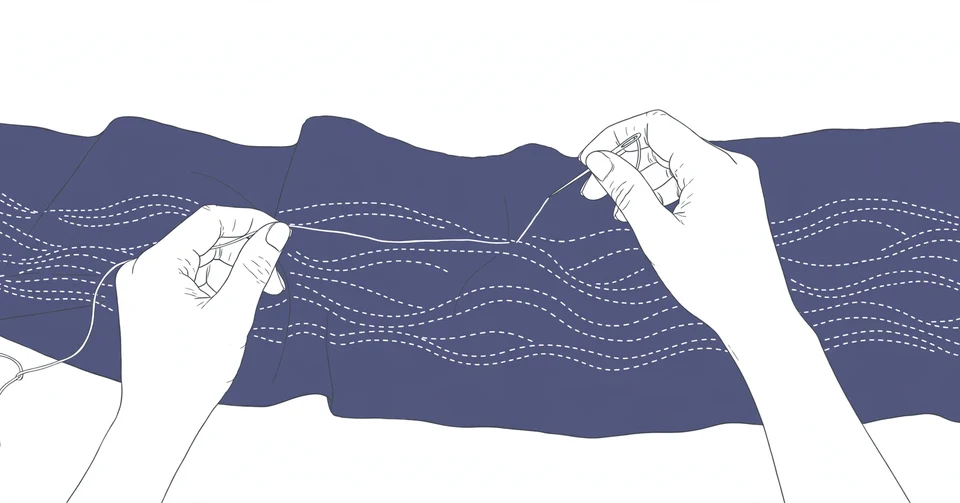
That honesty is what makes sashiko different from most kinds of embroidery. Embroidery usually adds decoration to cloth that is already whole. Sashiko began as a way to keep cloth alive, and the decoration grew out of the repair rather than the other way around. To understand it, you have to start not in a craft shop but in a farming village, where cloth was too precious to throw away.
A stitch born from scarcity
The first thing to know about sashiko is that it was born from need. In the Edo period, which ran from 1603 to 1867, Japan lived under a strict class order, and the rules reached into people's wardrobes. Commoners were limited in the fabrics they could wear, and cloth itself was expensive because every step of making it was done by hand. Cotton, silk, and hemp had to be spun, woven, and dyed before a garment could even be cut, and hemp, the cloth ordinary people wore most, tore easily. When a garment wore thin, the sensible answer was not to replace it. It was to stitch it back into strength.
The Wikipedia entry on sashiko traces the craft to the Edo period, when worn clothes were pieced together with simple running stitches to make new garments, and the stitching made the patched cloth stronger than it had been before. Sashiko was also used to layer thin fabrics together for warmth, turning two weak pieces of cloth into one sturdy one. By the Meiji period, which began in 1868, the work had become so established that it was winter work in northern farming communities, done indoors while the fields lay under snow.
There are hints that the stitch is older than the Edo period. A monk's robe from the 8th century, kept in the Shoso-in treasure house in Nara, carries a decorative running stitch, and it suggests that Japanese makers were already drawing with a needle long before sashiko had a name. The name itself came later, when the stitch became a daily tool of farming and fishing families rather than a rare decoration. I like that order of events. The beauty came second. The usefulness came first, and it never really left.
How sashiko holds a hanten together
The clearest way to see what sashiko does is to look inside a hanten, the padded winter jacket that Japan wears to work. Sashiko stitching, the small running stitches used across Japanese textiles, holds the layers together and spreads the warmth evenly, and the story of the hanten shows how much depends on that quiet work. Without the stitching, the loose wadding inside the jacket would slide downward with wear, leaving the shoulders thin and the hem lumpy. The pattern is decorative, but it is decoration with a job to do, and the prettiest part of the jacket is also the part that keeps it working.
Firemen's coats give the same lesson in a more dramatic form. The hikeshi banten of the Edo period was made of several layers of indigo cloth stitched together with sashiko until it became thick and absorbent, and the coat was soaked in water before the fireman ran toward the flames. The wet layers held off the heat long enough for the work to be done, and the dragons and heroes stitched or painted onto the coat were a kind of armour of their own. The story of the hikeshi tells how those coats carried their wearers into the fire, and sashiko is the reason the layers stayed together at all. A running stitch does not look heroic. It looks plain. But plain stitches, laid down by the thousand, are what turned thin cloth into a coat a man could trust with his life.
Two ways of making a pattern
Once the practical job is understood, the patterns make sense. Sashiko patterns are almost always geometric, built from lines and shapes that a running stitch can draw easily, and they fall into two broad styles. In moyozashi, the pattern is made with long lines of running stitch that travel across the cloth. In hitomezashi, the pattern emerges from single stitches lined up on a grid, each stitch a small mark that joins with its neighbours to make a larger shape. The two styles look different, but they use the same stitch, and a maker can move between them the way a cook moves between two knives.
The names of the patterns read like a walk through the Japanese countryside. Seigaiha draws waves in overlapping scales. Shippo tsunagi links rings into an endless chain, and its name reaches back to the seven treasures of Buddhist teaching. Kagome weaves a bamboo basket pattern, uroko lays down fish scales, and yabane lines up arrow feathers. Fishermen's coats often carried patterns with meaning, waves for safe return, scales for a good catch, and the stitching turned a working garment into a quiet kind of prayer for the day's work.
One regional style deserves a mention of its own. Kogin-zashi, developed in Aomori Prefecture in the far north, builds diamond patterns in horizontal rows, and it is so distinct that it is often named as a craft in its own right. The great woodblock artist Katsushika Hokusai, who lived from 1760 to 1849, also left his mark on the craft. His book of design patterns from 1824 inspired many sashiko motifs, and the borrowing shows how freely the stitch moved between art and everyday life. A pattern could start in a famous artist's book and end up on a farmer's jacket, and nobody thought that strange.
The needle, the thread, and the rhythm
The tools of sashiko are few, and that is part of its charm. The needle is longer than a Western sewing needle, with a larger eye to take the thicker cotton thread, and the thread itself is different from embroidery thread. Where embroidery thread is made of strands that can be split apart, sashiko thread is made by twisting fine threads into a single sturdy cord that will not fray as it is pulled through layer after layer of cloth. A thimble, a piece of fabric, and a pattern to follow are all the rest that is needed, and the whole kit fits in a small bag.
The rhythm of the work matters as much as the tools. The stitcher loads several stitches onto the needle at once, rocking it in and out of the cloth before pulling the thread through in one smooth motion, and the hand learns the spacing by feel rather than by measuring each stitch. There is a small debate among makers about whether to knot the thread before starting. Some knot it, and some hold the work together by reversing and doubling the first stitches instead, trusting the weave of the stitch itself to lock the thread in place. Either way, the finished surface should look even and unhurried, with the stitches a little longer on the front of the cloth than on the back.
Different regions made the stitch their own. In the wet mountain country of Tsugaru, white thread ran over deep indigo cloth in horizontal and vertical lines, and the darkness of the dye was itself a sign of wealth, because so much indigo was needed to reach it. In the drier north of Nanbu, light blue ramie and hemp formed the base, with cotton layered over the shoulders and edges. On the Shimokita Peninsula, fishermen's families used more thread to make garments sturdier for work at sea, while in Shonai the stitch ran in dark cloth with white or blue thread, sewn from right to left and top to bottom. The stitch was the same everywhere. The cloth, the climate, and the work decided the rest.
From workwear to the runway
Sashiko has a close cousin that is often confused with it, and the difference is worth knowing. Boro is a mending technique built on layering and patching, while sashiko is the stitching itself, and the two are usually found together, with sashiko stitches holding boro patches in place. A patched garment can be pure boro, but the moment neat rows of running stitch appear, sashiko has joined the work. Together they form the look that the world now recognises as Japanese visible mending, where a repair is not hidden but celebrated.
That look has travelled far from the farming villages where it began. The Japan Objects guide to sashiko follows its path from a frugal necessity into contemporary fashion, where labels such as Kapital stitch sashiko patterns into denim jackets and Issey Miyake has used the technique in his collections. It has appeared on the runway for Maison Margiela, and it now turns up on bucket hats, bags, cushions, and wall hangings, far from any winter field. A small museum in the village of Hinohara, on the outskirts of Tokyo, keeps the older pieces, vintage yukata and bags and wall hangings gathered in a house said to be two hundred years old, and it is worth a visit for anyone who wants to see how much beauty can be stitched into an ordinary garment.
I think the fashion world found sashiko at the right moment. For years, the industry treated clothes as disposable, and a torn seam was a reason to buy a replacement. Sashiko answers with the opposite idea, that a garment becomes more valuable the longer it is kept and the more carefully it is repaired. That idea has a Japanese name, mottainai, the regret at wasting something that still has life in it, and it fits the present mood better than any trend forecast. A stitch that saves a jacket from the bin is not nostalgia. It is a practical answer to a real problem, and it happens to be beautiful as well.
Learning to mend in plain sight
Anyone can try sashiko with very little preparation. A worn shirt, a pair of jeans with a thin knee, or a tea towel with a frayed edge will do for a first piece, and a simple running stitch is all the skill the work demands at the start. The usual advice is to begin with a straight pattern, lines or a simple grid, and to let the hand find its rhythm before attempting a wave or a ring. The stitches do not have to be perfect. In fact, the small unevenness of a beginner's hand is part of what makes the finished piece feel alive, and it fades with practice anyway.
What matters more than neatness is the habit the work builds. Mending asks for an evening of patience instead of a minute of shopping, and it asks the maker to look closely at something they own and decide that it is worth keeping. That is a small decision, but it is not a trivial one. Every garment saved from the bin is a small vote for a world where things are made to last and cared for when they break, and the vote is cast with a needle rather than a wallet.
Sashiko turns mending into the most beautiful part of a garment because it never pretends the damage did not happen. The stitch marks the place where the cloth failed and says, plainly, that someone cared enough to fix it. A jacket that has been stitched back into strength carries its history on its surface, in white thread on indigo, and it is warmer for the layers and richer for the pattern. The next time a favourite garment tears, it is worth remembering that the tear is not the end of the story. It may be the beginning of the prettiest part.
More in Culture & Society
- Boro Turns Rags Into the Cloth Japan Refused to Throw Away
- Iga Ware Fires the Clay Pot That Holds Heat the Longest
- Warosoku Burns Brighter Because Its Wick Is Hollow
- Japanese Chopsticks and the Quiet Rules Behind Every Meal
- The Haze Tree Grows the Wax Behind Japan's Oldest Candles
- Haze Wax Keeps Japan's Oldest Candles Burning
Latest posts
- Mount Takao and the Day Trip Tokyo Takes When It Needs Air
- A Donabe Turns a Clay Pot Into Japan's Slowest and Warmest Way to Cook
- A Shichirin Turns a Handful of Charcoal Into a Full Meal
- A Tanzen Is the Full Length Robe Japan Wears Indoors in Deep Winter
- A Hanten Is the Winter Jacket Japan Wears to Work
- Furoshiki, the Japanese Cloth That Wraps Almost Anything
- Japanese Candles Are Still Rolled by Hand in Japan
- Ubame Oak Is the Tree That Turns Into White Charcoal
- Binchotan Is the Charcoal That Made the Hibachi Possible
- Igusa Is the Humble Grass Under Every Tatami Mat
- Japanese Incense and the Art of Listening to Smoke
- Kumiko Builds Beauty From Wood Without a Single Nail
- A Hibachi Carries the Hearth Anywhere in the House
- A Kotatsu Turns a Cold Winter Evening Into the Warmest Room in the House
- The Jizaikagi Hangs Above the Fire and Sets the Pace of Dinner