Rangda Is the Witch Queen Bali Never Lets Win
· 17 min read
Rangda is the demon queen of Bali, the witch queen of the leyak, whose terrifying mask and eternal battle with Barong keep the island's balance between good and evil alive.
There is a face in Bali that children learn to fear before they can even say its name. Rangda stares out from temple gates and dance stages with bulging eyes, a lolling tongue, and fangs that curve down past her chin. She is the demon queen of the island, the queen of the leyak witches, and in the old stories she brings plague, ruined crops, and death in the night.
And yet Bali does not hide her away. Rangda appears in the most beloved dance on the island, her mask is kept in the temple like a sacred object, and her battle with the lion Barong is performed again and again, in village after village, year after year. The island fears her and honours her at the same time, and that contradiction is the whole point.
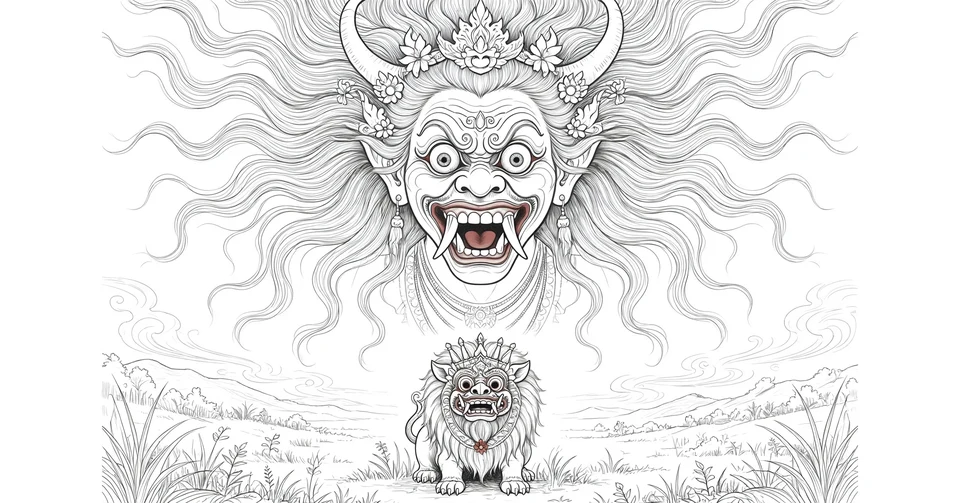
To understand Rangda is to understand something essential about Bali. She is not a villain who will one day be defeated for good. She is a force the Balinese believe must exist, because without her there would be nothing for the good to push against, and the balance the island lives by would collapse. This is her story, the widow, the witch, the queen, and the goddess, all wearing the same terrifying face.
What rangda looks like, and why the mask frightens
The first thing to know about Rangda is that her appearance is not an accident. Every detail of her mask is designed to frighten, and the fright is the message. She is shown as an old woman with long, wild, unkempt hair, a mostly bare body, pendulous breasts, and long clawed fingers. Her face is a mask with round, goggling eyes, a long tongue that hangs out of her mouth, and a row of fangs. The old tales even call her child-eating, a detail that tells you how completely she embodies the fears of a village, the danger that comes for the most defenceless first.
The mask is white, the colour of death and magic in Balinese belief, and it is made to be seen from far away. In a crowded temple courtyard at dusk, when the gamelan is playing and the torches are lit, there is no mistaking the moment she enters. The whole mood of the performance changes. The playful monkeys leave, the music turns dark, and the audience, even the people who have seen the dance a dozen times, goes quiet. That is not stagecraft in the ordinary sense. It is a community looking directly at what it fears most, and refusing to look away.
But the mask is more than a frightening face. In Balinese belief it is a vessel for power. The Spurlock Museum, which holds a Barong dance mask in its collection, describes the mask of Rangda as a receptacle for the power of the goddess Durga, who protects communities from epidemics in exchange for veneration. Before a performance, the masks of both Rangda and Barong are charged with spiritual power, called sakti, and they become magically unstable, a state the Balinese call tenget. Only people who have been initiated may handle them. The dancer who wears the Rangda mask must become possessed by the power inside it, because that possession is the sign that Durga is present and will protect the community.
That detail changes everything about how you should watch her. The dancer is not pretending to be a monster. In the understanding of the village, the mask is a place where a real power shows itself, and the dancer is the person through whom it appears. The fear the audience feels is not the fear of a costume. It is the fear of standing close to something genuinely dangerous, and trusting the ritual to hold it.
There is something honest about that, I think. Modern life trains us to look away from what frightens us, to scroll past it, to call it superstition and move on. Bali does the opposite. It carves its fear into wood, paints it white, gives it fangs, and then puts it at the centre of the village, where everyone can see it. A fear you can see is a fear you can face, and a fear you can face is a fear you can live with.
The widow behind the mask
Every frightening figure has a story, and Rangda has two of them, which may be two faces of the same memory. The first is the legend of Calon Arang, and it begins, like so many old stories, with a widow who had been wronged.
Calon Arang was a widow in ancient Java who had mastered black magic, and she used it against the people around her. She damaged the farmers' crops and brought disease to the villages. She had a daughter named Ratna Manggali, who was beautiful but could not find a husband, because people were afraid of her mother. Angry on her daughter's behalf, Calon Arang took her revenge. She kidnapped a young girl and brought her to a temple of death to be sacrificed to the goddess Durga. The next day, a great flood engulfed the village, many people died, and disease spread.
The story is set in the reign of King Airlangga, in the late tenth century, and it is told as history in the old texts, though no one can now verify how much of it really happened. What the tale preserves is not a date but a pattern, the widow, the feared mother, the daughter who cannot marry, the revenge that falls on the whole village. That pattern is the heart of Rangda, and it is worth pausing on, because it is not the story of a monster who was born evil. It is the story of a woman who was pushed to the edge of her community and then punished that community for pushing her.
King Airlangga, hearing of the disaster, asked his adviser Empu Bharada to deal with the problem. Empu Bharada sent his disciple Empu Bahula to marry Ratna, and the marriage was celebrated with a feast lasting seven days and seven nights, after which calm returned for a time. But Calon Arang kept a book of magic incantations, and when Empu Bahula found it and gave it to his teacher, she grew furious and challenged Empu Bharada to a fight. Without the help of Durga, she was defeated, and the village was safe from her black magic. That is how the tale ends, with the witch beaten, though never quite gone.
The Wikipedia entry on Rangda tells this story in full, and it is worth reading, because the details matter. The flood, the feast, the stolen book, the fight with the holy man, all of it survives because the story is still performed, still danced, still argued over in Bali today. A legend that no one told would have died centuries ago. This one is alive because the island keeps retelling it.
The other story, a queen named Mahendradatta
The second story about Rangda is stranger, because it may be history wearing the clothes of myth. Some interpretations say that Rangda was derived from a real person, the eleventh-century queen Mahendradatta, also called Gunapriyadharmapatni, a Javanese princess who married the Balinese king Udayana and became the mother of Airlangga himself.
Mahendradatta was known for her devotion to the cult of Durga in Bali, and the story goes that her husband condemned and exiled her for allegedly practising witchcraft and black magic. After she became a widow, hurt and humiliated, she sought revenge on her former husband's court and on the whole of his kingdom. She summoned the evil spirits of the jungle, the leyak, and the demons that cause plague and death, and she took her revenge by killing off half the kingdom with a plague before she was overcome by a holy man.
Read that story slowly, because it changes the meaning of the mask. If Rangda is Mahendradatta, then she is not a demon who came from nowhere. She is a queen who was cast out, a mother who was separated from her son, a widow whose grief turned to fury. The old Javanese word rangda means widow, and that meaning sits at the centre of both stories. In each version, the terrifying figure begins as a woman who has lost her husband, her place, and her protection, and who answers that loss with power no one can control.
Which version is true? No one can say, and it is probably the wrong question. The two stories may be two ways of remembering the same fear, the fear of what happens when a community turns on one of its own. What matters is that both stories agree on the shape of Rangda, a widow, a witch, a queen of dark powers, and both agree that she cannot simply be erased. She can be fought, she can be held back, she can be defeated for a season, but she always returns, because the conditions that made her, grief, exile, and revenge, are always with us.
I find that reading of her more unsettling than the simple monster story, and also more useful. A monster you can dismiss. A wronged widow who became a queen of witches asks you to look at how your own community treats the people it pushes aside. Bali's old stories do not let the audience off that easily, and that is one reason they have lasted a thousand years.
Rangda and Durga, destruction with a purpose
To understand why Rangda is sacred as well as feared, you have to understand her connection to Durga. Bali is a Hindu island, and it is widely suggested that Rangda is closely associated with Durga, the great goddess, and similar in some ways to Kali, the goddess of destruction, transformation, and protection. But the association is not simple, and the difference matters.
Durga is seen as a benevolent mother goddess, a protector and a giver of fertility, as well as a destroyer. Rangda, by contrast, is mostly considered the personification of evil. Yet her mask is a receptacle for Durga's power, and Durga, in this understanding, protects communities from epidemics in exchange for veneration. The same goddess who sends the plague can also hold it back. The same power that destroys can also protect. That is not a contradiction the Balinese try to resolve. It is a contradiction they build their rituals around.
Rangda is also the queen of the leyak, the shape-shifting practitioners of dark magic who are said to be able to possess humans and animals and spread illness. Her mask, according to the Spurlock Museum's account, may also control the leyak, the sorcerers who propagate disease. So Rangda is both the ruler of the forces of sickness and the power that can restrain them. Rangda commands the very thing she is feared for, and that command is what makes her necessary.
This is the part of the story that outsiders most often miss, because it does not fit the simple picture of good against evil. In the Balinese view, the dark is not a foreign invader. It is part of the world, part of the gods, part of the balance. Rangda is not a rebel against the cosmic order. She is one half of it, the half that destroys, and destruction has its place. Crops must rot so new ones can grow. Old things must end so new things can begin. A world with no destruction in it would be a world with no change, and no change means no life.
That is a hard teaching, and I do not think it is meant to be comfortable. It asks you to accept that the things you fear may also be the things that keep the world turning. It asks you to honour a power you would rather banish. But there is wisdom in it, the kind of wisdom that comes from living for centuries on a small island where disease, drought, and disaster are never far away, and where pretending they do not exist has never kept anyone safe.
The dance where rangda meets Barong
The place where all of this comes together is the Calonarang, the performance in which Rangda and Barong meet. The Spurlock Museum describes it as an exorcistic and dramatic performance, meant to magically restore a disturbed cosmic equilibrium and, afterwards, to prevent and control epidemics. That is a precise description, and it tells you what the dance is for. It is not entertainment first. It is medicine for the village, performed in public, with the whole community watching.
The performance begins with the masks being charged with power, and from that moment the event is dangerous in a way a stage show is not. The dancer wearing the Rangda mask becomes possessed by the power inside it, and the followers of Barong become possessed by the buta kala, the demons that bring illness and calamity, and attempt to attack Rangda. Overwhelmed by her power, they turn their keris daggers on themselves instead, in the act called ngurek, pressing the blades to their own chests. It is the same keris scene that unsettles first time watchers of the Barong dance, and it is real, not a trick, which is why a priest must be present to keep the dancers safe.
Then Barong answers, and the lion's protective magic makes the dancers' bodies resistant to the blades. The dance ends with the final battle between Barong and Rangda, and with the lion's victory, Rangda is driven off, and order is restored. Or rather, it is restored for now, because the story will be told again, and the balance will need keeping again.
You can read the full story of the lion in our account of how Barong is the lion Bali calls out when the village needs protection, and the philosophy behind their endless battle is set out in our account of how rwa bhineda keeps opposites from going to war. The two articles belong together, because the two figures belong together. Neither one means anything without the other.
The dance is performed at times of trouble, when a village feels it needs cleansing, and at the great festivals, when the sacred objects are brought out in any case. But it is also performed for visitors now, in theatres and hotel stages across the island, and that has changed how the story travels. The tourist version is shorter, brighter, and easier to follow, and there is nothing wrong with that, as long as you remember that the dance you see on a stage is a small part of a much older and much more serious thing. In the village, the performance is a ritual. On the stage, it is a retelling. Both are real, but they are not the same.
There is a detail worth carrying with you if you ever attend one. Watch the moment Rangda enters, and watch the audience, not the stage. The children will hide behind their parents. The older people will go still. Everyone in the courtyard knows who she is, and everyone knows what she means, and for a few minutes the whole village is paying attention to the same thing, the danger they all share, and the protection they all share too. That shared attention is part of the ritual. It is how a community reminds itself that it is a community.
Why Bali does not destroy her
The question that stays with you, after you have learned her stories, is a simple one. If Rangda brings plague and death, why does Bali keep her? Why is her mask consecrated, why is her dance performed, why is her power honoured with offerings? The answer is the same answer that runs through everything in Balinese belief, and it is worth stating plainly. Bali does not believe that evil can be destroyed, only balanced.
In this view, good and evil are not two armies, one of which will eventually win. They are two forces that exist together, and the health of the world depends on keeping them in their proper tension. Barong does not destroy Rangda. He holds Rangda back, and that holding back has to be done again and again, in every generation, in every village. The dance ends with the lion's victory, but everyone watching knows the victory is temporary, and that knowledge is not a disappointment. It is the point.
There is a lesson in that for anyone who lives outside Bali, and it is a lesson I keep returning to. The modern instinct, when faced with something frightening, is to delete it, to ban it, to pretend it was never there. We block, we cancel, we look away, and we call that solving the problem. Bali takes the opposite approach. It gives its fear a face, a name, a mask, and a place in the temple, and then it meets that fear on a schedule, in public, with the whole village watching. The fear is not denied. It is managed, ritually, together, over and over.
That is not superstition. It is a practical system for living with forces no one can control. Disease will come back. Bad luck will come back. Grief and anger will come back, because people will keep being widowed, keep being exiled, keep being wronged. A culture that has a ritual for facing those things is a culture that has thought seriously about how to survive them.
It is also worth saying, plainly, that the mask is not a souvenir. Rangda's mask, like the Barong mask, is a sacred object, consecrated in ceremony, kept in the temple when it is not in use, and handled only by those who have been initiated. Visitors who buy a copy in a market are buying a carving, not the thing itself, and the difference matters. The power of the mask comes from the ritual, the temple, and the community that honours it, not from the wood. Respect, in this case, is not politeness. It is accuracy.
What rangda teaches about fear
So what does Rangda leave you with, once the dance is over and the masks are back in the temple? I think she leaves you with a better question than the one you arrived with. Most of us come to a story like this asking who wins, the lion or the witch, good or evil, and we expect an ending. Bali answers with a different question, which is how you live with both of them, and keep them in balance, for as long as you live.
Rangda teaches that fear is not a failure. The villagers who go quiet when she enters are not cowards. They are people who know what they are looking at, and who have a way to face it together. She teaches that the people a community pushes aside do not disappear, and that their anger, if it is ignored long enough, becomes something the whole village has to answer for. And she teaches that destruction is not the opposite of life, but part of it, the dark half of a world that needs both halves to turn.
Rangda loses every time she dances, and she returns every time she loses. That is not a defeat. It is a promise, that the balance will be kept, that the village will gather again, that the lion will answer again, and that the story will go on. Bali never lets Rangda win, and Bali never lets her go, and in that double refusal, fear and honour held together in the same hands, there is a kind of wisdom that is worth carrying home.
More in Culture & Society
- The Japanese School Uniform and the Story Behind the Sailor Suit
- Aikido and the Martial Art That Refuses to Fight Back
- Barong Is the Lion Bali Calls Out When the Village Needs Protection
- Setsubun, the Bean Throwing Festival That Chases Winter Away
- Karate, the Empty Hand That Became Japan's Most Exported Martial Art
- Kemari Is the Ball Game Japan Played Without Trying to Win
Latest posts
- Satay and the Smoke That Carries Indonesia to the World
- Tumpeng Is the Rice Cone Java Serves When It Wants to Say Thanks
- Onsen Etiquette and the Unwritten Rules of Japan's Hot Springs
- Japan's Winter Illuminations Turn Dark Nights Into Light
- Chagama Is the Kettle That Never Leaves the Tea Room
- Judo, the Gentle Way Japan Gave the World
- Lake Toba and the Supervolcano That Made the World's Largest Volcanic Lake
- Raja Ampat and the Coral Kingdom at the Edge of Indonesia
- Tokyo Skytree and How Japan Built the World's Tallest Tower
- Matsumoto Temari Turns Mountain Cocoons Into Wishes You Can Hold
- Nambu Tekki Is the Iron That Outlasted the Lords Who Ordered It
- Forest Bathing in Japan, the Quiet Science of Shinrin-Yoku
- Tokyo Tower and the Orange Giant That Refused to Be Replaced
- Emoji, the Tiny Pictures Japan Gave the World
- Temari Is the Embroidered Ball Japan Gives for Good Luck