Barong Is the Lion Bali Calls Out When the Village Needs Protection
· 18 min read
Barong is the lion-like guardian spirit of Bali, king of the good spirits, whose sacred mask and dance defend the village against Rangda and restore balance.
When something is wrong in a Balinese village, when sickness spreads or bad luck settles over the houses, the village does not only call a priest. It calls out the lion. Barong is carried from the temple, its great furred body swaying between two dancers, its red face grinning above the crowd, and the village gathers to watch it drive the darkness back.
Barong is the guardian spirit of Bali, a lion-like creature who is king of the spirits and leader of the hosts of good. He is the protector every village keeps, the figure who stands between the community and the forces that would harm it. His story is told in dance, his mask is kept in the temple like a sacred object, and his appearance is an event, not a decoration.
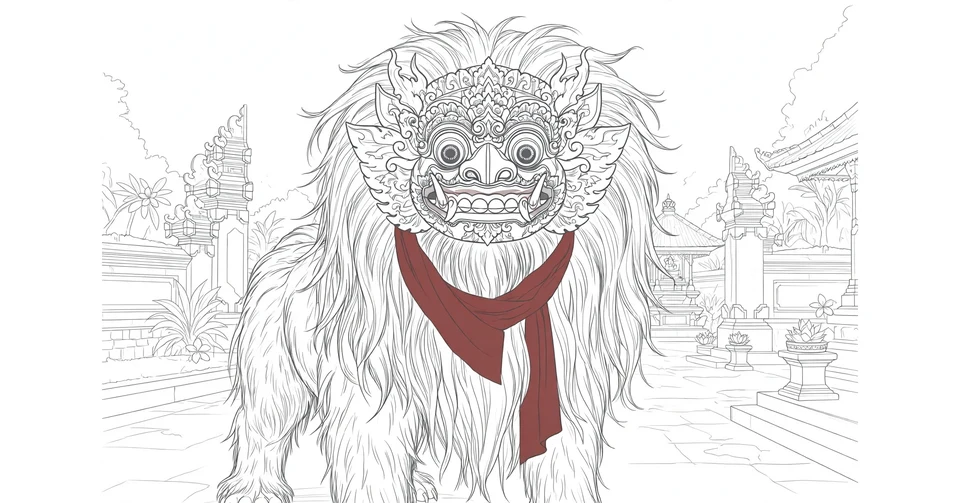
To meet the lion is to meet the Balinese idea of balance made visible. He never appears alone in the old stories, because his meaning depends on his opposite. His enemy is Rangda, the demon queen, and their battle is never finally won, only fought again, in every generation, in every village, so that good and evil stay in their proper tension. That is the heart of what Barong means, and it is worth understanding before you ever see the dance.
What barong is, and where the lion came from
The guardian is usually described as a lion, though the creature is stranger than any real lion. He has a red head, bulging eyes, a mouth lined with fangs, and a body covered in thick white fur, with gilded jewellery set with pieces of mirror that catch the light as he moves. His shape has been compared to a Pekingese dog, which gives a sense of how compact and shaggy the figure is. Inside the costume are two dancers, one working the head and front legs, the other the rear, moving together so that the animal seems to breathe.
The name itself hints at an older history. Barong is thought to come from the local word bahruang, which corresponds to the Indonesian word beruang, meaning bear, and the creature is understood as a good spirit that took the form of an animal to become the guardian of the forest. That forest guardian idea matters, because it suggests that Barong predates the Hinduism that later shaped Bali. The animal mask dance, together with the sanghyang dance, is considered a native Balinese tradition, probably older than Hindu influence on the island, rooted in the old Austronesian belief that ancestral and natural spirits could be given a face and a body.
In Balinese belief, the spirit that animates the lion is Banas Pati Raja, the fourth spirit brother who accompanies a child through life, a little like a guardian angel in other traditions. That detail changes how you should picture the lion. He is not a mascot or a piece of folklore kept for tourists. He is a living presence in the village, a protector with a name and a history, whose home is the temple and whose duty is the safety of the people who live around it.
The most famous form is the lion, Barong Ket, also called banaspati raja, king of the jungle. He is the most common form, the one most visitors see, and he comes in particular from the Gianyar region, where Ubud sits. But he is only one of several, and the variety is part of the story, since each region of Bali has its own protective spirit, modelled on a different animal, guarding its own forests and lands.
Barong and Rangda, the battle that never ends
No account of the lion is complete without Rangda, because the two are defined against each other. Rangda is the demon queen, the incarnation of Calon Arang, the legendary witch who, according to the old tales, wreaked havoc in ancient Java during the reign of King Airlangga in the tenth century. She is the mother of all spirit guarders in the dark sense, the force that brings disease, bad harvests, and misfortune. Where Barong protects, Rangda threatens, and the dance between them is the story of that tension played out in public.
The Calon Arang tale is long and tangled, as old stories tend to be. Calon Arang was a widow who had mastered black magic, and she used it against the farmers whose crops she damaged and the villages she filled with disease. Her daughter, Ratna Manggali, was beautiful but could not find a husband, because people feared her mother. Angry on her daughter's behalf, Calon Arang took revenge, kidnapping a young girl and bringing her to a temple to be sacrificed to the goddess Durga. A flood followed, and many people died, and disease spread.
King Airlangga, hearing of this, asked his adviser Empu Bharada to deal with the problem. Empu Bharada sent his disciple Empu Bahula to marry Ratna, and the marriage, celebrated with a feast lasting seven days and seven nights, restored calm for a time. But Calon Arang kept a book of magic incantations, and when Empu Bahula found it and gave it to his teacher, she grew furious and challenged Empu Bharada to a fight. Without the help of Durga, she was defeated, and the village was safe from her black magic. That is one version of the tale. Another holds that Rangda was linked to the historical queen Mahendradatta, a Javanese princess, wife of the Balinese king Udayana, and mother of Airlangga himself, who was condemned for practising black magic and who, as a widow, sought revenge on her former husband's court. In old Javanese, the word rangda means widow, and the two stories may be two faces of the same memory.
What matters for understanding the guardian is not which version is true, since neither can be verified as history, but what the pairing means. The lion and Rangda are not a hero and a villain in the simple sense. They are the two halves of a worldview in which good and evil are always present, always in tension, and never finally settled. The Balinese call this rwa bhineda, the balance of opposites, and you can read more about that idea in our account of how rwa bhineda keeps opposites from going to war. Barong does not destroy Rangda. He holds her back, and that holding back has to be done again and again.
The Barong dance, scene by scene
The dance is the most famous way most visitors meet the lion, and it is worth knowing what you are watching, because the performance follows a shape that has been repeated for generations. The dance opens quietly, with two playful monkeys teasing Barong in a peaceful setting. Then Rangda appears, and the mood changes. She casts her black magic on the male dancers, who represent the soldiers of Airlangga, and orders them to turn their poisoned keris daggers on themselves. In a trance, the men press the blades to their chests, and the audience holds its breath.
Then the lion answers. He and the priest cast protective magic on the men, making their bodies resistant to the sharp keris, so that the blades cannot wound them. The dance ends with the final battle between Barong and Rangda, and with Barong's victory. Rangda runs away, the evil is driven off, and the order of the world is restored. Or rather, it is restored for now, because the story will be told again, and the balance will need keeping again.
That keris scene, often called the keris dance, is the part that unsettles first time watchers, and it should. The dancers really do press real blades against their skin, and the trance is real enough that the priest must be present to keep them safe. It is not a trick, and it is not a stunt for tourists. It is a ritual in which the community watches its protectors prove, with their own bodies, that Barong's power is stronger than Rangda's. The Wikipedia entry on Barong describes this sequence in detail, and it is worth reading before you attend a performance, so that you recognise the story rather than just the spectacle.
There is a smaller detail that first time watchers often miss. A priest throws holy water over the lion as he dances through the street toward the performance, blessing the creature and the road it travels. The dance does not begin on a stage. It begins in the village, among the houses, and the stage is only where it ends. That movement, from temple to street to stage, is part of the meaning. Protection is not something that stays inside the temple. It walks out to meet the people.
I think that is the detail that stays with you. A guardian who only sat in a shrine would be easy to forget. A guardian who walks through your street, shaking his great furred body, throwing his mirrored ornaments into the sunlight, is impossible to ignore. The dance makes protection a public event, something the whole village witnesses together, and that shared witnessing is part of the protection itself.
The sacred mask, and why it is not a costume
It is a mistake to think of the lion mask as a costume piece, because the Balinese do not treat it that way. The mask, called tapel in Balinese, is a sacred object, carved from selected wood by experienced makers, and its creation requires a special ritual of its own. Once the mask is finished, it is purified in a consecration ceremony, and from then on it is treated as a vessel that holds a spirit. The dancer is the intermediary, the person through whom the spirit in the mask can show itself, and a dancer who can truly enter the mask is said to bring the character to life.
The masks are kept in the temple shrine when they are not in use, and they are honoured with offerings, just as other sacred objects are. The distinction matters because it explains why the mask is handled with such care, and why it is never treated as a souvenir. A mask that has been consecrated is not a representation of Barong. In the understanding of the village, it is a place where the guardian is present.
That sacred status also explains one of the most striking sights in Balinese festival life. During Galungan, consecrated temple objects such as barong masks, keris daggers and pratima, the images of deities, are carried through the streets in a ceremonial procession to bless the people. The masks leave the temple and travel among the houses, and the blessing is not symbolic in a weak sense. People come out to be near the procession, to be touched by the protection it carries. You can read about the festival that frames this procession in our account of how Galungan welcomes the ancestors back to Bali.
The mask makers themselves are part of this sacred economy. Carving a Barong mask is not ordinary woodwork. The maker works with wood believed to hold spiritual energy, follows ritual prescriptions, and understands that the object will be consecrated and housed in a temple. A guide published by GWK Cultural Park, which stages a modern Barong performance, describes the mask as a sacred art form, made from selected wood, purified with a special ceremony, and treated as a manifestation of the unity of art and spirituality. That is a good summary of the attitude, and it applies just as much to the village mask as to the stage version.
The many barong of Bali
The lion is the Barong most people know, but Bali keeps several others, and each one belongs to a particular place and a particular kind of protection. The variety is not decorative. It reflects the fact that every region of the island has its own guardian, modelled on the animal that its forests and fields suggested.
Barong Ket is the lion, the king of spirits, the most common and most recognised form. His headdress uses sekar taji, made of carved leather, sliced with prada, a gold coloured material, and decorated with small pieces of mirror. He is the central figure of the dance, and the one most visitors will see in Ubud and Gianyar.
Barong Bangkal, also called Barong Bangkung, is the old boar. The male boar is called bangkal in Balinese, while the female is called bangkung, which is why the same figure carries two names. He is made of velvet fabric, and he is paraded at Galungan and Kuningan, the great festival days. The boar stands for raw power and tenacity, and he is a favourite with children, who love his clumsy energy during ritual dances.
Barong Macan is the tiger, with fur that resembles a tiger's coat, made of velvet fabric. Tigers are famous mythical animals in Balinese stories, especially the tantri tales, and the tiger Barong stands for strength, agility, and protection. He is a guardian of sacred spaces and of the forest, and his dance is part of the ngelawang tradition, the wandering procession in which the Barong travels around the village.
Barong Asu is the dog, and he is a very sacred figure, kept in Pacung in Tabanan, and paraded especially at Galungan and Kuningan. Barong Gajah is the elephant, a rare figure, seen only in some villages of Gianyar, Tabanan, Badung, and Bangli. Barong Landung is different from all the others, because he is not danced by two dancers inside one body. He appears as a pair of tall human-like figures, a male and a female called Jero Gede and Jero Luh, standing several metres high, in a form similar to the Betawi Ondel-ondel. The Landung pair represent ancestral spirits, and their towering presence is meant to impress and to bless.
There are smaller, local forms as well, such as Barong Guak the raven, Barong Kambing the goat, Barong Lembu the ox, Barong Jaran the horse, and Barong Rusa the deer, each close to the everyday life of its village. The GWK Cultural Park guide lists five of the best known types together, Ket the lion, Macan the tiger, Bangkung the boar, Gajah the elephant, and Landung the ancestral pair, and notes that their modern stage show is unusual in bringing five Barong figures onto one stage. In a village, you would normally meet one Barong, your own, and that is the point. The guardian belongs to a place, and the place knows which animal watches over it.
When barong walks the village
The lion does not only appear on stage. In village life, he walks. The ngelawang is a ritual procession in which the Barong, accompanied by musicians and dancers, travels around the village, visiting houses and compounds, driving out bad influences and blessing the people it passes. The word means wandering, and the wandering is the work. A guardian that stayed in the temple would protect the temple. A guardian that walks protects the village.
These processions are most common at times of trouble or transition, when a village feels it needs cleansing, or at the great festivals, when the sacred objects are brought out in any case. The Barong is accompanied by gamelan, by priests, and by a crowd that grows as the procession moves from house to house. Offerings are made, holy water is sprinkled, and the lion pauses at each doorway, shaking his mane, while the family inside receives the blessing.
There is also a quieter, daily side to the Barong's presence. The mask rests in the temple shrine, and offerings are made to it regularly, as part of the ordinary round of temple care. The village does not only call on its guardian in emergencies. It tends the guardian, feeds it with offerings, and keeps the relationship alive, so that when the call comes, the guardian is already at home.
That relationship is what separates Barong from a performance tradition that exists only for an audience. The dances for visitors are real, and they are beautiful, but they are a small part of the life of a village Barong. The larger part is invisible to a tourist, and it is made of small repeated acts, offerings, processions, blessings, and the knowledge, shared by everyone in the village, that the lion is theirs.
What barong means to Balinese Hinduism
In Balinese Hinduism, the lion is the embodiment of dharma, the cosmic power of goodness, order, and virtue. That is a large claim, and it is worth slowing down for. Dharma is not only a moral idea. It is the order of the world, the way things ought to be, and Barong is that order given a body, a face, and a dance. When the lion appears, the village is seeing its own values walk down the street.
That is also why the battle with Rangda is never resolved. In this worldview, good and evil are not two armies, one of which will eventually win. They are two forces that exist together, and the health of the world depends on keeping them in balance. The lion's victory in the dance is real, but it is temporary, and everyone watching knows it. The dance will be performed again, because the balance will need keeping again. That is not a pessimistic view. It is a realistic one, and it is, I think, more honest than the stories in which evil is defeated once and for all.
There is a lesson in that for anyone who visits Bali. The island's beauty is famous, and its temples and dances are photographed a million times a year, but the culture behind them is not a performance for visitors. It is a working system for living with forces that cannot be controlled, only balanced. The lion is the part of that system you can see. The philosophy behind him is the part you have to listen for.
It is also worth noting, for visitors, that respect is part of the experience. The mask is sacred, the dance is a ritual, and the trance is not entertainment. Watching with attention, without treating the ceremony as a show put on for your benefit, is the right way to receive it. The villages that keep Barong are generous with visitors, and the least a visitor can do is to be a good guest, quiet during the prayers, careful with cameras, and grateful for the invitation.
Why the lion still matters
Barong has survived centuries of change in Bali, from the arrival of Hinduism to the arrival of mass tourism, and he has survived because he answers a need that does not go away. Villages still get sick. Bad luck still arrives. People still want to know that something good is watching over them, and that the community has a way to call on it together.
The modern stage shows, like the one at GWK Cultural Park, are part of that survival. They bring the lion to people who would never see a village procession, and they do it with respect for the sacred roots of the figure, keeping the masks large and the story intact. A guide from the park describes the mask as more than an artistic masterpiece, calling it a sacred symbol of protection, balance, and spiritual harmony at the heart of Balinese tradition. That is not marketing language. It is, as far as I can tell, an accurate description of what the village has always believed.
I find it encouraging that a figure this old can still fill a theatre, and still be carried through a village street, and that both of those things can be true at once. Too often, traditions are presented as a choice between the authentic and the accessible, as if a sacred dance must either stay hidden or become a show. Barong refuses that choice. The same lion walks in the village and dances on the stage, and the meaning travels with him, because the meaning was never about secrecy. It was about protection, and protection is something you want as many people as possible to witness.
The next time you see Barong, whether in a temple courtyard or on a stage in Ubud, watch for the moment when the monkeys leave and Rangda enters, and the mood of the whole performance shifts. Watch the keris dancers, and the priest with the holy water, and the lion answering. You are watching a story that is older than the island's Hindu temples, told by people who still believe it matters. The lion will win, this time. And then, as always, the village will gather again, and the story will begin once more.
More in Culture & Society
- Setsubun, the Bean Throwing Festival That Chases Winter Away
- Karate, the Empty Hand That Became Japan's Most Exported Martial Art
- Kemari Is the Ball Game Japan Played Without Trying to Win
- Chagama Is the Kettle That Never Leaves the Tea Room
- Judo, the Gentle Way Japan Gave the World
- Matsumoto Temari Turns Mountain Cocoons Into Wishes You Can Hold
Latest posts
- Tumpeng Is the Rice Cone Java Serves When It Wants to Say Thanks
- Onsen Etiquette and the Unwritten Rules of Japan's Hot Springs
- Japan's Winter Illuminations Turn Dark Nights Into Light
- Lake Toba and the Supervolcano That Made the World's Largest Volcanic Lake
- Raja Ampat and the Coral Kingdom at the Edge of Indonesia
- Tokyo Skytree and How Japan Built the World's Tallest Tower
- Nambu Tekki Is the Iron That Outlasted the Lords Who Ordered It
- Forest Bathing in Japan, the Quiet Science of Shinrin-Yoku
- Tokyo Tower and the Orange Giant That Refused to Be Replaced
- Emoji, the Tiny Pictures Japan Gave the World
- Temari Is the Embroidered Ball Japan Gives for Good Luck
- A Tetsubin Turns Iron and Fire Into Japan's Slowest Kettle
- Hakone and the Hot Spring Town Below Mount Fuji
- Ninja, the Shadow Warriors of Feudal Japan
- A Kamado Turned the Japanese Kitchen Into a Slow Oven