Chagama Is the Kettle That Never Leaves the Tea Room
· 17 min read
A chagama is the round cast iron kettle of the Japanese tea ceremony, and it has boiled the water for matcha in the same quiet way for about eight centuries.
There is a kettle in Japan that has never been in a hurry, and never needed to be. It has no spout, no pouring handle, and no whistle to announce that the water is ready. It simply sits over the charcoal, round and black, and waits for the host to lift its lid and ladle the water out, one bamboo scoop at a time. That kettle is the chagama, the iron kettle of the Japanese tea ceremony, and it has been doing this one quiet job for about eight centuries.
A chagama is not a teapot, and it is not quite a kettle in the Western sense either. It never holds tea leaves, and nobody pours from it. Its only work is to heat water, and to hold that water at the right temperature while the host prepares matcha. The Japanese tea ceremony treats it as the most essential vessel in the room, which is a striking claim when you consider everything else on the tatami: the tea bowl, the whisk, the caddy, the scroll on the wall. The chagama earns that title because nothing in the ceremony can begin until the water is hot, and the water comes from nowhere else.
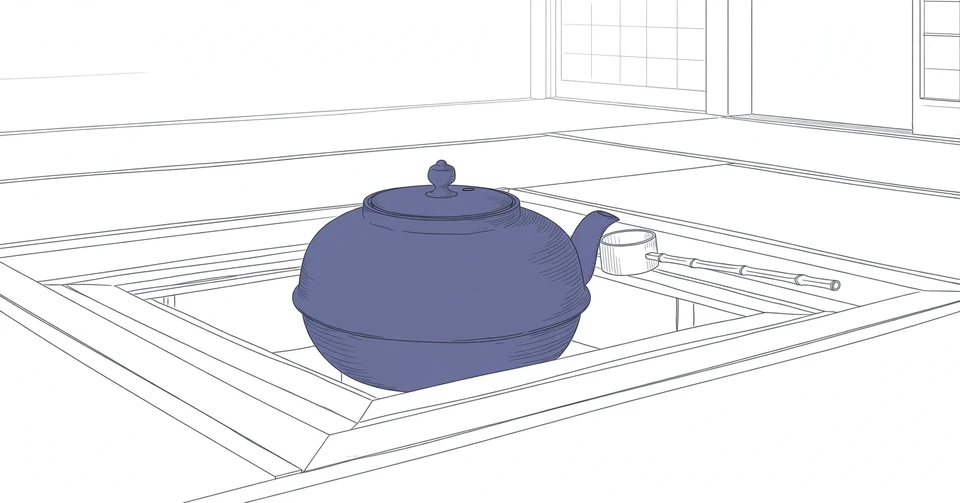
The reason the chagama stays in place is built into its shape. It is a heavy, round pot with a small mouth, two lugs on its shoulders, and a lid that is forged to fit its body exactly. You do not carry it to the table. You go to it. That single design decision shapes the whole rhythm of the tea ceremony, because the host must move around the kettle rather than move the kettle around the guests, and that slow orbit is part of what makes the gathering feel unhurried.
What a chagama actually does
The word chagama means tea kettle, written with the characters for tea and kettle. It is a specific kind of kama, the general Japanese word for a metal pot or kettle, and the distinction matters. A kama can cook rice or boil water for a bath. A chagama does one thing only, and it does it in the tea room.
Most chagama are made of cast iron, although copper examples exist. The body is round, with shoulders that may be rounded, squared, or sloping, and a mouth that can be turned inward or outward, wide or narrow, or even notched. Two loops are cast onto the shoulders, and metal rings called kan are fitted through them so the kettle can be carried or hung. The bottom may be rounded, flat and round, or flat and square. The lid is as much a part of the object as the body, and tradition holds that it should be forged at the same time so the two fit perfectly. Lids can also be made of bronze, copper, brass, silver, and even an ancient bronze mirror, and they carry their own names according to their shape: a high domed lid is a moributa, a low domed one is an usumoributa, and a flat topped lid is an ichimonjibuta.
The sound of a chagama is part of its identity. As the water comes to a boil over the charcoal, the kettle sings, a low murmur that tea people listen to the way a cook listens to a simmering pot. The host judges the water by that sound and by the steam, and the guests, sitting close by, hear it too. A modern electric kettle hides its work behind a switch and a click. A chagama performs its work in the open, and everyone in the room is invited to notice.
What I like about this is how honest the design is. The chagama does not pretend to be convenient, and it does not apologize for being heavy. It is a tool that asks the person using it to slow down to its pace, and in return it gives water that has been heated slowly over charcoal, in iron, with a steadiness that no fast appliance can copy. That trade, patience for quality, runs through a lot of Japanese craft, and the chagama is one of its clearest examples.
Two hearths, two seasons
A chagama never works alone. It always sits over one of two kinds of fire, and which one depends on the season. From November through April, the cold half of the year, the kettle is set in the ro, a hearth sunk into the floor of the tea room, framed by a wooden border called the robuchi. From May through October, the warm half, the kettle moves to the furo, a portable brazier that stands on the tatami. The changing of the hearths between ro and furo is a small seasonal ceremony in itself, and it marks the tea year the way the first snow or the first cherry blossom marks the year outside.
The two hearths ask for two slightly different kettles. A chagama made for the furo usually carries a flaring flange called a hane around its middle, and that flange rests on the collar of the brazier to hold the kettle in place. A chagama made for the ro has no need of the flange, because it is supported instead by a three legged iron trivet called a gotoku, which stands in the bed of ash inside the sunken hearth. Kettles made for the furo also tend to be slightly smaller than those made for the ro, a practical detail that comes from the size of the brazier.
The fire itself is charcoal, laid on a bed of wood ash, and the kettle sits close enough to the coals to stay hot for the whole gathering. In the ro, the heat is partly trapped by the sunken hearth, so the water warms faster and stays warm longer, and the hearth itself becomes a small picture of warmth in a cold room. In the furo, the brazier is open to the air, and the kettle stands out against the tatami like a small black moon. The host must tend the fire in both cases, adding charcoal and adjusting the ash, because a tea gathering can last hours and the water must be ready at every stage.
There is also a third way to use a chagama, and it is the most dramatic. Some kettles are hung from a chain or a bamboo pole above the fire, suspended in the air. This hanging kettle is called a tsurigama, and in the Urasenke tradition it is used in March, often with a cloud dragon kettle called an unryu-gama. A hanging chagama turns the kettle into the center of the room in a different way, floating above the flames with nothing beneath it but air, and it is a reminder that even an object this heavy can be given a sense of lightness by the way it is placed.
Eight centuries of iron
The earliest kettle for tea is said to have been made for the priest Myoe, who lived from 1173 to 1232, at Kozanji temple in Kyoto, by a master kettle maker from Ashiya in what is now Fukuoka Prefecture. The story is told as tradition rather than proven fact, and the careful wording matters, because the early history of the chagama survives in temple records and craft lore rather than in dated workshop ledgers. Still, the Ashiya kettles, known as ashiyagama, were the most prized tea kettles in Japan until the end of the Muromachi period, and one Ashiya chagama from the 1400s, a shinnari type kettle decorated with Japanese kerria flowers, is now held by the Tokyo National Museum as a registered important work of art.
Alongside Ashiya, the other great early name was Tenmyo, the kettles made in Sano in Tochigi Prefecture, known as tenmyougama. For centuries these two traditions set the standard, and a chagama from either place was a treasure worth passing down. By the late sixteenth century, tea masters had begun ordering kettles to their own tastes, and artisans moved to Kyoto to work at the Sanjo kilns, close to the heart of the tea world. From then on, a chagama was not just a bought object. It was a commissioned one, shaped by the wishes of the person who would use it.
That is why old kettles have names. A chagama that passes from one generation to the next often carries a name drawn from its owner, its shape, its pattern, or its finish, and the name becomes part of its history. The patterns themselves are a small language: rough skin called arehada, sandy skin called sunahada, tortoise shell, Chinese style mountains and rivers, the seven gods of fortune, plants, animals, and even cloisonne. No two famous kettles look quite alike, because each one was made for a particular tea master, a particular tea room, and a particular moment in the ceremony.
The most enduring shape is the shinnari, the true form. It is round, with a rim like a belt running around its lower half, and it follows the shape of the oldest kettles. During the Edo period, makers invented many new and different kettle shapes, but the shinnari remained the most popular, and it still is. I think there is something quietly reassuring about that. In a craft that could have chased novelty for four hundred years, the shape that survived was the simplest one, the round pot that does its job without showing off.
The Japanese dictionary of art history, JAANUS, describes the tea kettle as the ceremony's most essential vessel, and it records the long line of makers from Ashiya and Tenmyo to the Kyoto kilns. Reading that entry, what stands out is how little the basic object has changed. The materials are the same, the shapes are the same, and the job is the same. Only the names of the owners have changed, one generation at a time.
How a chagama is made
Making a chagama begins with a mirror image of the intended shape, worked in sheet metal. That metal pattern is used to build a mold, together with a counter part that forms the hollow interior, and molten iron is poured into the mold. A single cast iron kettle takes more than eighty separate processes, and every one of them has to be mastered by the craftsman, learning while working. It is slow, hot, exacting work, and it explains why a good chagama costs what it does.
The mold itself has a short life. Each time molten iron is poured in, and each time the cooled casting is pulled out, the mold wears a little more. The decoration fades, the details soften, and after a certain number of uses the mold has to be discarded, no matter how good it was. That is why the crispness of a chagama matters to collectors. Sharp decoration, like the fine shrimp and stone textured surface on a famous kettle by the metalworker Joun Kanaya, tells you the kettle was cast early in the life of its mold, when the pattern was still fresh.
The lids are made with the same care. Because a lid is forged together with its body, the fit is exact, and a lid from one chagama will not sit properly on another. Some lids are decorated with small dots, called ishime, or with a fine linear pattern, called itome, and the knob on top can take many forms, from a simple sphere to a plum blossom. These are small details, easy to miss, and they are exactly the details that tea people look at first.
The same casting tradition lives on in the ironware of Iwate Prefecture, where the story of Nambu Tekki, the iron that outlasted the lords who ordered it, begins with kettle makers invited from Kyoto to Morioka in the middle of the seventeenth century to cast chagama. The chagama came first, and everything else in that craft, the pots, the pans, and the famous tetsubin, grew out of the skill of making it. That is a useful way to remember the order of things. The tea kettle is the ancestor, and the kitchen kettle is the descendant.
A chagama and a tetsubin are not the same kettle
It is easy to confuse a chagama with a tetsubin, because both are round, black, and made of cast iron, and both belong to the world of Japanese tea. But they are different tools, and the difference tells you a lot about how tea is actually served.
A tetsubin has a spout and a handle, and it is made to be picked up and poured. A chagama has neither. It stays over the fire, and the water is ladled out of it with a bamboo ladle called a hishaku. The tetsubin was invented around 1750, when the kettle maker Nizaemon Koizumi, third of his line, realized that a small kettle with a spout would be easier to carry to an open air tea ceremony than the heavy chagama that had to stay in place. That small kettle was the first tetsubin, and it was the moment the iron kettle learned to leave the tea room. The story of the tetsubin, the slowest kettle in Japan, picks up exactly where the chagama leaves off, and the two articles belong together, like two chapters of one history.
The other difference is what goes inside. A chagama holds plain water, and only plain water. Tea leaves never go into it, because the bare iron interior is meant for boiling water, and steeping tea in it would stain the iron and spoil the flavor. A tetsubin follows the same rule. Both are water kettles, not teapots, and the teapot used to steep the leaves is a different vessel entirely, usually a small kyusu with a lined interior.
If you ever buy one, this is the first thing to check. A seller who calls a chagama a teapot, or who shows it being poured like a teapot, is selling you a misunderstanding. The chagama is not meant to move. Its dignity comes from staying put, and from the way the whole ceremony arranges itself around that stillness.
The kettle that became a folk tale
The chagama is so deeply planted in Japanese life that it has its own folk tale, Bunbuku Chagama, the story of the lucky tea kettle. In one version, an old man rescues a tanuki, a raccoon dog, that is caught in a trap in the forest. In gratitude, the animal transforms itself into a chagama and stays with the man, and together they earn money as a sideshow act, with the tanuki kettle walking a tightrope. In another version, a priest chasing a tanuki through the forest watches it turn itself into a tea kettle to escape. He carries his prize home, sets it on the fire, and the kettle sprouts paws, a long nose, and pointed ears, and turns back into the tanuki in front of him.
There are many variations of the tale, and that is part of its charm. The story is not really about a magical kettle. It is about gratitude, and about the way a humble household object can carry a whole moral inside it. A chagama is an ordinary thing, found in any tea room, and the folk tale turns it into a character with a will of its own. Children in Japan grow up knowing the tanuki kettle, and the tale keeps the object alive in the imagination long before anyone sits down for a formal tea ceremony.
I think the folk tale also explains why the chagama has survived when so many other tools have vanished. An object that appears in stories is harder to throw away than an object that appears only in a manual. The chagama lives in the tea room, in the museum, and in the storybook, and each of those places protects it in a different way.
Living with a chagama
Owning a chagama is a commitment, and it is worth saying so plainly. Cast iron rusts if it is left wet, so the kettle must be dried thoroughly after use, and never left with water standing in it. A faint red spot of rust is not a disaster, it is a reminder, and a kettle that is used regularly and dried properly will last for decades, darkening and settling into its finish as the years pass. The interior of a good chagama often carries a rust preventing coat of Japanese lacquer, and that coat is a sign that the kettle has been cared for.
People who use a chagama often say the water it boils tastes different, smoother, with a softness that a steel kettle does not give. Some of that is the slow heat of the charcoal, and some of it is the iron itself, which is believed to add a little iron to the water. Whether the difference is chemical or psychological is hard to prove, and I would not want to overstate it. What I can say is that water heated slowly in iron, over a real fire, tastes like it has been given time, and time is an ingredient that no modern appliance can add.
A chagama also asks for a room that can hold it. It needs a hearth, or a brazier, and a floor that can take the heat, and a gathering that is willing to sit on the tatami and wait. That is why the chagama has never become a kitchen appliance in the ordinary sense. It belongs to the tea room, and the tea room belongs to a particular kind of time, the kind where an afternoon is given over to a single bowl of tea. In a world that measures everything in minutes, that is either a luxury or a small act of resistance, and I am not sure it matters which one you call it.
For most people, the closest they will come to a chagama is in a museum, or in a photograph, or in a tea ceremony demonstration. That is enough to understand it. You do not need to own one to see what it stands for. A round iron pot, a charcoal fire, and a host who ladles the water by hand: the whole ceremony is there, in those three things, and the chagama is the one that holds them together.
The kettle stays, and that is the point
What stays with me about the chagama is how little it has changed while everything around it changed completely. Eight centuries passed over it, from temple tea rooms to samurai castles to modern museums, and the kettle answered each century by staying round, staying black, and staying in place. It never learned to pour, never grew a whistle, never got lighter or faster, and it never needed to.
There is a lesson in that for anyone who makes things, and I include myself in it. Not every object has to do more. Some objects are finished, and the work is to keep making them well, one mold at a time, one generation at a time. The chagama is finished in that sense. It does one job, it does it beautifully, and it has been doing it since before most of the countries on the map existed in their present form.
The next time you see a photograph of a tea ceremony, look past the bowl and the whisk and find the kettle. It will be sitting in the middle of the frame, round and black, saying nothing. That silence is the point. The chagama does not need to announce itself, because the whole room is already arranged around it, and has been for about eight hundred years.
More in Culture & Society
- Kemari Is the Ball Game Japan Played Without Trying to Win
- Judo, the Gentle Way Japan Gave the World
- Matsumoto Temari Turns Mountain Cocoons Into Wishes You Can Hold
- Nambu Tekki Is the Iron That Outlasted the Lords Who Ordered It
- Temari Is the Embroidered Ball Japan Gives for Good Luck
- A Tetsubin Turns Iron and Fire Into Japan's Slowest Kettle
Latest posts
- Lake Toba and the Supervolcano That Made the World's Largest Volcanic Lake
- Raja Ampat and the Coral Kingdom at the Edge of Indonesia
- Tokyo Skytree and How Japan Built the World's Tallest Tower
- Forest Bathing in Japan, the Quiet Science of Shinrin-Yoku
- Tokyo Tower and the Orange Giant That Refused to Be Replaced
- Emoji, the Tiny Pictures Japan Gave the World
- Hakone and the Hot Spring Town Below Mount Fuji
- Ninja, the Shadow Warriors of Feudal Japan
- A Kamado Turned the Japanese Kitchen Into a Slow Oven
- Bizen Ware Lets the Fire Do the Painting
- The Japanese Alps and the Mountains at the Heart of Honshu
- Japanese Haiku and the Seventeen Syllables That Hold a Season
- Japanese Wagashi and the Sweets That Mark the Seasons
- Japanese Futon and the Art of Sleeping on the Floor
- A Hohin Is the Handleless Teapot Gyokuro Was Waiting For