Ninja, the Shadow Warriors of Feudal Japan
· 13 min read
The ninja were real covert agents of feudal Japan, spies and scouts from the mountain villages of Iga and Koga, not the black-clad superheroes of the movies. Here is what history actually says about them.
The ninja is one of the most famous figures Japan ever produced, and also one of the most misunderstood. Ask anyone to picture one and they will describe a masked figure in black, throwing stars and vanishing in a puff of smoke. The real thing looked nothing like that, and their real story is stranger and more interesting than the movies. They were covert agents of feudal Japan, spies, scouts, messengers and saboteurs who worked in the shadows of the samurai age, and they came from two small mountain regions that refused to be ruled like everyone else.
The word itself gives the first clue. A ninja was called a shinobi, short for shinobi-no-mono, which means roughly "one who sneaks" or "one who operates in stealth". The reading "ninja" comes from the same two characters read in the Chinese style, and it only became the common word in the West after the Second World War. In Japan, people of the time used many local words for them, and the men themselves would probably not have introduced themselves as ninja at all. They were, for the most part, practical people doing a dangerous job for pay.
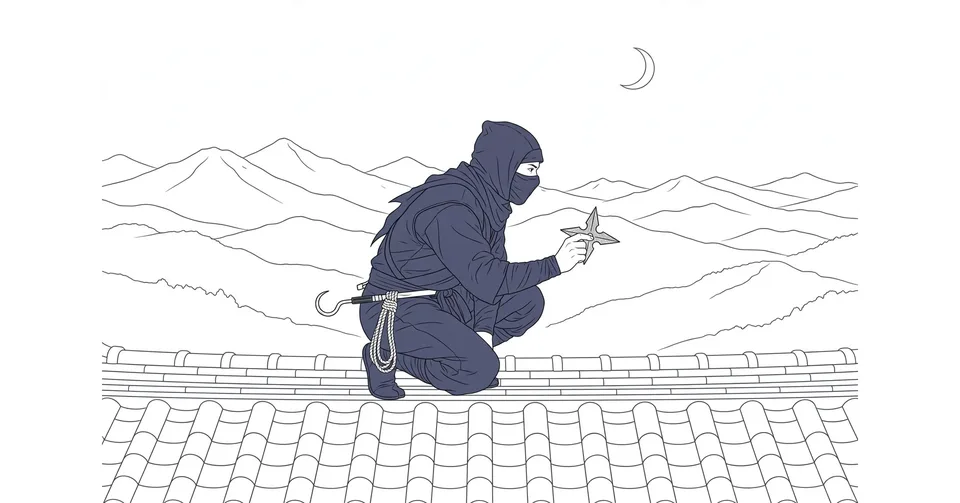
What a ninja actually was
A ninja was a covert agent, a mercenary and a guerrilla warfare expert in feudal Japan. That is the plain definition historians use, and it is worth holding on to, because almost everything else people believe about the ninja is decoration added later. The shinobi proper, men specially trained as spies and saboteurs, appeared in the 15th century, during the Sengoku period, the long age of civil war that ran from the late 1400s to the early 1600s. Before that, the word shinobi had appeared in poems as far back as the 8th century, but it described a person who hid or spied in a general sense, not a profession.
They were not a caste and not a secret society with a single leader. They were mostly jizamurai, farmer warriors from mountain villages who owned their land and answered to no great lord. When a warlord needed someone to slip into a castle, listen in a camp, burn a storehouse or carry a message through enemy lines, he hired them. They ranked below the samurai in the social order, and that was exactly the point. A samurai fought in the open and valued honour in battle. A ninja did the work a samurai could not be seen doing, and was paid to be forgotten afterwards.
Their training covered far more than fighting. The traditional list of a shinobi's eighteen disciplines included disguise, escape, explosives, medicine, the reading of weather and terrain, and the study of human psychology, alongside unarmed combat and the use of blades. One who could not pass as a monk, a merchant or a wandering priest was of little use, because the job was mostly about not being noticed. Killing, when it happened, was the exception, not the rule. Information was the real product, and a good one brought back knowledge that could win a battle before it started.
Iga and Koga, the two ninja heartlands
Almost every real shinobi came from one of two neighbouring regions in central Honshu: Iga Province, in what is now Mie Prefecture, and Koga, also written Koka, in what is now Shiga Prefecture. The two places were not chosen by accident. Both were ringed by mountains, hard to invade and easy to defend, and both had developed a habit of governing themselves instead of obeying a single lord.
Iga was run as a confederation of local warrior bands, an ikki, in which leading families such as the Hattori, the Momochi and the Fujibayashi shared power. Its people knew every trail, stream and hiding place in their valleys, and they passed that knowledge down inside families by word of mouth rather than in written manuals. Koga was organised differently, as a looser collection of more than fifty semi-autonomous families, the so-called Koga Fifty-Three Families, including the Mochizuki and the Ugai. Tradition credits Iga with a strength in gunpowder and tactics, and Koga with a strength in medicine and pharmacology, which made its people useful as healers and poison makers as well as spies.
The roots of both schools are often traced to the yamabushi, the mountain ascetics who wandered the same ranges and practised a mix of Buddhism, folk religion and survival skills. Folklore went further and claimed the shinobi descended from a demon that was half man and half crow, which tells you how mysterious these mountain people seemed to outsiders. The sober version is simpler: generations of living in rough country, plus generations of political instability, produced families who were very good at moving unseen, and warlords eventually started paying for that skill.
The Tensho Iga War and the fall of Iga
The independence of Iga could not last once Japan started to be unified by force. In 1579, Oda Nobunaga's son Nobukatsu led an invasion of Iga and was humiliated when the defenders used guerrilla tactics, night raids and ambushes to drive his army out. Nobunaga himself answered two years later. In 1581, in the second Tensho Iga War, he marched on the province with an army of tens of thousands, with some accounts putting the number near 40,000 and others higher, attacking from six directions at once. The Iga fighters held the mountain passes as long as they could, but they were overwhelmed, and the province was devastated.
That defeat is the great turning point in the history of the shinobi. The survivors scattered across Japan, and because their skills were suddenly for hire everywhere, the art of the shinobi spread far beyond its two home valleys. Men from Iga and Koga found work as guards, scouts and spies for lords all over the country, and the secrets that had once been guarded inside a few mountain villages became a trade. The destruction of Iga, in other words, is the reason the ninja became a national phenomenon instead of a local curiosity.
Hattori Hanzo and the escape through Iga
No name is more attached to the shinobi than Hattori Hanzo, and his real story is a good example of how the legend grew out of the facts. Hanzo, properly Hattori Masanari, lived from 1542 to 1596 and served the warlord Tokugawa Ieyasu as a samurai commander. He was not, strictly speaking, a ninja himself. The first Hanzo, his father Yasunaga, may have worked as a shinobi, but the famous Hanzo was a general whose value to Ieyasu was his command of Iga men and his knowledge of their networks.
His finest hour came in 1582, after the Honno-ji Incident, when Ieyasu was stranded in Sakai and needed to get back to his home province of Mikawa through hostile country. Hanzo guided him through Iga, using the same mountain paths and local contacts that the Iga families had guarded for generations. Ieyasu never forgot it. When he became shogun in 1603, he employed Iga men as his direct retainers and guards, and one of the gates of Edo Castle, Hanzomon, still carries Hanzo's name today. It is also the name of a station on the Tokyo Metro, which means millions of commuters pass through his gate every day without knowing it.
The castles of the period explain why men like Hanzo mattered. Japan's great fortresses were built for exactly this kind of warfare, with layered walls, hidden gates and killing grounds designed to slow an attacker, and the story of Himeji Castle shows how much a lord would spend to keep his enemies outside. A ninja was the answer to that problem: if you could not break the walls, you sent someone through them quietly. The same logic runs through the wider history of Japan's castles, which were as much instruments of information and intimidation as they were piles of stone.
The tools and skills of the trade
The equipment of a shinobi was practical, cheap and easy to hide, which is the opposite of the glamorous arsenal in the films. The shuriken, the throwing star, was real, but it was a small distraction weapon, not a tool for duels. The makibishi, a spiked caltrop scattered on the ground, was used to slow pursuers. The kusarigama joined a sickle to a chain, the fukiya was a blowgun for darts, and the kaginawa, a grappling hook on a rope, was for climbing walls. A ninja also carried medicines, lock picks, fire-making tools and disguises, because most missions ended with walking away, not fighting.
Even the famous black costume is mostly a myth. Working shinobi are thought to have worn dark indigo blue, which hides better than black on a moonlit night, and in daylight they wore whatever would let them blend in, the clothes of a farmer, a priest or a travelling merchant. The all-black outfit comes from the Japanese theatre, where stagehands dressed in black to signal that the audience should ignore them, and puppet handlers used the same convention. When a play needed one to appear from nowhere, the stagehand simply stood up, and the image stuck.
The knowledge of the trade was eventually written down, though late. The Bansenshukai, compiled by Fujibayashi Yasutake in 1676, is a compendium of shinobi methods covering disguise, explosives, signalling and infiltration, and it remains the most important surviving shinobi manual. The Shoninki, written in 1681, is a shorter and more practical guide. Both were written after the age of civil war had ended, which is telling: they wrote their secrets down only when they no longer needed them. Female shinobi existed in the tradition too, though the word for them, kunoichi, was popularised by a novel in 1964 rather than by history, and the real women who worked as spies were valued for the same reason as the men, because nobody expected them.
The quiet centuries after the wars
When the Tokugawa shogunate brought peace in 1603, the shinobi lost their main employer. There were no more wars to spy in, so the Iga and Koga men who stayed in service became guards, watchmen and onmitsu, the shogunate's secret inspectors who reported on the loyalty of distant lords. It was quiet work, and it suited the new age. The skills did not vanish overnight, but they stopped being a living profession and became a family inheritance, passed from father to son in a world that no longer had much use for them. By the time of the Meiji Restoration in 1868, the shinobi had become a memory, kept alive in stories, plays and cheap novels.
That is, in a way, the saddest part of the story, and also the most human. They were useful only while Japan was tearing itself apart. Peace made them obsolete, and the families who had guarded their secrets for centuries watched the world move on without them. There is something honest about that fate. A trade built on secrecy and war does not survive the arrival of railways, telegraphs and modern police, and the last people who carried the tradition knew it.
How the ninja became a global icon
They returned, not as spies, but as entertainment. The film series Shinobi no Mono began in 1962 and made the ninja a star of Japanese cinema. Five years later, the James Bond film You Only Live Twice put a shinobi training school on screen for the whole world, and the image of the black-clad warrior went global. The 1980s brought a full ninja boom in the West, with action films, comic books and the Teenage Mutant Ninja Turtles, who debuted in 1984 and turned the word into a household name for a generation of children.
Manga and games carried the idea further. Naruto, which began as a manga in 1999, built an entire world out of ninja villages, clans and techniques, and it became one of the most read comics on the planet, a story told in detail in the history of Japanese manga. Video games did the same, from early arcade titles to modern stealth games, a lineage that belongs to the wider story of Japanese video games. None of this is historically accurate, and that is not really the point. The idea survived because the fantasy is fun, and the fantasy is fun because it is built on a real foundation of people who really did move through the dark.
I find that trade-off easy to accept. The movies turned a difficult, secretive and often unglamorous job into a costume, but they also kept the names of Iga and Koga alive long after the history books had moved on. A child who meets them through a cartoon may one day visit the real Iga and learn the real story, and that is a better fate than being forgotten entirely.
The last ninja and the art today
The claim to be the last true ninja belongs to Jinichi Kawakami, born in 1949, who says he is the 21st head of the Koga Ban family and the only heir to its authentic tradition. Kawakami trained from the age of six, learning combat, chemistry, weather reading and psychology from a teacher who claimed to be one of the last practitioners alive. In 2012 he announced that he would not appoint a successor, saying that the art of the ninja had no place in the modern age, since the world now had guns, the internet and better medicines. He serves as the honorary director of the Iga-ryu Ninja Museum and has worked as a researcher at Mie University, which founded the world's first research centre devoted to the shinobi in 2017. Its master's course produced its first graduate, Genichi Mitsuhashi, in 2020.
You can still visit the world the ninja came from. The Iga-ryu Ninja Museum, opened in 1964 in Iga-Ueno, shows the tools, the traps and the hidden rooms of a shinobi house, and its daily demonstrations are deliberately playful, which feels right for a tradition that now belongs to everyone. Koka, the other heartland, has its own ninja village, and the town of Iga leans into its history with shinobi-themed trains, signs and festivals. The history of the shinobi is well documented by researchers who separate the facts from the films, and the history of ninjutsu from Iga and Koga to the modern dojo gives a careful account of how the schools grew, fell and survived. For the places themselves, the Iga ninja guide covers the museum, the castle and the Tensho Iga War in the town where it happened.
The real ninja were not superheroes. They were mountain people who learned to move quietly, hired hands who did the work nobody else wanted, and survivors of a war that destroyed their home. Their story is worth knowing exactly because it is smaller and sadder than the legend, and because the legend only exists because the truth was interesting enough to steal. The smoke bomb was real, but it was a distraction so a man could run away, and running away, done well, is a skill in itself.
More in Culture & Society
- Bizen Ware Lets the Fire Do the Painting
- Japanese Haiku and the Seventeen Syllables That Hold a Season
- Shigaraki Ware Turns an Ancient Lake Bed Into Japan's Warmest Pottery
- Boro Turns Rags Into the Cloth Japan Refused to Throw Away
- Iga Ware Fires the Clay Pot That Holds Heat the Longest
- Sashiko Turns Mending Into the Most Beautiful Part of a Garment
Latest posts
- A Kamado Turned the Japanese Kitchen Into a Slow Oven
- The Japanese Alps and the Mountains at the Heart of Honshu
- Japanese Wagashi and the Sweets That Mark the Seasons
- Japanese Futon and the Art of Sleeping on the Floor
- A Hohin Is the Handleless Teapot Gyokuro Was Waiting For
- Mount Takao and the Day Trip Tokyo Takes When It Needs Air
- A Donabe Turns a Clay Pot Into Japan's Slowest and Warmest Way to Cook
- Warosoku Burns Brighter Because Its Wick Is Hollow
- A Shichirin Turns a Handful of Charcoal Into a Full Meal
- Japanese Chopsticks and the Quiet Rules Behind Every Meal
- A Tanzen Is the Full Length Robe Japan Wears Indoors in Deep Winter
- The Haze Tree Grows the Wax Behind Japan's Oldest Candles
- A Hanten Is the Winter Jacket Japan Wears to Work
- Haze Wax Keeps Japan's Oldest Candles Burning
- Furoshiki, the Japanese Cloth That Wraps Almost Anything