Temari Is the Embroidered Ball Japan Gives for Good Luck
· 12 min read
Temari is a traditional Japanese handball, a core wrapped in yarn and embroidered with geometric silk thread patterns, made as a gift that carries wishes for good luck, friendship and a happy life.
Some gifts are bought in a hurry and forgotten by spring. A temari is the opposite, a ball that takes weeks to make, cannot really be played with any more, and is given away with a wish folded inside it. That combination sounds impractical, and it is. It is also the reason the ball has survived for more than a thousand years.
A temari is a traditional Japanese handball, a round core wrapped tightly in yarn and covered in embroidered patterns of silk or cotton thread. It began as a children's toy and a New Year game, and it slowly became a folk craft, a keepsake, and a gift that stands for good luck, deep friendship and a happy marriage. Today most of these balls are never thrown. They sit on a shelf, doing the quiet work of a wish that was made by hand.
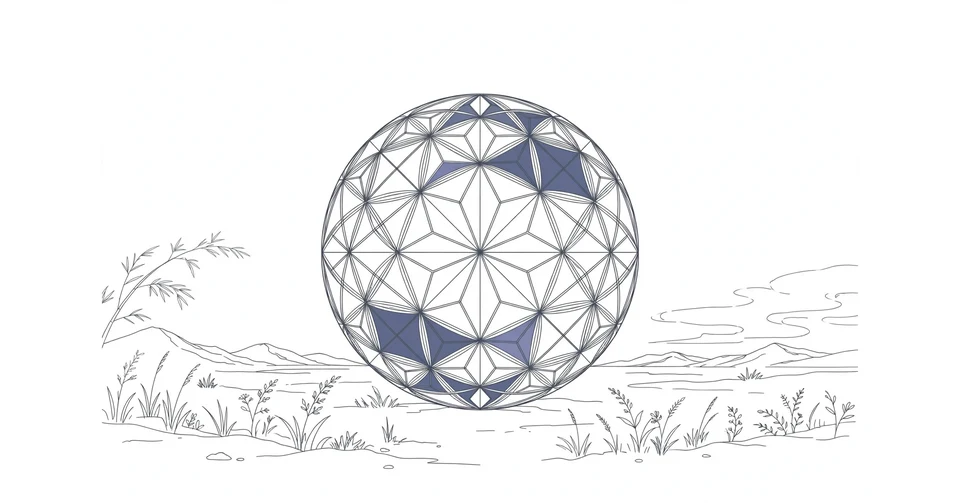
I came to this ball through a single phrase tucked inside another article. In my piece on takoage, kite flying at the Japanese New Year, the old New Year song lists the games of the holiday, and the last one named is "the temari ball game." The phrase sent me looking for the ball itself. What I found was a craft that starts with old clothes, passes through the hands of court ladies, and ends, a thousand years later, as a gift a mother still makes for her child.
What temari actually is
The word breaks apart neatly. Te means hand, and mari means ball, so temari is simply a hand ball. The name is believed to come from kemari, a kickball game that arrived from China more than 1,300 years ago. The leather kemari was kicked with the feet, but the hand ball was softer and smaller, made from silk scraps and played with the hands and elbows indoors. That softness mattered. It made the ball a thing for women and children, and it set the craft on a different path from the game it came from.
A finished ball is a small sphere, often about the size of an orange. Under the coloured thread sits a core, traditionally a bundle of old fabric scraps or a pouch of rice husks, wound round and round with yarn until it holds a smooth, firm shape. Over that base the maker winds the pattern, coloured thread laid in careful geometry, sometimes stitched with a needle, sometimes simply wound and tucked, until the whole surface is covered in diamonds, stars, flowers and interlocking bands. The ball is surprisingly hard when it is done, and each stitch has to be pushed through with real force.
From a kickball game to a palace craft
Nobody can put an exact date on the birth of temari, and the honest sources admit as much. The usual telling traces it to kemari, the kickball game that came from China along with Buddhism in the early centuries of the first millennium. One account places the arrival in the Asuka period, from 538 to 710. Another, from the Yomiuri Shimbun, traces it to kemari as it was played in the Heian period, from 794 to the late 12th century. The safest thing to say is that the ball came from China and took root as a court game. In the palace, noblewomen made balls from silk scraps and competed to make them more beautiful, until the stitching that had held the ball together became decoration in its own right, and the ball had stopped being a toy and become a way of showing skill, taste and patience.
The craft stayed close to the upper classes until the Edo period, from 1603 to 1868, when cotton manufacturing spread through Japan. Cotton thread was cheaper than silk, and ordinary mothers could afford it. Temari making moved from the palace to the common home, and that move changed its meaning. It became a craft of recycling, because mothers made the balls from the scraps of worn out kimono, winding old cloth into new toys for their children. In the early 1900s the rubber ball arrived and replaced the homemade temari as a toy, and the craft dwindled as a plaything. But it survived as a gift, and that survival is the story of the rest of this article.
How a temari is made
Every ball, however elaborate, follows the same three steps. The first is laying the foundation. The maker forms the core, traditionally from fabric scraps or rice husks, and today often from a plastic or foam ball, then wraps it in yarn and thread until it is round and smooth. The wrapping has to be even, with no lumps and no flat spots, because every mistake in the foundation shows up in the pattern later. Makers of the Sanuki Kagari style in Kagawa begin with rice husks, cooked and dried, placed in cotton and wound with thread until a ball appears in the hands.
The second step is dividing the surface. The maker marks the top and bottom of the ball, the north and south poles, and the equator, using pins and guide threads. The surface is then divided into sections, commonly 4, 6, 8, 10, 12 or even 16, much like the lines on a globe. The guide threads run from pin to pin, a map for the coloured thread that follows. A 12 division temari is itself considered a good luck charm, a ball that brings wealth and prosperity, so the number of divisions is not only a technical choice. It is part of the wish.
The third step is making the pattern. Coloured thread, silk or cotton, is wound around and between the pins and guide threads in a precise formation. Simple diamond and star shapes can be made by careful winding alone. More intricate designs need a needle, so the maker can weave one thread through another layer, and occasionally small designs are embroidered onto particular areas. The work is slow and exact. A single ball by a master can take weeks or months to finish, and the finished balls are surprisingly hard, so each stitch needs a concentrated push. I find the order of it reassuring. The foundation is hidden, the division is a map, and the pattern is the reward, and the beautiful part only works if the hidden part is sound. The Japan Objects guide to temari lays out these three steps clearly, and it is a good place to start for anyone who wants to understand the craft before trying it.
The patterns speak in symbols
More than 200 traditional patterns have been officially recorded, and a change of colour or one extra division can make the same pattern look like a different ball altogether. Many of the patterns use seasonal motifs. Sakura stands for spring. The chrysanthemum, the kiku, is a flower of autumn. A tortoise shell pattern is stitched to ward off evil. Colours carry meaning too. Red and gold are the colours of luck and prosperity, and a temari in those colours is itself a wish for a bright life.
Some patterns have names that sound like poems. The futatsu giku, or double chrysanthemum, divides the ball into two halves with a pair of flowers. The hime temari, the princess ball, uses more than 100 different coloured silk threads to make a bright, lustrous ball. In the Sanuki Kagari tradition of Kagawa, patterns carry names such as firefly flowers and layered stars. The names are not decoration. They tell the maker, and the person who receives the ball, what the pattern is wishing for.
Matsumoto temari and the regional styles
Temari is not one craft. It is a family of regional styles, and each region made its ball from what it had. In Matsumoto, in Nagano Prefecture, people once went into the mountains to collect cocoons for the cores, rolled fern fibres around them, and stitched the design with thread dyed with plant extracts, including indigo. The craft is so much a part of the town that the ball's designs now appear on Matsumoto manhole covers, a small public honour for a private craft.
In Kagawa, on the island of Shikoku, the Sanuki Kagari Temari has been passed down for more than 1,000 years. The master Eiko Araki works in a studio that also serves as the head office of the craft preservation society, and the studio keeps some 140 hues of cotton thread, dyed by hand with plants, flowers and other natural ingredients, including cochineal, a bug that lives on cacti and produces a red dye. Only several dozen people, all women, can make Sanuki Kagari Temari to traditional standards today, and it typically takes more than 10 years to train a successor.
Other regions have their own styles. Honjo Gotenmari, from Akita, has tassels on its bottom and sides. Echigawa Binzaiku Temari, from Shiga, sits inside a ball shaped glass container. Matsue Washi Temari, from Shimane, is stitched on pieces of washi paper pasted onto the ball. The Yomiuri Shimbun report on temari describes these regional styles and the museum in Tokyo where they are displayed, and it notes that only about a dozen kinds of the craft are still made in Japan today. That number is small, and it is a reminder that a regional craft can be lost in a single generation if nobody picks up the needle.
A gift that carries a wish
The heart of the ball is not the technique. It is the giving. Traditionally, mothers made a temari for their children and gave it on New Year Day, hiding a small piece of paper with a goodwill wish for her child inside the tightly wrapped layers. The child was not told what the wish said, and the wish stayed hidden while the ball stayed whole.
The giving spread beyond New Year. They were made for the birth of a child, for weddings, and for the Doll Festival, Hinamatsuri. A temari patterned kimono is traditionally given to a bride as a good luck charm, in the hope that she will build a happy family. A ball given at a wedding carries the same hope in a different form, a round thing with no end, given at the start of a life together. A sphere has no beginning and no end, which is why the ball suits weddings and births, moments when people wish for something that lasts. I think this is why the craft outlived its life as a toy. A toy is outgrown. A symbol is kept. The ball is also a symbol of deep friendship and loyalty, and the bright colours of the thread are a wish for a brilliant and happy life for the person who receives it.
That is why the ball belongs with the other New Year games. In the old song, takoage comes first, then spinning tops, then hanetsuki, then the temari ball game, four pastimes that fill the first days of January. I wrote about hanetsuki, the wooden paddle game that keeps New Year in the air as a companion to the kite piece, and the two games sit naturally beside this one. Hanetsuki is quick and close, a rally kept aloft by hand. Temari is slow and quiet, a ball made over weeks and given in a moment. Together they describe the holiday well, one part play and one part prayer.
Where temari lives today
The ball is no longer a toy, and nobody pretends otherwise. The rubber ball won that contest a century ago. But the craft has found a second life. The balls are displayed in homes, given as gifts, and worn as jewellery. Very small ones are made into earrings, hairpins and phone straps, and in recent years those accessories have become popular among young people.
The craft is also kept alive by museums and workshops. Haretemari Kobo, a temari museum and atelier in Adachi Ward in Tokyo, displays about 50 balls showing the diversity of the regional styles, and it runs hands on workshops for beginners. Its director, Yuka Sato, was born in Yurihonjo in Akita Prefecture, a place known for making temari, and she opened the museum in 2019. Each temari, she says, is made with special care and kindness, and she can feel the affection of the maker, stitch by stitch. They have warmth, she says. Just looking at them makes me happy.
The Japan Temari Association, founded in Tokyo in 1979, works to preserve and promote the tradition, and the first instructional book on the craft, Temari Juni Kagetsu, or Twelve Months of Temari, by Chiyoko Ozaki, was published in 1968, putting into print what had been passed from mother to daughter for centuries. Beginners are advised to start with a kit, a premade base, a needle and threads, rather than struggling to make the foundation from scratch.
The craft is not safe. Production has gradually decreased because fewer people are willing to take up the work. But the ball has survived the rubber ball, a century of change, and the move from palace to kitchen table to museum shelf. It survives because it is not only an object. It is a wish that can be held in one hand, and people keep finding new reasons to hold one.
The ball asks very little of the person who receives it. It does not need to be played with, wound up, or charged. It only needs a place to sit where it can be seen, and a person who knows what it means. If you ever receive one, keep it where you can see it. Somewhere inside the thread, folded small and out of sight, there is a wish with your name on it, and it has been waiting patiently to come true.
More in Culture & Society
- Matsumoto Temari Turns Mountain Cocoons Into Wishes You Can Hold
- Nambu Tekki Is the Iron That Outlasted the Lords Who Ordered It
- A Tetsubin Turns Iron and Fire Into Japan's Slowest Kettle
- Ninja, the Shadow Warriors of Feudal Japan
- Bizen Ware Lets the Fire Do the Painting
- Japanese Haiku and the Seventeen Syllables That Hold a Season
Latest posts
- Tokyo Skytree and How Japan Built the World's Tallest Tower
- Forest Bathing in Japan, the Quiet Science of Shinrin-Yoku
- Tokyo Tower and the Orange Giant That Refused to Be Replaced
- Emoji, the Tiny Pictures Japan Gave the World
- Hakone and the Hot Spring Town Below Mount Fuji
- A Kamado Turned the Japanese Kitchen Into a Slow Oven
- The Japanese Alps and the Mountains at the Heart of Honshu
- Japanese Wagashi and the Sweets That Mark the Seasons
- Japanese Futon and the Art of Sleeping on the Floor
- A Hohin Is the Handleless Teapot Gyokuro Was Waiting For
- Shigaraki Ware Turns an Ancient Lake Bed Into Japan's Warmest Pottery
- Boro Turns Rags Into the Cloth Japan Refused to Throw Away
- Iga Ware Fires the Clay Pot That Holds Heat the Longest
- Mount Takao and the Day Trip Tokyo Takes When It Needs Air
- A Donabe Turns a Clay Pot Into Japan's Slowest and Warmest Way to Cook