Matsumoto Temari Turns Mountain Cocoons Into Wishes You Can Hold
· 15 min read
Matsumoto Temari turns silk cocoons gathered in the mountains of Nagano into embroidered balls that carry wishes for happiness, friendship and good fortune.
Hold a Matsumoto Temari in your palm and you are holding a small mountain, a little silk, and a wish someone stitched in by hand. The Matsumoto Temari ball is round and light, its surface covered in bright geometric patterns, and it looks too beautiful to throw. That is the point. Matsumoto Temari began as a toy, but it stayed in Japanese life because it stopped being only a toy and became a way to say something words could not carry.
The story starts with a walk into the mountains. In old Matsumoto, in Nagano Prefecture, people went up into the hills to gather cocoons, then rolled fern fibre around them to make a firm core, and stitched the surface with thread dyed from plants, including indigo. Nothing in that list came from a shop. The mountain gave the core, the field gave the fibre, and the garden gave the colour. A Matsumoto Temari is, in that sense, a piece of the landscape wound into a sphere.
Today the craft is the best known symbol of its home town. You can spot the round patterns of Matsumoto Temari on buses and light posts, on posters and pamphlets, and even on the manhole covers under your feet as you walk the castle town. Matsumoto Temari has left the nursery and entered the street, which is a rare honour for a handmade thing. This is the story of how a mountain cocoon became a wish you can hold, and why the craft still matters.
How Matsumoto Temari began in a castle town
The name temari means hand ball, and the game behind it is old. The name is said to have come from kemari, a kick ball game brought to Japan from China more than 1,300 years ago, and the early balls were simple things made of cloth ribbon wrapped around silk from old kimono. Over time the rough stitching grew into fine patterns of silk thread, and the ball turned from something to kick into something to keep, and Matsumoto Temari still carries that history. Matsumoto Temari follows that same long road, but it took a local turn that gave the craft its own character.
Matsumoto was for a time a major producer of high quality silk, and the silk trade shaped the town as surely as its castle did. During the Edo period the silk industry flourished in Japan, and the decorative balls of today grew out of that abundance. In Matsumoto the craft drew on what the surrounding mountains and fields could supply, so each Matsumoto Temari carried the colours of the place where it was made. The town sits in a basin ringed by peaks, and the craft reflects that setting in a quiet way. It is a mountain town craft, made from mountain materials, by people who knew the hills around them.
Local legend gives the craft two different beginnings, and both are worth keeping. One story says a noblewoman created the first temari about two hundred years ago. Another says the child of a warrior of Matsumoto started making them to bring money to the family. Neither story can be proven, and that uncertainty is part of the charm. What matters is that both stories place Matsumoto Temari in the town itself, made by ordinary people and by people of standing, for reasons that were practical as well as beautiful. I like that the legends disagree, because it suggests the craft belonged to the whole town rather than to one workshop or one family.
The town itself helps explain why the craft took root here. Matsumoto Castle drew samurai families, merchants and craftspeople into one compact castle town, and the old shopping streets of Nakamachi and Nawate grew up in its shadow. The local guide to the town describes how Matsumoto Temari became a symbol of the castle town, and how the balls can now be seen all over town, which shows how deeply the craft settled into daily life there.
A cocoon, some fern fibre and a needle
The making of a Matsumoto Temari starts with the core, and the core is where the mountain enters the story. In the older way of working, people went into the mountains to collect cocoons, the small silk cases left by silkworms. A cocoon is light and fragile on its own, so the maker rolled fern fibre around it, layer upon layer, until it formed a firm round ball. The fibre gave the core its shape and its spring. It is a humble beginning for something so bright, and I think that contrast is the heart of the craft. The most beautiful part of the ball, the embroidery, rests on the plainest part, a gathered cocoon wrapped in mountain fern.
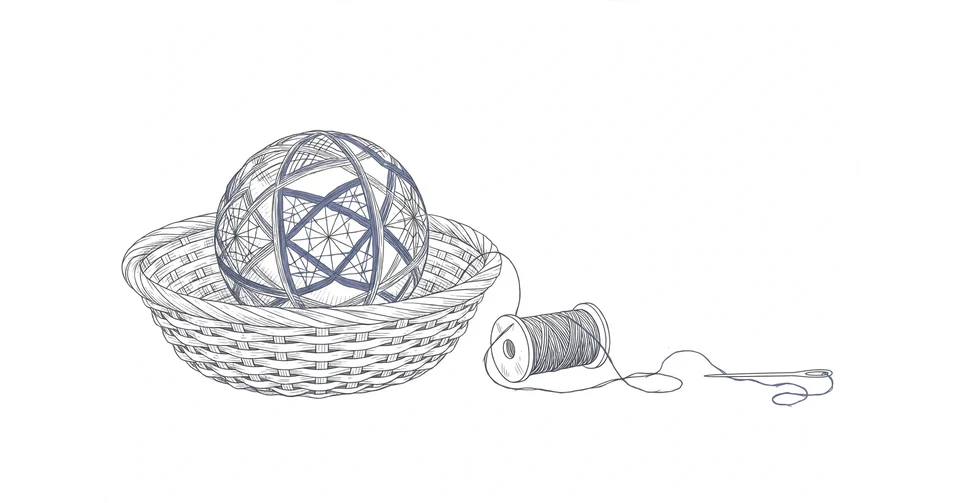
Once the core was round and firm, the maker wound thread around it to make a smooth surface for stitching. Then came the slow work. The maker marked guide lines on the Matsumoto Temari, dividing the sphere into equal sections, and stitched the pattern along those lines with silk thread. The thread was dyed with plant extracts, including indigo, which gave the deep blue that still marks many examples of Matsumoto Temari. Plant dye is not as loud as chemical dye, and that softness suits the craft. The colours sit close together without shouting, and the ball looks calm even when the pattern is complex.
The work takes time, and the time is part of the value. Winding the silk threads into the intricate patterns takes four to five hours for each ball, according to the Nagano tourism board, and that is only the stitching. The gathering, the dyeing and the preparation of the core come before it. A maker who finishes one Matsumoto Temari in a day has done a full day of careful work, and the ball shows it. Every stitch is visible, every line is placed by hand, and there is no machine to hide a mistake. When you hold a finished Matsumoto Temari you are holding hours of attention, and I find that a reassuring thing in a world that prizes speed above almost everything else. The tourism board calls these balls Matsumoto's most well known folk craft, and the hours behind each one explain why that title is earned rather than given.
The patterns and what they wish for
The surface of a Matsumoto Temari is covered in geometry, and the geometry is a language. The maker divides the sphere with guide threads, then fills the sections with stars, flowers, diamonds and waves, each pattern built stitch by stitch from coloured silk. Some patterns look like chrysanthemums opening on the surface of the Matsumoto Temari. Others form layered stars or interlocking diamonds that seem to turn as you rotate the ball in your hand. The patterns are precise, but they are not cold. They have the warmth of something made slowly, and the small unevenness of a human hand keeps them from looking printed.
The patterns carry meanings that go beyond decoration. A round Matsumoto Temari has no beginning and no end, and in Japan that shape has long been tied to wishes for a life that lasts and a family that stays whole. Bright colours are a wish for a brilliant and happy life for the person who receives the ball. Matsumoto Temari is also a symbol of deep friendship and loyalty, so giving one is a way of saying that a bond will hold. The stitching itself adds to the meaning. A wish worked over many hours says something a spoken wish cannot. It says the giver took the time.
The patterns also travel well beyond the ball. The designs of Matsumoto Temari now appear on the manhole covers of the city, turning a piece of street furniture into a small public gallery. You can walk over a chrysanthemum or a star pattern without noticing it, and then one day you look down and see it, and the street feels different. I think that is a lovely fate for a craft that began in private hands. A Matsumoto Temari was once made at home, for a child or a bride. Now its patterns belong to everyone who walks the town, and the town has chosen to wear them in public.
From toy to treasured gift
Matsumoto Temari began as a plaything, and for a long time that was enough. Children tossed the Matsumoto Temari balls, caught them and rolled them, and the soft core made them safe for small hands. In the early Showa Era the white, red, yellow and purple balls were everyday children's toys, the kind of thing a child might carry to a friend's house or play with in a temple yard. A Matsumoto Temari was sturdy enough for play and pretty enough to keep, and that combination kept it in use long after other toys had worn out.
But a toy that takes four to five hours to stitch is too precious to stay only a toy, and Matsumoto Temari slowly changed its role. Today the balls are mainly used as gifts and interior decorations. The change did not happen because the craft failed. It happened because the craft succeeded too well. A Matsumoto Temari that beautiful, made with that much care, asks to be kept on a shelf rather than thrown across a room. The gift took over from the game, and the craft found a longer life in that new role.
The giving of temari follows old customs that still make sense today. Temari have traditionally been given to young children on New Year Day, as a symbol of the parents' wish for their child's happiness. They are made for the birth of a child, for weddings, and for the Doll Festival, Hinamatsuri. A temari patterned kimono is traditionally given to a bride as a good luck charm, in the hope that she will build a happy family. The round shape of Matsumoto Temari suits all of these moments, because each one is a beginning, and a shape with no end is a fitting wish for a beginning. The temari ball Japan gives for good luck carries the same idea in its wider Japanese form, and the Matsumoto version keeps the local colours and materials that make it distinct.
There is also a quiet custom that I find moving. Traditionally, mothers made a temari for their children and hid a small piece of paper with a goodwill wish inside the tightly wrapped layers, and the child was not told what the wish said. The wish stayed hidden while the ball stayed whole, a secret kept by thread and silk. A gift that contains a secret is different from a gift that only shows its surface. It asks the receiver to trust that something good is inside, even though it cannot be seen. That trust is part of the gift, and it is why a handmade Matsumoto Temari can feel more personal than something bought in a shop. The maker put time into it, and the giver put a wish into it, and the receiver carries both.
Where to see Matsumoto Temari today
The best way to understand Matsumoto Temari is to see it where it lives, in the town that made it. Walk the streets near Matsumoto Castle and the round patterns of Matsumoto Temari start to appear, on buses and light posts, on posters and pamphlets, and under your feet on the manhole covers. The city has made the ball part of its public face, and a visitor who keeps an eye out will see it everywhere. Look down at a crossing and you may find a star pattern set into the pavement. Look up at a bus and you may see the same geometry rolling past. The town wears its craft the way a person wears a favourite scarf, casually and with pride.
The old shopping streets are the natural place to look closer. Nakamachi Street, with its white walled storehouses turned into craft shops and cafes, is a good place to browse for balls and for the threads and tools that makers use. Nawate-dori, the narrow street by the river, is lined with small shops where temari style gifts sit beside other local crafts. On Daimyo-cho Street, near the main entrance to Matsumoto Castle, you can find Matsumoto Temari souvenirs and workshops where you can learn to make your own ball, with advance reservations required. The workshops matter, because watching a maker wind thread and mark guide lines teaches more in an hour than reading about the craft ever could. Your first ball will not be perfect, and that is fine. The point is to feel how much patience the craft asks for.
Museums and displays give the wider picture. The Matsumoto City Museum keeps temari on display among its folk craft collections, and a visit there puts the ball beside the other crafts of the town, from festival dolls to local textiles. The displays show how the craft changed over time, from the bright toys of the early Showa Era to the refined gift balls of today, and they make clear that the craft was never frozen. It adapted, as living crafts do, and each generation of makers added something of its own. A museum visit also gives a useful pause. After the noise of the castle crowds, a quiet room full of small round balls is a calm place to stand and look.
For visitors who want to take a ball home, the shops of the castle town offer a wide choice, from small simple balls to large elaborate ones with dense geometric stitching. Choose slowly, and hold the Matsumoto Temari before you buy it. Feel its weight, turn it in your hand, and look at how the pattern meets at the poles of the sphere. A well made ball feels even and firm, and the pattern sits cleanly on the surface. Price follows size and complexity, and a ball that took many hours will cost more than a small simple one, which is as it should be. The money goes to a maker, not a factory, and the ball you carry home carries the town with it. If you are travelling onward, wrap it well. The ball is tougher than it looks, but its threads deserve a soft place in your bag.
Why a ball made of wishes still matters
Matsumoto Temari matters because it is a craft that refused to become only a memory. Many folk crafts fade when their original use disappears, and Matsumoto Temari could easily have gone that way when rubber balls replaced cloth ones and children found new toys. Instead the makers of Matsumoto let the ball change. It stopped being only a toy and became a gift, a decoration, a souvenir and a symbol of the town, and each new role gave it a reason to keep being made. That willingness to change, without losing the handwork at the centre, is what keeps a craft alive. Tradition is not the refusal to change. It is the decision to keep making something well while letting its purpose grow.
The ball also matters because of what it is made from. A cocoon gathered in the mountains, fern fibre rolled by hand, thread dyed with plants including indigo, these are the materials that tie the maker of Matsumoto Temari to a particular place. A Matsumoto Temari could not have been made anywhere, because its materials came from the hills and fields around the town. In a time when so many objects could have been made in any country, a ball that carries the colour of one valley feels honest. It is a small argument for paying attention to where things come from, and for valuing the knowledge of people who know their local plants, their local silk and their local seasons.
Walk through Matsumoto on your next visit to Nagano and look for the round patterns, on the street and under your feet, in the shops of Nakamachi and in the museum cases. Pick up a Matsumoto Temari if you can, turn it in your hand, and notice how light it feels for something that carries so much history. The cocoon came from the mountains, the fibre from the fern, the colour from a plant, and the wish from a person who took the time. That is a lot to hold in one palm, and it is why a small embroidered ball from a castle town in Nagano still deserves its place in Japanese life. The kite that sends New Year wishes into the sky belongs to the same season of wishes, and the two crafts sit well together, one rising on the wind and one resting in the hand, both carrying hopes that are too large for words alone.
More in Culture & Society
- Nambu Tekki Is the Iron That Outlasted the Lords Who Ordered It
- Temari Is the Embroidered Ball Japan Gives for Good Luck
- A Tetsubin Turns Iron and Fire Into Japan's Slowest Kettle
- Ninja, the Shadow Warriors of Feudal Japan
- Bizen Ware Lets the Fire Do the Painting
- Japanese Haiku and the Seventeen Syllables That Hold a Season
Latest posts
- Tokyo Skytree and How Japan Built the World's Tallest Tower
- Forest Bathing in Japan, the Quiet Science of Shinrin-Yoku
- Tokyo Tower and the Orange Giant That Refused to Be Replaced
- Emoji, the Tiny Pictures Japan Gave the World
- Hakone and the Hot Spring Town Below Mount Fuji
- A Kamado Turned the Japanese Kitchen Into a Slow Oven
- The Japanese Alps and the Mountains at the Heart of Honshu
- Japanese Wagashi and the Sweets That Mark the Seasons
- Japanese Futon and the Art of Sleeping on the Floor
- A Hohin Is the Handleless Teapot Gyokuro Was Waiting For
- Shigaraki Ware Turns an Ancient Lake Bed Into Japan's Warmest Pottery
- Boro Turns Rags Into the Cloth Japan Refused to Throw Away
- Iga Ware Fires the Clay Pot That Holds Heat the Longest
- Mount Takao and the Day Trip Tokyo Takes When It Needs Air
- A Donabe Turns a Clay Pot Into Japan's Slowest and Warmest Way to Cook