Raja Ampat and the Coral Kingdom at the Edge of Indonesia
· 13 min read
Raja Ampat holds more coral and reef fish species than almost anywhere on Earth. Here is how to reach it, what it costs, and why the journey is the point.
Raja Ampat is the richest reef system ever measured. More than 600 species of hard coral and over 1,700 species of reef fish live in one small archipelago off the western tip of Papua, and a single dive at Cape Kri once counted 374 fish species in 90 minutes, a world record for one reef. No other place on Earth packs that much life into such a small patch of sea.
The name means Four Kings, for the four large islands at its heart: Waigeo, Batanta, Salawati, and Misool. Around them sit about 1,500 smaller islands, islets, and shoals, scattered across the Dampier Strait and the seas beyond. Raja Ampat sits at the center of the Coral Triangle, the global heart of marine biodiversity, and the reefs here hold roughly three quarters of all known coral species.
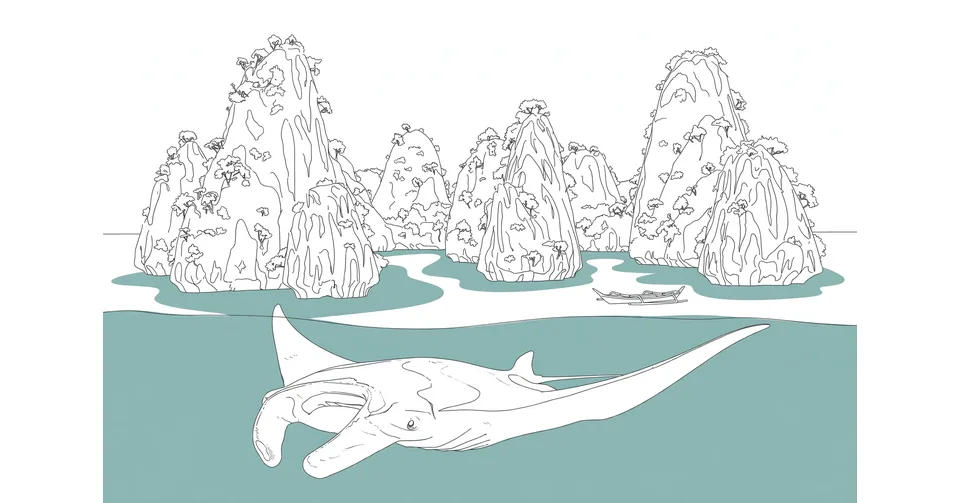
Getting to Raja Ampat is not easy, and that difficulty is part of why the reefs are still alive. There are no international flights and no bridges. You fly to Sorong, cross to Waisai on a public ferry, and continue by small boat to a village homestay or a liveaboard at anchor. The journey takes patience, cash, and a willingness to let phone signal come and go. What it gives back is a sea that looks the way seas must have looked before the rest of the world got crowded.
The four kings and a name that explains itself
Raja Ampat translates as Four Kings, and the name comes from a local legend about four brothers who became kings of the four main islands. Waigeo is the largest and the administrative center, home to Waisai, the small port town where most trips begin. Batanta lies just south of Waigeo, Salawati sits to the southwest, and Misool, the southernmost of the four, is the quietest and the farthest from Sorong.
The archipelago covers about 9.8 million hectares of land and sea, most of it water. That scale matters because Raja Ampat is not one destination. A diver based in the Dampier Strait will see a different sea from a traveler who sails south to Misool, and both will miss the karst lagoons of Wayag in the far north unless they book a liveaboard that goes there. Choosing where to base yourself is the first real decision of the trip, and it shapes everything that follows.
For first time visitors, the Dampier Strait is the sensible center. It runs between Waigeo and Gam to the north and Batanta and Mansuar to the south, and its strong tidal currents carry the nutrients that feed the reefs. The strait is where Cape Kri sits, where manta rays gather at cleaning stations, and where most village homestays cluster on small islands like Arborek, Kri, Mansuar, Gam, and Saonek.
Why the reefs here hold records
The numbers behind Raja Ampat are worth stating plainly because they explain why scientists talk about this place the way they do. Surveys have recorded more than 600 species of hard coral in Raja Ampat, around 75 percent of all the coral species known to science. More than 1,700 species of reef fish have been recorded, along with over 700 species of mollusks. A single dive site can hold more fish species than entire marine parks elsewhere in the world.
The record that gets quoted most often belongs to Cape Kri. In one 90 minute dive there, the ichthyologist Gerald Allen counted 374 fish species, the highest tally of his career and a world record for a single dive on a single reef. The number is not a trick of luck. Cape Kri sits at a point where currents meet, and the reef slope drops from shallow coral gardens into deep blue water, so reef fish, pelagic visitors, and schooling species all pass through the same small area.
The Coral Triangle, the region Raja Ampat anchors, spans the waters of Indonesia, Malaysia, Papua New Guinea, the Philippines, the Solomon Islands, and Timor-Leste. It holds about 76 percent of the world's coral species and 37 percent of its reef fish species. Raja Ampat sits at the richest point of that already rich region, which is why divers who have seen reefs everywhere still describe their first dive here as a shock.
My own view, after reading trip after trip report, is that the statistics undersell the experience. Numbers describe diversity, but they cannot describe what it feels like to drop into water so full of life that the reef itself seems to move. The honest reason to go is not a checklist of species. It is the feeling of being somewhere the ocean is still in charge.
Cape Kri and the dive that counted 374 fish
Cape Kri is a sloping reef off Kri Island, a short boat ride from most Dampier Strait homestays. The dive starts shallow, over coral gardens full of anthias and damselfish, then follows the slope down past sea fans and barrel sponges into water where reef sharks, giant trevally, and schools of fusiliers patrol. Currents can be strong, which is exactly what brings the big fish in, so guides plan the dive around the tide and many operators ask for advanced certification or a recent refresher before taking divers there.
Non divers are not left out. The same reef that holds the fish record is a snorkeling site, and the shallow coral gardens above Cape Kri are among the best snorkeling in Raja Ampat. Manta rays visit cleaning stations in the strait, and snorkelers at Manta Sandy, a shallow cleaning station off Arborek, often watch mantas circle for an hour while small cleaner fish work over their skin.
Other dive sites in the strait have their own character. Sardine Reef is a seamount covered in schooling fish. Blue Magic is a small pinnacle where mantas and reef sharks appear on the current. The Passage, a narrow channel between Waigeo and Gam, is a drift dive through soft corals and sea fans that looks more like a river canyon than a reef. Each one is a short boat ride from the next, which is why a week in the strait never feels repetitive.
The islands above the water
Raja Ampat is famous for what lies below the surface, but the islands above the water are just as strange and beautiful. The karst islands of Pianemo and Wayag rise out of turquoise lagoons like green cones, and the viewpoints above them are the images that fill every Raja Ampat photo collection. Pianemo is a day trip from most Dampier Strait stays, a climb up wooden stairs to a platform over a lagoon scattered with mushroom shaped islets. Wayag is farther north, a full day by speedboat or a stop on a liveaboard route, and its lagoon is the classic image of the archipelago.
Misool, the southern king, offers a different landscape. Its limestone islands hide marine lakes where stingless jellyfish drift in the sun, and its soft coral reefs are among the most colorful in the archipelago. Misool is reached by liveaboard, resort transfer, or a slow overnight public boat from Sorong, and the journey keeps it quiet. The Misool Marine Reserve, created in 2005 with local communities, protects a large no take zone that has become a model for community managed conservation in Indonesia.
On land, the islands are covered in rainforest, and the wildlife is as unusual as the reefs. Birds of paradise, including the Wilson's bird of paradise and the red bird of paradise, live in the forests of Waigeo and Batanta. Guided dawn walks to their display grounds are one of the most popular non diving activities in Raja Ampat, and they start early, often before 5 in the morning, when the males display in the canopy.
Getting there is half the story
Every trip to Raja Ampat starts the same way: a flight to Sorong. Domine Eduard Osok Airport, code SOQ, is the only practical gateway, and there are no international flights to Sorong. Travelers normally fly into Jakarta or Makassar first, then take a domestic flight with Garuda Indonesia, Batik Air, or Lion Air. The airport sits about 10 to 20 minutes by taxi from the ferry harbor, and the ride costs around IDR 100,000.
From Sorong harbor, the public fast ferry to Waisai, the capital of Raja Ampat on Waigeo, takes about two hours. The Express Bahari ferry runs once or twice daily, typically around 9 in the morning and 2 in the afternoon, and tickets cost roughly IDR 115,000 to IDR 165,000 per person, bought at the harbor. There is no reliable online booking system, so schedules should be confirmed locally. Many travelers spend a night in Sorong because a midday flight arrival can easily miss the last ferry.
From Waisai, the final leg is a small boat arranged by the homestay, resort, or liveaboard, taking 30 minutes to two hours depending on the island. This is where the remoteness becomes real. There are no ATMs on the small islands, electricity is limited, and phone signal comes and goes. Bring all the rupiah you will need from Sorong or Waisai, and bring it in cash.
What a week in Raja Ampat costs
Costs in Raja Ampat vary widely between the two ways of staying: village homestays and liveaboards. Homestays are the budget choice and the one that puts money straight into local hands. A village homestay on Arborek, Kri, Mansuar, Gam, or Saonek costs from about USD 35 per night, usually including three simple meals a day. Boat trips to dive and snorkeling sites are extra, arranged with the homestay or a local boat owner.
Liveaboards are the other way to see Raja Ampat, and the only practical way to cover the full range from Wayag in the north to Misool in the south in one trip. Prices start from about USD 290 per night and rise steeply for larger boats with more comfort. Most liveaboards run from October to April, the calm season, and they book out months ahead for the best months.
| Item | Typical cost |
|---|---|
| Sorong to Waisai ferry | IDR 115,000 to IDR 165,000 per person |
| Village homestay, full board | From about USD 35 per night |
| Liveaboard | From about USD 290 per night |
| Conservation fee and visitor levy | Around IDR 2,000,000 per foreign visitor in late 2026 |
| Domestic flight to Sorong | Varies widely by route and season |
The entry fees deserve a note of their own. As of late 2026, foreign visitors pay two separate charges that together come to around IDR 2,000,000 per person. The marine park tag is around IDR 1,000,000 and is valid for a year, and the regency visitor levy is around IDR 1,000,000 per visit. Both rose during 2026, and the numbers have changed more than once, so confirm the current amount with the Raja Ampat marine park authority or your accommodation before you travel. Registration runs through the regency online system, and the tag can be bought online, at Sorong harbor, or in Waisai, largely in cash.
When to go to Raja Ampat
The best months for Raja Ampat are October to April, when the seas are calmest and the visibility is best. November to March is the core season, when most liveaboards operate and the diving is at its finest. The dry months bring flat seas and clear water, while the wet season from May to September brings rougher seas and fewer boats, though the diving continues and the islands are quieter.
That seasonality matters more than it does in most tropical destinations. A liveaboard that runs in February may not run at all in July, and some homestays close or reduce services in the low season. If the goal is a liveaboard trip, book for the October to April window and book early. If the goal is a quiet week in a homestay with good snorkeling, the shoulder months can be rewarding, with lower prices and fewer visitors, as long as the sea cooperates.
Weather in Raja Ampat is tropical and changeable in every month. Rain can arrive in any season, and the wind can turn a calm morning into a choppy afternoon. The practical advice from operators is simple: build slack into the plan, do not schedule a tight connection on the day you leave the islands, and treat the ferry timetable as a guide rather than a promise.
The conservation fee and why it rose
The entry fee is not a tourist tax in the usual sense. It funds the community managed conservation network that patrols the marine park, pays rangers, and supports the villages that gave up fishing grounds to create no take zones. That network has cut illegal fishing sharply since 2010, and the reefs are the visible result. Paying the fee is part of the trip, not an extra on top of it.
The fee rose during 2026, and the rise caused complaints from travelers who had booked trips months earlier at the old price. The honest view is that a place this rich costs money to protect, and the cost of protection rises as visitor numbers rise. The alternative, a cheap entry fee and no patrols, is how reefs get emptied. Raja Ampat chose the other path, and the fish counts suggest it is working.
There are pressures beyond tourism. Mining and development proposals in the region have drawn attention during 2026, and the situation has changed more than once during the year. That is another reason to check current conditions with the marine park authority before traveling, and to treat any single article, including this one, as a starting point rather than the last word.
What Raja Ampat asks of visitors
Raja Ampat rewards visitors who travel slowly and lightly. The islands have no large resorts in the usual sense, no nightlife strip, and no shopping district. The pleasures are simple: a boat ride at dawn, a snorkel over a coral garden, a bowl of rice and fish at a homestay table, a night sky without light pollution. Travelers who arrive expecting Bali will be disappointed. Travelers who arrive expecting remoteness will find it.
The practical rules are simple too. Bring cash, because there are no ATMs on the small islands. Bring reef safe sunscreen, because the sun is strong and the reefs are sensitive. Do not touch the coral, do not chase the mantas, and do not feed the fish. Dive medical evacuation insurance is worth having, since the nearest recompression chamber is in Sorong or Manado, and the sea here is wild enough to deserve respect.
For Indonesians planning the trip, the contrast with the rest of the country is part of the appeal. Indonesia holds volcanoes like Mount Bromo, temples like Borobudur, and islands like Komodo, where dragons still walk. Raja Ampat belongs in that company, not as a beach holiday but as one of the great natural places of the country, a sea so alive that it changed what scientists thought a reef could hold.
The journey is long, the fees are real, and the islands ask for patience. What they give back is a week in the richest sea on Earth, in a place that still feels like the edge of the map. For a traveler who has seen enough crowded beaches, that is a fair trade, and it is why Raja Ampat keeps drawing people back across the long road through Sorong, year after year.
More in Food & Travel
- Tokyo Skytree and How Japan Built the World's Tallest Tower
- Tokyo Tower and the Orange Giant That Refused to Be Replaced
- Hakone and the Hot Spring Town Below Mount Fuji
- The Japanese Alps and the Mountains at the Heart of Honshu
- Japanese Wagashi and the Sweets That Mark the Seasons
- A Hohin Is the Handleless Teapot Gyokuro Was Waiting For
Latest posts
- Matsumoto Temari Turns Mountain Cocoons Into Wishes You Can Hold
- Nambu Tekki Is the Iron That Outlasted the Lords Who Ordered It
- Forest Bathing in Japan, the Quiet Science of Shinrin-Yoku
- Emoji, the Tiny Pictures Japan Gave the World
- Temari Is the Embroidered Ball Japan Gives for Good Luck
- A Tetsubin Turns Iron and Fire Into Japan's Slowest Kettle
- Ninja, the Shadow Warriors of Feudal Japan
- A Kamado Turned the Japanese Kitchen Into a Slow Oven
- Bizen Ware Lets the Fire Do the Painting
- Japanese Haiku and the Seventeen Syllables That Hold a Season
- Japanese Futon and the Art of Sleeping on the Floor
- Shigaraki Ware Turns an Ancient Lake Bed Into Japan's Warmest Pottery
- Boro Turns Rags Into the Cloth Japan Refused to Throw Away
- Iga Ware Fires the Clay Pot That Holds Heat the Longest
- Mount Takao and the Day Trip Tokyo Takes When It Needs Air