Emoji, the Tiny Pictures Japan Gave the World
· 10 min read
Emoji began as 176 tiny pictures drawn for a Japanese mobile service in 1999. Today more than 3,600 emoji carry conversations in almost every language on earth.
You have probably sent an emoji today. A thumbs up to a friend, a laughing face in a group chat, a red heart at the end of a message that needed no words. The little pictures feel so natural now that it is easy to forget they had to be invented, and that they were invented in Japan, for a phone service most of the world never used.
Emoji began as 176 tiny drawings made in 1999 for NTT DoCoMo, Japan's largest mobile carrier. They were designed to fit on the small screens of early mobile phones, and they were never meant to leave Japan. Within fifteen years they had become a world standard, collected by a museum in New York and named the word of the year by Oxford Dictionaries. This is how a set of pictures drawn on a grid twelve pixels wide and twelve pixels tall became a second language for the planet.
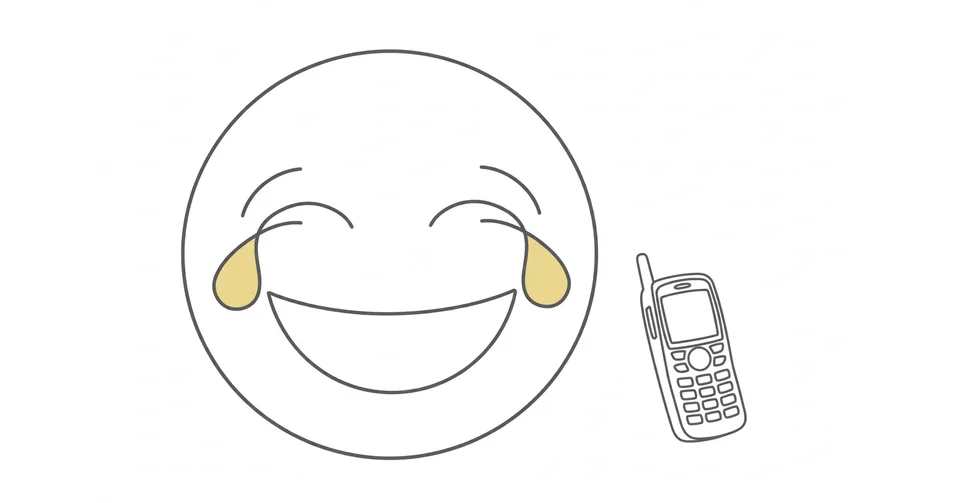
The first thing to know about emoji is that the word has nothing to do with emotion. It comes from two Japanese words, e, meaning picture, and moji, meaning character. An emoji is a picture character, a small image that stands in for a word or an idea. The resemblance to the English word emotion is a coincidence, and a fitting one, since feelings are what emoji carry best. A single face with tears of joy can say what a paragraph cannot, and it can say it in any language.
A Heart on a Pager
The very first emoji was not part of the famous set of 176. It appeared two years earlier, in 1997, on a pager. J-Phone, a Japanese carrier that later became part of SoftBank, put a single small heart on its SkyWalker pager so users could add it to text messages. One symbol, one feeling, and people loved it immediately. The heart proved that a picture could carry meaning a short message could not, and it gave the idea a future.
Two years later, NTT DoCoMo was preparing i-mode, Japan's first mobile internet service. The service would let phone users check the weather, read entertainment news, look up train times, and send email, all on a tiny screen. The team knew that short messages on a small screen felt cold and flat, and that people missed the tone of voice they got from talking face to face. They needed a way to put feeling back into text, and they gave the job to a young designer on the team.
176 Pictures on a Grid of Twelve Pixels
The designer was Shigetaka Kurita, a 25-year-old artist and interface designer. His brief was simple and almost impossible. He had to draw a set of pictures that would work on the low-resolution screens of 1999, where every image had to fit inside a grid twelve pixels wide and twelve pixels tall. Each emoji had just 144 pixels, about the size of a grain of rice on the screen, and it still had to be clear at a glance.
Kurita worked for about five weeks. He drew on the visual language of manga, the Japanese comics he grew up with, borrowing the sweat drop that means embarrassment, the crinkled eyes that mean strain, and the bold symbols that manga artists use to show feelings. He borrowed from weather charts and international road signs, and from a typeface called Zapf Dingbats. When he finished, he had 176 emoji: faces, weather symbols, traffic signs, zodiac signs, clocks, phases of the moon, and everyday objects. Only 45 of them were faces. The rest were the small facts of daily life, the sun, the rain, a telephone, a train.
When i-mode launched on 22 February 1999, the emoji were already inside it. Japanese users took to them at once. A heart or a sun at the end of a message did what words could not do on a tiny screen. It told the reader how to feel about what they had just read. That small trick turned out to be the whole idea. Emoji were never decoration. They were tone of voice, drawn in twelve pixels.
From One Network to Every Phone
For a few years emoji stayed inside Japan, and that was the plan. The problem was that each Japanese carrier drew its own set. DoCoMo had one, KDDI had another, SoftBank had a third, and a picture sent from one network could arrive as a broken box on another. The idea was too good to stay locked inside one country, but it could not spread while every carrier spoke a different dialect of pictures.
The change began in 2007, when engineers at Google started petitioning the Unicode Consortium, the body that standardises the characters used by every computer on earth, to take emoji in. In March 2009, Apple engineers Yasuo Kida and Peter Edberg filed a formal proposal for 625 emoji characters, drawn from the three major Japanese carrier sets. Apple had already put emoji in iPhone OS 2.2 in 2008, but at first they were only available in Japan. The proposal made the case that these small pictures belonged to everyone.
In October 2010, Unicode 6.0 made emoji a formal standard, giving each one a code point, the same kind of unique identifier every letter in every language already had. From that moment an emoji sent from any phone would arrive as the same emoji on any other phone, even if each company drew it in its own style. The Japanese invention had become a world standard, the same way the QR code had gone from a Japanese factory floor to every shop on earth. Japan has a habit of inventing small things that quietly become infrastructure for the whole world, and emoji belong on that short list next to the QR code and the bullet train.
Why Emoji Spread So Fast
Emoji spread faster than almost any communication system in history because they solve a problem every language has. Written text has no tone of voice. A short message like "fine" can sound happy, angry, or bored, and the reader has to guess. A face next to the word removes the guess. The pictures work in any language, which is why they crossed borders that words could not. A laughing face needs no translation, and neither does a heart.
There is also something older at work. Writing began as pictures. The first human writing was carved images of animals, the sun, and the moon, and only later did those images become abstract letters. Emoji brought pictures back into writing, but in a form built for the speed of a phone. They are not a step backward. They are a reminder that people have always wanted their writing to show feeling, and that letters alone were never quite enough.
The numbers tell the story. The set that started with 176 pictures in 1999 grew past 3,600 by 2023, and it keeps growing through a formal proposal process, the same way new words enter a dictionary. The laughing face with tears of joy was the most used emoji in the world for years in a row, and in 2015 Oxford Dictionaries made it the Word of the Year, the first time a picture had ever won the award. One recent estimate puts emoji use at 92 percent of the world's online population. There is even a World Emoji Day, on 17 July, the date shown on the calendar emoji itself.
A Museum Collects 176 Tiny Drawings
In 2016, the Museum of Modern Art in New York acquired Kurita's original 176 emoji for its permanent collection. The museum's curator, Paola Antonelli, called them "the humble masterpieces of the digital world", and the description fits. The drawings are small, plain, and made for a practical job, yet they changed how billions of people write. They sit in the same collection as chairs, posters, and typefaces, because the museum treats them as design, and it is right to do so. Every pixel in the original set was a choice, and every choice was made under a constraint that would have defeated a lesser designer.
Kurita himself never became rich from the invention. He never patented his work, and although NTT DoCoMo held the intellectual property, the company did not enforce it when Unicode took the idea global. The pictures belonged to everyone by then, and trying to own them would have missed the point. The man who drew them has said he simply wanted to make conversations warmer, and in that he succeeded beyond anything he could have imagined.
What Emoji Still Get Wrong
For all their success, emoji are not perfect, and their flaws are worth knowing. The same emoji can look different on different phones, because each company draws its own version. The pistol emoji became a water gun on most platforms after years of debate. The peach and the aubergine mean one thing in a grocery list and something else entirely in a group chat, and no standard can fix that. A gesture that is friendly in one country can be rude in another, and the pictures carry those differences with them.
The set has also had to grow up. The first emoji were drawn as yellow faces with no skin colour at all, which was fine until the set started drawing people. In 2015, Unicode added skin tone modifiers based on the Fitzpatrick scale, so a hand or a face could be shown in five tones. It was a small technical change with a large meaning. A picture language that belongs to everyone has to show everyone, and the set is still catching up, adding new jobs, new families, and new flags every year.
There is a quieter lesson in the way emoji are approved. Anyone can propose a new emoji to the Unicode Consortium, but the proposal has to prove that people actually need the picture, that it will be used often, and that it is not a brand logo or a passing joke. The process is slow on purpose. A picture that enters the standard will be drawn on billions of screens, so it has to earn its place. That is why the set grows by dozens a year, not hundreds, and why the original 176 still feel so complete.
I think the best thing about emoji is how little they ask of the reader. They do not need grammar, they do not need a dictionary, and they do not care which language you speak. A Japanese designer drew them to make phone messages warmer, and they ended up giving the whole world a way to be understood in a single tap. That is a rare thing for an invention to do, and it is why a set of twelve-pixel drawings now hangs in a museum. The next time you send a face with tears of joy, you are using a piece of Japan, drawn in five weeks, by a 25-year-old who only wanted his friends' messages to feel a little more human.
More in Tech & Internet
- Japanese Video Games and How a Small Island Rewired Play
- Otohime, the Small Sound That Protects Privacy in Japanese Toilets
- Disaster Vending Machines in Japan That Give Their Drinks Away
- Japan's Maglev Train That Runs at 500 Kilometres an Hour
- How to Use a Suica Card in Japan
- Jakarta's MRT, the Subway That Changed a Megacity
Latest posts
- Tokyo Skytree and How Japan Built the World's Tallest Tower
- Matsumoto Temari Turns Mountain Cocoons Into Wishes You Can Hold
- Nambu Tekki Is the Iron That Outlasted the Lords Who Ordered It
- Forest Bathing in Japan, the Quiet Science of Shinrin-Yoku
- Tokyo Tower and the Orange Giant That Refused to Be Replaced
- Temari Is the Embroidered Ball Japan Gives for Good Luck
- A Tetsubin Turns Iron and Fire Into Japan's Slowest Kettle
- Hakone and the Hot Spring Town Below Mount Fuji
- Ninja, the Shadow Warriors of Feudal Japan
- A Kamado Turned the Japanese Kitchen Into a Slow Oven
- Bizen Ware Lets the Fire Do the Painting
- The Japanese Alps and the Mountains at the Heart of Honshu
- Japanese Haiku and the Seventeen Syllables That Hold a Season
- Japanese Wagashi and the Sweets That Mark the Seasons
- Japanese Futon and the Art of Sleeping on the Floor