A Kamado Turned the Japanese Kitchen Into a Slow Oven
· 14 min read
A kamado is an enclosed clay cooking stove that turned a Japanese kitchen into a slow oven, and its story runs from the old farmhouse hearth to the ceramic grill in a modern backyard.
A Japanese farmhouse once cooked over an open fire in the floor. Then a clay box with a lid changed the work. A kamado is an enclosed cooking stove, built of earth or clay, with a fire burning inside it and a pot set into a hole in its top. It kept the heat where the cooking happened, and it turned a kitchen into something closer to a slow oven.
That sounds like a small change, and in one sense it is. The fire did not get bigger. It got a house of its own. But the change mattered because it separated cooking from heating. The open hearth warmed the room and cooked the meal at the same time, which was wonderful in winter and miserable in summer. A kamado let the cook keep the fire contained, feed it through a small opening in the side, and use its stored heat to simmer rice and stews for hours.
The story does not end in the farmhouse. The portable clay rice cooker that grew out of this tradition crossed the Pacific after the Second World War, and in the 1970s an American importer turned it into the ceramic grill now sold around the world as the Big Green Egg. A kamado began as a stove in a Japanese kitchen, and it ended up as a garden cooker on another continent, still doing the same job with the same trick: a thick clay body, a tight lid, and air let in slowly through a vent.
The first thing to understand is that this was a working tool before it was a tradition. People did not keep a kamado because it looked picturesque. They kept it because it cooked rice properly, saved fuel, and kept smoke out of the living room. The romance came later, after the stove itself had mostly gone.
What a kamado actually is
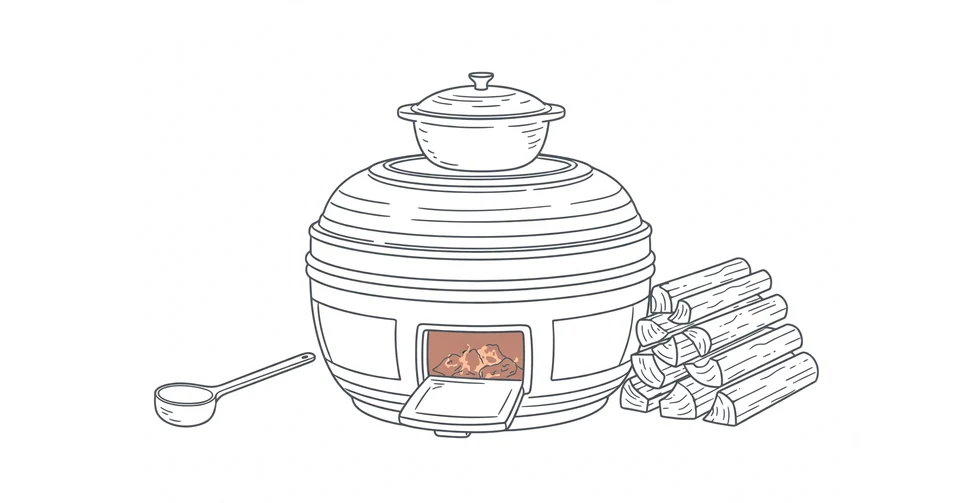
Strip away the history and a kamado is a simple machine. It is a hollow body of clay or earth, with a fire burning inside, a stokehole in the side for feeding fuel, and one or more round holes in the top where a pot sits. The pot drops partway into the fire, and a projecting rim on the pot rests on the edge of the hole, sealing the gap so heat cannot escape upward around it. The JAANUS entry on the traditional Japanese cooking range describes this arrangement in plain terms, and it notes that the kamado, along with the open hearth, was one of the two basic forms of domestic cooking appliance in pre-modern Japan.
The word itself gives the job away. Kamado is often translated as cooking range or stove, and its literal sense is the place for the cauldron. The pot was the point. The stove existed to hold the pot over a controlled fire, and everything about its shape follows from that. The thick clay walls stored heat. The small stokehole limited the air. The lid, where there was one, held the steam in. A cook who understood those three facts could cook with very little fuel, and could keep a pot simmering long after the flames had died down.
The sizes varied enormously. A small household might have a single hole for the rice pot, while a large house or a temple kitchen might have a range with several holes in a row, each with its own fire, so rice, soup, and the kettle could cook at the same time. The most elaborate examples, curved like a comma or a horseshoe, had as many as eleven cooking holes, and were built into the earth floored entrance area of the house, the doma, where the smoke and the mess of cooking belonged. In a smaller house the stove might be low and simple, set into a shallow hollow in the floor. In a cramped city tenement it might be a small portable version, carried where it was needed and put away when the cooking was done.
The materials were local and unglamorous: clay and earth first, with stone, tile, and brick added from the middle of the nineteenth century. A kamado was not bought and replaced. It was built, patched, and rebuilt from the same mud and clay it was made from.
How the kamado differs from the irori
The nearest neighbour of the kamado is the irori, the sunken open hearth in the floor of the main room, and the two are easy to confuse until you see what each one is for. The irori is open, and its job is to warm the room and gather the people around it. The kamado is enclosed, and its job is to cook. One is a hearth. The other is a stove. The house needed both, and the balance between them changed from region to region.
In the cold north, on the Sea of Japan coast and in the mountains of Tohoku, the irori mattered more. Fuel was scarce, winters were long, and a fire that heated the room was worth more than a fire that only cooked. In warm western Japan, people had long since learned to use the two fires separately according to the season, keeping the open fire for winter warmth and moving the cooking outside the main room in summer. The regional split is a useful reminder that neither device was a national rule. Each household used the fire that fitted its climate, its house, and its fuel supply.
The clearest picture of the change comes from the north itself. In the Hokuriku region, on the Sea of Japan coast, cooking was done with the irori until the kamado, the enclosed cooking stove, became widespread in the 1950s. That sentence, from our earlier look at the irori hearth that warmed the room and the people around it, is worth pausing over. It means that within living memory, in a part of Japan many readers would call traditional without thinking, the kitchen still ran on an open fire in the floor. The enclosed stove did not arrive as an ancient inheritance. It arrived as a practical improvement, late and welcome, and it took over the cooking because it did the job better.
The type itself is old, with excavated examples from pit dwellings of the Kofun period, but the stove that spread through northern kitchens in the 1950s was a modern, standardised version of it. The people who adopted it were choosing efficiency, not nostalgia, and I find that distinction quietly reassuring. Old Japanese houses were workshops, and the people in them kept changing the tools.
The kamado and the slow cooking of rice
Rice is where the enclosed stove proved itself, because rice is a fussy crop to cook well. It needs a hard boil first, then a long gentle simmer, and then a rest in its own steam. Too much heat at the end and it burns. Too little at the start and it never cooks through. An open fire is hard to control that finely. A kamado, with its thick walls and its small air opening, is almost designed for the job.
The portable clay rice cooker known as the mushikamado took that logic to its limit. It was a round clay pot with a removable domed lid, made to steam rice, and its great innovation was control. The cook brought the pot to a boil, then closed the damper on the chimney and the air intake, and the heat stored in the clay carried the rice through its simmer to perfection. The fire could be put out while the cooking went on, which is the kind of trick that sounds like magic until you have felt how long a thick clay pot stays hot.
The mushikamado was designed in the early 1900s and became the definitive rice cooker of its day. Some traditional sushi restaurants still use it, which tells you how good the result was. But the electric rice cooker arrived in the 1950s, and sales of the clay cooker as a household appliance fell away.
There is a small sadness in that, and also a small lesson. The kamado did not fail. It was outgrown by the very convenience it had made imaginable. The electric cooker that replaced it was, in its shape and its logic, a descendant of the same idea: a lidded pot fitting snugly into a heated enclosure. The family that bought one was not abandoning the old way of cooking rice. They were buying it in a new box, with a plug instead of a stokehole. The donabe, the earthenware pot that sits over the fire, belongs to the same family of slow clay cooking. A donabe turns a clay pot into Japan's slowest and warmest way to cook, and the reason it works is the same reason the enclosed stove worked: thick clay, gentle heat, and time.
Charcoal, clay and the patience of slow heat
The fuel of a kamado was wood or charcoal, and the choice mattered. Wood was cheap and close at hand, but it burned fast and smoky. Charcoal burned hotter, cleaner, and longer, and a small amount of it could keep a thick clay stove warm for hours. In the mountains, where firewood was free, wood did the daily work. Where charcoal could be bought, it was the fuel of choice for cooking that needed steady heat.
Clay was the other half of the partnership. A thin metal pot heats quickly and cools quickly. A thick clay body heats slowly and cools slowly, and that lag is the whole point of slow cooking. The stove absorbed the fierce heat of the fire, smoothed it out, and gave it back to the pot as a gentle, even warmth. A stew could simmer without scorching. Rice could finish in trapped steam. A pot of beans could sit on the stove all afternoon while the household got on with other work.
This is also why the kamado demanded patience from its cook. You could not turn it up the way you turn up a gas ring. You lit the fire, waited for the clay to warm through, and then cooked at the pace the stove allowed. That pace was slow, and it shaped the food. Dishes that needed long, gentle heat, like simmered vegetables, braised fish, and rice, suited it perfectly. Dishes that needed a quick fierce heat did not, and they were cooked elsewhere, over the open hearth or on a small portable grill.
The small portable grill deserves a mention here, because it is often confused with its larger cousin. The shichirin is a small ceramic brazier, light enough to carry outside, and it is made for grilling over charcoal. A kamado is a stove, built to hold pots and to cook rice and stews. A household that owned both had the whole range of charcoal cooking covered.
From the Japanese kitchen to the backyard grill
The second life of the kamado began after the Second World War, when American servicemen stationed in Japan noticed the portable clay rice cooker and shipped examples home. It was a strange souvenir, heavy and fragile, but it cooked beautifully, and the people who tried it remembered the food. The domed clay cooker offered something the metal charcoal and gas grills of the day did not: flavour and juiciness from a sealed, slow cook, with smoke and steam held inside the pot.
The history of the ceramic grill told by Big Green Egg picks up the story from there. Ed Fisher, an American serviceman turned entrepreneur, tasted food cooked on one of these domed clay cookers and was amazed at how much better it was. He began to import them, and when he opened the first Big Green Egg store in Atlanta in 1974, he sold a simple clay cooker based on the same design and materials that had been used for generations. The original clay cookers were fragile and did not survive exposure to the weather, but the shape was right, and the cooking was right, and people came back for more.
The modern ceramic grill is the same idea with better materials. State of the art ceramics replaced the fragile clay, and a patented draft door and vent cap gave the cook precise control over the air, and therefore over the temperature, from high heat searing to low and slow smoking. Air enters at the base, heats the lump charcoal, and carries the aroma through the cooker and out of the top. The egg shape is not a joke. It is a dome that holds heat evenly and lets smoke circulate around the food.
It is worth being honest about what changed in the crossing. The Japanese kamado was a kitchen stove, used every day to cook rice and stew. The backyard grill is a leisure cooker, used at weekends to sear steaks and smoke pork. The shape survived. The purpose shifted, from daily necessity to chosen pleasure, which is simply what happens when a tool travels.
What the kamado still teaches a modern kitchen
The kamado is mostly gone from Japanese kitchens now. Gas and electricity took its place, as they took the place of the irori, and the houses that still have one usually keep it as a museum piece or a garden feature. But the idea it carried has not gone away, and it is worth naming plainly before this article ends.
The first lesson is about heat. A kamado cooks by storing heat in clay and giving it back slowly, rather than by blasting food with a flame. Modern cooking has rediscovered that lesson in slow cookers and heavy cast iron pots. The technology changes. The physics does not.
The second lesson is about attention. A kamado cannot be hurried, and it cannot be ignored either. It asks the cook to light the fire, wait, and then trust the stove to do its work. That is a different rhythm from a microwave, which asks for nothing, and from a gas hob, which answers instantly. I think many of us miss that rhythm without knowing what we miss. We have faster kitchens and less time in them, which suggests the problem was never speed.
The third lesson is about enough. A kamado was built from the earth under the house, fuelled with wood or charcoal from nearby, and used to cook the food the household grew or bought locally. It did not promise more than it could do, and it did not need more than it had. That is not a call to give up the modern kitchen. It is a reminder that a good tool does not need to be impressive. It needs to be sufficient, repairable, and suited to the food it cooks.
There is also a spiritual thread that should not be left out. The kamado had a tutelary spirit, the kamadogami, one of the principal household deities, revered as the provider of the means to cook and feared as a potential cause of fire. The deity has mostly gone with the stove, but the respect is still good advice.
The kamado turned the Japanese kitchen into a slow oven, and then it quietly left the kitchen, leaving its shape behind in rice cookers and garden grills. That is a good ending for a tool. It was useful, it was copied, and it was outgrown, in that order. The next time you lift the lid of a heavy pot and find the rice steaming gently inside, or you watch smoke curl from a ceramic grill on a summer evening, you are meeting the same old idea again. It never really went away.
More in Life & Style
- Japanese Futon and the Art of Sleeping on the Floor
- A Tanzen Is the Full Length Robe Japan Wears Indoors in Deep Winter
- A Hanten Is the Winter Jacket Japan Wears to Work
- A Hibachi Carries the Hearth Anywhere in the House
- A Kotatsu Turns a Cold Winter Evening Into the Warmest Room in the House
- The Jizaikagi Hangs Above the Fire and Sets the Pace of Dinner
Latest posts
- Ninja, the Shadow Warriors of Feudal Japan
- Bizen Ware Lets the Fire Do the Painting
- The Japanese Alps and the Mountains at the Heart of Honshu
- Japanese Haiku and the Seventeen Syllables That Hold a Season
- Japanese Wagashi and the Sweets That Mark the Seasons
- A Hohin Is the Handleless Teapot Gyokuro Was Waiting For
- Shigaraki Ware Turns an Ancient Lake Bed Into Japan's Warmest Pottery
- Boro Turns Rags Into the Cloth Japan Refused to Throw Away
- Iga Ware Fires the Clay Pot That Holds Heat the Longest
- Mount Takao and the Day Trip Tokyo Takes When It Needs Air
- A Donabe Turns a Clay Pot Into Japan's Slowest and Warmest Way to Cook
- Sashiko Turns Mending Into the Most Beautiful Part of a Garment
- Warosoku Burns Brighter Because Its Wick Is Hollow
- A Shichirin Turns a Handful of Charcoal Into a Full Meal
- Japanese Chopsticks and the Quiet Rules Behind Every Meal