Lake Toba and the Supervolcano That Made the World's Largest Volcanic Lake
· 11 min read
Lake Toba is the largest volcanic lake on Earth, a 100-kilometre caldera filled with water after a supervolcano eruption 74,000 years ago. Here is the science, the culture of Samosir Island, and how to visit.
Lake Toba is the largest volcanic lake in the world. It stretches 100 kilometres across the highlands of North Sumatra, and it is so large that the island inside it is almost the size of Singapore. The water fills a caldera left by a supervolcano eruption about 74,000 years ago, the largest known explosive eruption on Earth in the last 25 million years. Standing on its shore, you are looking at the scar of an event that once darkened skies around the planet, and today it is one of the calmest places in Indonesia.
The numbers behind Lake Toba are hard to picture until you are there. The lake covers about 1,130 square kilometres, reaches 505 metres at its deepest point, and sits 900 metres above sea level, so the air stays cool, usually 18 to 25 degrees Celsius. It holds around 240 cubic kilometres of water. Samosir Island rises in the middle of it, a resurgent dome pushed upward by magma still sitting beneath the lake floor, and the island itself holds another lake inside it, a small one called Lake Sidihoni, which makes Lake Toba a lake inside an island inside a lake inside an island.
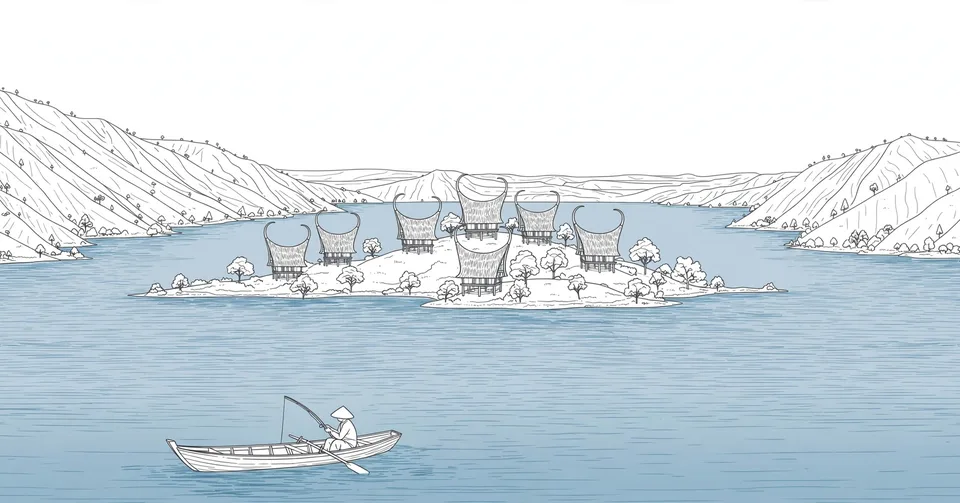
Most visitors base themselves in Tuktuk, a small peninsula on the northeastern shore of Samosir Island. It has guesthouses, cafes, and a slow rhythm that feels a long way from the rest of Indonesia. That is the point. Lake Toba rewards travellers who slow down, and the best plan is to give it at least three days: one for the water, one for the culture, and one for doing very little at all.
The eruption that changed the world
About 74,000 years ago, the Toba supervolcano erupted with a force rated VEI 8, the maximum on the Volcanic Explosivity Index. It ejected around 2,800 cubic kilometres of rock and ash, more than any other eruption in the last 25 million years. Ash fell as far away as East Africa, some 7,500 kilometres distant, and the sulphur thrown into the atmosphere cooled the planet for years. Some scientists argue it caused a volcanic winter that lasted up to a decade, and a controversial theory even links it to a bottleneck in the early human population. The theory is disputed by more recent research, but the scale of the eruption itself is not in doubt.
The caldera left behind measures 100 kilometres by 30 kilometres, the largest Quaternary caldera on the planet. Rain and rivers filled it over the centuries, and the result is the lake we see today. The geology is still active in a quiet way. Magma sits 7 to 30 kilometres beneath Samosir Island, and sediments on the island show it has been pushed upward at least 450 metres since the eruption. Lake Toba is a reminder that the ground beneath a peaceful landscape can still be moving.
Indonesia has a long history of eruptions that changed the world. The eruption of Mount Tambora in 1815 caused the Year Without a Summer, and I wrote about that in my article on the eruption that changed the world. Toba was far bigger. Tambora ejected roughly 150 cubic kilometres of material. Toba ejected nearly twenty times that amount. If Tambora could freeze a summer in Europe, Toba could, and probably did, reshape the climate of the whole planet.
In July 2020, UNESCO recognised the Toba Caldera as a UNESCO Global Geopark. The status came with homework. In mid-2025, UNESCO issued a yellow card warning over poor management and limited involvement of local communities in tourism planning, then sent an assessment team for a five-day evaluation that July. By September 2025, Indonesia had done enough to earn a green card, renewing the designation for another four years. The episode is a useful sign. Lake Toba is being taken seriously as a place worth protecting, not just a place worth photographing.
Samosir, the island inside the island
Samosir Island covers about 630 square kilometres, roughly the size of Singapore, and it is the largest island within an island anywhere on Earth. It is not a separate island in the geological sense. It is a resurgent dome, a piece of the caldera floor shoved upward by magma, and it is joined to the caldera wall by a narrow isthmus that was cut through to let boats pass. Most of the island is quiet farmland and small villages, and the tourist life concentrates on the Tuktuk peninsula, where the road loops for about three kilometres along the shore.
Samosir is the cultural heartland of the Batak Toba people, one of the six main Batak subgroups. The island holds stone chairs where village chiefs once held court, traditional houses with tall curved roofs shaped like buffalo horns, and tombs carved into cliffs. At Tomok village, you can see the stone sarcophagus of King Sidabutar and watch weavers making ulos cloth on wooden looms. At Ambarita, the old stone chairs of the Siallagan kings still stand in a circle, and local guides will tell you, with some relish, that the flat stone in the middle was once used for executions.
The Batak culture around Lake Toba is not a museum display. It is alive in the churches that dot the island, in the music that drifts from guesthouses in the evening, and in the food. Try arsik, carp cooked in a spiced broth of andaliman pepper, and naniura, raw fish cured in lime and spices. The andaliman pepper, sometimes called Batak pepper, gives dishes a citrusy tingle that is unlike anything in Javanese cooking. Eating it on the shore of the lake, with the water stretching to the horizon, is one of those small travel moments that stays with you.
Getting to Lake Toba
The main gateway is Medan, the capital of North Sumatra. From there, the town of Parapat on the eastern shore of the lake is about 176 kilometres to the south, a drive of four to five hours depending on traffic. The faster option is to fly to Silangit Airport, officially Raja Sisingamangaraja XII Airport, which now runs direct flights from Jakarta and other major Indonesian cities. From Silangit, it is about an hour to the lake. A detailed Lake Toba travel guide from a couple who live on Samosir Island covers the same routes with current prices and ferry times.
From Parapat, ferries cross to Samosir Island in about 45 minutes, landing at Tomok or Tuk Tuk. The crossing itself is part of the experience. The water changes colour as the boat moves away from shore, from green near the edge to a deep blue in the middle, and on a clear morning you can see the far shore as a thin dark line. Boats run through the day, and the last ferry back is usually in the early evening, so plan the return before dark.
| Route | Time | Notes |
|---|---|---|
| Medan to Parapat by road | 4 to 5 hours | Bus or private car, traffic varies |
| Jakarta to Silangit by air | About 2 hours | Direct flights, then 1 hour to the lake |
| Parapat to Samosir by ferry | About 45 minutes | Ferries run through the day |
Once on Samosir, the simplest way to move around Lake Toba is by motorbike, which most guesthouses rent for a small daily fee. The roads are quiet, and a loop of the island takes most of a day with stops. Cars with drivers are available too, and they are the better choice if you want to reach the far side of the island or travel after dark, when the roads have little lighting.
What to do at Lake Toba
The obvious activity at Lake Toba is to be on the water. Rent a kayak or a small boat from Tuktuk and paddle along the shore in the early morning, when the lake is flat and the mist sits low over the surface. The water is clean enough to swim in, and many guesthouses have their own small jetties where you can jump straight in. Fishing boats leave before dawn, and if you ask the night before, a fisherman will usually take you along.
The second thing to do is to walk. The path around the Tuktuk peninsula takes about an hour, and it passes guesthouses, small warungs, and gardens that smell of frangipani. Further afield, the hike to the top of Pusuk Buhit, the mountain on Samosir where Batak legend says the first Batak people descended from the heavens, takes most of a day and rewards you with a view across the whole lake. Go early, take water, and expect the last stretch to be steep.
For culture around Lake Toba, spend a morning in Tomok and Ambarita, then visit the Batak Museum in Simanindo, where traditional dances are performed for visitors. The museum is a traditional house itself, and the dancers perform tortor, the Batak dance, to the sound of gondang drums. It is short, it is joyful, and it is the kind of thing that is easy to skip and hard to forget once you have seen it.
Waterfalls are the other draw of the Lake Toba region. Sipiso-piso, a tall waterfall on the northern rim of the caldera, drops about 120 metres into a gorge below, and the viewpoint looks straight across the lake. It is a detour from the main road, but it is the single best viewpoint in the area. Go in the morning, when the light is behind you and the lake is at its bluest.
When to go and what it costs
The best time to visit Lake Toba is the dry season, from May to September. The skies are clearer, the roads are drier, and the lake is at its calmest. The wet season, from November to March, brings heavy rain and rougher water, and the mountain roads can be slow. Avoid the big holiday weeks at Lake Toba, Chinese New Year, Eid al-Fitr, Christmas and New Year, when domestic tourists fill the guesthouses and the ferries run crowded.
Lake Toba is not an expensive destination. A room in a lakeside guesthouse in Tuktuk costs less than a night in a mid-range hotel in Jakarta, and meals at local warungs are a few dollars each. The ferry is cheap, motorbike rental is cheap, and most of the sights, the stone chairs, the viewpoints, the beaches, cost little or nothing. The main expense is getting there. Once you arrive, the lake asks for time more than money.
That cheapness is part of why I think Lake Toba deserves more attention than it gets. Indonesia has spent years promoting the lake as one of its ten new Balis, and the government has set targets of growing foreign arrivals from 250,000 toward one million. The risk is that success changes the place. The quiet of Tuktuk, the empty roads, the feeling that you have the lake to yourself, is exactly what makes it special, and it is fragile. Go now, go gently, and spend your money with the small guesthouses and boatmen who live there, not just with the big resorts.
A lake that asks you to slow down
Lake Toba is not a place for ticking boxes. It does not have a single famous temple or a single famous view, and that is why some travellers pass it by. What it has instead is scale, deep time, and a culture that has lived with both for centuries. The eruption that made it was one of the most violent events in the history of the planet. The lake that filled the scar is one of the most peaceful places in Indonesia. That contrast is the whole story.
If you climb a volcano in Java, like Mount Bromo, you stand inside a crater and feel the heat of the earth. At Lake Toba, you float on the crater instead, and the heat is gone, replaced by cool water and slow mornings. Both are volcanic Indonesia, but they are opposite experiences, and they belong on the same trip if you have the time. The same goes for Borobudur, which sits on the other side of Java and shows what humans built while Toba was already ancient.
I think the best way to understand Lake Toba is to sit on a jetty at dawn and watch the mist lift off the water. There is no rush, no entrance fee, no queue. Lake Toba is 74,000 years old, and it is in no hurry. After a few days there, neither are you. That is the real gift of the place, and it is the reason I would go back.
More in Food & Travel
- Raja Ampat and the Coral Kingdom at the Edge of Indonesia
- Tokyo Skytree and How Japan Built the World's Tallest Tower
- Tokyo Tower and the Orange Giant That Refused to Be Replaced
- Hakone and the Hot Spring Town Below Mount Fuji
- The Japanese Alps and the Mountains at the Heart of Honshu
- Japanese Wagashi and the Sweets That Mark the Seasons
Latest posts
- Judo, the Gentle Way Japan Gave the World
- Matsumoto Temari Turns Mountain Cocoons Into Wishes You Can Hold
- Nambu Tekki Is the Iron That Outlasted the Lords Who Ordered It
- Forest Bathing in Japan, the Quiet Science of Shinrin-Yoku
- Emoji, the Tiny Pictures Japan Gave the World
- Temari Is the Embroidered Ball Japan Gives for Good Luck
- A Tetsubin Turns Iron and Fire Into Japan's Slowest Kettle
- Ninja, the Shadow Warriors of Feudal Japan
- A Kamado Turned the Japanese Kitchen Into a Slow Oven
- Bizen Ware Lets the Fire Do the Painting
- Japanese Haiku and the Seventeen Syllables That Hold a Season
- Japanese Futon and the Art of Sleeping on the Floor
- A Hohin Is the Handleless Teapot Gyokuro Was Waiting For
- Shigaraki Ware Turns an Ancient Lake Bed Into Japan's Warmest Pottery
- Boro Turns Rags Into the Cloth Japan Refused to Throw Away