A Tetsubin Turns Iron and Fire Into Japan's Slowest Kettle
· 14 min read
A tetsubin is a Japanese cast iron kettle from Iwate that boils water slowly over charcoal, and its heavy iron body turns an ordinary pot of water into a small daily ceremony.
There is a kettle in Japan that does not hurry. It is heavy, black, and covered in tiny raised dots like hailstones, and it takes its time over a low flame while the rest of the kitchen rushes on. That kettle is a tetsubin, and it has been boiling water the same slow way for about four hundred years.
A tetsubin is not a teapot, though many shops outside Japan sell it as one. It is a kettle for boiling water, made of bare cast iron, and it belongs to the craft of Nambu Tekki, the ironware of Iwate Prefecture in the cold northeast of Japan. Its job is simple, and it does that one job with a patience that modern kettles have forgotten.
What makes it worth owning is not speed. It is the way a tetsubin changes the small act of boiling water into something worth paying attention to. The iron, the charcoal, the weight in the hand, and the faint hiss as the water comes to a boil all slow the morning down by a few minutes, and those minutes turn out to matter.
What a tetsubin actually is
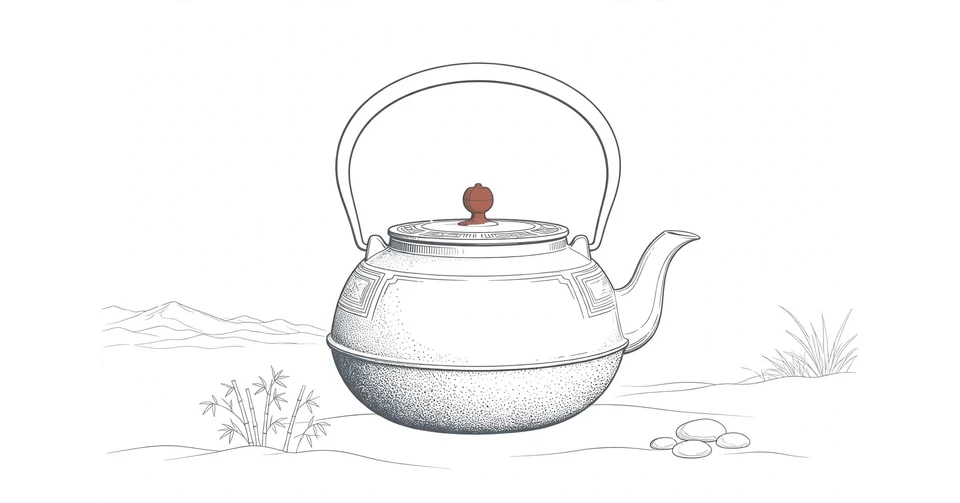
A tetsubin is a Japanese cast iron kettle built for one purpose, boiling water over direct heat. It has a round body, a short pouring spout, a lid, and an overhead handle, and its interior is bare iron with no lining at all. That bare iron is the whole point. The water touches the iron while it boils, and that contact is what the kettle is for.
The most recognisable tetsubin wear a pattern called arare, which means hailstones. Thousands of tiny raised dots cover the body, stamped into the mould one by one by hand, and some kettles carry about two thousand of them. The pattern gives the hand something to grip, and it marks the kettle at a glance as a product of Iwate.
A household tetsubin often holds about a litre of water, enough for a small pot of tea shared between two or three people. It is heavy for its size, because cast iron is heavy, and that weight is part of how you know it is real. That heaviness is not a flaw. It is the kettle telling you, before you have even lit the fire, that it is built to last longer than you are.
I think that weight is the first thing that changes how a person treats the kettle. A light electric kettle is a tool you switch on and forget. A tetsubin is an object you lift with both hands, set down carefully, and listen to while it works.
How a tetsubin was born in Iwate
The story of the tetsubin begins in Morioka, the castle town of the Nanbu clan in what is now Iwate Prefecture. The region was rich in everything an ironworker needs, iron sand, river sand, clay, charcoal, and lacquer, and in the middle of the seventeenth century the Nanbu lord invited master kettle makers from Kyoto to cast chagama, the large round kettles used in the tea ceremony. That invitation is regarded as the origin of Nambu Tekki, the ironware tradition that still defines the region today. A second, older line of casting ran further south, around Mizusawa in what is now Oshu City, where iron casting is said to reach back to the Oshu Fujiwara family of the twelfth century. Morioka grew up making tea ware and objects of beauty, while Mizusawa built its name on the iron pots and cooking vessels of daily life, and today both centres carry the single name of Nambu Tekki.
The tetsubin itself came later, as a smaller and more practical child of the great tea ceremony kettle. Around 1750, Nizaemon Koizumi the third, one of the four families of retained craftsmen in the Nanbu domain, devised a small kettle with a handle and a pouring spout, more convenient for an open air tea ceremony than the conventional chagama. That small kettle is said to be the origin of the tetsubin, and compared with the ceramic kettle that had been used to boil water, the iron kettle conducted heat far better.
The kettle spread slowly at first, because iron rusts and a kettle that rusts is a kettle that fails. A unique rust prevention procedure, worked into the craft in the late nineteenth century, changed that, and the Nambu tetsubin started to be widely used. The craft later survived war and the postwar years, and when the Law for the Promotion of Traditional Crafts Industries was enacted in 1974, Nambu tetsubin became the first craft to be officially designated as one of Japan's traditional crafts. The Google Arts and Culture story on Nambu Tekki traces this whole arc, and it is the clearest single account of how a regional ironware became a national treasure.
Four hundred years is a long time for a kettle to stay in production. The tetsubin never chased speed, never added features, and never pretended to be a teapot. It boiled water well and lasted for generations, and objects that do one thing well tend to outlive objects that do many things adequately.
How a tetsubin is made
Making a tetsubin is slow work, and almost all of it is done by hand. The mould is built first, from special moulding sand packed inside a cylindrical wooden frame. The core, which forms the hollow inside of the kettle, is made 2mm smaller in radius than the outer mould, and that small difference becomes the thickness of the cast iron wall.
The patterns are stamped while the mould is still moist. To make the arare hailstone dots, a craftsperson uses a special rod to stamp small dents into the mould one by one, and the dots vary slightly in size depending on where they will sit on the finished kettle. Once the mould is assembled and bound tightly, it is burnt in charcoal at 800 to 1000 degrees Celsius to dry it completely. The cast iron is melted separately, and when the temperature reaches 1500 degrees the impurities are skimmed away from the surface of the bright red molten iron. The iron is then cast into the mould to fill it completely and evenly.
When the iron has cooled enough, the tetsubin is removed from the mould, still bright red with heat, gradually turning silvery grey. The caster taps it with a hammer and listens to the sound to check whether the thickness is even. Then comes the step that sets Nambu ironware apart. The kettle is baked once again in charcoal at 900 degrees, in a process called kanake-dome, which creates an oxide film inside the kettle to prevent rust. The surface is covered with lacquer using a special brush made from bundled water grass, and finally it is coated with a rust preventing liquid made by putting bits of steel in acetic acid and brewed tea, known as ohaguro. Only then is the handle attached and the lid put in place, and the tetsubin is complete.
A tetsubin and a teapot are not the same thing
This is the confusion that causes the most trouble for new owners, and it is worth clearing up plainly. A tetsubin is a kettle. It boils water on a flame, and its interior is bare iron. A cast iron teapot, called a tetsu kyusu, is a different object. It is lined with enamel on the inside, it is made for steeping tea leaves, and it must never be placed on a stove, because the enamel can crack under direct heat. The two look similar from the outside, and they are often sold side by side, but they do opposite jobs.
The difference matters because it decides how you use the thing you bought. Water goes into a tetsubin, is boiled over a flame, and is then poured into a separate teapot that holds the leaves. That separation is the traditional way of making tea in Japan, and it is also the practical way, because the kettle never has to deal with tea leaves and the teapot never has to survive a flame. The small kyusu teapot is the partner in that pairing, the vessel where the leaves steep while the kettle does the boiling. The traditional heat source was charcoal, and a hibachi brazier could keep a tetsubin at a gentle simmer through the afternoon, ready whenever someone wanted a cup.
How to use a tetsubin day to day
Using a tetsubin is simple, but it has rules, and the rules are there because cast iron is unforgiving about a few things. Before the first use, rinse the inside and boil water two or three times, discarding the water each time, until the boiled water runs clear. That first seasoning settles the interior and washes away any loose residue from the making.
Fill it with cold water, leaving room at the top so the water does not spill when it boils, and heat it gently on low to medium heat. A tetsubin should never be heated empty, and it should never be blasted on high heat from cold, because a sudden shock can crack the iron. Leave the lid slightly ajar so steam can escape, and keep the steam away from the handle. The lid and the handle will both get hot, so use a cloth on both while pouring. Never pour cold water into a hot kettle. The sudden temperature change makes the cast iron contract rapidly, and that is how a good kettle cracks, so add warm water instead if you want more.
The most important habit is the one that comes after the boiling. Empty the kettle completely while it is still hot, and leave the lid off so the residual heat can evaporate the last of the moisture. That takes less than two minutes, and it is the whole foundation of owning a tetsubin. A kettle that is emptied hot and dried by its own heat will last for decades. A kettle that is left with water sitting in it overnight will start to rust within days, and rust left alone only gets worse.
Caring for a tetsubin
The care routine for a tetsubin is short, and every part of it matters. Empty it while it is still hot, remove the lid, and set the lid aside separately so air can move around both pieces. Do not wipe the interior with a cloth, because the inside develops a mineral scale over time that insulates the iron and softens the boiled water, and wiping it removes that layer and sets the process back. Wipe the outside with a dry soft cloth after each use to remove water spots before they settle.
Soap should never enter a tetsubin, not even a small amount. Soap disrupts the developing mineral scale inside, leaves residue that affects the taste of the water, and strips the surface treatment the maker applied. Hot water only, and only when genuinely necessary, is the rule. Abrasive sponges, steel wool, and stiff brushes are equally damaging, because they scratch the interior and remove the oxide layer that develops with regular use.
Some surface rust inside a tetsubin is normal and is not a sign that the kettle has been damaged. A reddish brown coating that lies flat against the surface and does not flake is typical, particularly in the first few months of use. The standard remedy is to boil sencha tea leaves inside the kettle. The tannins in the tea react with the iron oxide and produce a darker, more stable coating. Fill the kettle to about two thirds with water, add a bag of sencha, simmer gently for twenty minutes, then let the water sit for several hours after cooling, discard it, and rinse. Repeat two or three times if needed. The Nio Teas guide to tetsubin care sets out this whole routine in detail, from the daily drying habit to the sencha treatment.
When the kettle will not be used for a while, make sure it is completely dry before storing it. A light warming on low heat for two or three minutes, followed by a cool down with the lid off, is enough preparation. Store it in a dry place with air circulation, never in a sealed plastic bag or an airtight container, which traps residual moisture and speeds up rust.
I think the care routine is the honest price of the kettle, and it is a fair one. Two minutes after each use, no soap, no scrubbing, and a little patience when rust appears. In exchange, the kettle will outlive the stove it sits on.
Choosing your first tetsubin
If you are buying your first tetsubin, the first choice is the most important one, and it is the choice between a real kettle and a teapot wearing a kettle's shape. A true tetsubin has a bare iron interior and is made to sit on a flame. An enamel lined teapot is made to steep tea and must never go on a stove. Check the inside before you buy, and if the seller cannot tell you which one it is, buy it somewhere else.
Look for the marks of the Iwate tradition. The best known workshops include Iwachu, founded in Morioka in 1902 and now the most internationally recognised name, and Oigen, founded in 1852 in Oshu, known for a slightly more rustic and artisanal look. The Suzuki Morihisa workshop, with roots going back more than four hundred years, is the oldest still operating studio. Any of these names is a good sign, and a kettle from a named workshop will usually tell you its origin plainly.
Size matters too. A kettle of about a litre suits one or two people and a small teapot, and it is light enough to lift and pour safely when full of boiling water. Check the lid, the spout, and the handle before you pay. The lid should sit snugly without rattling, the spout should pour in a clean stream without dribbling down the side, and the handle should feel secure and balanced when the kettle is full. A tetsubin is not a cheap object, and it is not meant to be. It is a purchase measured in decades, and the right way to judge it is to imagine using it every morning for the next twenty years.
The slowest kettle in the kitchen
A tetsubin will never boil water as fast as an electric kettle, and it will never be as convenient as one. It is heavy, it needs drying after every use, it rusts if you forget it, and it asks you to learn a small set of rules before it will work properly. By every measure of modern convenience, it is the worse kettle, and that is exactly why it is worth owning.
What it offers instead is a different relationship with a daily act. Boiling water becomes something you do with attention rather than something that happens while you check your phone. A tetsubin does not save time. It spends it, carefully, on something small and ordinary, and it reminds you that small and ordinary is most of a life. That is the quiet argument of the kettle, and after four hundred years of boiling water in Iwate, it shows no sign of hurrying now.
More in Culture & Society
- Matsumoto Temari Turns Mountain Cocoons Into Wishes You Can Hold
- Nambu Tekki Is the Iron That Outlasted the Lords Who Ordered It
- Temari Is the Embroidered Ball Japan Gives for Good Luck
- Ninja, the Shadow Warriors of Feudal Japan
- Bizen Ware Lets the Fire Do the Painting
- Japanese Haiku and the Seventeen Syllables That Hold a Season
Latest posts
- Tokyo Skytree and How Japan Built the World's Tallest Tower
- Forest Bathing in Japan, the Quiet Science of Shinrin-Yoku
- Tokyo Tower and the Orange Giant That Refused to Be Replaced
- Emoji, the Tiny Pictures Japan Gave the World
- Hakone and the Hot Spring Town Below Mount Fuji
- A Kamado Turned the Japanese Kitchen Into a Slow Oven
- The Japanese Alps and the Mountains at the Heart of Honshu
- Japanese Wagashi and the Sweets That Mark the Seasons
- Japanese Futon and the Art of Sleeping on the Floor
- A Hohin Is the Handleless Teapot Gyokuro Was Waiting For
- Shigaraki Ware Turns an Ancient Lake Bed Into Japan's Warmest Pottery
- Boro Turns Rags Into the Cloth Japan Refused to Throw Away
- Iga Ware Fires the Clay Pot That Holds Heat the Longest
- Mount Takao and the Day Trip Tokyo Takes When It Needs Air
- A Donabe Turns a Clay Pot Into Japan's Slowest and Warmest Way to Cook