A Hohin Is the Handleless Teapot Gyokuro Was Waiting For
· 17 min read
A hohin is a small handleless Japanese teapot made for brewing gyokuro and other fine shaded teas at low temperature, held in the hand and poured slowly, a little at a time.
Hold a hohin for the first time and your hand will ask the obvious question. Where is the handle? A hohin is a small, handleless Japanese teapot made for brewing gyokuro and other fine shaded teas at low temperature, and the missing handle is not a mistake. It is the whole idea. The water inside is barely warmer than a bath, so the pot can be cradled in the palm, and the hand becomes part of the brewing.
The name itself gives the game away. Hohin means treasure bottle, a name that suits a vessel built for the most precious leaf in the cupboard. Gyokuro is the tea that made this pot necessary, a shaded green tea with so much umami that hot water would ruin it, and the hohin exists to brew it gently, slowly, and in very small amounts. A full pot of gyokuro fills only the bottom of two small cups, and that smallness is the point.
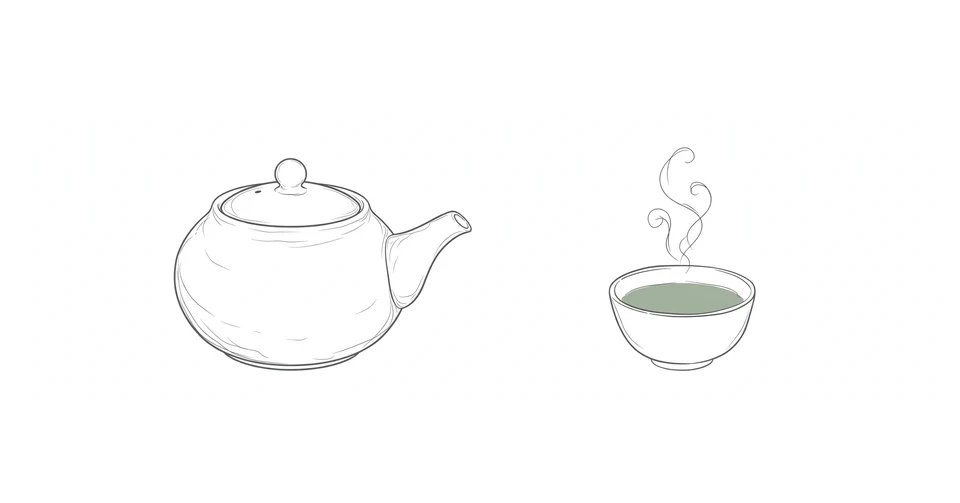
That is the honest starting point for understanding this pot. It is not a ceremonial object, and it is not a showpiece for a shelf. It is a working tool, shaped by the temperature of the water it holds and the tea it serves. Once you understand that the vessel follows the tea rather than the other way round, every detail of its shape starts to make sense.
What a hohin actually is
A hohin is a small, handleless Japanese teapot with a lid and a short spout, usually holding somewhere between 80 and 150 millilitres. That is enough for one or two small cups, and deliberately so. Gyokuro is brewed with very little water, often around 100 millilitres for a generous amount of leaf, so a pot any larger would be the wrong tool. The small volume is not a limitation. It is the design.
The idea is said to have come from the Chinese gaiwan, a lidded cup held with one finger on the lid, and the hohin carries the same gesture into Japanese tea. Musubi Kiln, in its guide to brewing with a houhin, describes the pot as a teapot without a handle, made for tea brewed at low temperature, and notes that the strainer, a sasame of fine holes formed in the clay at the mouth of the spout, means there is no need to strain the tea when pouring. The leaves stay in the pot, the liquor flows out clean, and nothing else is required.
The body is usually a deep cup shape rather than a wide bowl, with the lid sitting close over the leaves and a small knob on top for a fingertip. The spout is short and direct, and the whole pot fits comfortably in one hand, though it is usually held with two. There is no handle to grip, no lever to pull, and nothing between the hand and the clay except warm ceramic. That direct contact is part of the pleasure, and part of the discipline.
I think the first thing this pot teaches is restraint. A Western teapot is built to serve a table, so it is large and generous. A hohin is built to serve one or two people, a few sips at a time, from leaf that costs too much to waste. It asks the drinker to slow down and pay attention to each pour rather than filling a big pot once and forgetting about it. That is a small difference in the hand and a large difference in how the tea is experienced.
Why a hohin has no handle
The missing handle is the feature that makes a hohin instantly recognisable, and it exists for a very practical reason. Gyokuro is brewed at about 50 to 60 degrees Celsius, much cooler than the 70 to 80 degrees used for sencha, because cool water draws out the sweet theanine while leaving most of the bitter catechins behind. At that temperature the pot is warm, never hot, and the hand can hold it comfortably. A handle would be solving a problem that does not exist.
There is a second reason, and it is the more interesting one. When the hand cradles the pot, it feels the temperature of the water directly. Too hot, and the fingers know before the tongue does. Too cool, and the pot feels flat and lifeless in the palm. The heat becomes feedback, a quiet signal that the brewing water is right. Japan Objects, in its guide to Japanese teapots, puts it plainly: because the water for gyokuro is 60 degrees or even lower, the teapot never becomes too hot to touch, and from a Japanese minimalist point of view, a handle is not necessary. The missing handle is not an inconvenience. It is a design cue.
The discipline works both ways. If the water is too hot to hold, it is probably too hot for the tea. A hohin will not let you forget that, because your hand is part of the instrument. I find that honesty refreshing. Most kitchen tools hide their working temperature behind plastic and insulation, and the drinker has to guess. This pot tells the truth through the palm, and the truth is usually that the water is cooler than you think, which is exactly where gyokuro wants it.
A hohin, a kyusu, and a shiboridashi
A hohin is the smallest member of a family of Japanese teapots, and it is worth knowing its relatives before buying one. The kyusu is the standard, a small teapot with a side handle and a built in strainer, and it is the right tool for everyday sencha. The kyusu article on this site explains how that side handle, set at a right angle to the spout, lets the brewer pour with one hand and shake out the last drops with a turn of the wrist. A kyusu is built for volume and repetition, a pot that can be emptied and refilled several times in a morning.
The shiboridashi is the closest cousin, and the two are easy to confuse at first glance. Both are handleless, both are small, and both are made for low temperature brewing. The difference is in the pour. A hohin has a spout and a built in strainer, so it behaves like a tiny teapot, with a clean, directed stream. A shiboridashi is flatter and wider, more like a low bowl with a lid, and it pours from the rim through a narrow gap between lid and body, with no strainer at all. The shiboridashi is for the most concentrated gyokuro, a few thick drops at a time, and for drinkers who enjoy the slowest possible pour. The hohin is the easier of the two to live with, because the spout gives the pour a little more control.
Choosing between them is less a question of right and wrong than a question of temperament. A drinker who wants a neat, repeatable pour will be happier with a hohin. A drinker who treats brewing as a form of meditation may prefer the shiboridashi, which demands more attention and rewards it with a slower, more deliberate stream. Either will brew a good cup. The honest advice is to start with the handleless teapot with the spout, which forgives a clumsy hand, and try a shiboridashi later, when the slow pour has become a habit rather than a challenge.
Tokoname and Banko clay, and porcelain too
Most examples of this pot are made from unglazed clay, and the two famous names are the same ones that dominate the kyusu world. Tokoname, in Aichi Prefecture, fires its red shudei clay in oxidation, which turns the iron in the clay into hematite and gives the pot its warm red brown colour. Banko, from Yokkaichi in Mie Prefecture, fires its purple shidei clay in reduction, with the kiln starved of oxygen, and the same iron turns dark and purple brown instead. Both clays are left unglazed inside and out, and both develop a patina with use, as tea oils settle slowly into the porous surface.
The claim that unglazed iron clay makes green tea taste smoother is old shop wisdom, and it has been tested with instruments rather than opinions. A 2022 study in Japan brewed identical sencha in six different vessels and found tannin, the astringent fraction of the tea, at 73.2 milligrams per 100 millilitres from a Tokoname shudei pot, against 88.9 milligrams from Arita porcelain, roughly 18 percent less astringency from the same leaf. The umami fraction stayed essentially unchanged. The mechanism is thought to be physical: catechins adsorb into the pores of the unglazed surface and bind to iron compounds in the clay. The studies stop short of proving the exact chemistry, but the effect itself is not folklore.
Porcelain has its own virtue, which is neutrality. A porcelain hohin takes up nothing and gives up nothing, so the tea arrives exactly as the leaf made it, and one pot can be used for many different teas without carrying a memory from one to the next. A clay pot remembers. It carries a faint trace of the teas it has brewed, which is pleasant when the pot is dedicated to one tea and confusing when it is not. For a first purchase, porcelain is the safer choice, because it forgives a drinker who rotates through several teas. For a drinker who has settled on one gyokuro, a clay hohin is a small pleasure that grows with time.
I would start with clay, honestly, and with Tokoname if the choice has to be made. The red clay is warm in the hand, it softens the cup a little, and it ages visibly, darkening and gaining lustre with use, so the pot records its own history. Porcelain stays the same forever, which is a virtue in a laboratory and a small loss in a kitchen. A hohin is used slowly, a few times a week at most, and a pot that changes with its owner feels like the right companion for that kind of ritual.
How to brew gyokuro in a hohin
Brewing in a hohin is simple once the temperature is understood, and the method follows the tea rather than the pot. Gyokuro is brewed strong, with far more leaf and far less water than an everyday cup. The gyokuro article on this site explains why this shaded tea commands its price, and the brewing follows from the same logic: cool water, plenty of leaf, and a long, patient steep.
Start by warming the pot and the cups with hot water, then discard it, so the cool brewing water does not lose more heat to cold ceramic. Boil fresh water and pour it into a yuzamashi, a small cooling vessel, or simply pour it back and forth between two cups a few times. Each transfer drops the temperature by roughly 5 to 10 degrees. For the first steep, the water should be cooled to about 50 to 60 degrees, warm to the touch rather than hot.
Add the leaf, about 5 grams for a small pot, or up to 10 grams for a richer cup, and pour the cooled water slowly over it, filling about two thirds of the pot. Place the lid on and wait about two minutes without stirring. The leaves will open slowly in the cool water, and the liquor will turn a pale, cloudy green.
Pouring is the part that needs practice, and the method has a name: the three finger method. Rest the pot between thumb and middle finger at the rim, place the index finger on the lid knob to keep it in place, then tilt in a slow, continuous stream until every last drop is in the cup. Pour a little at a time into each cup, so every cup ends up the same strength. A hohin filled with tea will probably fill only a third of each cup, and that is normal. A second infusion works well at a slightly higher temperature, around 60 to 65 degrees, for 30 to 45 seconds, and a good leaf can be steeped three or four times, with the water a little warmer and the wait a little shorter each round.
One habit matters more than any single recipe, and it is the habit of emptying the pot. Water left in the pot keeps extracting, and the next cup comes out bitter and flat. Pouring everything out, down to the last drop, keeps each steep clean. It is a small discipline, and it is the difference between a pot that produces good tea and a pot that produces tea that tastes somehow tired.
How to choose a hohin
Choosing a hohin is simpler than the catalogues make it look, because the decision comes down to three questions: how much tea is brewed at once, which tea is brewed most often, and whose hand will hold the pot.
Size comes first. A hohin of 80 to 150 millilitres is the standard for gyokuro, and it is the right default for almost everyone. A pot in that range holds enough for one or two small cups per steep and empties completely in one pour, which is exactly how gyokuro is meant to be served. Smaller pots, around 80 to 100 millilitres, suit a single drinker and the most concentrated brewing. Larger pots, toward 150 millilitres, suit two people sharing a quiet cup. The rule that survives every argument is to match the pot to the leaf actually drunk most often, and to keep the volume small enough that the pot is emptied in one pour.
Material comes second, and the choice follows the tea shelf. A clay pot, Tokoname or Banko, suits a drinker who brews gyokuro most days and wants the cup a little rounder and a little less sharp. A porcelain one suits a drinker who rotates through gyokuro, kabusecha, and high grade sencha, and wants one pot that stays neutral. Either will brew a good cup, and the choice can safely come down to which colour and which feel is more pleasing in the hand. A hohin is used slowly, after all, and a pot that is pleasant to hold will be used more often than a pot that is merely correct.
Finish comes third, and it is worth a slow look before buying. The lid should sit flat and steady, with no wobble when the pot is tilted. The spout should pour in a clean stream without dribbling down the side. The strainer holes at the mouth of the spout should be even and clear, because a clogged pour is the one flaw that ruins a pot in daily use. A real handmade pot often carries a stamped or incised mark on the underside, and better pieces come with a signed wooden box called a tomobako. None of these signals guarantees quality on its own, and a small workshop in a lesser known region can produce a better pot than a famous name, but they are a useful starting point for a first purchase.
Price deserves an honest word. A functional hohin can be bought for a modest sum, and a handmade pot from a named maker can cost many times more. The expensive pot is usually better finished, with a lid that fits perfectly and a spout that pours cleanly, but the difference in the cup is small. I would rather see a beginner buy a simple, well made clay pot and spend the rest of the budget on good gyokuro than buy a beautiful pot and fill it with stale leaf. The leaf matters more than the vessel, and the vessel matters more than the price tag suggests.
How to care for a hohin
An unglazed clay hohin wants almost nothing, and that is part of its charm. Rinse it with hot water after use, and never use soap. The porous body absorbs detergent as readily as it absorbs tea, and a soapy pot will lend a chemical note to the next few brews that no amount of rinsing fully removes. Dry it fully with the lid off before storing, so no moisture is trapped inside, and pay particular attention to the inside of the spout, where water can remain for a long time. Porcelain tolerates anything, but clay asks for this one courtesy, and it is not a difficult one.
If a sasame strainer clogs, a soft brush under running water clears it. Never use a hard object, because the ceramic teeth are the most fragile part of the pot, and a chipped strainer cannot be repaired. If the pot is used regularly, it will slowly change colour inside as tea oils settle into the clay. That is normal, and in Japan it is considered a virtue rather than a stain. The pot records the tea it has brewed, and over years that record deepens the colour and, many drinkers believe, softens the cup further.
There is one more habit worth keeping, and it is the simplest of all: use the pot for one tea, or at least for one family of teas. A clay hohin that brews gyokuro every week will carry a faint memory of gyokuro into later brews, which is pleasant. A clay pot that brews gyokuro on Monday, hojicha on Tuesday, and a flavoured tea on Wednesday will carry a confused memory, which is less pleasant. Porcelain has no memory at all, which is why it is the honest all rounder for a drinker who rotates through many teas. But for the drinker who has one special tea, a dedicated clay hohin is a small pleasure that grows with time.
A small pot worth slowing down for
A hohin will never be the most dramatic object in the kitchen. It has no ceremony attached to it, no seasonal ritual, and no correct way to hold it beyond the way that works. What it has is something quieter: a shape refined by the temperature of the water it holds, a clay that softens the cup a little, and a spout that pours a few precious sips at a time.
That modesty is easy to miss, and I missed it myself for a long time, treating the handleless pot on the shelf as a curiosity rather than as something worth learning. But a country does not brew its most expensive tea in a pot like this by accident. It brews it in a hohin because the volume is right, because the hand fits the pot, because the heat tells the truth, and because a small cup fits the shape of a quiet moment.
The next time a cup of gyokuro arrives, it is worth taking a slow sip and noticing the pot it came from. A hohin is a small thing, and it does a small job, and it does that job well enough that the tea itself gets to be the point. For a tool that costs little and lasts for years, that is a good bargain, and a good reason to keep one on the shelf.
More in Food & Travel
- Mount Takao and the Day Trip Tokyo Takes When It Needs Air
- A Donabe Turns a Clay Pot Into Japan's Slowest and Warmest Way to Cook
- A Shichirin Turns a Handful of Charcoal Into a Full Meal
- Binchotan Is the Charcoal That Made the Hibachi Possible
- Chawanmushi Hides a Whole Meal Inside a Teacup
- Himeji Castle, Japan's White Heron That Survived War and Fire
Latest posts
- Japanese Futon and the Art of Sleeping on the Floor
- Shigaraki Ware Turns an Ancient Lake Bed Into Japan's Warmest Pottery
- Boro Turns Rags Into the Cloth Japan Refused to Throw Away
- Iga Ware Fires the Clay Pot That Holds Heat the Longest
- Sashiko Turns Mending Into the Most Beautiful Part of a Garment
- Warosoku Burns Brighter Because Its Wick Is Hollow
- Japanese Chopsticks and the Quiet Rules Behind Every Meal
- A Tanzen Is the Full Length Robe Japan Wears Indoors in Deep Winter
- The Haze Tree Grows the Wax Behind Japan's Oldest Candles
- A Hanten Is the Winter Jacket Japan Wears to Work
- Haze Wax Keeps Japan's Oldest Candles Burning
- Furoshiki, the Japanese Cloth That Wraps Almost Anything
- Japanese Candles Are Still Rolled by Hand in Japan
- Ubame Oak Is the Tree That Turns Into White Charcoal
- Igusa Is the Humble Grass Under Every Tatami Mat