Japanese Wagashi and the Sweets That Mark the Seasons
· 13 min read
Japanese wagashi are the traditional sweets of Japan, shaped by the seasons and the tea ceremony. Here is what they are, how they began, and where to taste them.
Japanese wagashi are the traditional sweets of Japan, small confections built from sweet bean paste, rice, and agar, and shaped to match the season. They are not desserts in the Western sense. They are quieter than that, less sweet, and made to be looked at before they are eaten. A single piece can carry the shape of a plum blossom in February, a maple leaf in November, or a goldfish in August.
What sets Japanese wagashi apart is how little they rely on the things Western sweets depend on. There is almost no butter, no cream, and no chocolate. The base is plant based: azuki beans simmered into a sweet paste called anko, glutinous rice pounded into mochi, and kanten, an agar made from seaweed that sets jellies without gelatin. The result is a sweet that tastes restrained to a first timer, then grows on you, because the flavor comes from the bean and the rice rather than from fat and sugar.
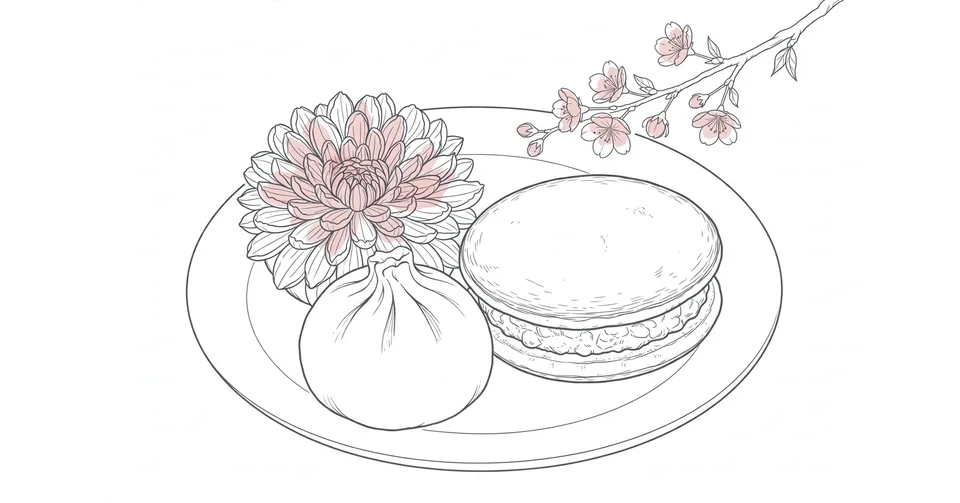
My first proper piece of Japanese wagashi came not from a famous shop but from a small counter in a Kyoto department store basement, the kind of food hall the Japanese call a depachika. The woman behind the counter lifted a nerikiri shaped like a cherry blossom with bamboo tweezers and set it on a paper square as carefully as if it were jewelry. It cost less than a coffee and it lasted about four bites, but I still remember its shape better than most meals I had that year. That is the whole point of Japanese wagashi. They are small, seasonal, and made to be noticed.
What Japanese Wagashi Actually Are
The word wagashi means Japanese sweets, and it only exists because Western sweets arrived. When cakes and chocolate came to Japan in the Meiji period, from 1868 to 1912, the older sweets needed a name of their own, so wa, meaning Japanese, was added to kashi, meaning confection. The Western imports became yogashi, and the traditional sweets became Japanese wagashi.
There is no single official definition of Japanese wagashi, and the range is wide. The family includes chewy mochi rice cakes, jewel toned jellies, steamed buns, baked pancakes, and pressed sugar sweets. What they share is a short list of ingredients and a long attention to the seasons. Most Japanese wagashi are built from mochigome, glutinous rice, rice flour, kanten, kuzu starch, chestnuts, sesame, and above all anko, the sweet bean paste made from simmered azuki beans. A few contain egg and wheat flour, like dorayaki and castella, but the core of the tradition is plant based, which is one reason Japanese wagashi have found new fans among people looking for lighter, lower fat sweets.
The most useful way to understand Japanese wagashi is to sort them by moisture, the way Japanese confectioners do. Fresh sweets spoil in a day or two and must be eaten where they are made. Dried sweets keep for weeks and travel well as souvenirs. Everything else sits between the two.
| Family | Moisture | Examples | Shelf life |
|---|---|---|---|
| Namagashi | Over 30 percent | Nerikiri, daifuku, dango | One to two days |
| Han-namagashi | Medium | Yokan, manju, monaka | Several days |
| Higashi | Very low | Rakugan, konpeito, senbei | Weeks |
A History That Starts Before Sugar
The history of Japanese wagashi reaches back further than most people expect. In the Jomon period, roughly 14,000 to 300 BCE, people ground nuts into flour, removed the bitterness, and shaped the paste into dumplings that were offered to the gods. Mochi, pounded glutinous rice cake, is often described as Japan's oldest processed food, and it grew out of the same ritual world.
The sweets changed shape when Buddhism arrived from China in the Asuka and Nara periods, in the 600s and 700s CE. Confections and techniques came with the monks, including the idea of shaped, filled sweets. Centuries later, in the Muromachi period, a Chinese monk named Lin Jingyin is said to have brought manju, steamed buns filled with bean paste, to Japan. Then, from around the 16th century, contact with Portugal and Spain brought castella, a sponge cake from Nagasaki that still counts as Japanese wagashi today even though its roots are European.
The real turning point came in the Edo period, from 1603 to 1868, when Japanese wagashi became inseparable from the tea ceremony. Tea masters needed a sweet to serve before bitter matcha, and confectioners answered with sweets that matched the season of the gathering. Japan also began making its own sugar during this period, which freed makers from expensive imported sugar and let the craft spread beyond Kyoto. By the end of the Edo period, nearly every type of Japanese wagashi eaten today had already been developed.
The craft is still recognized as living heritage. On November 17, 2022, the techniques for making nerikiri and konashi, the sculpted fresh sweets with named seasonal designs, were registered as a Registered Intangible Cultural Property of Japan. And every June 16 is Wagashi Day, a date that reaches back to a ritual in the year 848, when the emperor offered sweets and rice cakes in multiples of 16 to the gods to pray for health.
The Sweets to Know First
If you are new to Japanese wagashi, start with these. Each one teaches you something different about the tradition, and all of them are easy to find in Japan.
Nerikiri is the showpiece. It is made from shiroan, white bean paste, mixed with gyuhi, a soft mochi, then colored and shaped by hand into flowers, fruit, or seasonal scenes. A single piece can take a skilled maker minutes to finish, and it is the sweet most often served at a formal tea ceremony. Prices usually run from 300 to 800 yen, depending on the complexity and the shop.
Daifuku is the friendly one. A soft, chewy mochi shell wraps a filling of anko, and modern versions add strawberry, matcha cream, or even ice cream. It is the easiest Japanese wagashi to love on first taste, because the texture does the talking before the flavor does.
Dorayaki is two small castella like pancakes sandwiching a layer of anko. Its name comes from dora, the gong shaped pan traditionally used to cook the batter, and it is famous far beyond Japan as the favorite snack of Doraemon, the blue robot cat of manga and anime. Children eat it as an everyday snack, and adults buy it by the box.
Mochi itself needs little introduction. Pounded glutinous rice, steamed and worked until it turns stretchy and smooth, is the base of half the family. On its own it is plain, which is why it so often appears filled, grilled, or floated in soup.
Yokan has the strangest origin story of all. The word originally meant a soup made with lamb in China. Zen monks who did not eat meat made a plant based version from azuki and other ingredients, and over time it settled into the firm, sliced jelly eaten today, usually with green tea.
Manju, the steamed bun Lin Jingyin brought centuries ago, is still sold at temples and hot spring towns across Japan, often filled with anko and stamped with the name of the place. Warabi mochi, a jelly made from bracken starch and dusted with kinako, roasted soybean flour, is the summer cousin of the family, cool, wobbly, and eaten with dark kuromitsu syrup.
A Calendar You Can Eat
Japanese wagashi follow the year more closely than almost any other food in Japan. Shops change their case with the month, and regulars notice when a favorite appears or disappears. The rhythm is part of the pleasure, and it is also the easiest way to choose what to try.
| Season | What to look for |
|---|---|
| Spring | Sakura mochi, hanami dango in pink, white, and green |
| Summer | Mizu yokan, warabi mochi, kuzukiri with kuromitsu |
| Autumn | Chestnut sweets, momiji shaped nerikiri |
| Winter | Hanabira mochi in January, warm zenzai with mochi |
Spring brings sakura mochi, rice cake wrapped in a salted cherry leaf, and hanami dango, three colored dumplings on a skewer that stand for cherry blossom, snow, and new leaves. Summer brings mizu yokan, a lighter, cooler version of yokan, and warabi mochi served over ice. Autumn belongs to chestnuts, pressed into sweets or folded into anko. Winter opens with hanabira mochi, a white sweet eaten in January that hides a strip of burdock root inside, a reminder that the new year is a time for quiet wishes rather than loud ones.
This seasonality is why Japanese wagashi are hard to mass produce well. A nerikiri shaped like a maple leaf cannot be sold in April, and a fresh daifuku made on Monday is stale by Wednesday. The craft stays small and labor heavy by design, and that is both its charm and its problem.
Where to Find Japanese Wagashi
The easiest place to start is the depachika, the food hall in the basement of a department store. In cities like Tokyo and Kyoto, a single floor can hold a dozen wagashi counters, each with its own specialty, and the staff will usually let you buy a single piece to try. Street snacks cost around 150 to 300 yen, while a hand made nerikiri runs 300 to 800 yen, and the most elaborate pieces reach 500 to 1,000 yen or more.
Two shops carry the history of the craft. Toraya traces its history to the early 16th century in Kyoto, supplied the imperial court, is known for its yokan, and opened a shop in Paris in 1980. Ichimonjiya Wasuke, founded in the year 1000 near Imamiya Shrine in Kyoto, is often cited as the oldest continuously operating wagashi shop in Japan, and its specialty is aburi mochi, grilled skewered mochi brushed with a sweet miso glaze. Both are worth a visit even if you buy nothing, because they show how little the craft has changed.
For a first taste, my honest advice is to skip the souvenir boxes and buy three single pieces from a counter: one daifuku, one dorayaki, and one nerikiri. Eat them in that order, from the plainest to the most decorated, and you will understand the range of Japanese wagashi in about ten minutes. The Japanese tea ceremony is where these sweets matter most, since the sweet is chosen to match the season of the gathering, and the cherry blossom season is when the prettiest pieces appear. Even a convenience store now sells modern versions, with chains launching new style dorayaki and daifuku that borrow the old shapes for a younger crowd.
The Quiet Crisis in the Craft
For all the admiration Japanese wagashi receive abroad, the trade at home is shrinking. The small family shops that make them by hand are closing faster than they are being replaced, mostly because the makers are growing old without anyone to take over. Japan's succession problem goes well beyond confectionery, and surveys by Teikoku Databank have found that roughly half of Japanese companies have no designated successor.
Everyday demand has fallen too. Western cakes, convenience store desserts, and chocolate have taken much of the spending that once went to the neighborhood wagashi shop, and the occasions that sustained local makers, like tea lessons, Buddhist memorial services, and seasonal gift giving, are themselves in decline. Hokkaido grows most of Japan's azuki, and poor harvests push bean prices up, squeezing margins that were already thin.
There are reasons for hope, and they are real. The global matcha boom has created cafes around the world that need a sweet to serve beside the tea, and Japanese wagashi fit that role better than any Western cake. Mochi ice cream, a Japanese American invention, has put mochi in supermarket freezers across America and introduced millions of people to the texture. The 2013 UNESCO listing of washoku, traditional Japanese food culture, gave the whole tradition a standing that importers and hotels can point to. And on social media, nerikiri has become a small star, with makers from Bangkok to Paris posting seasonal designs under the same hashtag.
I find this tension honest rather than sad. A craft that refuses to scale is a craft that stays itself, and Japanese wagashi have refused to scale for a thousand years. The shops that survive will be the ones that keep making sweets by hand, one season at a time, and the rest of us will have to go to them rather than waiting for them to come to us.
How to Eat Them Well
There is a small etiquette to Japanese wagashi, and it is simple enough to learn in one sitting. At a tea ceremony, eat the sweet before the tea, because the sweetness softens the bitterness of the matcha that follows. Use the small pick or the bamboo tweezers provided, and take small bites rather than eating the whole piece at once. Look at it first. The maker shaped it to be seen, and a few seconds of looking is part of the experience, not a delay before it.
Outside the tea room, the rules relax. A dorayaki from a station kiosk is an everyday snack, eaten on a bench with no ceremony at all, and that is fine too. Japanese wagashi live in both worlds, the formal and the ordinary, and they are comfortable in each. The best way to respect the craft is not to be solemn about it, but to pay attention for the few minutes the sweet is in front of you.
That is, in the end, what Japanese wagashi are for. They are not meant to fill you up or to impress you with richness. They are meant to mark a moment, a season, a gathering, a quiet afternoon, with something small and beautiful that disappears in a few bites. The next time you are in Japan, buy one piece, look at it for a moment, and let it tell you what month it is.
For a deeper guide to the ingredients and the three moisture families, the Ministry of Agriculture, Forestry and Fisheries page on traditional Japanese sweets lays out the official classification, and Bokksu's guide to wagashi gives a friendly introduction to the most popular types.
More in Food & Travel
- A Hohin Is the Handleless Teapot Gyokuro Was Waiting For
- Mount Takao and the Day Trip Tokyo Takes When It Needs Air
- A Donabe Turns a Clay Pot Into Japan's Slowest and Warmest Way to Cook
- A Shichirin Turns a Handful of Charcoal Into a Full Meal
- Binchotan Is the Charcoal That Made the Hibachi Possible
- Chawanmushi Hides a Whole Meal Inside a Teacup
Latest posts
- Japanese Haiku and the Seventeen Syllables That Hold a Season
- Japanese Futon and the Art of Sleeping on the Floor
- Shigaraki Ware Turns an Ancient Lake Bed Into Japan's Warmest Pottery
- Boro Turns Rags Into the Cloth Japan Refused to Throw Away
- Iga Ware Fires the Clay Pot That Holds Heat the Longest
- Sashiko Turns Mending Into the Most Beautiful Part of a Garment
- Warosoku Burns Brighter Because Its Wick Is Hollow
- Japanese Chopsticks and the Quiet Rules Behind Every Meal
- A Tanzen Is the Full Length Robe Japan Wears Indoors in Deep Winter
- The Haze Tree Grows the Wax Behind Japan's Oldest Candles
- A Hanten Is the Winter Jacket Japan Wears to Work
- Haze Wax Keeps Japan's Oldest Candles Burning
- Furoshiki, the Japanese Cloth That Wraps Almost Anything
- Japanese Candles Are Still Rolled by Hand in Japan
- Ubame Oak Is the Tree That Turns Into White Charcoal