Bizen Ware Lets the Fire Do the Painting
· 14 min read
Bizen ware is unglazed stoneware from Imbe in Okayama, fired for days in wood kilns until ash and flame paint every surface, and this is how to read it, use it, and visit where it is made.
There is a kind of pottery that arrives at the table with no glaze, no paint, and no apology. Bizen ware is stoneware from Imbe, a small district of Bizen City in Okayama Prefecture, and everything you see on its surface was put there by clay, ash, and flame. A potter shapes the piece, packs the kiln, and then steps back for days while fire does work no brush could copy.
The result is that no two pieces match. One bowl comes out warm brown with red straw lines, another nearly black where smoke buried it, and a third speckled like sesame scattered across the clay. Collectors call these marks keshiki, scenery, and they read them the way other people read a landscape. That is the whole idea of Bizen ware in one sentence: the kiln is the painter, and the potter is the one who knows when to let it work.
It is also very old, and that age is part of the pleasure. Bizen ware belongs to a group of six pottery regions that have fired without a break since medieval times, and the thread that leads here runs through an earlier story on this site about its closest cousin. As that story put it, "The six are Seto, Echizen, Tokoname, Tamba, Bizen, and Shigaraki, the pottery producing regions that have fired continuously since medieval times." Bizen is the one of the six that trusts fire the most, because it adds nothing at all between clay and flame.
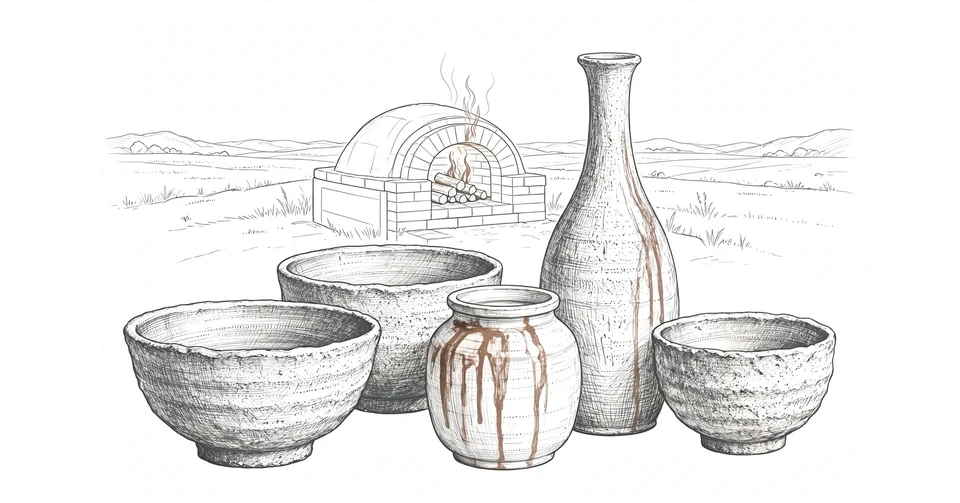
Once you know what to look for, a single cup starts to tell you a story. The red lines say straw was wrapped around it. The grey patches say it sat against the kiln wall. The speckles say ash rained down and melted where it landed. This article follows that story from the clay beds of Imbe to the long firing, the four named fire marks, the tea room, and the kitchen shelf, so you can choose a piece of Bizen ware with your eyes open and keep it for decades.
One of six kilns that never stopped
Bizen ware dates from around the end of the Heian period, in the late 12th century, though its roots reach further back. The Japan Heritage portal traces it to Sue ware made at Oku from the 5th century, with production moving to the Bizen area as the Heian period gave way to the Kamakura period. Scholars still argue about the exact start of Bizen ware, and one prefectural study weighs three proposed beginnings before settling for now on the late Heian, when potters began building many kilns around Imbe. Those first pots were grey, much like Sue ware, and the reddish brown most people picture today spread only in the 14th century.
For centuries the work was practical. Imbe made storage jars, crocks, and grinding mortars, and a saying quoted on the cooperative site runs, "Throw a Bizen mortar and it will not break." From the late 1500s, tea enthusiasts admired the plain, rustic look of Bizen ware, and flower vases and fresh water jars made Imbe one of Japan's leading centres of tea ware. In the Edo period, six potter families organised Bizen ware production around great shared kilns south, north, and west of Imbe, and the remains of those kilns can still be walked today at the Imbe Minami Ogama site, where the eastern kiln runs about 54 metres along the slope.
The lean years came with modernisation. Porcelain from Kyoto, Arita, and Seto pressed Bizen hard, and the Meiji to early Showa decades were thin, though the kiln fires never went out. The revival came in the early Showa period, when potters returned to the style of Momoyama era Ko-Bizen, old Bizen, and its leader Kaneshige Toyo became the first Bizen potter named a Living National Treasure in 1956. Four more followed, and Bizen ware became a national traditional craft in 1982. The group of six was named by the ceramics scholar Koyama Fujio around 1948 and recognised as Japan Heritage in 2017, which is why Bizen ware now sits on the same honours list as its old neighbours, including Shigaraki, the subject of an earlier story on this site.
How Bizen ware is made
Everything in Bizen ware starts with clay that only comes from here. Since the late Muromachi period, in the 1500s, the main material has been tatsuchi, an iron rich paddy field clay peculiar to the area, and the cooperative calls the local layer hiyose, a stratum that lies underground around Imbe. Only a few spots can be dug, and the clay is sticky and high in iron, so potters sometimes blend in mountain clay to suit a piece. The clay is not used as soon as it is dug. It is matured underground or in storage for several years, in some cases more than ten, and that long rest is said to bear directly on the quality of the finished piece. Trimmings and pieces that fail before firing can go back into the clay, so little is wasted, and the patience of Bizen ware starts long before the kiln is even lit.
The firing is where Bizen ware earns its name. Pieces are fired without glaze in a climbing kiln, a noborigama whose chambers link in steps up a slope, or in an anagama, a sloping kiln dug into the ground. The only fuel is split red pine, which is rich in resin, holds temperatures above 1,200 degrees Celsius, and drops ash rich in iron that melts at high temperature and settles on the ware as a natural glaze. A multi chamber climbing kiln fires for one to two weeks at 1,200 to 1,300 degrees Celsius, and a typical wood firing runs ten to fourteen days. One workshop, Shoen kiln, spends four days loading its climbing kiln and ten days firing it, feeding pine around the clock. Shorter routes to firing Bizen ware exist, and the cooperative says so plainly: combination kilns start on gas and finish on pine in two to three days, and electric and gas kilns are also used, though they cannot make every kiln effect, because there is no ash.
That length is the point. One potter often handles the whole cycle of packing, firing, and unpacking, and the period of managing the flame runs around the clock, work that has not been mechanised. A potter cannot rush a firing that lasts a fortnight, and cannot check the result until the kiln cools, which takes about three days. When the door finally opens, the pieces of Bizen ware inside have been decided by where each one sat, how the flame struck it, and how much ash fell on it. It is a slow way to make a cup, and that slowness is part of what you are buying when you buy Bizen ware.
Reading the fire marks
The colour changes on Bizen ware have a name, yohen, kiln change, and four of them appear so often that labels name them. Learning the four is the fastest way to read a piece of Bizen ware, and a detailed guide to reading them is kept by Awesome Tokyo Insider, which checked its account against the cooperative, the city, and the prefecture.
- Goma, sesame. Ash from the pine firewood settles on a piece of Bizen ware and melts into specks like sprinkled sesame, white, yellow, or other colours. Melted ash that runs is called tamadare, and some potters now apply ash before firing to get the look.
- Hidasuki, scarlet sash. Rice straw wrapped around a piece reacts with the iron in the clay and leaves red, brown, and vermilion lines on a pale body. The straw began as packing, placed between pieces to keep them from sticking together in the kiln, and the scarlet lines it left behind became a pattern in their own right.
- Sangiri. A piece set against the kiln wall is buried in ash, and the part shielded from the flame smokes to grey blue or blackish brown. Potters also produce it by throwing charcoal in at the end of the firing.
- Botamochi. Round patches left in the plain colour of the clay where small clay discs, called bota, sat on the surface during firing. The pale circles are the trace of how pieces were stacked and packed inside the kiln.
None of these patterns are drawn by hand, and that is the honest wonder of Bizen ware. The potter prepares the kiln and manages the flame, and the kiln decides the rest. Two bowls fired side by side can come out looking like strangers, and a single firing yields only a few pieces with the finest colours. That is why collectors talk about a piece being one of a kind without exaggerating: in this craft, it is literally true, and the price of a piece often follows the rarity of its firing marks rather than its size.
There is one more mark worth knowing, and it is the only one the potter makes on purpose. A potter seal is called a toin, and it is impressed on the foot of the piece. The cooperative in Imbe lists 134 members, and it publishes seal images in its artist directory, so a mark can be compared with the named maker entry rather than guessed at. A firing pattern is never a signature, and a seal on an old piece does not always name an artist either, since some catalogue entries record the ware and period without naming a maker. Reading Bizen ware means reading both kinds of mark, and knowing which one to trust.
Why tea masters chose it
The most important change in the history of Bizen ware came in the fifteenth and sixteenth centuries, when Sen no Rikyu, who perfected the way of tea, turned away from lavish gatherings decorated with Chinese imports and chose rough, unadorned ware instead. Bizen, with its clay texture and its expression born of the chance of flame, embodied wabi, the deep beauty residing in the plain and imperfect. An anecdote survives that Rikyu called Bizen sake ware the finest in the world, and whether or not he used those exact words, the direction of his taste is well recorded: the tea world valued Bizen ware from the late Muromachi period onward, and flower vases and water jars for tea became some of its most admired forms.
That history explains why Bizen ware still feels at home in a tea room. A tea bowl gains depth as tannin from tea soaks into the body, and a sake cup is said to soften the edge of the drink as the porous clay lets a little air through. The Japanese phrase for this slow change is often translated as growing your Bizen, and the idea is that a piece becomes yours alone over ten or twenty years of use, smoothing where your hand holds it and deepening in colour. It is a patient kind of luxury, the opposite of something bought to impress and then replaced.
I think that is the real test of any craft object: whether it gets better the more you live with it, instead of wearing out. Most things we buy do the opposite, and we accept it because replacement is cheap and attention is expensive. Bizen ware asks for the opposite bargain, a little care in exchange for a piece that deepens with you, and I find that trade honest. The same patience shows up in the tools around the tea itself, since a kyusu, the small side handled teapot behind a good cup of sencha, rewards the same slow attention, as I wrote in this story about the kyusu.
Living with a piece
Bizen ware is made for daily use, and the cooperative publishes simple rules for it. Wash a new piece with mild dish soap before its first use, and the same way after every use, then dry it thoroughly, since a piece left wet can develop mould and odours. With no glaze, the surface is not smooth, so set pieces on a cloth mat to protect tables and lacquered stands. Dipping a piece in water just before use and patting it lightly with a towel is said to bring out the colours, and the porous wall of a flower vase absorbs and releases water a little at a time, which is said to keep cut flowers longer.
One point deserves honesty rather than a firm rule. The cooperative says a piece can go in a microwave or dishwasher unless its maker says otherwise, but not in an oven, while another careful guide advises against both microwave and dishwasher altogether. The safe course is to ask the maker of your piece and follow that advice, because potters know their own clay and firing. Keep it out of the oven and off direct flame in any case, and heat warm sake in another vessel, then pour it into the Bizen ware flask.
Choosing well is mostly a matter of looking. Pick the fire mark you like, since no two pieces of Bizen ware match, and if the look of a long wood firing matters to you, ask how the piece was fired, because straw stripes and applied ash can also come out of an electric or gas kiln. Look for the impressed seal and compare it with the cooperative artist directory. At the festival, the tourism federation guide lists pieces from a few hundred yen, so a first piece need not be a grand purchase. For a fuller walk through the kiln effects and the wabi-sabi idea behind them, the guide published by Kyoto Nokaze is worth reading before you buy.
Visiting Imbe
The best way to understand Bizen ware is to stand where it is made. Imbe sits about 40 minutes by train from Okayama Station on the JR Ako Line, and kilns and galleries selling Bizen ware line the streets from the station. The Bizen City Museum of Art stands one minute from the station and presents contemporary ceramics centred on Bizen, while the cooperative shop at the station south exit sells work by member potters. The Imbe Minami Ogama kiln site, about ten minutes on foot, holds the remains of seven great shared kilns and a huge heap of broken pots and kiln tools, and the eastern kiln runs about 54 metres. The site belongs to a national historic site designated in 1959, and the kilns fell out of use at the end of the Edo period, when they no longer paid.
Time a visit for the Bizen Pottery Festival, held each October on the third Sunday and the Saturday before, when streets near the station become pedestrian only and more than 100 kilns take part together. It is the best chance to talk directly with makers and choose work in hand. Elsewhere in Bizen City, the Shizutani School, founded in 1670 under Ikeda Mitsumasa, has a lecture hall that is a National Treasure, and every roof tile on the school is Bizen ware, which is a quiet way of saying the craft once roofed the town as well as furnished its tables.
A quieter kind of beautiful
There is something steadying about a craft that refuses to hurry and refuses to decorate. Bizen ware does not try to be perfect, and it does not need to be. It trusts clay from one small place, fire fed for days, and the chance that falls between them, and the result is a cup that could not have been made anywhere else or twice the same way.
If you buy one piece of Bizen ware, buy it to use, not to display behind glass. Let tea darken it, let your hand smooth it, and let it grow into the shape of your days. The fire did the painting once, and the years you spend with it will finish the picture.
More in Culture & Society
- Ninja, the Shadow Warriors of Feudal Japan
- Japanese Haiku and the Seventeen Syllables That Hold a Season
- Shigaraki Ware Turns an Ancient Lake Bed Into Japan's Warmest Pottery
- Boro Turns Rags Into the Cloth Japan Refused to Throw Away
- Iga Ware Fires the Clay Pot That Holds Heat the Longest
- Sashiko Turns Mending Into the Most Beautiful Part of a Garment
Latest posts
- A Kamado Turned the Japanese Kitchen Into a Slow Oven
- The Japanese Alps and the Mountains at the Heart of Honshu
- Japanese Wagashi and the Sweets That Mark the Seasons
- Japanese Futon and the Art of Sleeping on the Floor
- A Hohin Is the Handleless Teapot Gyokuro Was Waiting For
- Mount Takao and the Day Trip Tokyo Takes When It Needs Air
- A Donabe Turns a Clay Pot Into Japan's Slowest and Warmest Way to Cook
- Warosoku Burns Brighter Because Its Wick Is Hollow
- A Shichirin Turns a Handful of Charcoal Into a Full Meal
- Japanese Chopsticks and the Quiet Rules Behind Every Meal
- A Tanzen Is the Full Length Robe Japan Wears Indoors in Deep Winter
- The Haze Tree Grows the Wax Behind Japan's Oldest Candles
- A Hanten Is the Winter Jacket Japan Wears to Work
- Haze Wax Keeps Japan's Oldest Candles Burning
- Furoshiki, the Japanese Cloth That Wraps Almost Anything