Japanese Haiku and the Seventeen Syllables That Hold a Season
· 13 min read
A Japanese haiku fits a whole season into seventeen syllables. This is how the form began, why Basho still defines it, and how to read one slowly.
A Japanese haiku is the shortest serious poem in the world, and it does not apologise for being short. Three lines, seventeen syllables, one image, and then silence. The first time I read one properly, I felt cheated. I had expected a poem to work harder for my attention. Then I read it again, and the image stayed with me for the rest of the day. That is the whole trick of the form. A Japanese haiku does not describe a feeling. It places one clear picture in front of you and trusts you to feel whatever follows.
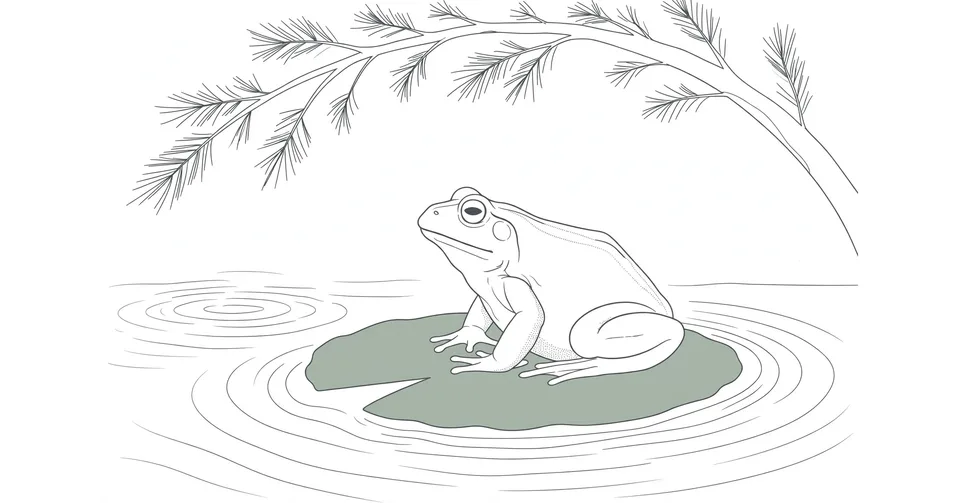
The form looks simple enough to write in a minute, and in a sense it is. Children in Japan write them at school. Office workers write them on the train. But the simplicity is earned, not accidental. Behind those seventeen syllables sit four hundred years of argument about what a poem should do, a handful of masters who rewrote the rules, and a discipline of looking closely that has very little to do with talent and everything to do with attention. This is the story of the Japanese haiku, from the drinking games of medieval courtiers to the classrooms and smartphones of today.
What a Japanese haiku actually is
A Japanese haiku is a poem of three lines with five, seven, and five syllables, seventeen in total. In Japanese the units are not quite syllables but mora, the small beats of sound in the language, so a strict count in English is always an approximation. The poem usually contains a season word, called a kigo, and a cutting word, called a kireji, that splits the poem into two parts. There is no rhyme, no title, and no explanation. The poem ends, and the reader does the rest.
The most famous example in the world belongs to Matsuo Basho, and it is about almost nothing. An old pond, a frog jumping in, the sound of water. That is the entire poem. Basho published it in 1686, when he was 42 years old, and it is still the first Japanese haiku most people meet. Its power comes from what it leaves out. There is no word for peace, no word for loneliness, no word for the passing of time. There is a pond, a frog, and a splash, and the silence that follows the splash does all the emotional work.
English readers sometimes treat the 5-7-5 pattern as a puzzle to solve, counting syllables on their fingers. That misses the point. The pattern is a frame, not the picture. A Japanese haiku can be shorter in English and still be a haiku, because Japanese mora and English syllables do not line up one to one. Many of the best English-language haiku have eleven or twelve syllables, not seventeen. What matters is the single image, the season, and the cut.
From renga to hokku, how the form broke free
The Japanese haiku did not appear out of nowhere. It grew out of renga, a linked-verse game in which poets took turns adding verses to a chain that could run to a hundred stanzas. The first verse of a renga, called the hokku, had a special job. It had to set the season, the place, and the mood for everything that followed, in just 5-7-5. Courtiers had been playing this game since at least the twelfth century, when the scholar-poet Fujiwara no Kiyosuke wrote about renga in 1157.
For centuries the hokku was only a beginning, never a poem on its own. Then, in the sixteenth and seventeenth centuries, poets began to notice that some opening verses were so complete that the chain behind them felt unnecessary. The hokku was quietly becoming a standalone form, first under the name haikai, a lighter and more playful kind of linked verse. The great age of the form, the period scholars still argue about, runs roughly from the 1670s to the 1780s, a little over a hundred years, and it produced the three names every student of the Japanese haiku still learns first.
Basho and the frog that changed poetry
Matsuo Basho was born in 1644, the son of a low-ranking samurai family, and he spent his early years writing the clever, funny linked verse that was fashionable in Edo, the city we now call Tokyo. In 1680 his students built him a small hut in Fukagawa and planted a banana tree beside it. Basho took his pen name from that tree. The word basho means banana plant, and the hut gave him the identity he carried for the rest of his life.
Basho changed the Japanese haiku by taking it seriously. Before him, the short verse was often a joke, a display of wit, a party trick. Basho treated the same seventeen syllables as a way of paying attention to the world, and he filled them with travel, loneliness, old age, and the changing seasons. His travel journal Oku no Hosomichi, usually translated as The Narrow Road to the Deep North, records a journey he made in 1689 through the north of Japan on foot, and it mixes prose with haiku in a form called haibun. The book was published after his death in 1702, and it is still in print in dozens of languages.
The frog poem is the one everyone quotes, but Basho wrote hundreds of others, many of them quieter and stranger. He wrote about the moon over a ruined castle, about a cicada crying into the rocks, about the summer grasses that now cover the dreams of warriors. His rule, if he had one, was to look until the looking itself became the poem. I find that idea comforting. It suggests that a Japanese haiku is not a gift for the talented but a practice for the patient, something anyone can attempt by standing still for a little longer than usual.
Buson, Issa, and the centuries after Basho
Basho died in 1694, and the Japanese haiku could easily have died with him. Instead it passed to a second generation that took it in new directions. Yosa Buson, born in 1716, was a painter as well as a poet, and his haiku read like small paintings, full of colour and movement. Where Basho was spare and still, Buson was vivid and romantic. Kobayashi Issa, born in 1763, went the other way. He wrote about frogs and fleas and sparrows, about poverty and the death of his children, in a plain voice that still feels shockingly modern.
Issa is probably the easiest of the old masters for a new reader to love. His poems are warm where Basho is cool, and he writes about small creatures with a sympathy that feels almost like a protest against a world that ignores them. One of his most loved poems simply watches a snail climbing Mount Fuji, slowly, and wishes it well. There is no grandeur in it, and that is the point. A Japanese haiku can hold a mountain and a snail in the same three lines and treat them as equals.
After Issa, the form went quiet for much of the nineteenth century. The old linked-verse schools had grown rigid, and the short poem had become a formula. It took a sick young critic from Matsuyama to rescue it.
Shiki renames the form
Masaoka Shiki was born in 1867, and he spent his short life, he died in 1902, arguing that the old poetry had gone stale. He gave the standalone 5-7-5 poem a new name, haiku, combining hokku with haikai, and he demanded a new method to go with it. His method was called shasei, sketching from life, and it asked poets to describe exactly what they saw, without decoration and without borrowing old phrases. A Japanese haiku, in Shiki's view, should be a sketch made with words, as direct as a drawing.
Shiki's reform worked. Newspapers began publishing haiku, ordinary readers began sending them in, and the form became something a whole country could practise, not just a circle of masters. His hometown of Matsuyama, on the island of Shikoku, still calls itself a haiku town, with haiku boxes on street corners where anyone can drop in a poem. That democratic streak is part of the reason the Japanese haiku travelled so well. It never belonged only to the educated. It belonged to anyone willing to look.
The two small tools inside every Japanese haiku
Two devices do most of the work inside a Japanese haiku, and both are worth knowing by name. The first is the kigo, the season word. A cherry blossom means spring, a cicada means summer, a persimmon means autumn, snow means winter. The kigo does more than set the calendar. It loads the poem with everything the reader already knows about that season, so the poet does not have to spell it out. A single word, snow, carries cold, silence, and the end of the year.
The second is the kireji, the cutting word. Japanese has a set of small particles that act like a cut in the poem, dividing it into two images that sit side by side without explanation. In English translation the cut is often shown with a dash or a colon, or simply with a line break. The cut is where the poem happens. One image on one side, one image on the other, and the reader's mind jumps the gap. That jump, that small shock of connection, is the pleasure of the form.
Together the kigo and the kireji explain why a Japanese haiku feels larger than its seventeen syllables. The season word brings a whole world in through the back door, and the cutting word makes the reader build the bridge between two pictures. The poet provides the materials. The reader provides the meaning.
How the Japanese haiku travelled the world
The Japanese haiku reached the West at the start of the twentieth century, carried by translators and by poets who were hungry for something shorter than the verse they had inherited. Ezra Pound read the form in 1913 and turned it into Imagism, the movement that shaped modern poetry in English. His two-line poem about faces in a Paris metro station, In a Station of the Metro, is a Japanese haiku in everything but name, and it is still anthologised as the moment English poetry learned to be brief.
From there the form spread everywhere. It is taught in schools on every continent, translated into dozens of languages, and written in forms the old masters would not recognise, including one-line haiku and haiku about city life, computers, and space travel. The Haiku Society of America was founded in 1968, and International Haiku Poetry Day is marked every year on April 17. Japan itself has never let go of the form either. Haiku contests fill newspapers, television shows judge celebrity haiku, and schoolchildren still learn to count 5-7-5 on their fingers.
The form's survival says something about why it works. A Japanese haiku is short enough to remember, open enough to belong to anyone, and strict enough to be a real discipline. It asks for attention rather than cleverness, and attention is something every reader can practise.
How to read one slowly
Reading a Japanese haiku well is a small skill, and it is mostly a matter of slowing down. Read the poem once, out loud if you can, and let the image form. Then read it again and notice the season word. What does that season carry for you. Then find the cut, the place where the poem turns, and sit in the gap between the two images for a moment. The feeling that arrives in that gap is the poem.
It helps to know that a Japanese haiku is not a riddle with one correct answer. Two readers can take different feelings from the same seventeen syllables, and both can be right. The poem is not a message in a bottle. It is a window, and what you see through it depends partly on where you are standing. That patience is the same quality the Japanese tea ceremony trains, one bowl of matcha at a time.
If you want a place to start, start with Basho's frog, then with Issa's snail, then with one of Buson's paintings in words. Three poems, three centuries of the form, and you will have a fair sense of what a Japanese haiku can do. The University of Oregon has a free introductory lesson on the history of the form that walks through renga, Basho, and Shiki in plain language, and the EBSCO research starter on haiku gives a careful account of the same history with a bibliography for readers who want to go further.
How to try writing one
Writing a Japanese haiku is a good way to understand it, and the rules for a first attempt are forgiving. Go outside, or look out of a window, and find one thing that is actually happening. A bird on a wire, rain on a bicycle seat, steam from a cup. Count roughly five, seven, and five syllables, but do not worry if the count is off by one or two. Put a season word in somewhere, even a small one, like cold or blossom or dusk. Then cut the poem in two, so that the last line lands as a surprise rather than a summary.
The hardest part is the last one. Beginners tend to explain their poem in the third line, adding a little moral or a neat conclusion. A Japanese haiku works better when the third line is an image, not a verdict. Show the thing, then stop. The reader will do the rest, and the poem will be better for their help.
I wrote a few bad ones while researching this article, and I will spare you the worst of them. What I kept was the habit, not the poems. Looking for a haiku makes an ordinary walk into a small hunt, and the hunt makes the walk longer and stranger than it would have been. That is a fair trade for seventeen syllables.
The season fits in seventeen syllables
Four hundred years after Basho planted his banana tree, the Japanese haiku is still the same bargain it always was. Seventeen syllables, one season, one clear image, and a silence the reader fills. The form has survived translation into dozens of languages, a world war, the arrival of television, and the arrival of the smartphone, because it asks so little and gives so much. It asks you to look, and it gives you a reason to look again.
If you have never read one outside a classroom, try one tonight. Read it twice, slowly, and let the image stay with you until morning. A Japanese haiku does not shout for your attention. It waits, quietly, for you to notice it. That patience is the whole art, and it is still working, four centuries later, one small poem at a time.
More in Culture & Society
- Shigaraki Ware Turns an Ancient Lake Bed Into Japan's Warmest Pottery
- Boro Turns Rags Into the Cloth Japan Refused to Throw Away
- Iga Ware Fires the Clay Pot That Holds Heat the Longest
- Sashiko Turns Mending Into the Most Beautiful Part of a Garment
- Warosoku Burns Brighter Because Its Wick Is Hollow
- Japanese Chopsticks and the Quiet Rules Behind Every Meal
Latest posts
- Japanese Wagashi and the Sweets That Mark the Seasons
- Japanese Futon and the Art of Sleeping on the Floor
- A Hohin Is the Handleless Teapot Gyokuro Was Waiting For
- Mount Takao and the Day Trip Tokyo Takes When It Needs Air
- A Donabe Turns a Clay Pot Into Japan's Slowest and Warmest Way to Cook
- A Shichirin Turns a Handful of Charcoal Into a Full Meal
- A Tanzen Is the Full Length Robe Japan Wears Indoors in Deep Winter
- The Haze Tree Grows the Wax Behind Japan's Oldest Candles
- A Hanten Is the Winter Jacket Japan Wears to Work
- Haze Wax Keeps Japan's Oldest Candles Burning
- Furoshiki, the Japanese Cloth That Wraps Almost Anything
- Japanese Candles Are Still Rolled by Hand in Japan
- Ubame Oak Is the Tree That Turns Into White Charcoal
- Binchotan Is the Charcoal That Made the Hibachi Possible
- Igusa Is the Humble Grass Under Every Tatami Mat