Judo, the Gentle Way Japan Gave the World
· 11 min read
Judo began in 1882 as one small dojo in Tokyo and became the first martial art in the Olympics. This is how Jigoro Kano turned yielding into a world sport.
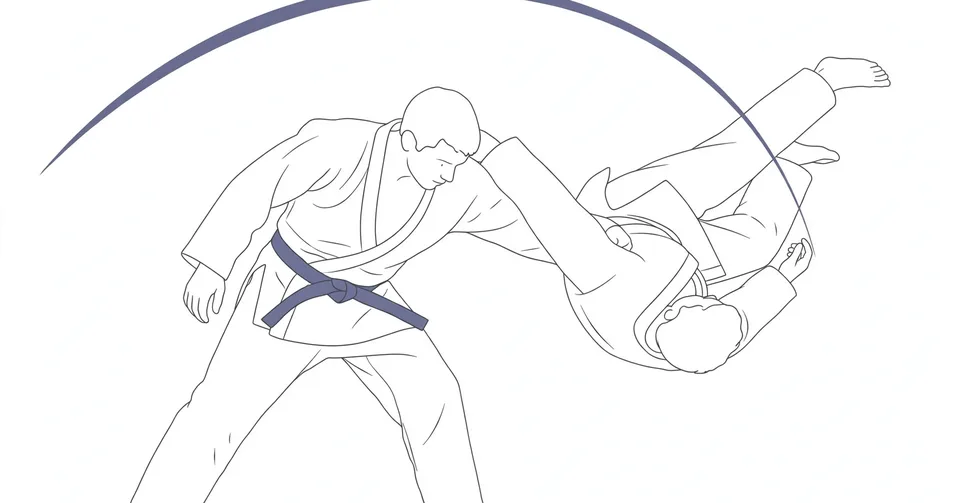
It looks like a fight, but its founder designed it as the opposite of one. In May 1882, a 22-year-old teacher named Jigoro Kano opened a tiny dojo in a Buddhist temple in Tokyo, with nine students and twelve tatami mats, and called what he taught judo, the gentle way. He had taken the old battlefield art of jujutsu, removed the strikes that made it impossible to practice safely, and kept the throws and holds that two people could train at full effort without injuring each other.
That small change remade a martial art into a system of education, and then into a world sport. It entered the Olympics at Tokyo in 1964, the first martial art ever included in the Games, and today the International Judo Federation counts more than 200 national federations. The gentle way turned out to be the most exportable idea Japan ever put on a mat.
Kano did not start from strength. He started it from weakness, and that is the whole point of the art. Born on 28 October 1860 in Mikage, near Kobe, he was small even by the standards of his time, about 5 feet 2 inches tall and 41 kilograms, and he was bullied at school. He took up jujutsu to defend himself, studying several old schools, and he was good enough at it to notice something his teachers had not fixed. The old techniques worked, but they were so dangerous that students could only rehearse them slowly, with a cooperative partner. Nobody could really test them.
Kano was a teacher by profession, and he thought like one. If a technique cannot be practiced at full resistance, he reasoned, students can never be sure it works, and they can never improve it. So he rebuilt the art around a different question. Not how to hurt an attacker, but how to use an attacker's force against them, with the least effort and the least harm. The name says it plainly. Ju means gentle, or yielding. Do means way. Judo is the gentle way, and the gentleness is not decoration. It is the method.
A small dojo above a temple
The first Kodokan, the place for studying the way, opened in 1882 in the Eishoji Temple in Tokyo. Twelve mats, nine students, one 22-year-old teacher. Kano was not a famous fighter. He was a young graduate who had just been appointed a teacher at the Gakushuin, the Peers School, and he ran his dojo in the evenings. Within four years, his students proved the system in public. In 1886, the Tokyo Metropolitan Police organized a tournament between martial arts schools, and the Kodokan team beat the older jujutsu schools. The police took notice, and the art began its long move from temple rooms into schools, police academies, and universities.
Kano organized what he taught with a teacher's care. In 1895 he classified the throws into the Go Kyo no Waza, five sets of techniques arranged from the simplest to the hardest, so a student could learn in order instead of by accident. In 1909, the Kodokan became an official foundation, and in the same year Kano became the first Asian member of the International Olympic Committee. He opened a women's section at the Kodokan in 1923, which was unusual for a martial art of that era, and he organized the first All Japan Judo Championships in 1930. He died in 1938, of pneumonia aboard the ship Hikawa Maru, before he ever saw the art in the Olympics. The dream was his, but the realization came later, and that feels fitting for a man who thought in generations rather than seasons.
Two principles that still hang on dojo walls
Every dojo in the world still recites Kano's two principles, and they explain why judo spread further than any other Japanese martial art. The first is seiryoku zenyo, maximum efficiency with minimum effort. A smaller person does not beat a larger person by pushing harder. They beat them by moving at the right moment, by breaking balance first and throwing second. The second is jita kyoei, mutual welfare and benefit. You cannot learn it alone. You need a partner who trusts you enough to be thrown, and you owe that partner the same care. The art only works if both people get better.
That second principle is the reason the art fits in schools. Kano wanted it taught as physical, intellectual, and moral education, not as a way to win street fights. When I watch a class today, what strikes me is not the throws, it is the bowing. Students bow to the mat, to the teacher, and to each other, before and after every practice. The ritual looks old fashioned until you realize it is the safety system. A partner who respects you will not crank your arm past the point of pain, and you learn to trust the person who is about to throw you to the floor. Compared with the shouting and showmanship of some combat sports, judo has a quiet confidence that I find more convincing than any highlight reel.
Kano also gave the world something every martial art now copies without thinking about it. He invented the system of kyu grades for students and dan grades for experts, marked by belt colors, so that a beginner and a master could be told apart at a glance and a student could see a path forward. The white belt to black belt ladder now feels like it has always existed. It has not. It is Kano's design, and it traveled with the sport to every country that adopted the sport.
How the gentle way became an Olympic sport
Getting the art into the Olympics was Kano's lifelong campaign, and the Games were its final step. The International Judo Federation was founded in 1951, and Kano's old dream of Olympic recognition moved from wish to negotiation. In 1964, when Tokyo hosted the Games for the first time, it entered the Olympic program as the first martial art in modern Olympic history. There were four men's weight categories, 74 athletes from 27 nations, and Japan was expected to win everything. Japan won three of the four gold medals. The fourth went to Anton Geesink of the Netherlands, a giant of a man who won the open category and ended the assumption that the art belonged only to Japan. It was the best thing that could have happened to the sport. Geesink's win proved that judo was not a Japanese secret. It was a system anyone could learn, and anyone could master.
Women's competition took longer to reach the same stage, which is a fair criticism of the sport's history. Women had trained at the Kodokan since 1923, and women's world championships began in 1980, but women's competition only became an official Olympic sport at Barcelona in 1992. Since then the women's events have produced some of the sport's most famous champions, and in Japan, the women's game is now as prominent as the men's game. The delay is part of the story, not a footnote to hide. Judo likes to present itself as a philosophy of equality, and its own history shows how slowly that philosophy was applied.
Judo at a glance
| Fact | Detail |
|---|---|
| Founded | May 1882, Tokyo |
| Founder | Jigoro Kano (1860 to 1938) |
| First dojo | Eishoji Temple, 9 students, 12 mats |
| Meaning | Ju, gentle or yielding, plus do, way |
| Principles | Seiryoku zenyo and jita kyoei |
| Olympic debut | Tokyo 1964, men; Barcelona 1992, women |
| Governing body | International Judo Federation, founded 1951 |
| National federations | More than 200 |
The table makes judo look tidy, but the practice of it is anything but tidy. A match lasts four minutes, and a single clean throw can end it in a second. The scoring has changed over the years, and purists still argue about the rule changes, especially the bans on leg grabs and the shortening of golden score overtime. But the core of the contest has not changed since 1882. Two people in white uniforms grip each other, each trying to break the other's balance, and the one who moves with the force instead of against it usually wins. If you have ever watched a small judoka throw a much larger opponent with what looks like no effort at all, you have seen seiryoku zenyo working in real time.
Why judo traveled further than sumo or kendo
Japan has older fighting traditions than judo. Sumo is more than a thousand years old, and kendo, the way of the sword, carries the spirit of the samurai. Both are magnificent, and both are harder to export. Sumo needs a stable, a ring of clay, and a lifetime of total commitment. Kendo needs armor and a bamboo sword and years of practice before a beginner can spar properly. Judo needs a mat, a uniform, and a partner. That simplicity is why it reached schools and police academies and community centers on every continent while sumo stayed mostly in Japan.
There is also a philosophical reason. Sumo and kendo are rooted in ritual and hierarchy in ways that can feel closed to outsiders. Judo was designed from the start to be taught, graded, and spread. Kano was an educator who served on the Olympic committee and traveled the world promoting his art. He wanted judo in schools because he believed falling safely, respecting a partner, and losing gracefully were lessons worth teaching to children. The Kodokan in Tokyo still functions as the world headquarters of the sport, and its seven story building draws judoka from everywhere, but the real headquarters of judo is every school gym where a child learns to fall without fear.
Watching judo as a visitor in Japan
If you visit Japan, the easiest way to see it is not at the Kodokan, though the Kodokan does welcome visitors to watch practice. It is at a local tournament or a school sports day, where the crowd is mostly parents and the matches are short and fierce. A few things are worth knowing before you go. The white uniform is called a judogi. The bow at the start is not a formality, it is a promise that both fighters will look after each other. A throw that lands an opponent flat on their back scores ippon and ends the match at once, which is why a judo contest can be over in ten seconds after three minutes of careful circling. And the sound of a clean throw, a body hitting the mat with a deep thud, is one of the most satisfying sounds in all of sport.
What I like most about watching judo is how quiet the crowd stays during the gripping exchanges. There is no music, no announcer shouting, no dancing. Just two people trying to solve each other. It reminds me of ikigai, the Japanese idea of a reason to live, in the sense that judo gives its practitioners a discipline that fills ordinary days with purpose, without needing an audience. The best judoka I have seen were not the loudest athletes in the room. They were the calmest.
Judo's story is ultimately the story of a small man who refused to accept that size decides everything. Kano took a battlefield art, removed its cruelty, organized it like a school subject, and gave it to the world with two principles that sound almost naive until you watch them work. Yield, and you win. Help your partner, and you both improve. The gentle way has now been practiced for more than 140 years, in more than 200 countries, by millions of people who have never been to Japan. That is a strange and wonderful legacy for twelve mats in a Tokyo temple. The next time you see two judoka bow to each other before a match, remember what that bow means. It is not a greeting. It is the whole philosophy, performed in a single gesture.
More in Culture & Society
- Matsumoto Temari Turns Mountain Cocoons Into Wishes You Can Hold
- Nambu Tekki Is the Iron That Outlasted the Lords Who Ordered It
- Temari Is the Embroidered Ball Japan Gives for Good Luck
- A Tetsubin Turns Iron and Fire Into Japan's Slowest Kettle
- Ninja, the Shadow Warriors of Feudal Japan
- Bizen Ware Lets the Fire Do the Painting
Latest posts
- Lake Toba and the Supervolcano That Made the World's Largest Volcanic Lake
- Raja Ampat and the Coral Kingdom at the Edge of Indonesia
- Tokyo Skytree and How Japan Built the World's Tallest Tower
- Forest Bathing in Japan, the Quiet Science of Shinrin-Yoku
- Tokyo Tower and the Orange Giant That Refused to Be Replaced
- Emoji, the Tiny Pictures Japan Gave the World
- Hakone and the Hot Spring Town Below Mount Fuji
- A Kamado Turned the Japanese Kitchen Into a Slow Oven
- The Japanese Alps and the Mountains at the Heart of Honshu
- Japanese Haiku and the Seventeen Syllables That Hold a Season
- Japanese Wagashi and the Sweets That Mark the Seasons
- Japanese Futon and the Art of Sleeping on the Floor
- A Hohin Is the Handleless Teapot Gyokuro Was Waiting For
- Shigaraki Ware Turns an Ancient Lake Bed Into Japan's Warmest Pottery
- Boro Turns Rags Into the Cloth Japan Refused to Throw Away