Tokyo Skytree and How Japan Built the World's Tallest Tower
· 11 min read
Tokyo Skytree stands 634 metres over eastern Tokyo, a broadcasting tower that became the city's second skyline. Here is why it is exactly 634 metres tall, what the two observation decks offer, and how to visit.
Tokyo Skytree is the first thing you notice from almost anywhere in eastern Tokyo, and the last thing you forget. At 634 metres it is nearly twice as tall as Tokyo Tower, and on a clear winter morning you can see it from train windows twenty kilometres away, a pale needle standing over the low roofs of Sumida ward. It looks like a monument. It was built to carry television signals.
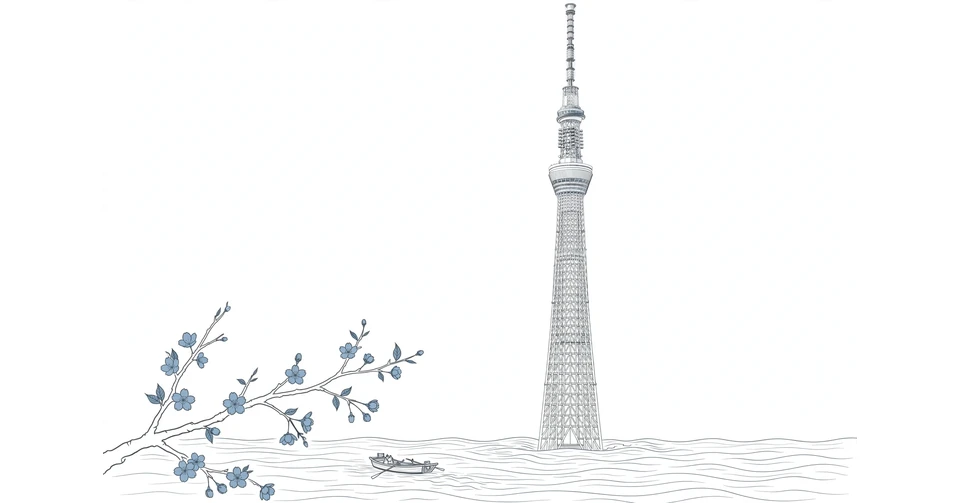
The tower opened to the public on 22 May 2012, and it solved a practical problem before it became a postcard. Tokyo Tower, the orange landmark built in 1958, stands 333 metres tall. By the 2000s it was surrounded by office towers of two hundred metres and more, and its broadcast antennas could no longer reach every home in the region cleanly. Japan was also switching fully to digital terrestrial television, which needs a clear line of sight. The answer was a new tower, taller than anything in the country, placed on the east side of the Sumida River in Oshiage, where the ground was open and the signal could spread. Tokyo Skytree is, at heart, a piece of infrastructure that happens to be beautiful.
That double identity is what makes Tokyo Skytree worth a visit rather than a glance. It is a working broadcast mast, a feat of earthquake engineering, and one of the best viewpoints in the largest city on earth, all in the same structure. Go for the view, but stay for the story of why it stands where it does and why it is exactly as tall as it is.
Why 634 metres
The height of Tokyo Skytree is not an accident, and it is not a round number. It is 634 metres because 6, 3 and 4 can be read in Japanese as mu, sa and shi, spelling Musashi, the old name of the province that covered what is now Tokyo and its surroundings. The designers picked a height that would carry a piece of history with it, and the number stuck. When Guinness World Records certified the tower on 17 November 2011, it called Tokyo Skytree the tallest tower in the world, a title it still holds. The only taller structures on earth are skyscrapers, led by the Burj Khalifa in Dubai, which are buildings rather than towers.
Construction began on 14 July 2008, designed by the architectural firm Nikken Sekkei. The tower rose fast. On 11 March 2011, when the great earthquake struck northeastern Japan, Tokyo Skytree was already nearly complete, and it suffered no structural damage, a first real world test of the engineering inside it. A week later, on 18 March 2011, workers topped it out at its full height of 634 metres. The tower was completed on 29 February 2012, and the Tokyo Skytree Town complex around its base opened with the tower itself on 22 May 2012. On opening day tens of thousands of people came even though it rained, and in the first weeks some visitors reportedly waited for hours, and a few for days, to get a ticket.
The height matters for broadcasting, which is still the tower's real job. Its antennas carry digital television and radio for the Tokyo region, and the extra three hundred metres over Tokyo Tower is what clears the modern skyline. Tokyo Tower did not retire, it still broadcasts and still draws crowds, but the heavy lifting moved east. If you have read about Tokyo Tower, the orange giant that refused to be replaced, think of Tokyo Skytree as its younger colleague rather than its replacement: one is a symbol of postwar recovery, the other is a symbol of a city that keeps rebuilding itself upward.
Two decks above the city
Tokyo Skytree has two observation levels, and they feel like two different visits. The lower one is the Tembo Deck at 350 metres, spread over three floors at 340, 345 and 350 metres. Floor 350 is a full circle of glass more than five metres high, with the Skytree Cafe, which the operator calls the highest cafe in Japan, and the Skytree Round Theater, a curved screen that plays panoramic films of the city. On floor 340 there is a section of glass floor, a small square of transparency that turns even confident visitors into careful steppers. The lift from the ground takes about fifty seconds, fast enough that your ears notice.
The upper level is the Tembo Galleria at 450 metres, a sloping glass tube that winds gently upward from floor 445 to floor 450, ending at Sorakara Point, 451.2 metres above the ground, the highest place a visitor can stand in the tower. The Galleria is quieter than the Deck, and the view is different in kind rather than degree. From 350 metres you can pick out streets and trains. From 450 metres Tokyo stops looking like a city and starts looking like a map, a grey and green plain that runs to the horizon in every direction. On a clear day, especially in winter when the air is dry, Mount Fuji is visible to the west, a small blue triangle floating above the sprawl. If you have ever read about climbing Mount Fuji, Japan's sacred peak, seeing it from Tokyo Skytree is a strange reversal: the mountain you would normally climb is suddenly a distant decoration on the skyline.
Tickets are sold as timed entries, and the two levels are priced separately. A ticket for the Tembo Deck starts from 1,800 yen for an adult, and the Tembo Galleria can be added for about 1,400 yen more, bought from machines inside the Tembo Deck on the day. Prices vary by day of the week and by time, and weekends and holidays cost more, so the cheapest way to go is a weekday morning booked in advance on the official ticket website. Foreign visitors can also buy a Skytree Fast Ticket, which skips the regular queue. The tower is open late, and the evening view is a different attraction entirely, when the city lights come on in a grid that stretches further than the eye can follow.
The pagoda inside the steel
What I like most about Tokyo Skytree is not its height but the way it was built. The tower's earthquake resistance borrows directly from Japan's oldest wooden architecture. At its centre runs a concrete column called the shinbashira, named after the central pillar of a five story pagoda. In a pagoda, the shinbashira stands free of the surrounding structure and sways independently during an earthquake, damping the shaking. Tokyo Skytree copies the idea at a scale no pagoda ever approached: the central column is connected to the outer steel frame by oil dampers, so the two parts move differently and absorb each other's energy. It is a thousand year old idea, rebuilt in steel and concrete for a 634 metre tower.
The shape carries the same thinking. The base of Tokyo Skytree is a triangle, which gives it a wide, stable footprint on the ground, and the tower curves gently upward until it becomes a circle at the top, the most efficient shape for a broadcast mast. The curve is not decoration, it is structure, and it is also a reference to the gentle inward slope of a Japanese sword and the silhouette of a pagoda roof. The steel is painted in a pale blue white the operator calls Skytree White, chosen after the designers studied how the tower would look against Tokyo's sky in different seasons.
At night the tower is lit in three rotating patterns: Miyabi, a deep purple that suggests elegance, Iki, a pale blue that suggests chic restraint, and Nobori, an orange that suggests a rising spirit. Special lightings appear for festivals, seasons and events, and the tower has become a kind of civic noticeboard in light. When you see it from across the river at dusk, the colour tells you something about the week, even before you check a calendar.
The town at its feet
Tokyo Skytree does not stand alone. Its base is the Tokyo Skytree Town complex, a shopping and leisure district called Tokyo Solamachi, with more than three hundred shops and restaurants, an aquarium, and a planetarium. The complex sits on the Tobu Skytree Line, and the nearest stations are Tokyo Skytree Station and Oshiage Station, both a few minutes on foot from the tower. Across the Sumida River lies Asakusa, with its Senso-ji temple and old shopping streets, about a twenty minute walk across the Sumida River Walk bridge, or one stop on the train. Pairing the two makes the best half day in eastern Tokyo: the old city in the morning, the new tower in the afternoon, and the river between them.
That pairing is also the honest way to judge Tokyo Skytree. On its own, a tower is a tower, and the observation decks of the world start to look alike after the third one. What makes this one different is the neighbourhood it anchors. Sumida was a working class district of small factories and canals long before the tower arrived, and the streets around it still feel like that, with old tofu shops and metal workshops a few minutes from a global landmark. The tower brought crowds and money, but it did not erase the district, and walking the back streets after coming down from 450 metres is the part of the visit I remember most clearly. The view from the top shows you the scale of Tokyo. The streets below show you its texture.
For a sense of how the city looks from its most famous ground level crossing, compare the panorama from Tokyo Skytree with the human tide at Shibuya Crossing, the busiest intersection on earth. From the tower you see the city as a system. From Shibuya you feel it as a crowd. Both are true, and neither makes sense without the other.
Is Tokyo Skytree worth it
The fair answer is yes, with one condition. Go on a clear day, and go early or late. A weekday morning gives you the shortest queues and the clearest air, and the late afternoon gives you the sunset and the lights coming on, which is the best single hour the tower offers. A cloudy day is still pleasant, the decks are indoors and the town below is worth the trip, but the main thing you are paying for is the view, and clouds charge full price for half the product. Check the visibility forecast, not just the rain forecast, and if the sky is grey, spend the day in Asakusa and come back tomorrow.
There is also a simpler reason to go. Tokyo Skytree is the rare landmark that rewards the effort of understanding it. Knowing that 634 spells Musashi, that the tower copies a pagoda's spine, and that it exists because television signals could not clear the new skyline turns a tall building into a story about a city solving a problem the way it always has, by borrowing from its past and building higher than before. I went up expecting a view. I came down thinking about a thousand years of Japanese engineering, compressed into a single tower over the Sumida River. That is a good trade for 1,800 yen.
Practical notes for a first visit
A few details are worth knowing before you go. Book online in advance for the best price and a guaranteed entry time, and arrive a little early, since security and the lift queue take time even with a timed ticket. The Tembo Deck ticket is the essential one, and the Galleria is worth adding if the sky is clear, since the difference between 350 and 450 metres is real. If you only have time for one level, pick the Deck, which has the cafe, the glass floor and the full circle of windows. Bring a light jacket even in summer, since the decks are air conditioned and the wind at the top is stronger than at street level. And leave an hour after the tower for Solamachi and the walk to Asakusa, because the town at the foot of Tokyo Skytree is half the visit, and the river walk at dusk is the best free view in the area.
More in Food & Travel
- Tokyo Tower and the Orange Giant That Refused to Be Replaced
- Hakone and the Hot Spring Town Below Mount Fuji
- The Japanese Alps and the Mountains at the Heart of Honshu
- Japanese Wagashi and the Sweets That Mark the Seasons
- A Hohin Is the Handleless Teapot Gyokuro Was Waiting For
- Mount Takao and the Day Trip Tokyo Takes When It Needs Air
Latest posts
- Matsumoto Temari Turns Mountain Cocoons Into Wishes You Can Hold
- Nambu Tekki Is the Iron That Outlasted the Lords Who Ordered It
- Forest Bathing in Japan, the Quiet Science of Shinrin-Yoku
- Emoji, the Tiny Pictures Japan Gave the World
- Temari Is the Embroidered Ball Japan Gives for Good Luck
- A Tetsubin Turns Iron and Fire Into Japan's Slowest Kettle
- Ninja, the Shadow Warriors of Feudal Japan
- A Kamado Turned the Japanese Kitchen Into a Slow Oven
- Bizen Ware Lets the Fire Do the Painting
- Japanese Haiku and the Seventeen Syllables That Hold a Season
- Japanese Futon and the Art of Sleeping on the Floor
- Shigaraki Ware Turns an Ancient Lake Bed Into Japan's Warmest Pottery
- Boro Turns Rags Into the Cloth Japan Refused to Throw Away
- Iga Ware Fires the Clay Pot That Holds Heat the Longest
- A Donabe Turns a Clay Pot Into Japan's Slowest and Warmest Way to Cook