Hakone and the Hot Spring Town Below Mount Fuji
· 11 min read
Hakone packs a volcanic valley, a caldera lake, a shrine in the water, and a hillside of sculpture into one loop 90 minutes from Tokyo, and this guide covers the route, the costs, and the best seasons to go.
Tokyo has a pressure valve, and its name is Hakone. When the city gets too loud, too crowded, or too grey, people board a train at Shinjuku and ninety minutes later they are standing in sulphur steam with Mount Fuji on the horizon. The town is not one attraction. It is a whole mountain town built around a single loop of trains, cable cars, a ropeway, and a boat, and the loop itself is the experience.
The town sits inside a volcanic caldera in Kanagawa Prefecture, on the western edge of the Fuji-Hakone-Izu National Park. The town grew up around hot springs that have drawn visitors since the Nara period, and the old Tokaido road between Edo and Kyoto once passed right through it, with a checkpoint that inspected every traveller. Today the checkpoint is a museum, the road is a cedar lined avenue, and the springs still do what they have always done.
What makes this valley different from other mountain escapes is how neatly it is put together. The classic route is a circle. You ride a mountain railway up from Hakone-Yumoto, change to a cable car, cross a volcanic valley by ropeway, sail across a lake on a boat shaped like a pirate ship, and ride a bus back down to Yumoto, where you started. Between the rides sit an open air sculpture park, a shrine with a red gate standing in the water, and more baths than one weekend can hold.
The Loop That Holds Hakone Together
The loop starts at Hakone-Yumoto, the gateway station at the foot of the mountains. From here the Hakone Tozan Railway climbs to Gora in about 35 minutes, winding through three switchbacks that let the train gain height on a steep slope. In June the trackside is lined with hydrangeas, and the railway runs a special evening service so passengers can see the flowers lit up after dark.
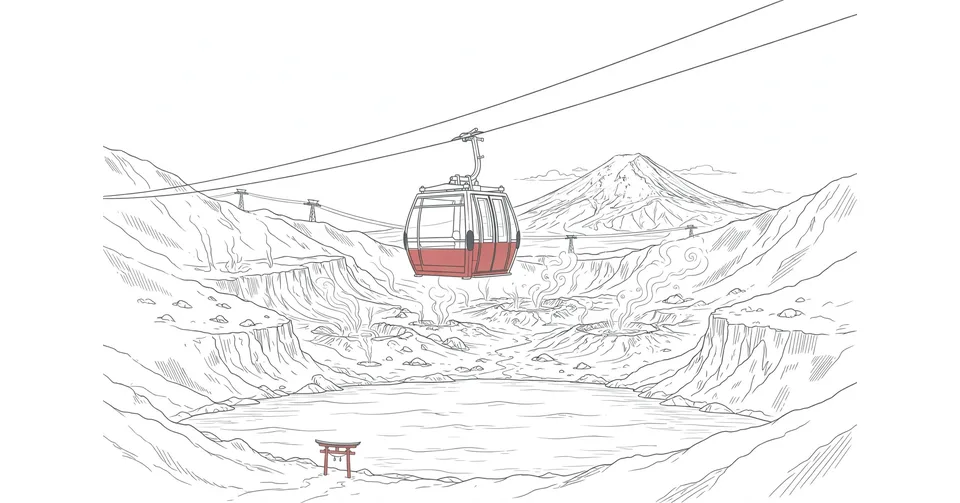
At Gora you change to the cable car up to Sounzan, then to the Hakone Ropeway, the long gondola ride that defines the whole trip. The ropeway runs about four kilometres from Sounzan to Togendai on the lake, in three sections of roughly ten minutes each. The middle stop is Owakudani, a volcanic valley where the ground steams and the air smells of sulphur. On a clear morning Mount Fuji appears on the Togendai side of the crossing, framed by the crater landscape.
Two maintenance closures are scheduled this winter, and they are worth knowing before you plan. The ropeway is closed between Owakudani and Sounzan from 7 to 24 December 2026, and between Togendai and Owakudani from 12 January to 26 February 2027, with replacement buses running. The ropeway also stops at short notice in high wind or when volcanic gas rises, so check the status on the morning of your trip.
The last leg of the loop is the boat. Sightseeing cruise ships styled like old galleons cross Lake Ashi between Togendai, Hakone-machi, and Moto-Hakone in 25 to 40 minutes, running every 30 to 40 minutes through the day. A bus from Moto-Hakone completes the circle back to Hakone-Yumoto. The whole loop can be done in a day, but it is a long day, and the town rewards the people who stay the night.
A Volcano You Can Stand In
Owakudani is the reason the ropeway exists. The valley sits on the slopes of Mount Kamiyama, the central cone inside the caldera, and it is still venting. Bare yellow ground, hissing fumaroles, and a smell that hits you the moment the gondola doors open make it the most dramatic stop on the loop. The caldera itself formed about 3,000 years ago, when an eruption dammed the valley that became Lake Ashi.
The local ritual here is the black egg. Eggs boiled in the hot spring water come out with black shells, and the legend says eating one adds seven years to your life. A bag costs about 500 yen, and the queue at the stall is usually the longest one in the valley. The eggs are ordinary inside, which is part of the charm. The story is the souvenir.
Owakudani is also the place where the valley reminds you that it is a living volcano. The area has closed before when gas levels rose, and the ropeway operators watch the readings every day. That is not a reason to stay away. It is a reason to respect the signs, keep to the paths, and check conditions before you go, the way you would with any mountain weather.
The Lake and the Shrine in the Water
Lake Ashi is the centrepiece of the town, and on a clear morning it is one of the most photographed views in Japan. Mount Fuji rises beyond the northwestern shore, and the red gate of Hakone Shrine stands in the water at Moto-Hakone. The lake is a caldera lake, and the boats that cross it are deliberately theatrical, with galleon styling that looks faintly absurd until you are on deck with the wind and the mountains around you.
Hakone Shrine was founded in 757 on the slope above the lake, reached by a stone stair through a cedar forest. The red gate standing in the water below, the Heiwa no Torii, went up in 1952 and now draws a long queue of photographers every morning. Go early if you want the gate without a crowd. Beside the main shrine sits Kuzuryu Shrine, which honours the nine headed dragon said to live in the lake.
From the shrine, the old Tokaido road runs through a cedar avenue called Suginamiki, and a short walk away stands the Hakone Checkpoint, the Sekisho, where Edo period officials inspected travellers and goods on the road between Edo and Kyoto. The checkpoint buildings are reconstructions, but they are careful ones, and walking through them makes the history of the road feel concrete in a way a plaque never does. If you have already read about climbing Mount Fuji, the shrine and the checkpoint give the mountain a human scale: this was the road pilgrims and travellers actually walked.
Art on a Hillside
The town is not only steam and water. The Hakone Open-Air Museum has stood on a hillside near Gora since 1969, spreading sculpture across 70,000 square metres of lawn and woodland. The collection includes a Picasso Pavilion and works by Henry Moore and Rodin, plus a stained glass tower you can climb inside. Admission is about 1,600 to 2,000 yen for adults, with a small discount for tickets bought online, and the museum is open every day from 9 in the morning to 5 in the afternoon.
The Pola Museum of Art, a short bus ride away in Sengokuhara, keeps its collection underground in a building designed to disappear into the forest, and the Hakone Venetian Glass Museum brings a small piece of Murano to the mountains. Both are quieter than the open air museum, and both are good shelter on a rainy afternoon, which Hakone has plenty of.
Art fits here because this valley has always been a place people came to look slowly. The gardens, the steam, and the lake all reward the same patience a sculpture park does. Two hours at the open air museum is about right. Less than that and you are rushing past work that was placed to be walked around, not glanced at.
The Baths That Started It All
Everything here comes back to the water. The hot springs at Hakone-Yumoto have been used for more than a thousand years, and the town at the foot of the mountains is still a cluster of inns, bathhouses, and souvenir shops built around them. Many ryokan open their baths to day visitors for a fee, and several public baths in Yumoto let you soak without booking a room. If you want the full experience, stay the night in a ryokan with an open air bath and a kaiseki dinner, and let the loop wait until morning.
The etiquette is the same as at any onsen in Japan: wash thoroughly before you enter the bath, keep your towel out of the water, and do not wear swimwear. If you are new to the ritual, the guide to why Japan's hot springs are a way of life covers the rules in detail. The one extra thing worth knowing here is that the water varies by spring. Some baths are clear and gentle, others are milky or faintly sulphurous, and the inns will usually tell you what their water is good for.
My own view is that the bath is the part of the town most visitors undervalue. The loop is spectacular, but it is also a queue, a timetable, and a crowd. The bath is the opposite. It is the one hour of the day when nothing is asked of you, and it is the reason people have been coming to this valley for a thousand years. A day trip gives you the loop. A night gives you Hakone.
When to Go and What It Costs
The town is a year round destination, but the seasons change it completely. October to February gives the clearest Fuji views, because the air is cold and dry. November brings autumn leaves to the maples around the lake and the temples, and the pampas grass fields of Sengokuhara turn silver from mid October to mid November. June is hydrangea season along the mountain railway, and summer is green and busy, with cooler air than Tokyo and frequent afternoon rain.
The most useful single purchase is the Hakone Free Pass from Odakyu. From Shinjuku it costs 7,100 yen for two days or 7,500 yen for three days, and from Odawara it costs 6,000 yen for two days or 6,400 yen for three. The pass covers the round trip on the Odakyu line, unlimited rides on the Tozan Railway, the cable car, the ropeway, the lake cruise, and local buses inside the free zone. Romancecar seats cost extra, and the limited express is the comfortable way to make the trip in about 90 minutes. Buying the individual tickets for the loop costs more than the pass, so the pass pays for itself on the first day. Details and current prices are on the Odakyu Hakone Free Pass page.
| Item | Price |
|---|---|
| Hakone Free Pass, 2 days from Shinjuku | 7,100 yen |
| Hakone Free Pass, 2 days from Odawara | 6,000 yen |
| Ropeway, one way | From 2,000 yen |
| Lake Ashi cruise, one way | 1,700 yen |
| Lake Ashi cruise, return | 3,000 yen |
| Open-Air Museum, adult | About 1,600 to 2,000 yen |
| Black eggs at Owakudani, bag of five | About 500 yen |
Prices change, so treat these as a planning guide rather than a promise, and check the operator pages before you travel. A useful day by day breakdown of the route, including the timed itinerary and the Fuji visibility question, is in this Hakone day trip guide.
A Practical Day in the Mountains
Start early. Take the first Romancecar you can, and be at Yumoto by 9 in the morning. Ride the Tozan Railway to Gora, then the cable car and the ropeway to Owakudani before the queues build. Eat a black egg, look at Fuji while the air is still clear, and continue to Togendai.
From Togendai, take the boat to Moto-Hakone, walk to the shrine, and queue for the torii photograph while the light is still good. Have lunch in Moto-Hakone, then take a bus to the Open-Air Museum for the afternoon. If you are staying the night, check into your ryokan by 4, soak before dinner, and let the loop go. If you are heading back to Tokyo, the bus from Gora or Yumoto will get you to Odawara in time for an evening train.
One practical note: the trains here run on time the way Japanese trains always do, but the ropeway and the boats do not. Wind and gas stop the ropeway, and fog hides Fuji without warning. Build slack into the plan, and if the morning is cloudy, do the loop in reverse, starting with the museum and the shrine and saving the ropeway for the afternoon, when the sky sometimes clears.
The town works because it is honest about what it is. It does not pretend the volcano is tame, the queues are short, or Fuji will always show up. It offers a mountain, a lake, a shrine, and a bath, joined by a loop of transport that is itself worth the ticket. Go in autumn if you can, when the leaves turn and the air clears, and stay the night if you can manage it. The loop will still be there in the morning, and the bath will be waiting when you get back.
More in Food & Travel
- Tokyo Skytree and How Japan Built the World's Tallest Tower
- Tokyo Tower and the Orange Giant That Refused to Be Replaced
- The Japanese Alps and the Mountains at the Heart of Honshu
- Japanese Wagashi and the Sweets That Mark the Seasons
- A Hohin Is the Handleless Teapot Gyokuro Was Waiting For
- Mount Takao and the Day Trip Tokyo Takes When It Needs Air
Latest posts
- Matsumoto Temari Turns Mountain Cocoons Into Wishes You Can Hold
- Nambu Tekki Is the Iron That Outlasted the Lords Who Ordered It
- Forest Bathing in Japan, the Quiet Science of Shinrin-Yoku
- Emoji, the Tiny Pictures Japan Gave the World
- Temari Is the Embroidered Ball Japan Gives for Good Luck
- A Tetsubin Turns Iron and Fire Into Japan's Slowest Kettle
- Ninja, the Shadow Warriors of Feudal Japan
- A Kamado Turned the Japanese Kitchen Into a Slow Oven
- Bizen Ware Lets the Fire Do the Painting
- Japanese Haiku and the Seventeen Syllables That Hold a Season
- Japanese Futon and the Art of Sleeping on the Floor
- Shigaraki Ware Turns an Ancient Lake Bed Into Japan's Warmest Pottery
- Boro Turns Rags Into the Cloth Japan Refused to Throw Away
- Iga Ware Fires the Clay Pot That Holds Heat the Longest
- A Donabe Turns a Clay Pot Into Japan's Slowest and Warmest Way to Cook