Nambu Tekki Is the Iron That Outlasted the Lords Who Ordered It
· 14 min read
Nambu Tekki is the cast ironware of Iwate Prefecture, shaped by samurai lords, tea masters, and four centuries of patient hands.
There is a piece of iron in Japan that has outlived the lords who ordered it, the wars that tried to melt it down, and the cheap metals that were supposed to replace it. It sits quietly on kitchen shelves and in tea rooms, black, heavy, and dotted like hailstones, and it still does the job it was given four hundred years ago. That iron is Nambu Tekki, the cast ironware of Iwate Prefecture, and it is one of the few crafts in Japan that can honestly claim it has never really stopped.
Nambu Tekki is not a single object. It is a whole family of iron things, from the round chagama kettles of the tea ceremony to the tetsubin that boils water on a stove, and on to pots, frying pans, and small incense burners. What holds the Nambu Tekki family together is not a shape but a way of working: sand molds, molten iron, hand-stamped patterns, and a rust-proofing fire that no other ironware tradition in Japan uses in quite the same way.
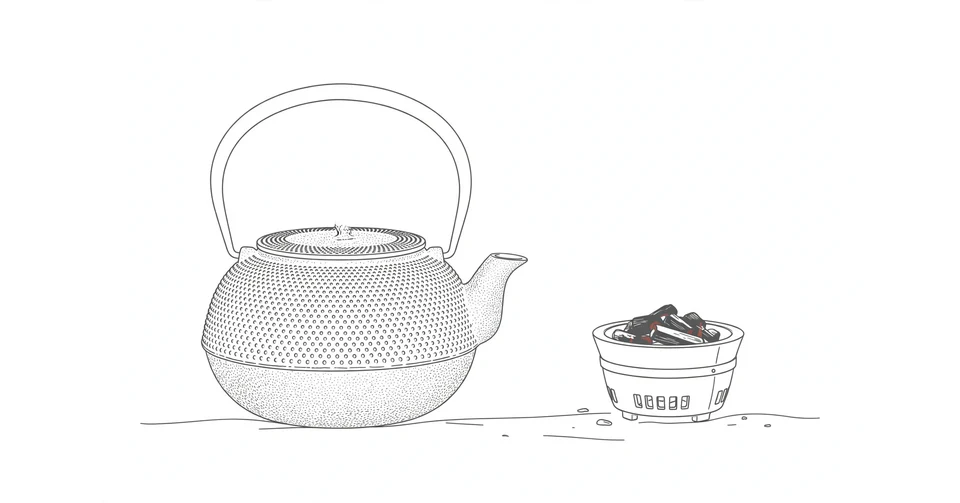
The name comes from the Nanbu clan, the family that ruled the Morioka region in the early Edo period and built its castle there. The clan is long gone, its castle is a ruin, and its domain was abolished with the rest of the feudal system in the nineteenth century. Yet Nambu Tekki is still cast in the same two cities, Morioka and Oshu, by workshops that pass their designs from one generation to the next. That is the quiet joke at the heart of this craft: the lords ordered iron to serve their tea, and the iron outlasted them.
A lord invites kettle makers from Kyoto
The story begins in the middle of the seventeenth century, when the Nanbu clan invited master kettle makers from Kyoto to Morioka to cast chagama, the large round kettles used in the tea ceremony. The invitation is regarded as the origin of Nambu Tekki, and it was a practical decision as much as a cultural one. Morioka happened to hold everything an ironworker needs within easy reach: iron sand, river sand, clay, charcoal, and lacquer. A lord who loved the tea ceremony and a region full of raw materials made a natural pair, and Nambu Tekki grew out of that pairing.
Four families of retained craftsmen, the Koizumis, the Suzukis, the Arisakas, and the Fujitas, took up the work and built Nambu Tekki into a trade. They made chagama for the tea room first, and their skill spread from there into the pots and tools of daily life. The work was slow, heavy, and exact, and it suited a cold northern region where people had learned to be patient with winter.
Around 1750, Nizaemon Koizumi, the third of his line, had an idea that changed the craft. He made a small kettle with a handle and a pouring spout, easier to carry to an open-air tea ceremony than the heavy chagama that had to stay in place while water was ladled out of it. That small kettle was the first tetsubin, and it was the moment Nambu Tekki learned to leave the tea room. It caught on because iron conducts heat far better than the ceramic kettles people had used before. A tetsubin could boil water quickly and hold the heat, and once a rust prevention procedure was worked into the craft in the late nineteenth century, Nambu Tekki began to spread beyond Iwate and into homes across Japan.
Nambu Tekki has a second root that runs even deeper. Around Mizusawa, in what is now Oshu City to the south, iron casting is said to reach back to the Oshu Fujiwara family of the twelfth century, who flourished in their capital at Hiraizumi. Morioka grew up making tea ware and objects of beauty, while Mizusawa built its name on the iron pots and cooking vessels of daily life. Today the ironware of both cities is registered under the single brand name of Nambu Tekki, and the two traditions are treated as one craft with two hometowns.
Two towns, one name, and a century of trouble
For two hundred years the craft lived under the protection of the clans, and then that protection vanished almost overnight. The Meiji Restoration abolished the han system, and Morioka and Mizusawa lost the patrons who had kept their foundries busy. Workshops closed, orders dried up, and a craft that had seemed permanent suddenly looked fragile.
Nambu Tekki revived itself the slow way, by finding new buyers. The railroad brought its kettles to distant markets, and participation in the National Industrial Exhibition, backed by the Meiji government policy of promoting industry, won the craft national acclaim again. It was a lesson Nambu Tekki would need more than once: a craft survives not by staying still but by finding the next person who wants what it makes.
In 1914 the former head of the Morioka clan, Toshiatsu Nambu, a cultured man with a passion for the arts, founded the Nambu Casting Institute to refine the quality of Nambu Tekki kettles. Its first director was Somei Matsuhashi, a Morioka native who had studied casting at the Tokyo Fine Arts School as one of its first year students. Matsuhashi raised Nambu Tekki to the level of fine art, and his successor Manji Takahashi carried the modernization further. For a while it seemed the craft had found a safe future.
Then came the war. Regulations enforced in 1938 ordered iron and steel objects to be turned in for munitions, casting workshops were banned from making kettles, and the craftsmen had no choice but to switch to war production. Local craftsmen who refused to let the heritage die formed a group to preserve the art of the Nambu tetsubin, and their stubbornness carried the craft through. After the war, demand fell again as aluminum and stainless steel took over Japanese kitchens, and it looked as if the iron kettle might finally lose.
It did not. When the Law for the Promotion of Traditional Crafts Industries was enacted in 1974, Nambu Tekki became one of the first crafts to be officially designated as a traditional craft of Japan, with the formal designation following in 1975. The government recognition did not make the work easier, but it gave Nambu Tekki a name worth defending, and it told buyers that this iron was not a relic but a living craft. The Google Arts and Culture story on Nambu Tekki traces this whole arc from the Kyoto invitation to the postwar revival, and it is the clearest single account of how a regional ironware became a national treasure.
How Nambu Tekki is made
A piece of Nambu Tekki begins as a drawing, and every workshop keeps its own book of designs, handed down over generations. From the drawing, the craftsman builds a mold. Special molding sand is packed inside a cylindrical wooden frame, rough sand first for the outer layer, then finer sand worked gradually into shape. A separate mold is made for the pouring spout, and the handle loops are fitted to the top mold.
Inside the mold of a Nambu Tekki kettle sits the core, the piece that forms the hollow of the kettle. The core is made 2 millimeters smaller in radius than the outer mold, and that small difference becomes the thickness of the cast iron. Clay is melted in water, mixed with sand, shaped, and left to dry completely before it is covered with charcoal powder. The molds are then fitted together, bound tight, and burned in charcoal at 800 to 1000 degrees Celsius until they are completely dry.
The pattern comes next, and it is where the hand of the maker shows most clearly. The distinctive patterns of Nambu Tekki are all stamped by hand, one dent at a time, into the mold while the sand is still moist. The best known is the arare pattern, neat rows of raised dots named after hailstones. Some kettles carry about 2,000 of these dots, each one placed with a special rod, and though they look alike at a glance, their sizes vary depending on where they sit on the kettle. No machine does this work. A Nambu Tekki kettle covered in two thousand hand-stamped dots is a record of an afternoon of patient labor, and you can feel it when you hold the finished piece.
Then comes the fire that finishes every piece of Nambu Tekki. The iron is melted in a pot until it reaches 1500 degrees Celsius, when impurities rise to the bright red surface and are skimmed away with a rod. The molten iron is poured into a ladle and then into the mold, which the casters hold down with wooden planks and their own weight so the pressure does not force the mold apart. When the iron has cooled enough, the kettle is lifted out, still glowing, and the caster taps it with a hammer and listens. The sound tells whether the thickness is even, a test no instrument has replaced.
The last step is the one that sets Nambu Tekki apart. Once the casting is finished and the core removed, the kettle is baked once again in charcoal at 900 degrees Celsius. This process, called kanake-dome, builds an oxide film inside the kettle that prevents rust, and it is unique to Nambu Tekki. The surface is then covered with lacquer using a special brush made from bundled water grass called kugo-hake, and coated with a rust preventing liquid made from bits of steel in acetic acid and brewed tea, known as ohaguro. Only then is the handle attached and the lid put in place. The government magazine Highlighting Japan notes that qualified traditional artisans perform most of the roughly 100 processes by hand, adjusting the thickness of each piece with the care of an artist.
How to recognize the real thing
The first thing to notice about genuine Nambu Tekki is its weight. Pick up a real tetsubin and it feels heavier than it looks, because the walls are thick and the iron is dense. A light kettle with the same shape is almost certainly not the real thing, and no amount of black paint makes up for missing iron.
The second thing is the pattern. On a genuine piece of Nambu Tekki the arare dots are stamped by hand, so they are regular without being perfect. Look closely and the dots vary slightly in size and depth, following the curve of the kettle. A molded copy pressed from a single master tends to repeat its dots too exactly, like a photocopy. The surface should also be a deep, soft black from the lacquer and ohaguro finish, not a glossy paint shine.
The third thing is the name behind it. Ironware from Morioka and Oshu carries the Nambu Tekki name, and the established workshops stamp their own marks and keep their own design books. A piece with a known workshop mark, bought from a reputable shop in Iwate or from the workshop itself, is the safest bet. Visiting the production sites in Morioka and Oshu to find a personal favorite is part of the pleasure of the craft, and a maker who will show you the workshop is a maker with nothing to hide.
Price is the last honest signal. A handmade piece of Nambu Tekki that passes through roughly a hundred hand processes cannot cost what a factory kettle costs, and a suspiciously cheap tetsubin is telling you the truth about itself. I think that is a fair trade rather than a flaw. You are not only buying a kettle, you are paying for the afternoon someone spent stamping two thousand dots into wet sand, and for the knowledge that the same hands will still be doing it when you need a replacement lid twenty years from now.
Nambu Tekki in a modern kitchen
A tetsubin is a kettle for boiling water, not a teapot, and the distinction matters more than it sounds for anyone buying Nambu Tekki. The bare iron interior is meant to hold plain water over heat, and the water it boils is said to taste smoother and to carry a little iron with it, a belief the makers themselves repeat with pride. A kyusu, the small teapot used to steep tea leaves, is a different tool, usually lined inside so the tea never touches bare iron. Knowing which one you hold keeps you from ruining a good kettle by steeping tea in it, and from blaming a good teapot for failing to boil water.
That is also why Nambu Tekki deserves its own slow corner of the kitchen, away from the rush of the electric kettle. Its high heat retention keeps boiled water warm for a long time after the flame is out, and makers say the water it produces makes tea and coffee taste better. Traditionally it sat over charcoal, the same slow heat that a hibachi carried from room to room, and even on a modern stove it keeps something of that unhurried temper. It does not reward impatience. It rewards the person who puts the water on early and lets the iron do its work.
Living with Nambu Tekki asks for a little care, but not much. Dry it thoroughly after use, never leave water standing in it, and warm it briefly to drive off the last moisture before you put it away. A faint red spot of rust is not a disaster, it is a reminder, and a kettle that is used regularly and dried properly will outlast its owner. The iron changes with use, darkening and settling into its finish, and makers say that watching a piece change over the years is part of owning it.
Nambu Tekki has also learned to live in the present. About thirty years ago, Nambu Tekki makers exhibiting at a trade show in Europe were challenged by a renowned French tea maker to produce colorful kyusu teapots, and it took several years to develop the new coloring technique. The colorful teapots found their audience in Europe first, then in North America, and their success prompted a reevaluation back in Japan. Today the range runs from traditional black tetsubin to colored teapots, frying pans, pots, and small items like incense burners, all made to fit modern kitchens rather than museum shelves.
The lords are gone, the iron remains
What stays with me about Nambu Tekki is how little it has compromised. Four centuries of fashion passed over it, from the tea ceremony to the electric kettle to the colored teapot, and the craft answered each one by changing just enough to survive and no more. It kept the sand mold, the hand-stamped dots, and the rust-proofing fire, because those are the things that make it what it is. Everything else, the colors, the shapes, the new products, is decoration on a core that never moved.
There is a lesson in that for anyone who makes things, and I include myself in it. Durability is not the same as stubbornness. The workshops of Morioka and Oshu survived because they knew which parts of Nambu Tekki were negotiable and which were not, and they defended the second list with their whole working lives. The lords who ordered the first kettles could not have imagined a world of stainless steel and same-day delivery, but Nambu Tekki is still boiling water in it. That is a better monument than any castle.
More in Culture & Society
- Matsumoto Temari Turns Mountain Cocoons Into Wishes You Can Hold
- Temari Is the Embroidered Ball Japan Gives for Good Luck
- A Tetsubin Turns Iron and Fire Into Japan's Slowest Kettle
- Ninja, the Shadow Warriors of Feudal Japan
- Bizen Ware Lets the Fire Do the Painting
- Japanese Haiku and the Seventeen Syllables That Hold a Season
Latest posts
- Tokyo Skytree and How Japan Built the World's Tallest Tower
- Forest Bathing in Japan, the Quiet Science of Shinrin-Yoku
- Tokyo Tower and the Orange Giant That Refused to Be Replaced
- Emoji, the Tiny Pictures Japan Gave the World
- Hakone and the Hot Spring Town Below Mount Fuji
- A Kamado Turned the Japanese Kitchen Into a Slow Oven
- The Japanese Alps and the Mountains at the Heart of Honshu
- Japanese Wagashi and the Sweets That Mark the Seasons
- Japanese Futon and the Art of Sleeping on the Floor
- A Hohin Is the Handleless Teapot Gyokuro Was Waiting For
- Shigaraki Ware Turns an Ancient Lake Bed Into Japan's Warmest Pottery
- Boro Turns Rags Into the Cloth Japan Refused to Throw Away
- Iga Ware Fires the Clay Pot That Holds Heat the Longest
- Mount Takao and the Day Trip Tokyo Takes When It Needs Air
- A Donabe Turns a Clay Pot Into Japan's Slowest and Warmest Way to Cook